

So That Man may Become Fully Human
GA 82
9 April 1922, The Hague
Translated by SOL
3. The Visual Arts
[ 1 ] In a certain sense, what I have to say today will be an interlude in the course of my lectures here, in that I will seek to offer a perspective on the realm of artistic creation from the standpoint of scientific inquiry. But the content of my remarks today will, on the other hand, demonstrate that this is not merely an episode, but will contribute to illuminating what I have said in the preceding days and what I will yet have to say in the days to come.
[ 2 ] After the anthroposophical movement had been active for some time, a conviction arose among a number of its members that a building of its own should be erected for this anthroposophical movement. Due to various circumstances, which I need not mention here, the Jura hills near Basel in Dornach, Switzerland, were ultimately chosen as the site for this building, where now — though not yet completed, but already usable enough to hold lectures and carry out work — stands the Goetheanum, the School of Spiritual Science.
[ 3 ] I would now like to speak only of the internal circumstances that led to this building. If the decision to erect a building of its own had matured in any other spiritual movement today, what would have been done to bring about this building? Well, one would have turned to an architect or several architects, and one would have had a building constructed in the classical or Renaissance style, or in the Gothic style, or in some other traditional architectural style. One would also have called upon artistic creativity, in accordance with what is being achieved today here and there in the various artistic fields, to adorn this building in some way through painting, sculpture, or plastic arts.
[ 4 ] None of this could have been done for the Dornach building, for the School of Spiritual Science, because it would have been in contradiction to the entire intention and the innermost essence of the anthroposophical worldview. This worldview does not wish to be something one-sidedly theoretical; it does not wish to be something that expresses the laws of the universe through a sum of ideas, but rather, this anthroposophical worldview seeks to be something that springs from the whole human being and, in turn, is there for the whole human being. It seeks to be something that, on the one hand, can certainly be expressed in thought forms, as is customary when any worldview is to be presented. But it seeks to be something far more comprehensive. It aims to speak from the full scope of the human being. It therefore aims to speak not only from a theoretical-scientific spirit; it aims to speak also from an artistic spirit; it wants to be able to speak from a religious, a social, and an ethical spirit; and all of this in a way that, in the respective fields, fully corresponds to the interests of immediate life practice. I have often expressed what stood before the Dornach Goetheanum as a task in a trivial way through the following comparison. I said: Consider a nut with its kernel inside and the shell surrounding it. When one looks at the nut shell, one cannot possibly imagine that the grooves and twists of the nut shell have arisen from laws other than those governing the grooves and twists of the nut kernel. Both emerge, so to speak, from a single being. The nut shell, in that it encloses the nut, arises from the same laws as the nut kernel itself. In the construction of the Dornach building, this double-dome structure, the aim was to create an architectural, sculptural, and painterly shell for that which is worked out within it from the anthroposophical worldview. Just as one can speak from the podium in Dornach through the language of thought about that which is beheld in the supersensible worlds, so too must one be able to bring forth from the same spirit that which, architecturally, sculpturally, painting—serves as a framework for this anthroposophical worldview—to spring from the same spirit.
[ 5 ] In doing so, one faces a great danger. One faces the danger of having ideas about this or that and then simply expressing these ideas externally in symbolic or even in a flimsy allegorical form. This happens very frequently when worldviews are translated into external representation. This results in symbols or allegories that are by no means artistic; on the contrary, they mock true artistic sensibility. It must be emphasized above all regarding the anthroposophical worldview that it has no desire to have anything to do with such symbolic or allegorical pseudo-art, anti-art, but rather that it seeks to spring forth as a worldview from such a rich inner spiritual life that this spiritual life can express itself not allegorically or symbolically, but through genuinely artistic creations. In Dornach there is not a single symbol, not a single allegory to be seen; rather, everything that has been artistically represented has arisen precisely through artistic perception, through the shaping of form, through creation from the realm of color and painting; it has arisen because the perception was thoroughly artistic, having nothing to do with what is usually expressed when people come and say: What does this mean? What does that mean? — In Dornach, not a single form is meant to signify anything in this sense; rather, every form is meant to be, in the true artistic sense, something that signifies itself, that expresses itself. Those people who come to Dornach today and claim that there is something symbolic or allegorical to be seen are simply projecting their own preconceptions onto this building and are by no means reflecting that has come about through this building. For it should certainly be the case that the same spirit—not the theoretical one, but the living spirit that speaks from the podium or works from the stage—also speaks through the artistic architectural forms, through the artistic-plastic forms, through that which is depicted in the paintings. The shell should emerge from the same essence as that which acts as the core within it, namely the worldview itself, which is expressed through the spoken word.
[ 6 ] But if the anthroposophical worldview is something that introduces itself as something new into the course of human development, as I have taken the liberty of explaining in the last two reflections here, then it was also natural that in the architectural style, in the sculptural and painterly forms, in the entire visual arts, what was already there could not be expressed. No artistic reminiscences—neither ancient, nor Renaissance, nor Gothic—could be realized; the anthroposophical worldview had to prove itself productive enough to bring forth its own style, its artistic style for the visual arts.
[ 7 ] Certainly, when such a desire lies on one’s soul and in one’s heart, one becomes quite modest. One becomes one’s own strictest critic. That is why I know full well that if I had to build the Dornach building a second time, many things that today seem to me quite imperfect, indeed often flawed, would look different. Yet, essentially, at least from today’s perspective, that is not what matters, but rather the aspiration I have just described. And it is this intention that I would like to speak about.
[ 8 ] When we speak of the visual arts, as they are indeed under consideration in this context—namely, of those visual arts to which the anthroposophical worldview has pointed as a necessary creation, through the fact that friends were found who made the sacrifices necessary to establish the Dornach building—when we speak of the visual arts in this sense, then the primary concern is to understand the human form, toward which everything in the visual arts ultimately points, and from which everything in the visual arts proceeds. To understand it in such a way that it can then truly be created as a human form.
[ 9 ] Yesterday I also spoke of an element, the spatial element, insofar as it is a world element, yet nevertheless emerges from the human being. Yesterday I spoke of how the three spatial dimensions, by which we ultimately determine all the forms underlying the world, can be drawn out of the human form. But when one speaks of space as I did yesterday, one never actually arrives at the conception of space that must be brought into the creative, artistic process if one wishes to fully and consciously drive forward plastic art, —the one that ultimately underlies all visual art—with full consciousness. Precisely when one has space so concretely before one’s mind’s eye in its three dimensions, as is the case in such a contemplation as I undertook yesterday, then one sees: the space one arrives at there cannot possibly be the one in which one finds oneself when, for example, one now also forms the human figure in space — we use the word there as well — sculpturally. One cannot possibly arrive at this space in which one finds oneself as a sculptor. One realizes: This is, after all, an entirely different space. In doing so, I am touching upon a mystery of the human way of viewing the world that has, in essence, been completely lost to our present-day perspective. And you will allow me to begin very briefly with an approach that appears to be entirely abstract and theoretical. It is intended only to serve as a prelude to what will then be able to appear before the eye of the soul in a much, much more concrete way.
[ 10 ] If one wishes to apply the space I spoke of yesterday—and one does so geometrically, initially in Euclidean geometry—to the things of this world, one naturally assumes a point for concrete space, as I described to you yesterday, one would naturally have to assume this point to be inside the human body—and starting from this point, one assumes three mutually perpendicular axes and relates some spatial region to them by determining the distances from these three axes, or rather from the three planes formed by these three axes. This leads to having a geometric definition for anything that fills our space, or, in the sense of the mathematics of motion, to having the possibility of finding ways to express even that which moves within space. But alongside this space, there is certainly another space. It is precisely this other space that the sculptor enters. The secret of this other space lies in the fact that one cannot start from a point and, so to speak, relate everything to that point, but must start from the opposite of that point. What is that? The opposite of this point is nothing other than an infinitely distant sphere, which one would look up to almost as one would to the blue firmament, if it were there. Imagine that instead of having a point, I have a hollow sphere within which I find myself, and I relate everything that is inside it to this hollow sphere. Instead of relating everything to a point via coordinates, I determine everything in relation to this hollow sphere. As long as I give you only this representation, you can rightly say: Yes, but determining things in relation to such a hollow sphere is, after all, somewhat chaotic. I can’t form a mental image when I’m supposed to think of something. You’re right; one can’t form a mental image. But there is a human faculty that can now relate to the cosmos just as we related yesterday to the human being, to the Anthropos. Just as we looked into the human being and perceived the three dimensions, and just as we can define the human being according to these three dimensions by saying: In the direction of the first dimension lies the length of the body; in the second lies that which falls roughly within the plane of outstretched arms, which is symmetrically constructed in the human organism; and in the third lies everything that is arranged in the direction from front to back and vice versa; thus, when we consider the human organism, we do not have something that lies arbitrarily in the three dimensions, but rather we have formed and shaped the human organism in a very specific way.
[ 11 ] One can relate to the cosmos in the same way. What happens inwardly and spiritually when one relates to the cosmos in this manner? Well, imagine yourself standing in a field on a clear, starry night, so that you can freely survey the starry sky far and wide in every direction. As you freely survey the starry sky, you see areas of the celestial vault where the stars are clustered, almost forming nebulae. You see other areas of the sky where the stars are arranged in such a way that they are more separate from one another, forming constellations, as they are called, and so on. If one approaches this starry sky solely with an intellectualistic perspective, the perspective of the human intellect, one initially comes to nothing. But when one faces this starry sky with one’s whole being, one feels differently. We have lost this capacity for feeling today, but it can be regained. One feels differently toward a patch of sky where, save for the vicinity of nebulae, the stars stand close together; one feels differently where constellations are. One feels differently toward that patch of sky where, for example, the moon stands and shines. One experiences a night differently when there is no moon, during the new moon phase, and so on. And just as one can concretely feel into the human organism to perceive the three dimensions—where space itself is something concrete, something connected to the human being—so one can acquire a perception of the cosmos, of that which is the surrounding space. One need not merely look within oneself to arrive at something like the three dimensions, but one can now look out into the vastness, can take in the configuration of the vastness. And when one learns to grasp this expanse by moving beyond the ordinary perception—which is still sufficient for geometry—to the kind of perception required for these vast expanses, then one gains a perception that I called yesterday and the day before “imaginative cognition,” that imaginative cognition whose development I will yet have to speak of.
[ 12 ] Anyone who would simply record what they see in the vastness of the worlds would achieve nothing. A mere sketch of the starry sky, as today’s astronomers make, leads to nothing. But when one sets the whole human being, with a full understanding of the cosmos, before this cosmos, then images form within the soul in response to these clusters of stars, as one sees them on old maps, where imaginations were still formed from the old, instinctive clairvoyance, and then one gains an imagination of the entire cosmos. One gains the counterpart to what I showed yesterday as the human foundation of the three geometric spatial dimensions. One gains something that can configure itself in infinite ways.
[ 13 ] People today basically have no idea at all how one once looked into the universe in earlier times, when instinctive clairvoyance was still present in human beings. Today it is believed that the various drawings, the images, and the imaginative representations of the zodiac signs were products of the imagination. They are not. They were sensed and beheld by standing face to face with the cosmos. Human progress demanded that this instinctive, this living, this imaginative perception fade away, that it be replaced by the liberating, intellectual perception; yet from this, if we are to be whole human beings, we must once again attain a perception of the cosmos that advances toward imagination, but now with full consciousness, no longer instinctively.
[ 14 ] One does not arrive at a space that can be exhausted by three dimensions if one wishes to arrive at the concept of space in this way, starting from the starry sky; rather, one arrives at a space that I can only suggest pictorially: If I were to suggest the space I spoke of yesterday using the three perpendicular lines (they are drawn as the center of the resulting drawing) , I would have to suggest this other space by drawing such configurations everywhere as if forces in planes were approaching the Earth from all sides of the universe and were acting plastically from the outside on the forms that are on the Earth’s surface.
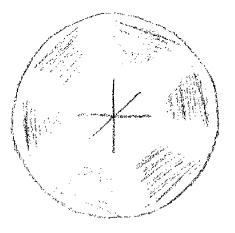
[ 15 ] One arrives at such a conception when one advances from what can be seen with the physical eyes in living beings—above all in human beings—to what I have now called imagination, whereby, instead of the physical human being, the cosmos opens up in pictorial form and bestows a new space upon one. As soon as one advances to this, one comes to behold that which is a second body of the human being, which an older, intuitive clairvoyance, an instinctive clairvoyance, has called the etheric body, which is better called the body of formative forces; a supersensible body, which, however, consists entirely of fine, etheric substance and which permeates the physical body of the human being. We can study this physical body if we seek the forces flowing through it within its spatial extent. We cannot study the etheric or formative-force body that permeates the human being if we proceed from this space (center). We can study it only if we conceive of it as formed from the entire cosmos, if we conceive of it in such a way that these very force fields, approaching the Earth from all sides, draw near to the human being and plastically shape his formative force body from the outside.
[ 16 ] In the times when the visual arts still arose from the elemental, from the primordial, these visual arts arose in no other way than this. One will view a work such as, for example, the Venus de Milo with an intuitive gaze. It was not created by studying anatomy, by appealing to forces that are comprehensible only from within the physical body’s spatial interior, but rather it was created because, in earlier times, one knew of that body of formative forces, which permeates the physical body, which is shaped from the cosmos, which is shaped from a space that is just as peripheral as earthly space is central. But because a being is shaped from the periphery of the universe inward, what is imprinted upon it is what, according to the original meaning of the word, is the beauty of the being. For the beauty of the being is, in fact, the imprint of the cosmos, through the medium of the etheric body, in a physical earthly being.
[ 17 ] If we study a physical earthly being according to the pure, dry truth, then we obtain precisely what it is in terms of ordinary physical space. If we allow the beauty of a being to affect us, if we wish to enhance this beauty of a being through plastic, visual art, then we must become aware: That which is imprinted upon the being as beauty originates from the cosmos; it is that which reveals to us, in the individual being, how the entire cosmos works within that being. To do this, however, one must perceive how this cosmos is expressed, for example, in the human form.
[ 18 ] This human form, when we are able to engage with it through inner, imaginative contemplation, initially breaks down in such a way that we direct our spiritual attention to the formation of the head. When we survey the formation of the head in its totality, then we do not understand this formation of the head if we try to explain it merely from within the head itself. We understand it only when we perceive it directly as brought about from the cosmos, indirectly through the form-forming body.
[ 19 ] If we turn to the formation of the human chest, we can arrive at an inner understanding—one related to the form—only if we have the ability to imagine how the human being lives on the Earth, which is orbited—even if, according to modern astronomy, this is only apparent; that does not matter for this consideration — of everything that orbits the Earth from the world of the stars along the zodiacal line. While we relate the head to the pole of the cosmos, we relate that which is formed in the human chest—which runs entirely along the repeating equatorial line—to that which takes place in the most varied ways within the annual or daily orbit of the Sun.
[ 20 ] Only when we turn to the human limb system, especially the lower limb system, do we get the sense: This is not assigned to the outer cosmos; it is assigned to the Earth; it is connected to the Earth’s gravity. If we look at the structure of the human foot with the eye of a sculptor, we see it adapted to the Earth’s gravity. We see the entire configuration of how the lower leg and thigh are joined together through the knee, such that we find them attuned to what the Earth is in its dynamics and statics, how gravity acts out into the universe from its center.
[ 21 ] We have a sense of this when we view the human form with the sculptor’s eye. For the head, we need all the forces of the cosmos; we need, so to speak, the entire sphere, if we wish to understand what is expressed in such a wondrous way in the formation of the head. If we wish to understand what is expressed in the formation of the chest, we need what, so to speak, flows around the Earth at the equatorial level. We come to the periphery. If we wish to understand, in particular, the lower limb system of the human being and the associated metabolic system, we must turn to the forces of the Earth. In this respect, the human being is bound to the forces of the Earth. In short, we perceive a connection between the entire living, vividly conceived world-space and the human form.
[ 22 ] Today, people in many circles—including artistic circles—will likely laugh at a view such as the one I have just presented. I can well understand why. But one knows little of the true history of human development if one laughs at such things. For anyone who can truly immerse themselves in the sculptural art of ancient times can see, even in the sculptural forms that were created there, how those feelings—which were formed through the imaginative gaze upon the starry sky—have flowed into them. In the oldest sculptural forms, the cosmos has indeed been brought into view in human form. However, what is otherwise called knowledge in an intellectual sense must be regarded as a kind of knowledge that is connected with the full scope of the human soul’s powers. One becomes a sculptor—if one is truly a sculptor—out of something elemental, not merely because one has learned to draw upon ancient stylistic forms in order to recreate what was known in this or that stylistic epoch, when one was still connected to living creativity, but what is no longer known today. One does not become a sculptor by drawing on tradition—which is what happens today for the most part, even among accomplished artists—but one becomes a sculptor by being able, out of full consciousness, to draw upon the formative forces that once led to the visual arts. One must once again gain cosmic sensibilities; one must once again perceive the universe and be able to see in the human being a microcosm, a small world. One must be able to see in the human forehead how its imprint is imprinted from the cosmos. One must be able to see in the nose how its imprint is imprinted from that which also imprints the entire respiratory system: from the orbit, from that which circles the Earth along the equatorial line, along the zodiacal line. And then one gains a sense of what one must depict. One does not create through mere imitation, through mere copying of the model, but one creates by immersing oneself in the very force from which nature itself has formed and created the human being. One shapes in the same way that nature itself shapes. But then the entire perceptive and artistically creative sensibility must be able to adapt to this.
[ 23 ] When we have the human form before us, we first direct our artistic gaze toward the human head. We do this with the intention of sculpting this human head. We will then strive to render this human head in as much detail as possible, treating every surface as lovingly as possible: to treat the forehead with care, to treat the curve toward the eyes with care, to work out the ears, and so on. We will strive to form the lines running across the forehead and over the nose as lovingly as possible. We will strive, depending on what we wish to create, to make a nose shaped in one way or another. In short, we will try to lovingly shape everything in the individual surfaces that pertains to the human head.
[ 24 ] If, on the other hand, as sculptors—perhaps I am saying something heretical to many people, but I do believe that what I have to say goes back to original, artistic sensibilities—if, as sculptors, we were to strive to shape human legs, we would constantly be repelled by the idea. One would want to shape the head as lovingly as possible, but not the human legs. One would want to conceal them, to remove them from the artistic form, by trying to cover them with all sorts of clothing, all sorts of things that otherwise adapt sculpturally to what is expressed in the head. A human figure with properly chiseled legs—calves, for example—is actually something unsympathetic to the sculptor’s artistic gaze. I know that I am saying something heretical here, but I also know that I am thereby speaking all the more fundamentally artistically. Properly chiseled legs—one does not want them. Why not? Well, because for the sculptor there is simply a different anatomy, a different understanding of human form, than for the anatomist. For the sculptor, as strange as it may sound, bones and muscles. For the sculptor, there is the human form, which is shaped from the cosmos with the help of the body of formative forces. And within this human form, there are forces, force effects, lines of force, and force relationships. As a sculptor, I cannot possibly think of the skull as I shape the human head; rather, I shape the human head from the outside in, as it is imprinted from the cosmos, and whatever gives me the corresponding curves on the head, I shape according to dynamics, according to forces that push the form from the inside out, which oppose the forces acting in from the cosmos. As a sculptor, when I shape the arms, I do not think of bones, but of those forces that act, for example, when I bend the arm. There I have lines of force, the unfolding of force, not what forms as muscle or bone. And the thickness of the arm depends on what lives there, not on the muscle tissue attached to it. But because, in creating beauty, one has above all the tendency to adapt the human being with his beauty to the cosmos—which can only be done with the head, since the lower limbs are adapted to the earth—one therefore wishes to omit them. When shaping the human being artistically, one wishes to lift him up from the earth. One would turn him into a heavy earthly being if one were to emphasize the lower part of the human form too much in sculpture.
[ 25 ] And again, if one considers the head alone, it is only the upper part of the head—the wonderfully curved skull, which is curved differently in every single individual—that is modeled after the entire cosmos; hence there is only individual, not general, phrenology. That which is formed in the eyes and nose is already shaped similarly to what constitutes the human chest region. It is already formed according to the circumference, according to the equatorial current. Therefore, when I depict the eyes in a sculptural work representing a human being, one knows that one cannot use any coloring to depict the gaze—whether deep or superficial— one must limit oneself to depicting large or small, slit-like or oval eyes, or more or less straight eyes. But how one depicts the transition of the eyes into the shape of the nose, of the forehead into the shape of the nose, how one suggests that the human being sees by putting their whole soul into their seeing—this is different with slit-like eyes, different with oval eyes, and again with straight eyes. How a person breathes—this wonderful means of expression—how a person breathes through the nose: one need only feel it, and there is something of which one can say: Just as a person is within their chest, just as the shape of their chest is formed from the cosmos, so the human being pushes what they breathe in through their chest—what beats there within the heart—up into the eyes and nose. This is expressed there in pictorial form. What a person is like in their head is actually expressed only in the skull, which, in terms of its shape, is an imprint of the cosmos. Just as the human being reacts to the cosmos—not merely by taking in oxygen and behaving passively, but by having their own share in the substance, by bringing their own being from the chest toward the cosmos—this is sculpturally expressed through the formation of the eyes and nose.
[ 26 ] And as we shape the mouth—oh, as we shape the mouth, we are actually already shaping the entire inner human being in his self-assertion, in his opposition to the cosmos. There we shape the way in which the human being reacts to the world from within his metabolic system. There, in the formation of the mouth, in the formation of the chin, in everything that belongs to the formation of the mouth, we shape the human being of limbs and metabolism, but in his spiritualization, in his outwardly manifest form. So that the one who, with a sculptor’s eye, has the human head before him, has the whole human being before him, the human being according to the nature of his systems: according to the nervous-sensory system in the skull with its remarkable curves; in the formation of the eyes and nose, the human being—if I were to speak in Platonic terms, I would have to say, the courageous human being, the human being who, insofar as it is courageous, is a disposition, to the external cosmos. And in forming the mouth, one actually has—though its configuration is still imposed from the outside, as it belongs to the formation of the head—but one has, pressing in from within against this configuration acting in from the outside, that which the human being is in his inner essence.
[ 27 ] From this fleeting hint—it could not be more than such a sketchy hint, which one will have to continue to reflect upon — you will have seen that the sculptor does not merely need a knowledge of the human being, which he gains by imitating a human model, but the sculptor must actually be able to relive inwardly the forces that work through the cosmos by shaping the human form. From what takes place as the human being is plastically formed from the fertilized germ cell of the mother’s body—not merely through the forces within the mother’s body, but through the mother from the cosmic forces—the sculptor must be able to create out of these forces. Thus he must be able to create in such a way that he can simultaneously grasp what is revealed from the human, individual being—more and more as one goes down— . Above all, he must be able to understand how this marvelous outer covering of the human being, the form of the skin, comes into being as the resultant of two forces: the forces that act peripherally from the cosmos on all sides, and that which now acts centrifugally outward and opposes them. For the sculptor, the human being in its outer form must be a result of cosmic forces and inner forces. One must have such a sense in every detail.
[ 28 ] When one works, say, with wood—and in art it is, after all, a matter of having a sense of the material, of knowing what this or that material is suited for— otherwise one is not creating sculpture, but merely illustrating an idea, in a novelistic way—when one shapes the human form from wood, one must know, while shaping the top of the head, that one must have the feeling that the form is pressing in from the outside. That is the secret of creating the human form. As I shape the forehead, I must have the feeling that I am pressing it in from the outside, that I am shaping from the outside; forces are working against me from the inside. I may only press in—pressing more or less strongly—to push back the forces acting from within, to the extent that, guided by the cosmic forces, the head must become what it can be.
[ 29 ] But when I come to the rest of the human body, I make no progress if I shape and form from the outside in. There I must have the feeling that I am inside. Even when I come to shaping the chest, I must place myself inside the human being and sculpt from the inside out. That is very interesting.
[ 30 ] Through the inner necessity of artistic creation, one comes to this: when shaping the head, one must form from the outside in, think of the outermost frame, and create toward the interior; when creating the chest, one must place oneself inside and push the form outward; toward the lower regions, one has the feeling that only a hint is needed, as it transitions into the indefinite.
[ 31 ] Contemporary artistic creation very often regards something like what I have just described as unartistic fanciful musing. But what matters is that one can artistically experience in one’s soul what I have just indicated, that one is actually able, as an artist, to stand within the entire creative universe. Then, when approaching the visual arts, one is guided everywhere not to imitate the physical human form. For it is itself merely an imitation of the body of formative forces. Then one will perceive the necessity that the Greeks, above all, perceived. They would never have produced their depictions of the nose and forehead through mere imitation, but rather because such things, as I have now described, were instinctively at the foundation of their work. One will only be able to return to a truly elemental sense of art if one is able to attune oneself in this way to the creative forces of nature with one’s entire inner soul-feeling, with one’s inner total perception, if I may use that expression. But then one does not actually address the outer physical body, which is itself only an imitation of the etheric body, but rather one addresses this etheric body itself. Then one shapes this etheric body and, in a sense, fills it only with matter, with substance.
[ 32 ] What I have just described is, at the same time, the path out of theoretical world-viewing and into the living vision of that which can no longer be viewed theoretically. One cannot construct sculptural space through analytical geometry in the same way that one can construct Euclidean space, but through imagination one can perceive this space, which is configured everywhere, which is capable everywhere of creating forms out of itself, and from the perception of this space, one can now truly create in the visual arts, whether architecturally or sculpturally.
[ 33 ] I would like to insert a remark here that seems important to me, so that what could easily be misunderstood is, at least, less misunderstood. If someone has a magnetic needle here, with one end pointing toward magnetic north and the other toward south, then—unless they wish to speak in a completely amateurish manner today—it would not occur to them to explain the direction of the magnetic needle based on the needle’s internal forces, merely by observing what is enclosed by the steel. That would be nonsense. To explain the direction of the magnetic needle, he takes the whole Earth into account. He looks beyond the magnetic needle. Embryology today commits this amateurish error that I have just criticized. It looks only at the human embryo as it develops in the mother’s body. All the forces that shape this human embryo are supposed to be contained within it. In reality, the entire cosmos acts through the mother’s body upon the configuration of the human embryo. The plastic forces throughout the cosmos are to the embryo what the forces of the Earth are to the alignment of the magnetic needle. Just as I must step outside the magnetic needle when observing it, so must I step outside the mother’s body when observing the embryo and must call upon the entire cosmos. And I must immerse myself in this entire cosmos if I wish to comprehend what guides my hand, what guides my arm, when I wish to sculpt the human form.
[ 34 ] You see, the anthroposophical worldview leads in a direct line of development from purely theoretical contemplation into artistic contemplation. For the contemplation of the etheric body is not possible in a purely theoretical way. One must, of course, possess the scientific spirit in the sense I characterized it yesterday; but one must enter into the contemplation of the form-force body by transforming what weaves in mere thought into imaginations; by no longer grasping the external world merely through thoughts or through natural laws formulated in thought, but by grasping it in imaginations. This, in turn, can also be expressed in imaginations. When a person becomes productive, this transitions into artistic creation.
[ 35 ] It is now a peculiar thing when, with the awareness that such a body of formative forces exists, we let our gaze wander over the realms of nature: The mineral kingdom has no form-forming body; the plant kingdom has it in its own way; animals have a form-forming body; and human beings have their own form-forming body. But the plant form-forming body differs greatly from the animal or even the human one. Here is the peculiar fact: Imagine yourself equipped with sculptural-artistic powers of perception, and you are supposed to use them to sculpt plant forms—it feels unnatural. I tried it recently, at least in relief. But one cannot sculpt plants; one can only somehow imitate the movement of plants in a trace-like way. One cannot sculpt plants. Imagine a rose or any plant with a long stem, sculpted in three dimensions—it is impossible. Why? Because when one thinks of the plant’s form, one instinctively thinks of its formative body. This is within the plant, like the physical body, but formed directly. The plant is by nature presented as a sculptural work of art; one cannot change it. Any alteration of the plant would be a botched attempt against what nature itself produces in the physical body and formative body of the plant. One must simply leave the plant as it is, or view it with a sculptural spirit, as Goethe viewed it in his Morphology of Plants.
[ 36 ] Animals, on the other hand, can be sculpted. Admittedly, artistic creation in animal sculpture is somewhat different from that involving human beings. One need only understand that, fundamentally, the animal is a creature of the respiratory process. This is the case, for example, when sculpting predators. There, one must conceive of them more as creatures of the respiratory process. One must view the creature as a being of respiration and, in a sense, build everything else around that. But if one wishes to artistically sculpt a camel or a cow, then one must start from the digestive process and adapt the entire animal to it. In short, one must look inward with an artistic eye to see what the main thing is. Then, by further differentiating what I am now stating in general terms, one finds the possibility of sculpting all the various animal forms. Why? Well, the plant has the etheric body. It is created for it from the cosmos. It is complete. I cannot reshape it. The plant is the sculptural work of art that stands in nature. It contradicts the whole meaning of the world of facts if I sculpt plants out of marble or wood. It works somewhat better with wood, because that is closer to the nature of plants, but it is still inartistic. The animal, however, sets its own nature in opposition to that which is formed from outside, from the cosmos. In the animal, the etheric body is no longer merely formed from the cosmos, but is also formed from within.
[ 37 ] And in the human being—well, I have just said how this etheric body is formed from the cosmos only for the top of the skull. I have said how the respiratory organism counteracts this, refined through the eyes and nose, how the entire metabolic organism counteracts it through the formation of the mouth. Here, that which comes from the human being, the human element, counteracts the cosmic. And the human limitation is the result of these two forces, the human and the cosmic. The etheric body is formed in such a way that it springs from within. By immersing ourselves artistically into the inner being, we can shape freely. Just as the animal shapes its etheric body for itself out of its own nature, just as the courageous or cowardly, the suffering or the jubilant human being attunes their etheric body to the soul, so can we investigate this, empathize with it, and recreate this etheric body. In doing so, if we possess the characterized, truly sculptural understanding, we will be able to form the human figure in the most varied ways.
[ 38 ] Thus it becomes clear to us that, as we enter into the contemplation of the etheric body, the imaginative body, we can certainly allow ordinary scientific observation to remain scientific, yet we flow into that which then becomes artistic of its own accord. One might object: Yes, art is not science. — But I already said the day before yesterday: If nature, the world, the cosmos itself are artistic, if they present us with that which can only be grasped artistically, then we can go on and on declaring that it is illogical to become artistic if one wants to understand things. Things simply do not yield to a kind of knowledge that does not lead into the artistic. The world cannot be understood in any other way than in a manner that is not limited to what can be grasped merely through thought, but rather one that aims at the universal grasping of the world, which finds the entirely organic, natural transition from contemplation to artistic viewing and also to artistic creation, so that the same spirit then speaks through artistic creation as speaks through the words with which one expresses, in a more theoretical and ideal way, what one beholds in the world. Art, then, is of the same spirit as science. In art and science, we have only two sides of one and the same revelation. One might say that, on the one hand, we look at things in such a way that we express what we see through thought; on the other hand, we look at them in such a way that we express what we see in artistic forms.
[ 39 ] From this inner spiritual attitude sprang what, for example, found expression in the Dornach building—both in its architecture and sculpture, as well as in its painting. I could also say much about painting, for it too belongs, in a certain sense, to the visual arts. But there one moves toward the more spiritual aspect of the human being, which becomes a direct expression of the soul—not merely in the etheric body, but emanating from the soul and coloring the etheric body. Here, too, it would become evident how precisely the anthroposophical worldview leads us to ascend once more to the elemental-artistic, to the artistic-creative, whereas today, in both the religious and the artistic spheres—without the viewers, and in most cases without the artists themselves, even realizing it—we are actually living solely from the traditional, from the old stylistic forms and motifs. We believe ourselves to be productive today, but we are not. We must once again find the way to immerse ourselves in creative nature, so that what we create may truly be an artistically original, elemental creation.
[ 40 ] And such an attitude has naturally led to the art form of eurythmy developing on the foundation of anthroposophy. That which emerges in human speech and human song through a very specific group of organs as a revelation of the human being can be extended to the whole human being, provided one truly understands it. In this regard, all religious texts speak from ancient, instinctive, clairvoyant insights. And it is significant when the Bible states that Yahweh breathed the breath of life into man, thereby implying that man is, in a certain sense, a breathing being. I indicated yesterday how, in earlier times of human development, the view prevailed that the human being is a breather, a breathing being. That which the human being becomes as a breathing being—in structured breathing, in speech, and in song—can in turn be returned to the whole human being and his form. Just as his vocal cords, his tongue, his palate, and other organs move when speaking and singing—this can be transferred to the whole being, because every single organ and organ system is, in a certain sense, an expression of the whole being. Then something like eurythmy can arise. We need only recall the inner character of Goethe’s theory of metamorphosis, which is still not sufficiently appreciated. Goethe rightly sees the whole plant in the individual leaf. The whole plant is contained in the leaf in a more primitive form, and in turn, the whole plant is merely a more complex leaf. In every single organ, he sees a transformed, complete organic being, and the entire organic being is a metamorphosis of the individual parts. The whole human being is a more complex metamorphosis of a single organ system, the laryngeal system. If one understands how the whole human being is a metamorphosis of the laryngeal system, then one is able, with just as much validity, just as much inner natural necessity, to bring forth from the whole human being a visible language, a visible song through the movement of its limbs, through moving groups of people, just as song and speech arise through an organ system. One is immersed in the creative forces of nature. One immerses oneself in the way the forces of the human being work in speaking and singing. And when one possesses these forces, one can transfer them to the forms of movement of the whole human being, just as one transfers the forces of the cosmos to the resting figure of the human being in sculpture. And just as one expresses what lives within the human being, from the soul, in poetry or song or some other artistic form that can be expressed through language, singing, or recitation, so too can this be expressed through the whole human being in visible language and visible song.
[ 41 ] I would like to say: By shaping the human being plastically, by sculpting the human form, by creating the microcosm out of the entire macrocosm, we create one pole. By now immersing ourselves completely in the inner being of the human being, by following the inner activity, by immersing ourselves in their thinking, feeling, and willing—into everything that can be expressed through speech and song—we can create dynamic sculpture. One might say: The entire vast universe is brought together as in a wondrous synthesis when we create a sculptural work of art; that which is concentrated in the deepest innermost part of the human being, as in a soul point, strives out into the vastness of the worlds in the forms of movement that the human being creates eurythmically from within. The other pole of the human being responds in eurythmic art, in moving sculpture. — We see the vastness of the worlds turning toward the earth, converging in the resting human form, and we have plastic, sculptural art; we then delve into the human interior, gazing, spiritually absorbed, into the human interior, at that which, in turn, seeks to meet those world forces that flow toward the human being from all sides and shape his form—that which now, in a sense, flows out from the human being to all points of the periphery of the universe—and in this sense we create eurythmy.
[ 42 ] I would like to say that the universe presents us with a great task, and the solution to this task is the beautiful human form; the inner being of the human being also presents us with a great task. We draw upon infinite depths when we delve into the human inner being with a loving, intimate gaze of the soul. But this human inner being also wants to reach out into all expanses; it wants to express outwardly in rhythm, through the swings, the oscillating movements, the swaying, that which is compressed into a single point in the soul—just as the sculpture in the human form, which is a point for the cosmos, seeks to compress within itself all the mysteries of the cosmos. The human form in sculpture is the answer to the great question posed to us by the universe. And when the human art of movement becomes cosmic, when a person creates something cosmic in their own movements, as is the case with eurythmy, then a kind of universe is born from within the human being, at least initially in a pictorial sense.
[ 43 ] We have before us two poles of the visual arts: ancient sculpture and the newly emerging art of eurythmy. One must enter into the spirit of the artistic in this way if one truly wishes to understand the justification of the art of eurythmy. One must also return to how sculpture once established itself within humanity. One can well imagine: there in the field outside, the shepherds, who cast their gaze out into the night, sleeping yet watching, into the vastness of the stars, unconsciously absorbing into their souls the images from the cosmos, into which the configured imaginations of the stars in the sky take shape. That which unfolded in the mind of the original human being was passed down to son and grandson. What was passed down grew in the soul and became sculptural abilities in the grandson. The grandfather perceived the cosmos in its beauty; the grandson created, from the forces the soul had absorbed from the cosmos, the beautiful plastic art.
[ 44 ] Anthroposophy must not merely look into the mysteries of the human soul theoretically. It must experience all the tragedy of the human soul, all the joy of the human soul, and everything in between. And it must be able to see not only what appears tragic, what rejoices, and everything in between, but also, just as the stars were clearly seen in ancient imaginations and the formative forces of the stars could be taken into the soul, so one must take from the human soul what one beholds within it, must be able to express it in outward movements—then eurythmy arises.
[ 45 ] This was meant to be merely a fleeting hint today of the nature of the natural transition from what anthroposophy is as an ideal to what it aims to be as a direct, not allegorizing or symbolizing, but truly form-creating visual art. If one can grasp this, then one will discover the remarkable relationship that art has to science and religion. One will see science on one level, religion on another, and art in between. One will see science, from which human beings essentially derive all their freedom; human beings could never have attained complete inner freedom without science. One will see what human beings have gained for their individuality, what the human being, when viewed impartially, has gained through the fact that human beings have come to science. They have detached themselves from the cosmos through thought, they alone, but through this they have become a human individuality. And just as he lives within the laws of nature, so does he take them up in thought. He becomes independent of nature. In religion, man seeks to surrender himself, to find his way back to the fundamental principles of nature. He wishes to merge once more with nature, to offer his freedom upon the altar of sacrifice of the universe, to surrender himself to the divine, to exchange the breath of freedom and individuality for the breath of sacrifice. But standing between them is art, and in particular the visual arts, and everything that is rooted in the realm of beauty.
[ 46 ] When human beings become free, individual beings through science, when they sacrifice their well-being in religious forms, still maintaining their freedom on the one hand, yet on the other already senses the service of sacrifice, then in art the human being finds the possibility of preserving himself by sacrificing, in a certain way, that which the world has made of him; he shapes himself as the world has shaped him, but he creates this form out of himself as a free being. There is also something redemptive and liberating in art. In art, we are, on the one hand, individuality; on the other hand, we sacrifice ourselves. And as we may say: In truth, it is so that it sets us free when we grasp it ideologically and scientifically, including through the humanities; so, on the other hand, we must say: In beauty, we find our connection to the world once again. And a human being cannot exist without living freely within themselves and without finding their connection to the world. Human beings find their individuality in free thought, and they find the possibility of transforming what the world has made of them back into something of their own, in connection with the world, by raising themselves up into the realm of beauty, into the realm of art.