

The History of Art
GA 292
24 January 1917, Dornach
IX. Sculpture in Ancient Greece and the Renaissance
I have often quoted Goethe's saying, when he felt in Italy the echo of the nature of Greek Art. I may remind you of it once again today, now that we shall show a few representations of Greek sculputre. Goethe was writing from Italy to his friends in Weimer. He had seen something in Italy of the Grecian Art, and he had divined still more. He had made acquaintance with it. And he wrote: After this experience he had become convinced that in the creation of their works of art the Greeks proceeded according to the same laws by which Nature herself proceeds—and he himself was on the track of their discovery.
This saying of Goethe's always seemed to me of deep and lasting significance. Goethe at that moment divined that something was living in the Greeks, in intimate unison with the laws of the great Universe. Alread before his journey to Italy, he had been trying to discover the principle of universal evolution and becoming. He had done so, above all, in his Theory of Metamorphosis. He found that the manifold forms of Nature can be referred to certain typical or fundamental forms, in which is expressed the spiritual Law and Essence that underlies the outer things. He started, as you know, from Botany—the study of the Plant world. He tried to perceive the growth of the plant in this way: A single fundamental organ, whose basic form he recognised in the leaf, undergoes constant metamorphoses. All organs are transformations of this one. Not only so, but having thus begun, he sought to understand the several plant species as diverse manifestations of one archetypal form, the primary plant.
Likewise he looked for a connecting thread throughout the world of animals. We have often spoken of this work of Goethe's. But, as a rule, we have not a ufficiently vivid conception of what he intended. We are wont to conceive things too abytractly, and we do so in this case. Goethe, if I may put it thus, wanted to take hold in a really living way of the life of living things, in their organic metamorphosis. He wanted to discover the principle on which Nature works. In so doing, he was, indeed, steering straight towards what must be the characteristic of the Science of the fifth post-Atlantean age, even as that which the Greeks conceived and expressed in their works of art was characteristic of the fourth.
In this connection I have often called upon you to observe what is recognisable in the Golden Age of Greek Art, and notably of Grecian sculpture, in so far as it been preserved for us. The Greek artist created from an altogether different starting point. He had a certain feeling. To exprec it in our fully concrete way, we must describe it thus: He felt how the Etheric Body in its living forces and mobility underlies the forms and movements of the Physical. He felt how the Etheric is manifested or portrayed in the forms of the Physical Body, while in the movements of the latter the living forces that abound in the Etheric Body come to expression.
The Greek art of Gymnastics, the Greek Athletics, were built on this foundation. Those who partook in them were to gain thereby a real feeling of what lives invisibly within the visible being of man. And in his plastic art the Greek wanted to portray what he himself experienced in his own nature. All this, as I have often said, grew different in later times, for afterwards men copied what they saw before them with their eyes, what they had outwardly before them. The Greek copies what he felt within himself. He did not work after the model as was done in later times—(whether they do so more or less obviously or indistinctly is not the point). To work from the model is only a peculiarity of the Fifth post-Atlantean age. Nevertheless, in this very age there must arise a new view of Nature, for which the living starting-point is given in Goethe's “Metamorphosis.” True, there are weighty obstacles, as yet, to such a view of Nature. In this sphere, as in all others, materialistic prejudices stand in the way of a healthy conception of existence. The latter will have to work its way forth in the overcoming of these hindrances. We have to witness in our time things that are little noticed yet—movements that tend in the long run to brutalise even the artistic life. Goethe recognised in a beautiful way the connection between Truth in knowledge or science and Truth in Art, in practice. Science to him was still a living life within the Spirit.
Among the hindrances in this regard is one thing to which—if able to look more deeply into all the impulses of hindrance and of progress in our timei—we cannot give a pleasant name. I refer to what are now called sports and games, athletics and the like, which—if we look more deeply—are also largely among the forces of hindrance in modern civilisation. I can describe them in no other way, than as a tendency to degrade civilisation to the level of the ape. Modern sports and athletics—themselves an outcome of the materialistic conception of life—represent, as it were, the other pole. At the one pole, materialism tends to conceive man as a merely more perfect ape, while at the other pole—through many of the activities that fall under the heading of sport—they are working hard to turn him into a kind of carnivorous monkey. The two things run parallel with one another. Needless to say, modern sports and games and athletics are regarded as a great sign of progress. Indeed, they are often thought of as a kind of resurrection of the spirit of ancient Greece. But in their real essence they can only be described as working towards the ideal, to “monkeyfy” the human race. What can become of man if he proceeds along this path of modern sports, etc? Precisely a “monkeyfied” man, whose chief distinction from the real monkey will lie in the fact that the latter is a vegetarian, while monkeyfied man—presumably—will be a carnivorous species of monkey. The hindrances that face us in the civilisation of today must sometimes be described grotesquely; otherwise we do not describe them strongly enough to bring them home—however little—to the people of today. It is quite in keeping with the propensities of our time: On the one hand theoretically, they are at pains to understand Man as a more perfect ape, while on the other hand in practice they work to bring out the apishness of Man. For if that human being were developed, who is the underlying ideal of the extremer movements in sports and games today, a scientist could truly describe him in no other way, than in all essentials as an offshoot of the ape-nature.
We must think truly on these matters, to gain some understanding of those noble forms of Humanity which underlay the Golden Age of Grecian Art. It was inevitable in the Fifth Post-Atlantean age, for man to leave behind him his life within the spiritual ... The ancient Greek was living in it still. When he moved his hand, he knew that the Spiritual—the etheric body—was in movement. Hence, too, as a creative artist, in all that he imparted to the physical material, he strove to create, as it were, the expression of what he felt within him—the movement of the etheric body. The man of today must go a different path. By way of outward vision, contemplation,—combined with the living Imagination of the weaving of the Ethereal in the organic reelm,—he must bring ancient Greece to life again on a higher level, permeated this time by conscious knowledge, according to the true impulses of the fifth post-Atlantean age. In an elementary way, Goethe was striving towards this end in his Theory of Metamorphosis.
Goethe lived with his whole being in this striving towards a living conception of the Spiritual in the world. For this reason he was glad to refresh and strengthen himself by all that came to him from the study of Greek Art.
To understand the art of ancient Greece in its proper nature—its characteristics entirely a product of the mood of soul of the fourth post Atlantean age—we must start from such ideas as we have just set forth. In this respect it is interesting to see how the Greek Art found its way. Few of the original works have been preserved. Most of them are only handed down to us through later copies. It was with the help of later copies that a man like Winckelmann, in the 18th century, strove so wonderfully to recognise the essence of the art of ancient Greece. Winckelmann, Lessing and Goethe, in the latter half of the 18th century, tried to express in words the essence of Greek Art—tried to find their way back, to re-discover it. And we may truly say: Greek Art in its essence, once it is really grasped, can bring salvation from the perils of materialism.
It would take us too far afield if I were to give you even an outline sketch of the real history, the occult history of Greek Art. Only this much may be said, in connection with the illustrations we shall see today. Even in the early works of the Fifth or of the end of the Sixth century B.C., the relics of which have come down to us; the underlying foundation which I described just now is clearly recognisable. Albeit, in that early period the Greeks had not yet the ability to express through the material what they experienced within, nevertheless even in the archaic forms, imperfect as they are, we can see that the artist's creation is based on a feeling of the inner life and movement of the etheric body. By this means the Greek could find the way to raise the human form so marvellously to the Divine. The Greek was well aware that the figures of his Gods were based on real Being in the ethereal universe. Out of this there arose quite instinctively (for everything in that time was more or less instinctive) the need to represent the world of the Gods and all that was connected with them, in such a way that the outer form was the human form idealised. The point was by no means merely to idealise the Human—that is only the idea of an age that fails to understand the real depths. Through the idealised human form they were able to express what lives and weaves in the ethereal life.
In the earliest figures we still see a certain stiffness. But out of this, in their Golden Age, the Greeks evolved the power to express in the outer physical form the etheric human being. In the earliest pictures we shall still see a certain stiffness; but even here it can be seen that the shaping of the limbs proceeds from a true feeling for the ethereal in movement.
Then as we go on to Myron and bring some of his works before our souls, we shall see how what first came to expression only in the forming of the limbs, begins to take hold of the whole body. In Myron we already see how when an arm is moved—or represented in movement—it means something for the whole breathing organism, the forming of the chest. The human being as a whole is felt through and through. And this must have been the case to the highest degree in Phidias and his School and in Polycletus—in the Golden Age of ancient Greece.
Thereafter we find a gradual descent of Art from this sublime feeling of the ethereal. Not that the ethereal is left out; but they now try to master the actual forms of Nature, they follow the forms of Nature more faithfully, more humanly and less divinely. Nevertheless, the forms are still an expression of the living etheric movement within.
In looking at the several pictures, we shall be less concerned to discuss the individual artists; we chiefly want to see the gradual evolution of the Grecian Art as a whole. Nor does it matter so much, whether we speak—as the historians of Art are wont to do—of a decline in the latest works. In the earlier period the body was conceived, as it were, more in position, thus a certain restfulness or repose pervades the older works. Movement itself is conceived as though it had come to rest. We have the feeling that the artist endeavors to represent the body in such a way that the position in which the figure is might be a lasting one. The later artists strive for a more dramatic quality, holding fast the moment of time in the progressive movement. Thus there is more of movement in the later works. It is, after all, a mere matter of choice—arbitrary human choice—whether we call this a decline or not.
After these few remarks we will see some illustrations, and whatever more there is to say can be said in connection with the single works that will be shown.
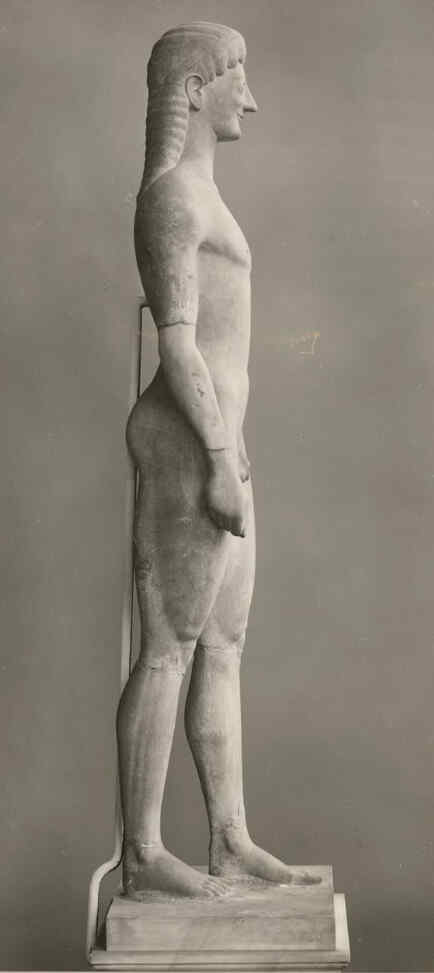
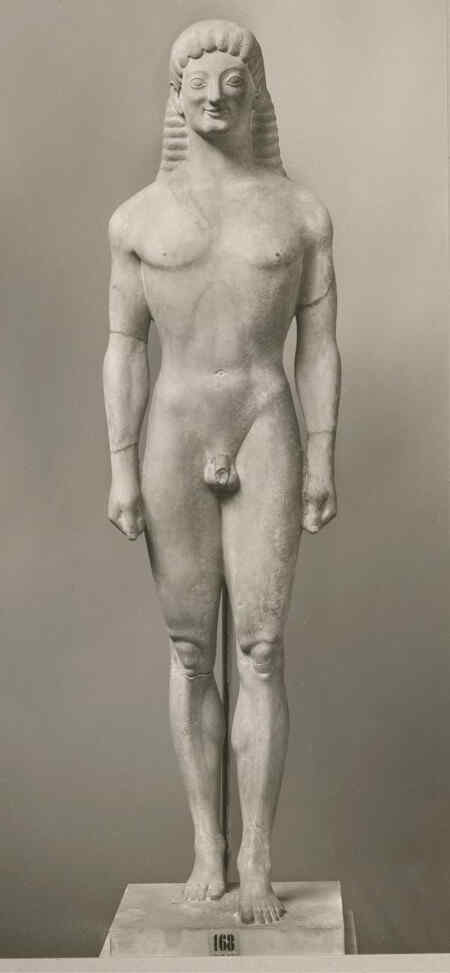
1. Apollo of Tenea. (Glyptothek. Munich.)
This is of an early period—about 600 B.C. Observe how the limbs, especially, are permeated with the ethereal ... One feature of the earliest Greek sculpture is often emphasized: the smile, as it is called, about the lips. In time to come this will be recognized as arising from the effort to represent not the dead human being—the mere physical body—but really to seize the inner life. In the earliest period they could do this in no other way than by this feature.
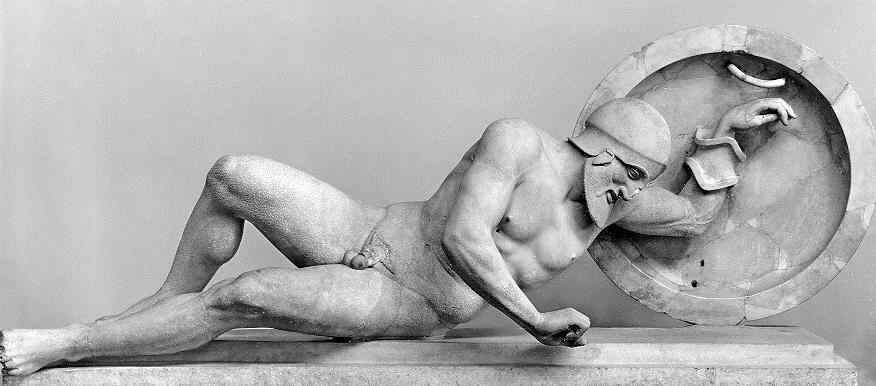
2. Dying Warrior. Eastern Pediment. Temple of Aegina. (Glyptothek. Munich.)
These works of art in the Doric Temple at Aegina were done as a thank-offering for the Battle of Salamis. They chiefly represent battle-scenes. Dominating the whole is the figure of Pallas Athene, which we shall see presently. This dying recumbent figure is a beautiful example of the figures that are found in this temple. The figures are grouped in the pediment. It is most interesting to see the composition, the perfect symmetry. The figures are distributed to the left and right with the most beautiful symmetrical effect.
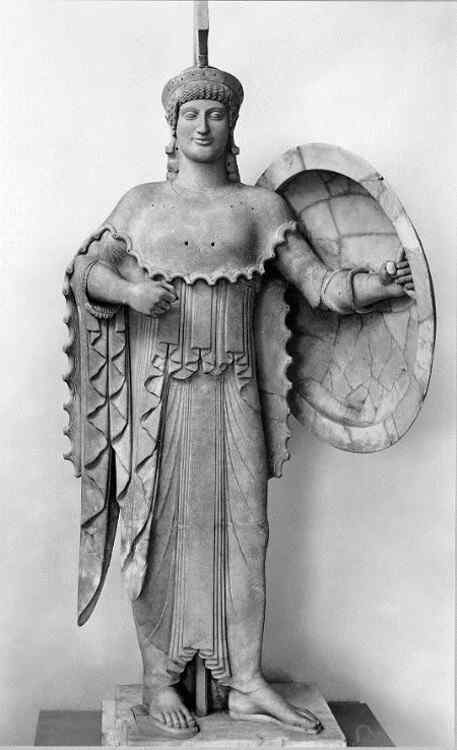
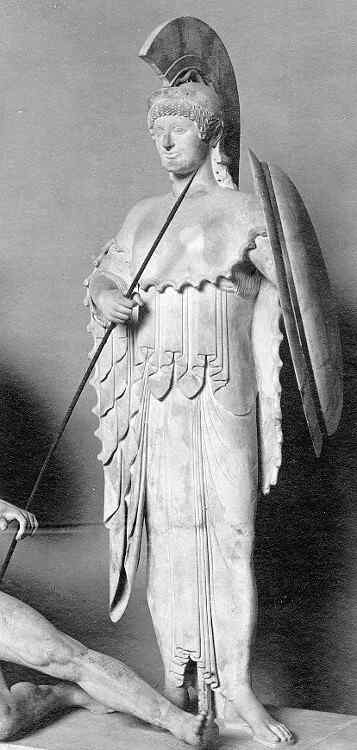
3. Pallas Athene from the Pediment of the Temple at Aegina. (Glyptothek. Munich.)
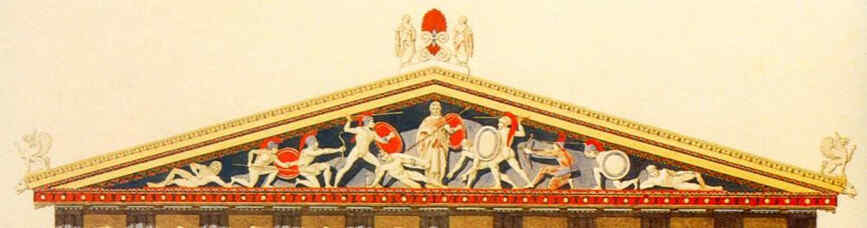
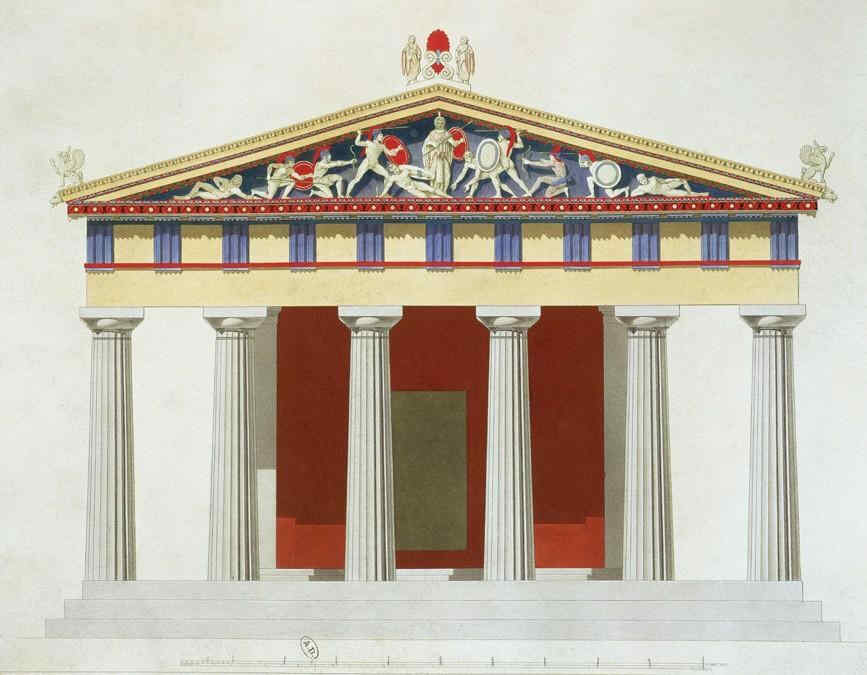
4. Reconstruction of the Western Piedemont of the Aphaia Temple.
These works take us to the beginning of the 5th century B.C.
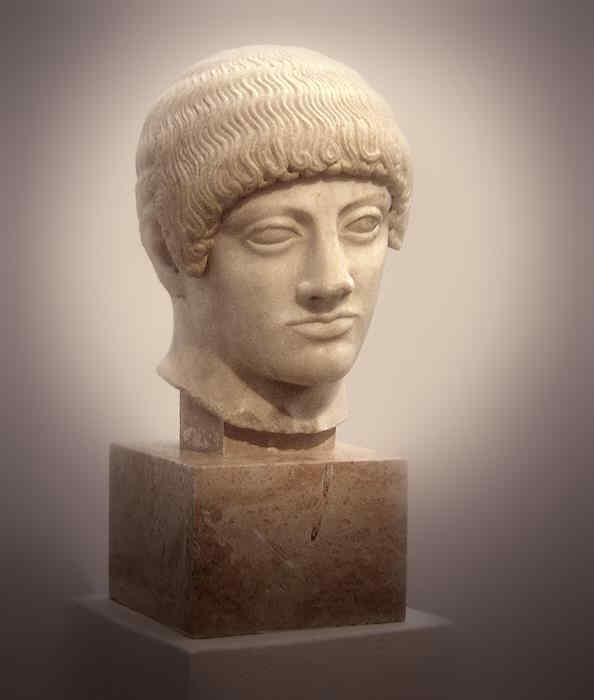
5. Head of a youth.
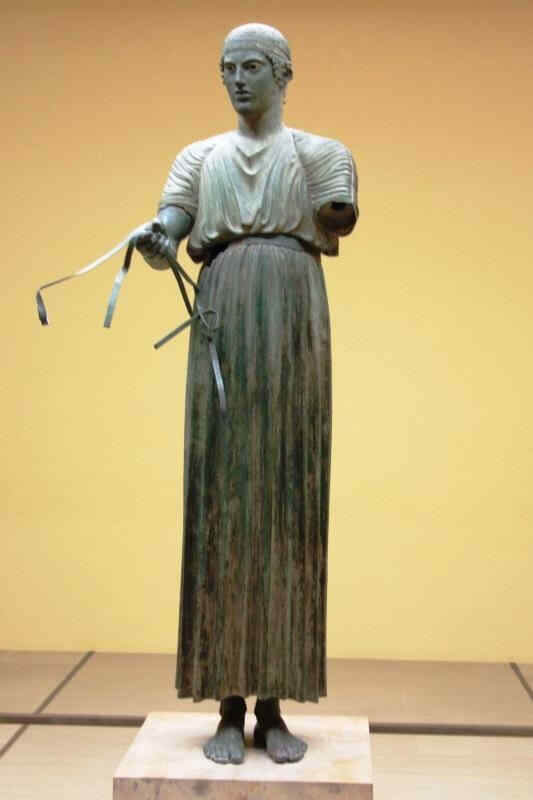
6. Charioteer from Delphi
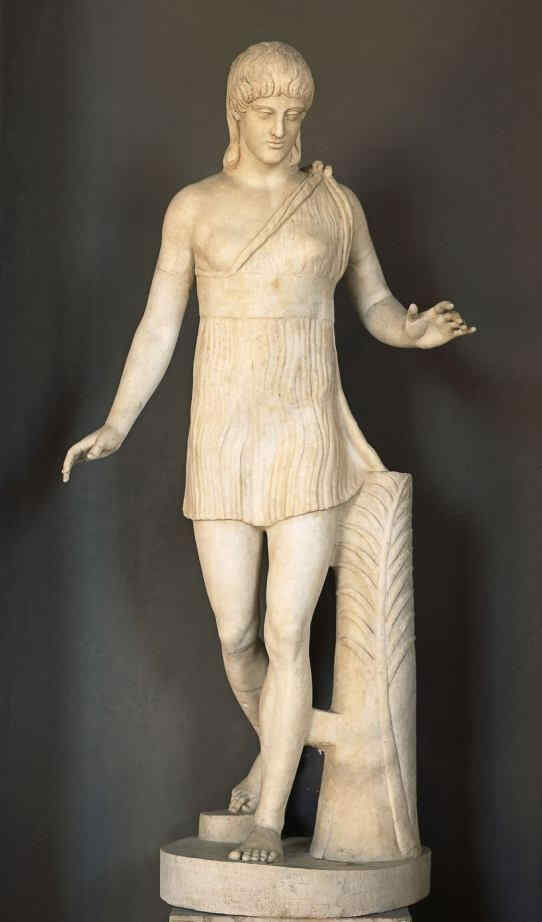
7. Runner (middle of the 5th century B.C.)
And then I ask you to note, as with Myron—as we come in to that age that one can denote as the pinnacle—as with Myron, that a very different treatment of the body arises, in that he no longer separates, what even here is still the case, but he knows how to treat the whole body in connection with the limbs.
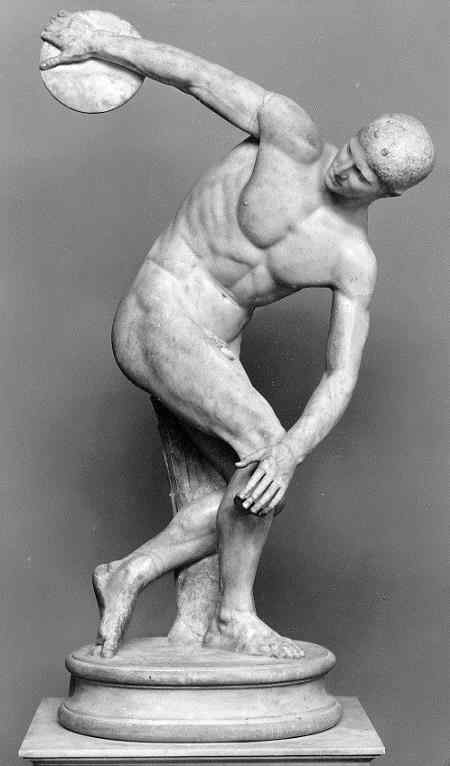
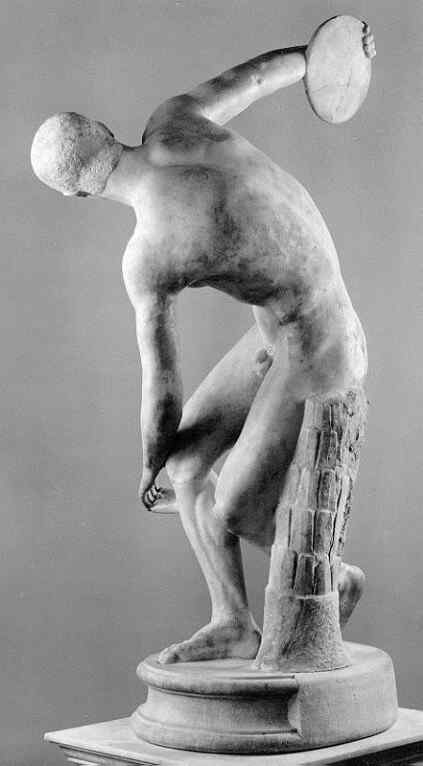
8. Discus Thrower
Thus we stand in the middle of the 5th century and find in such a shapes a tryly high degree of perfection in the direction, we have tried to characterize.
And now we come, or are already in, to the Age of Periclean. From the time of Phidias, of whomwe unfortunately know very little, you have the so-called Athena Lemnia:
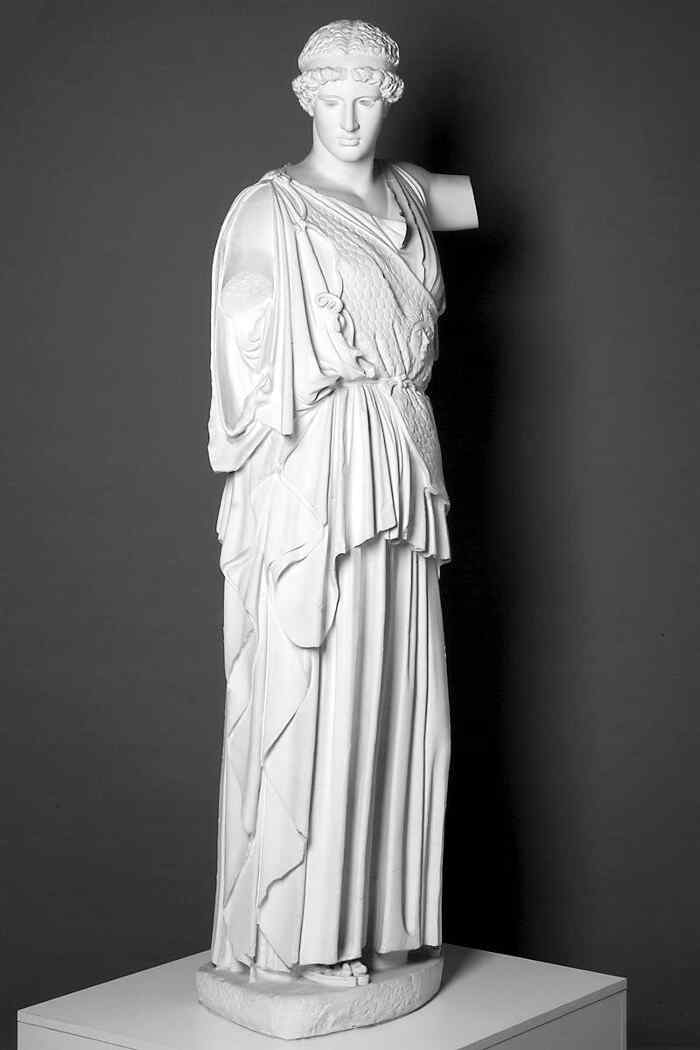
9. Athena Lemnia
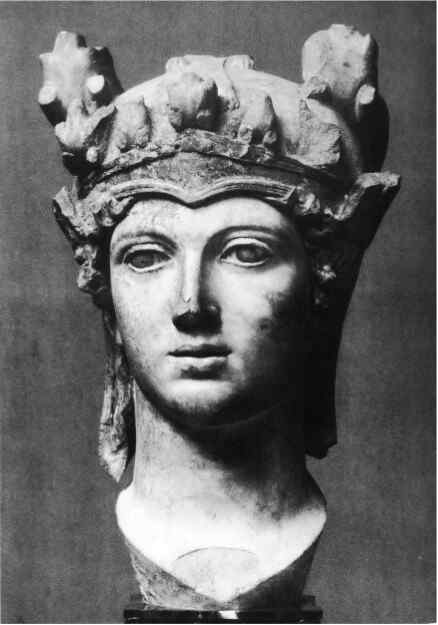
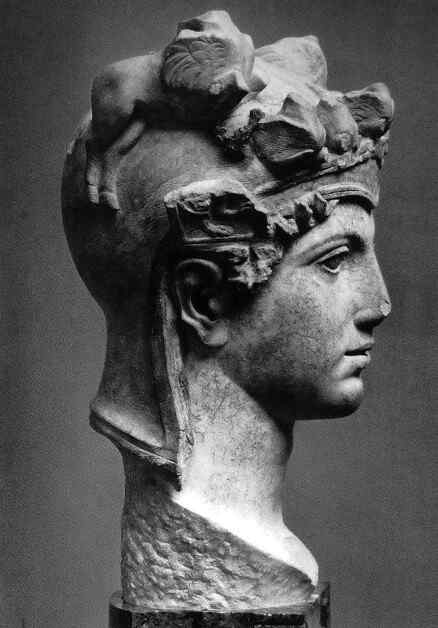
10. Head of Athena
We will now give a few examples of the famous Parthenon. You may read the interesting story of these figures in any History of Art. The greatest of them have in all probability been lost. We can only gain some idea of them from the drawings made by the Frenchman, Carrey, in the 17th century. Subsequently they were largely destroyed by the Venetians, and only the relics were discovered by Lord Elgin in the 19th century.
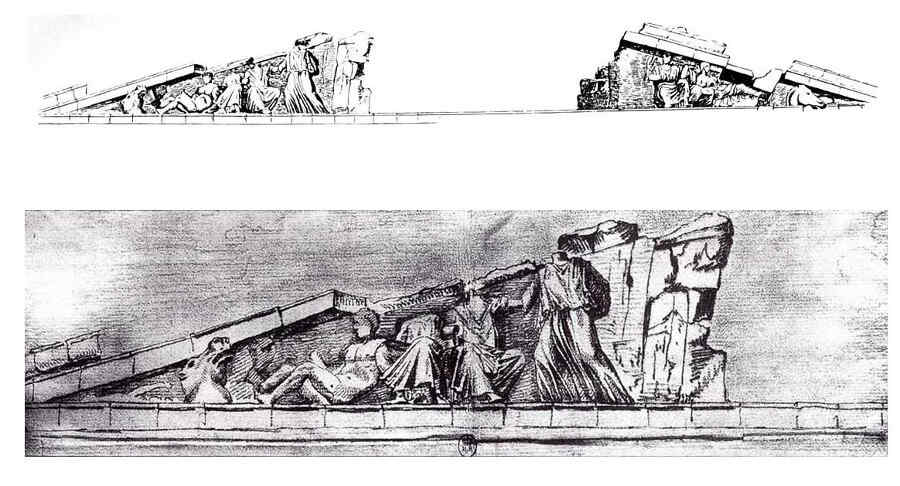
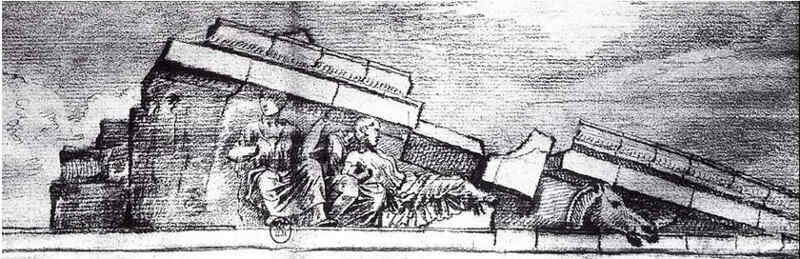
11a. Drawings of the eastern pediment.
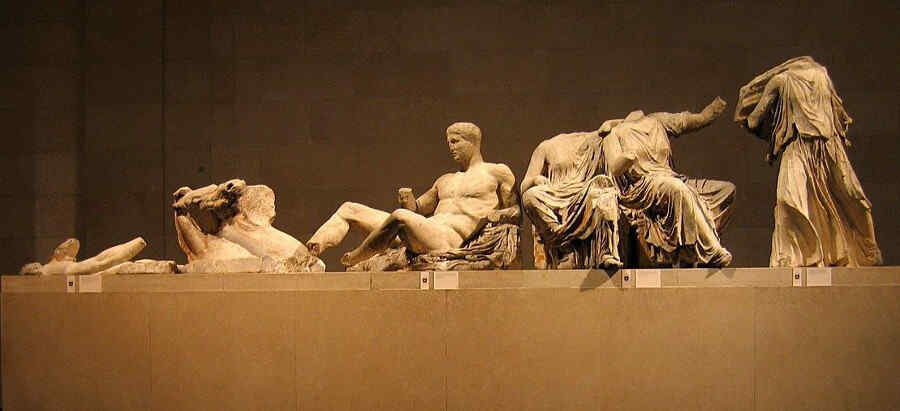
11b. Remains of the left side of the eastern pediment. (Bristish Museum. London.)
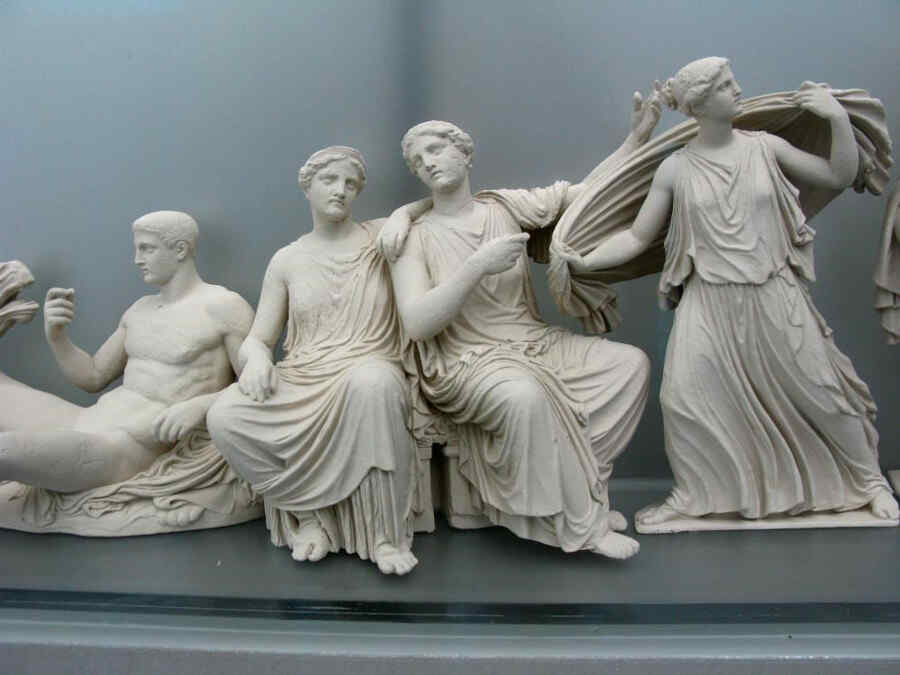
11c. Reconstruction of the figures in the last photo.
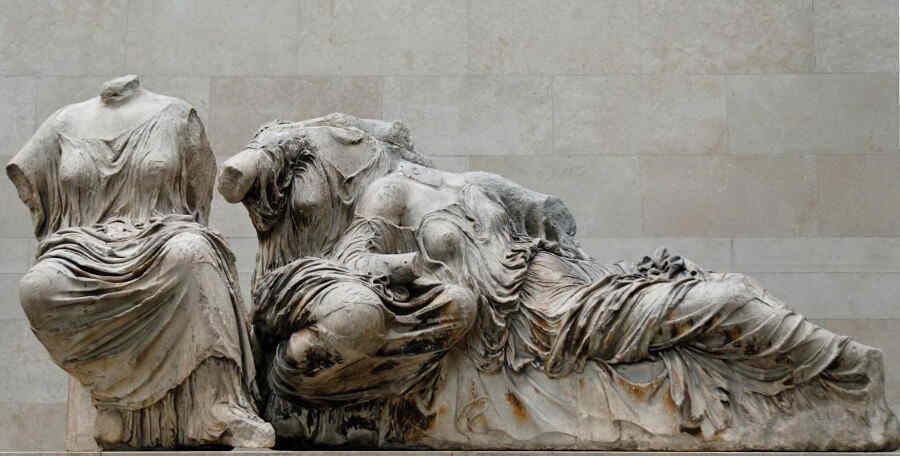
11d. Hestia, Dione, and Aphrodite from the right side of the eastern pediment. (British Museum, London.)
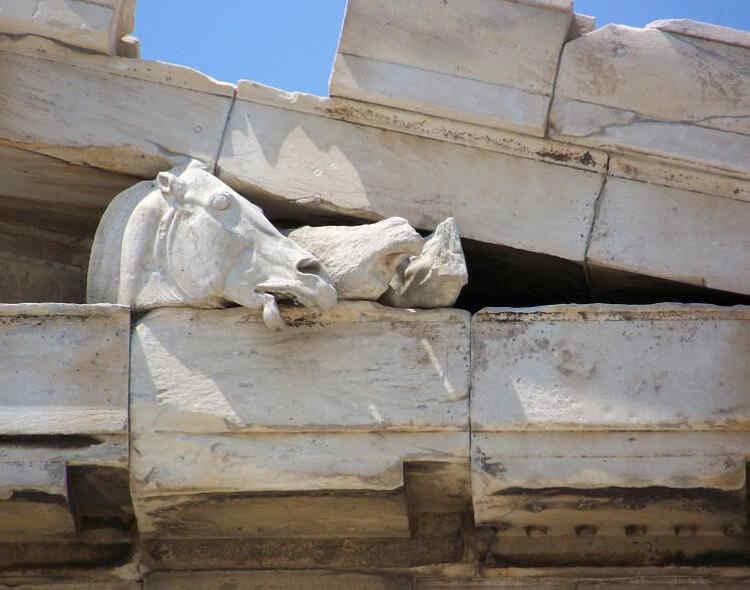
11e. Far right of the eastern pediment.
Now for the Parthenon western pediment:
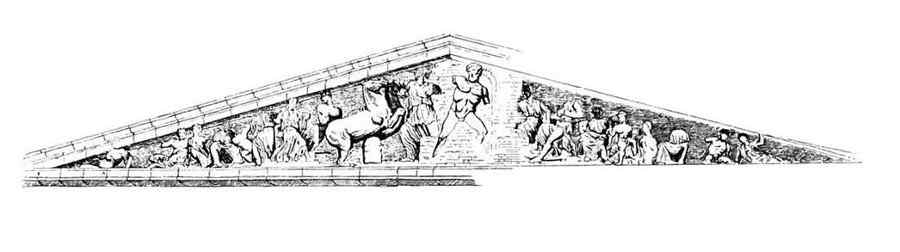
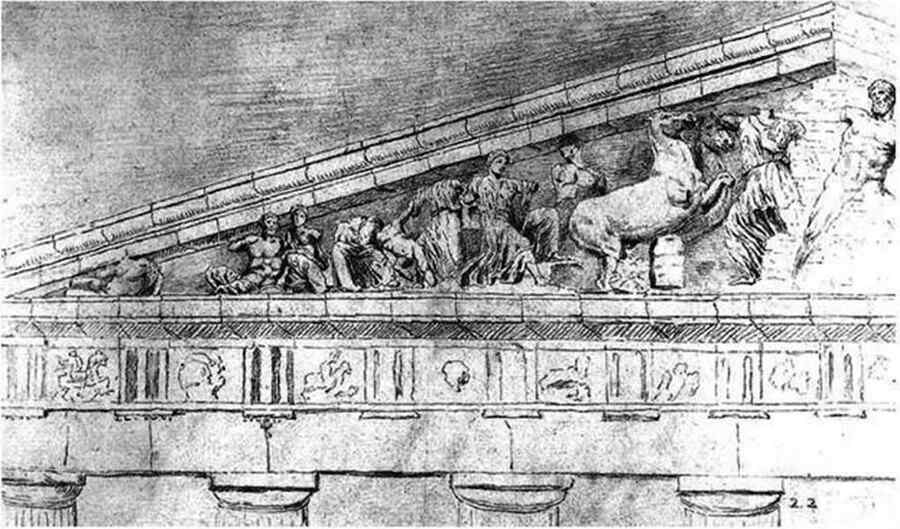
11f. Drawings of the western pediment.

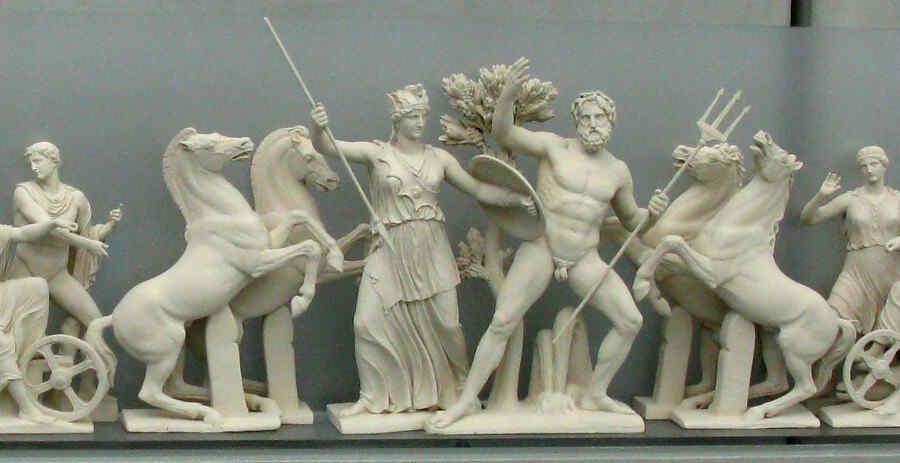
11g. Reconstruction of the western pediment.
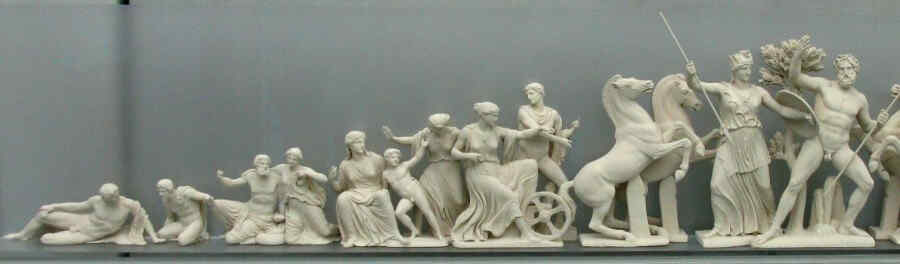
The Parthnon Friezes:
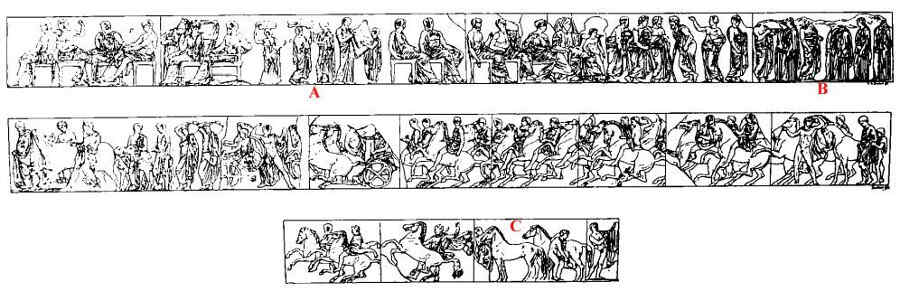
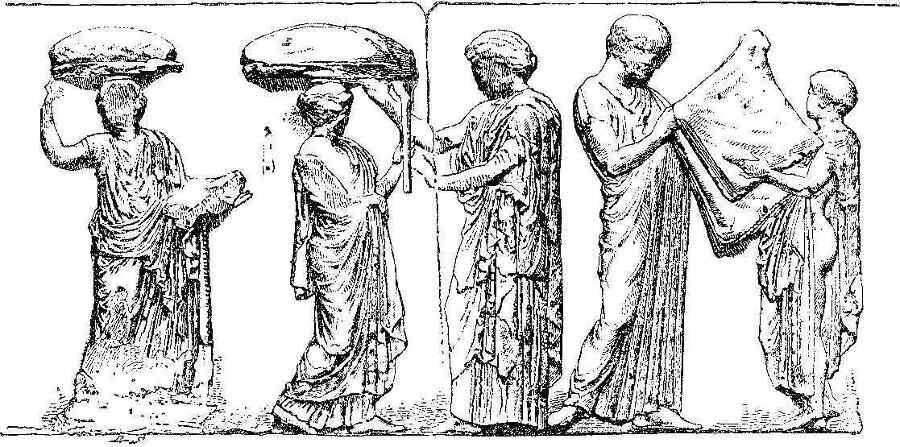
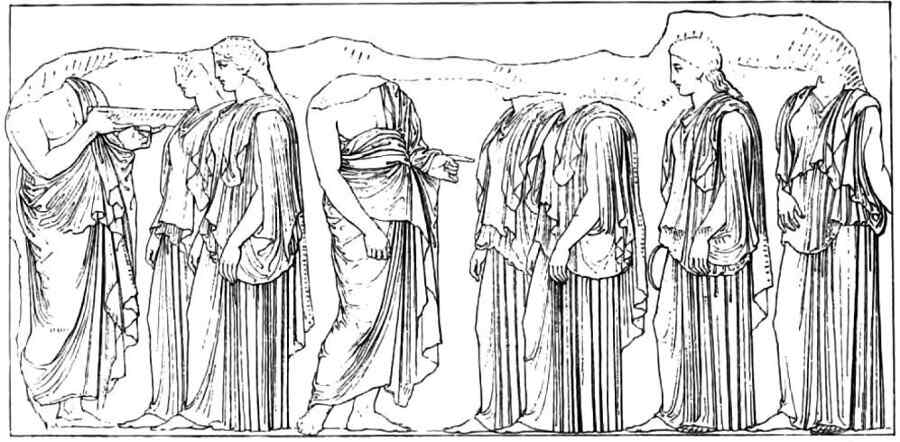
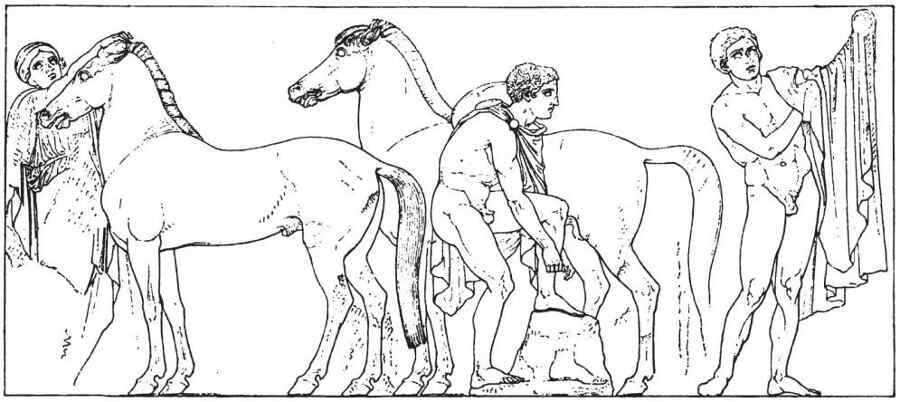
12a. Drawings of the Friezes.
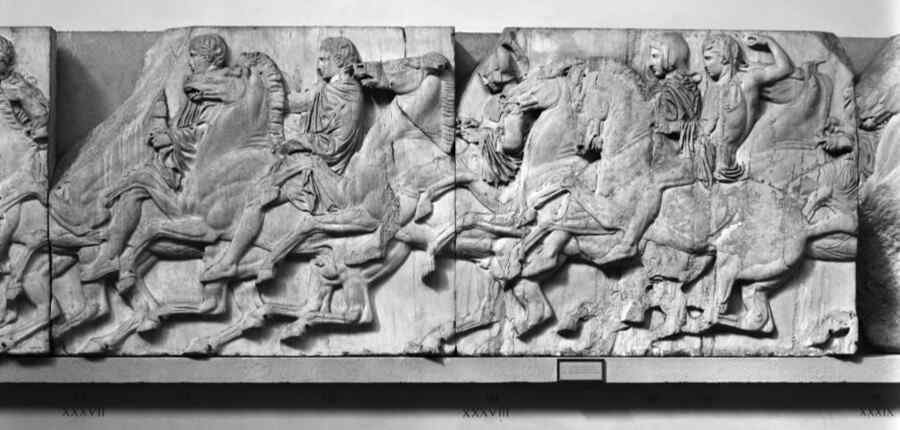
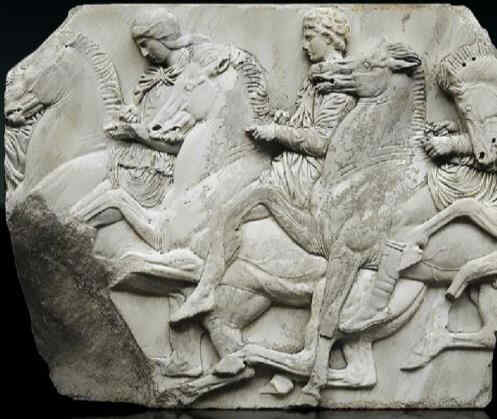
12b. Calvary. (Western Frieze.)
We may assume that these works were mostly executed in the presence of Phidias himself by his pupils. The next group is from the Eastern Frieze:
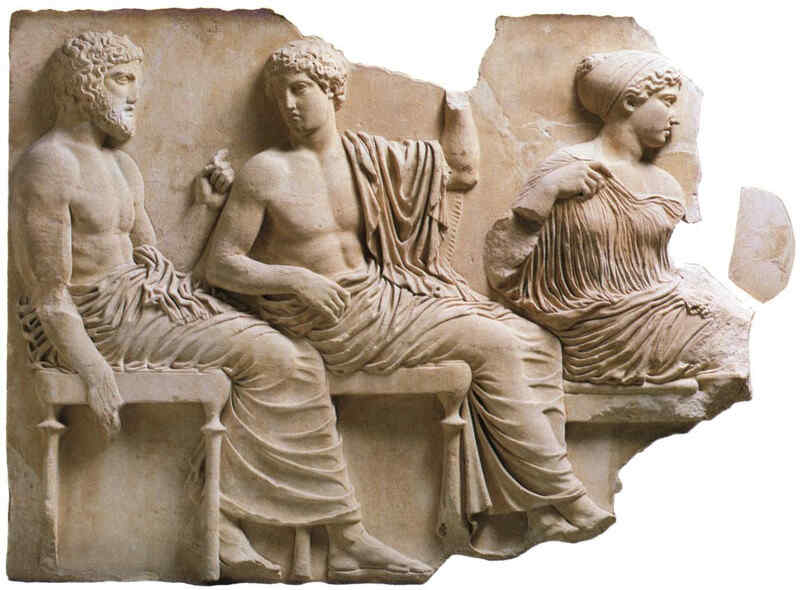
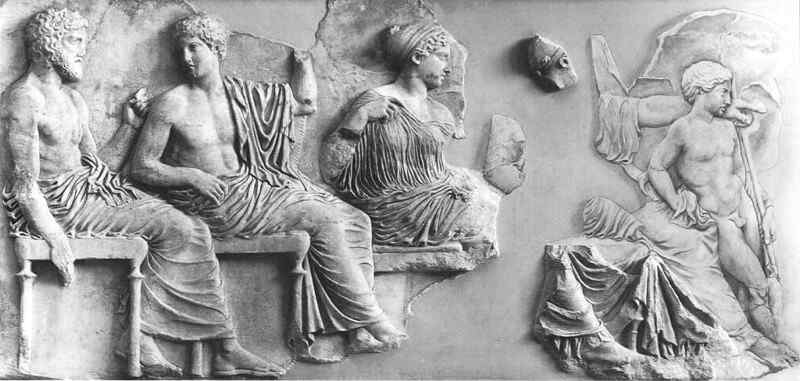
12. Poseidon Group. (Eastern Frieze.)
With Phidias, indeed, all that was typical of Greek Art was already given. The stamp, the signature, as it were, was now given to the bodily figure, as it should be represented in Art. The way in which Phidias and his pupils saw it lived on for a long time. It was felt that the line of the face, the features, the movement of the limbs, the flow of the drapery and so forth, should accord with what was evolved in this ideal age.
Through all the traditions this was handed down, even into the times when they were able to imitate quite superficially what had lived so strongly in this Golden Age of the Art of ancient Greece. Unhappily, the greatest works have been destroyed. It is no longer possible to gain by outer vision a conception of Phidias' greatest masterpieces, which were transcendent and sublime. We must realise that in the 18th century, when Goethe and others, stimulated by Winckelmann, entered so deeply into the essence of Greek Art, they could only do so with the help of poor, late imitations. Truly, great intuition was necessary to penetrate into the nature of Greek Art through the poor imitations that were then available. And if we really try to feel the truth about these things we cannot but admit: In the time when Goethe was a young man, or when he travelled in Italy, there was still quite a different instinctive feeling for Art than later in the 19th century,—let alone the 20th. For otherwise it would have been impossible for these late imitations to inspire the lofty conceptions of Greek Art which lighted forth in Winckelmann or in Goethe.
Look, for instance, at the next, the head of Zeus, which is to be seen in Rome:

13. Zeus of Otricoli. (Vatican. Rome.)
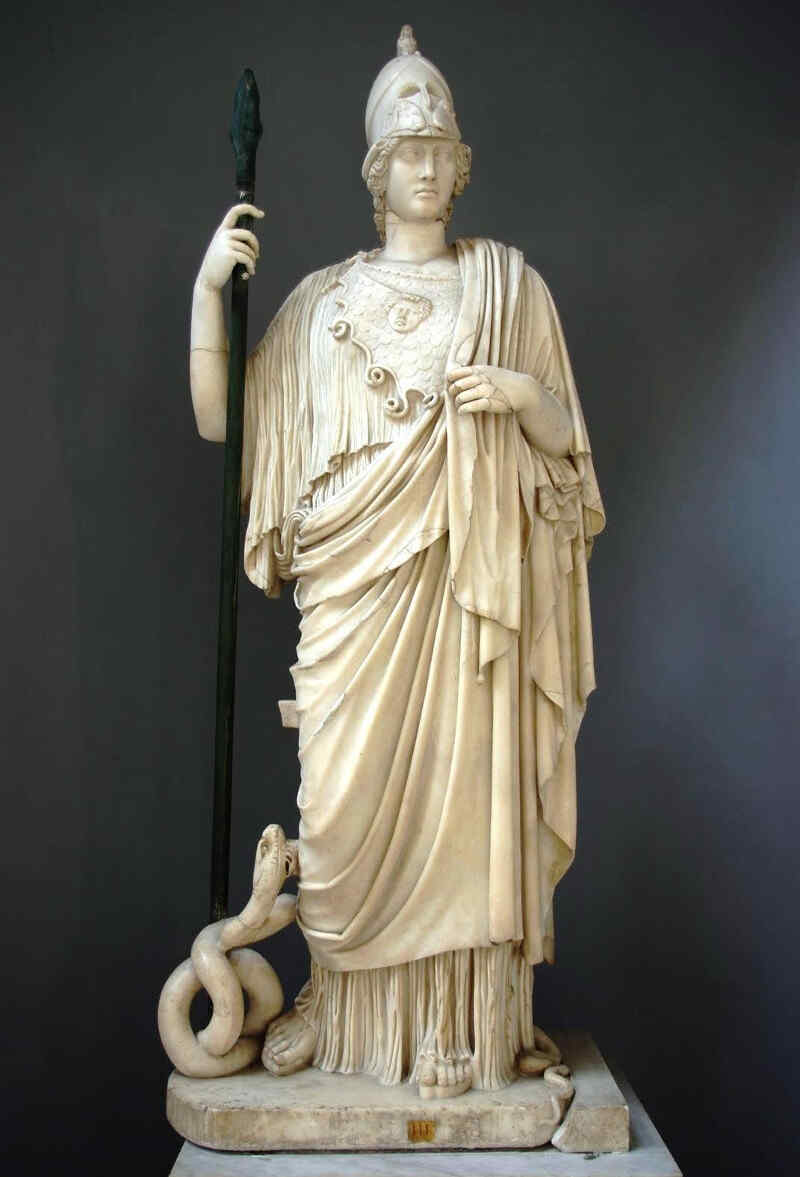
14. Athena
Here you can see something like a later continuation of the type that was evolved in the time of Phidias. This is, of course, a later imitation, though undoubtedly it still appears with a certain grandeur,—With a far less grandeur they imitated the Hera type which had been evolved by Polycleitus. And as to the famous Pallas Athene, which is also to be seen among these statues in Rome, here I must say the imitation has become insipid, fatuous. Indeed, this figure shows already the type of the later imitations of Pallas Athene. These things even become a little reminiscent of fashion-plates! We can but divine how magnificent were the works from which these later imitations were derived.
In this head of Zeus you see the tradition that was handed down from Phidias.
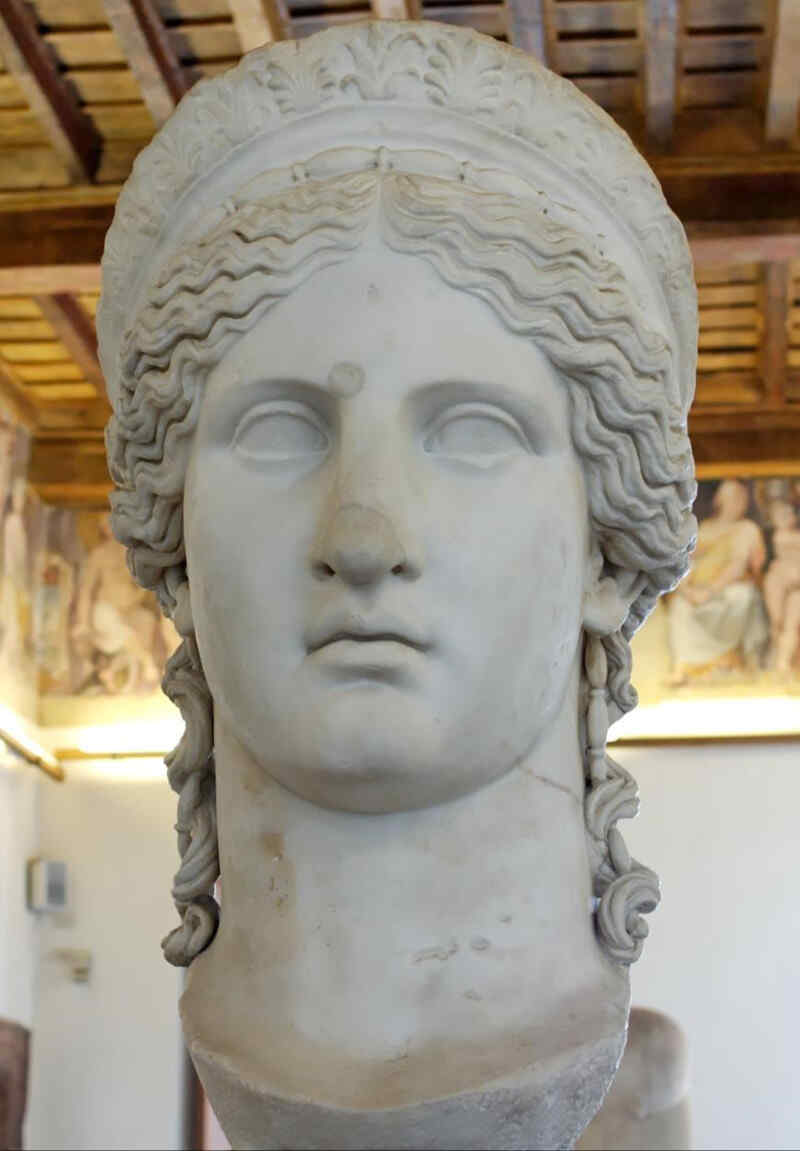
14a. Zeus
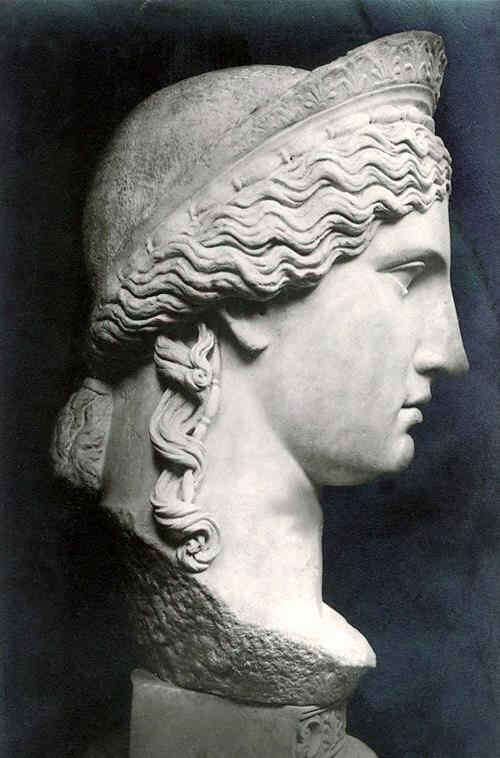
14b. Profile of Zeus.
And now we will go back to the figures from the temple of Zeus at Olympia. Here, too, the composition is magnificent:
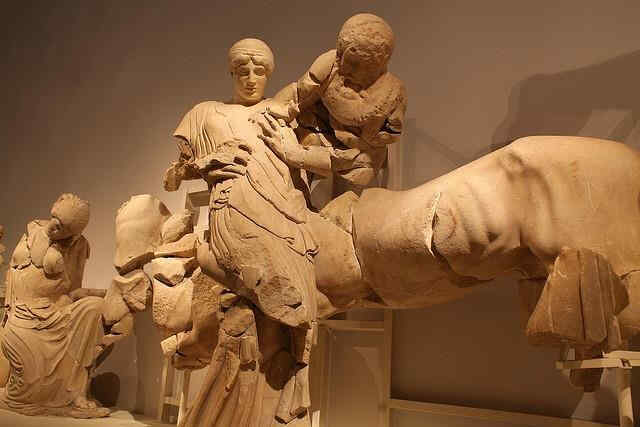
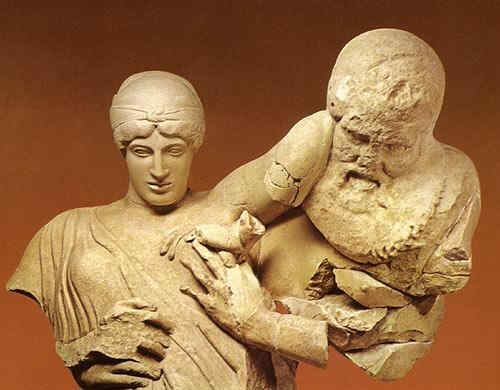
15. Western Pediment. Temple of Zeus at Olympia.
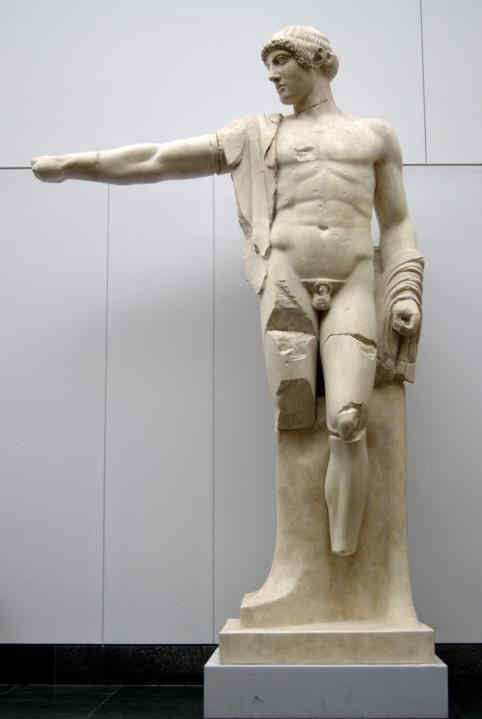
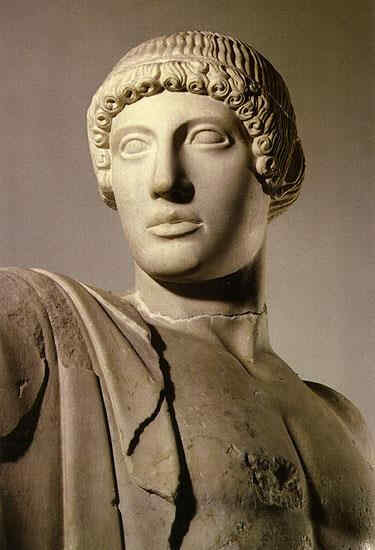
16. Figure of Apollo.
The next, too, is from the School of Phidias:—
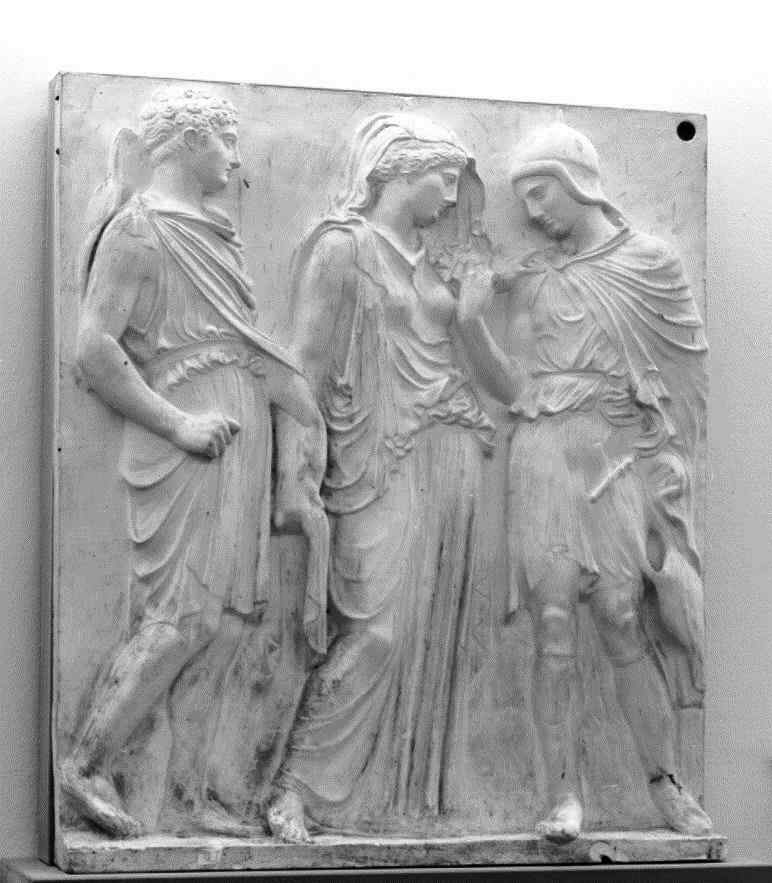
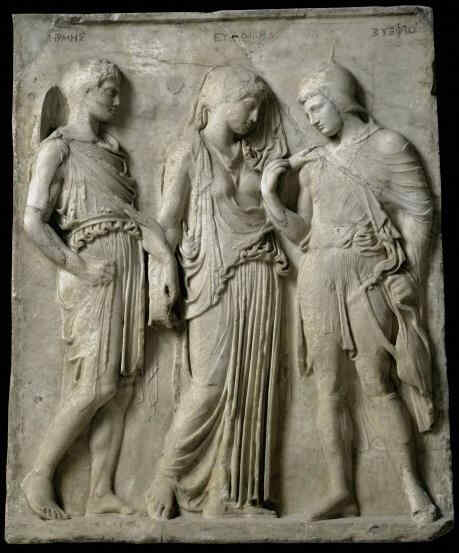
17. Orpheus Relief. (Museum. Naples.)
We remember how Phidias was accused by his fellow-citizens of stealing gold for his gold-and-ivory statue of Athene. His “grateful” fellow-citizens threw him into prison.
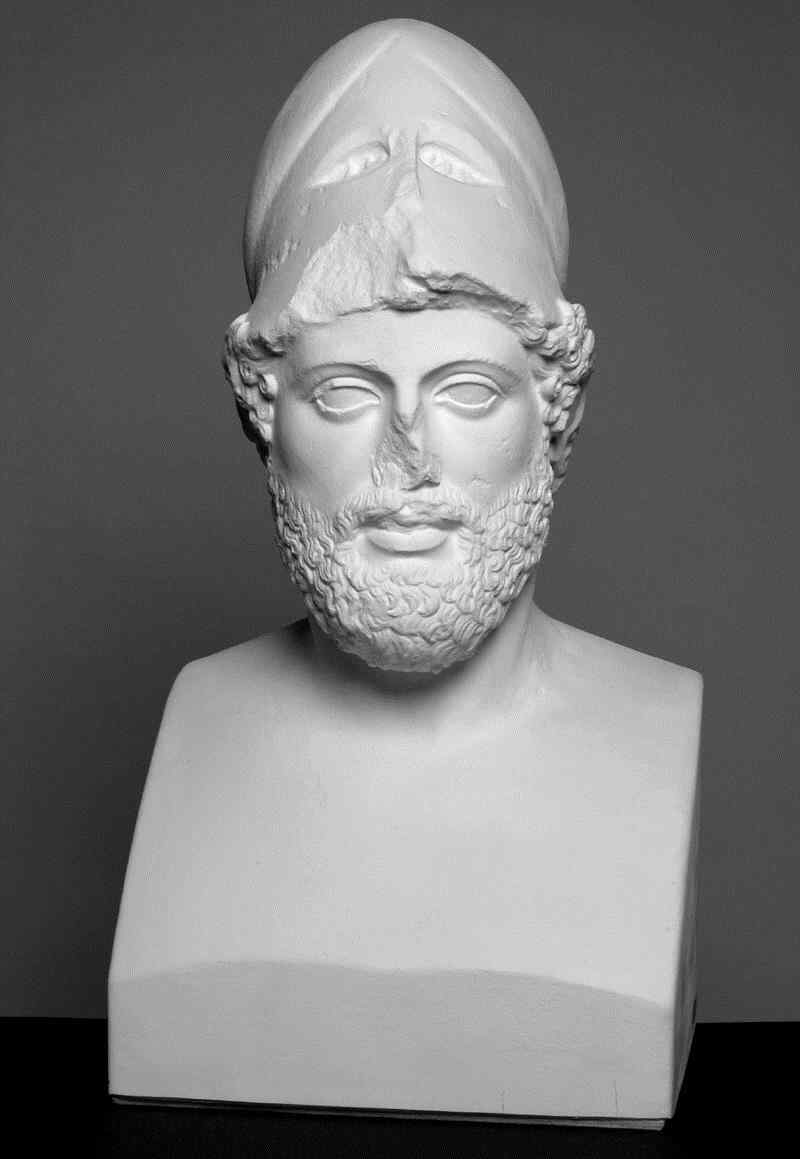
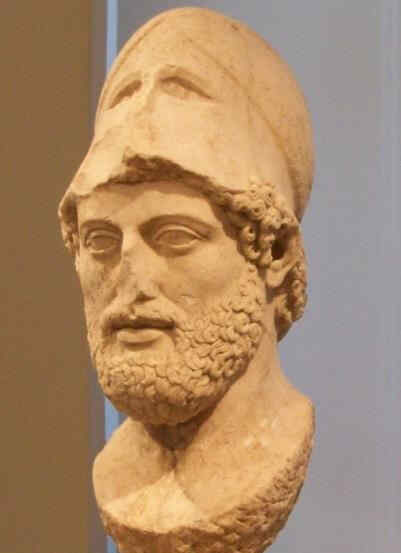
18. Bust of Pericles. (Berlin.)
Truly an ideal conception—lifted far beyond the sphere of portraiture.
The next is perhaps a work of Phidias' youth.—
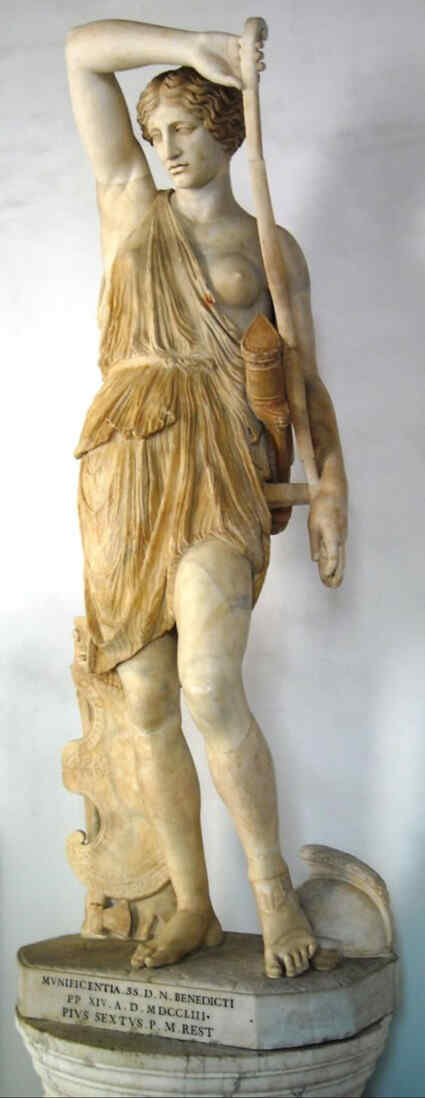
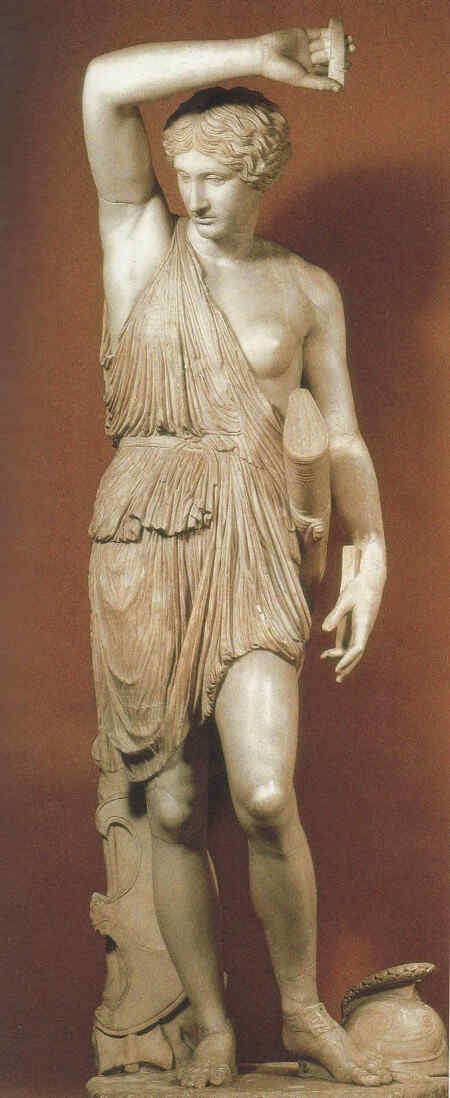
19. Amazon.
Here we will insert a work of Polycleitus:—
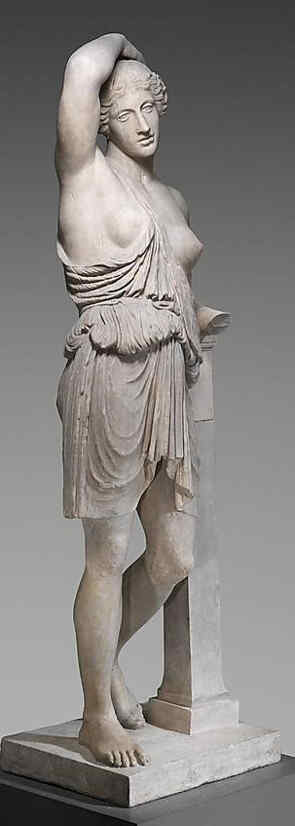
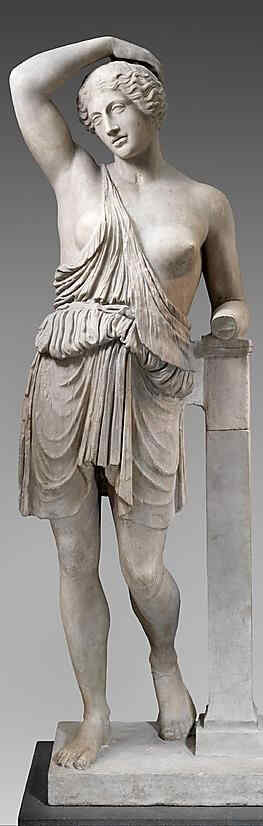
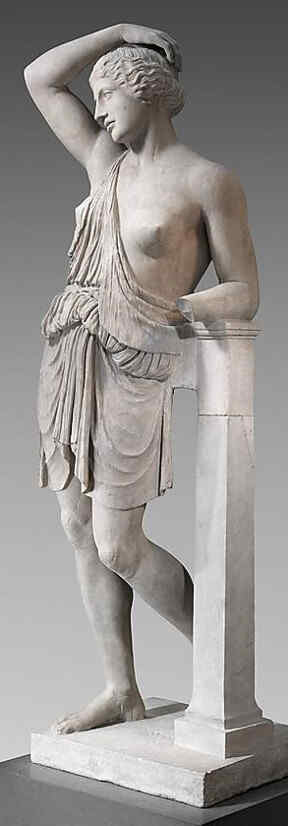
20. Amazon.
Myron and Phidias are the artists of the Golden Age of Grecian Art; they, indeed, created the traditions.
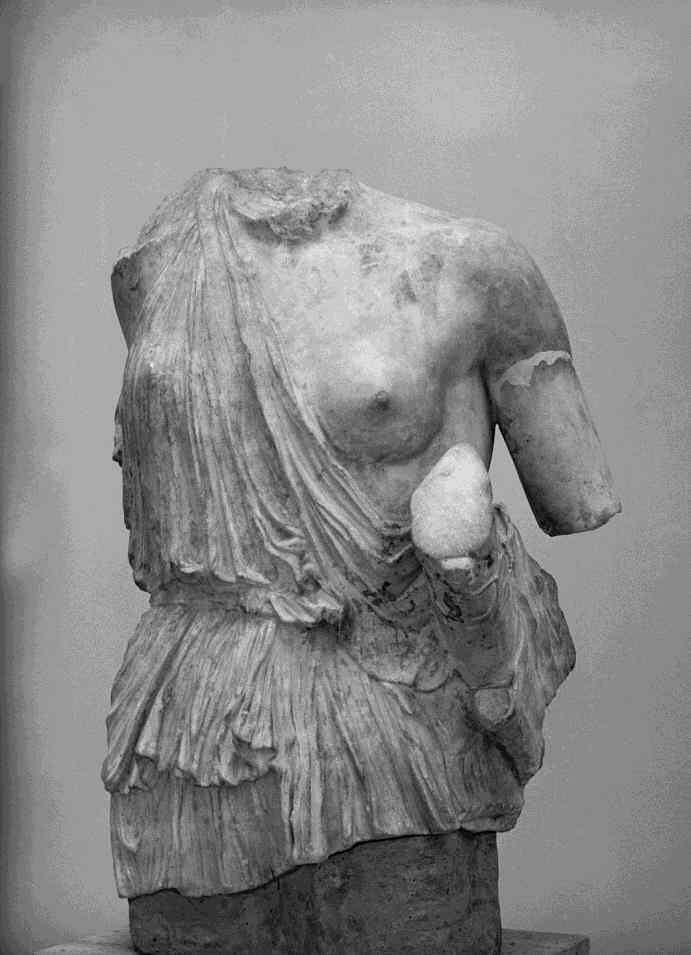
21. Amazon.
Another Amazon. The next is more difficult to date; it represents about the turn of the 4th and 5th centuries B.C. We insert it here to show that ancient Greece was quite capable of producing something of the character of Genre:—
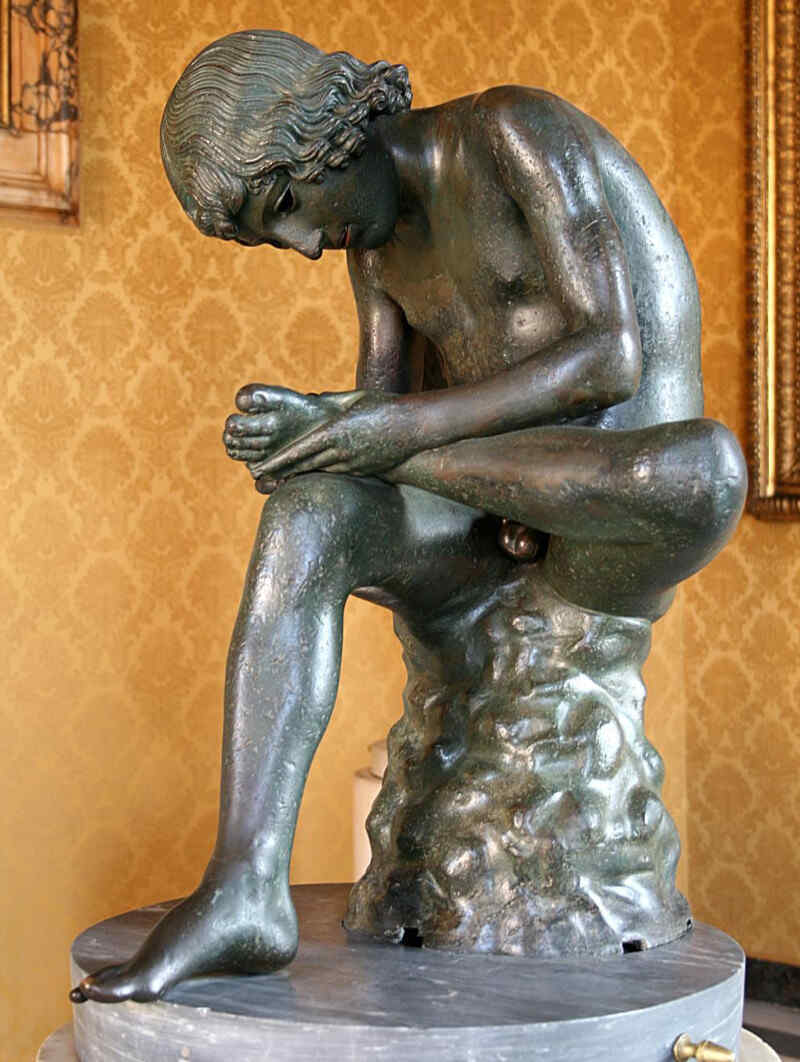
22. Boy, extracting the Thorn from his Foot. (Rome.)
And now we gradually come into the age of which I tried to indicate just now that the whole conception is lifted down into a more human realm, even though the figures be still the figures of the Gods. Take the following, for instance:—
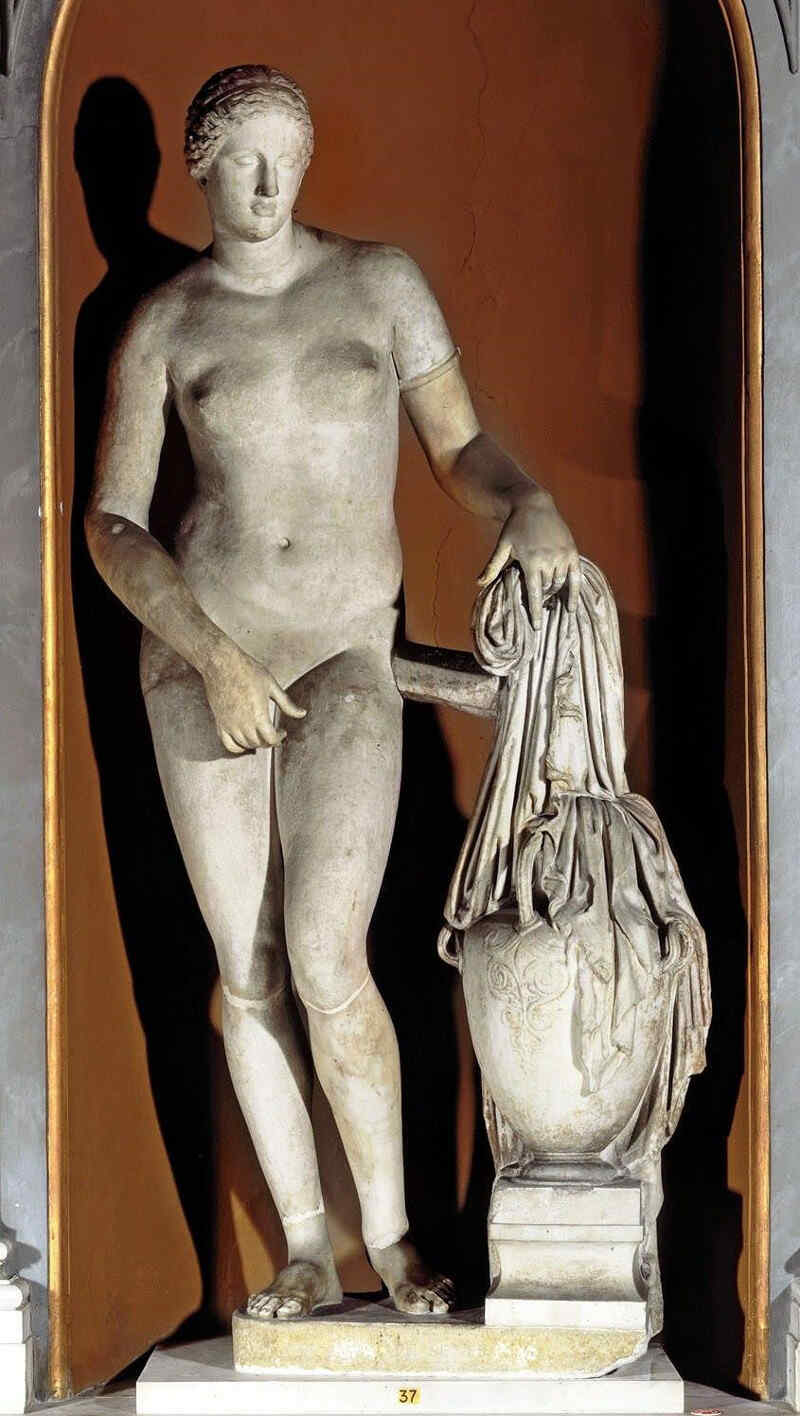
23. Aphrodite of Cnidos. (Vatican, Rome.)
Although it is the figure of a Goddess, it is brought down into a more human sphere. The sublimity of the earlier artists is made more human. We see this already in Praxiteles. This picture represents the so-called Aphrodite of Cnidos. Praxiteles brings us to the 4th century B.C. In connection with this we will also show the
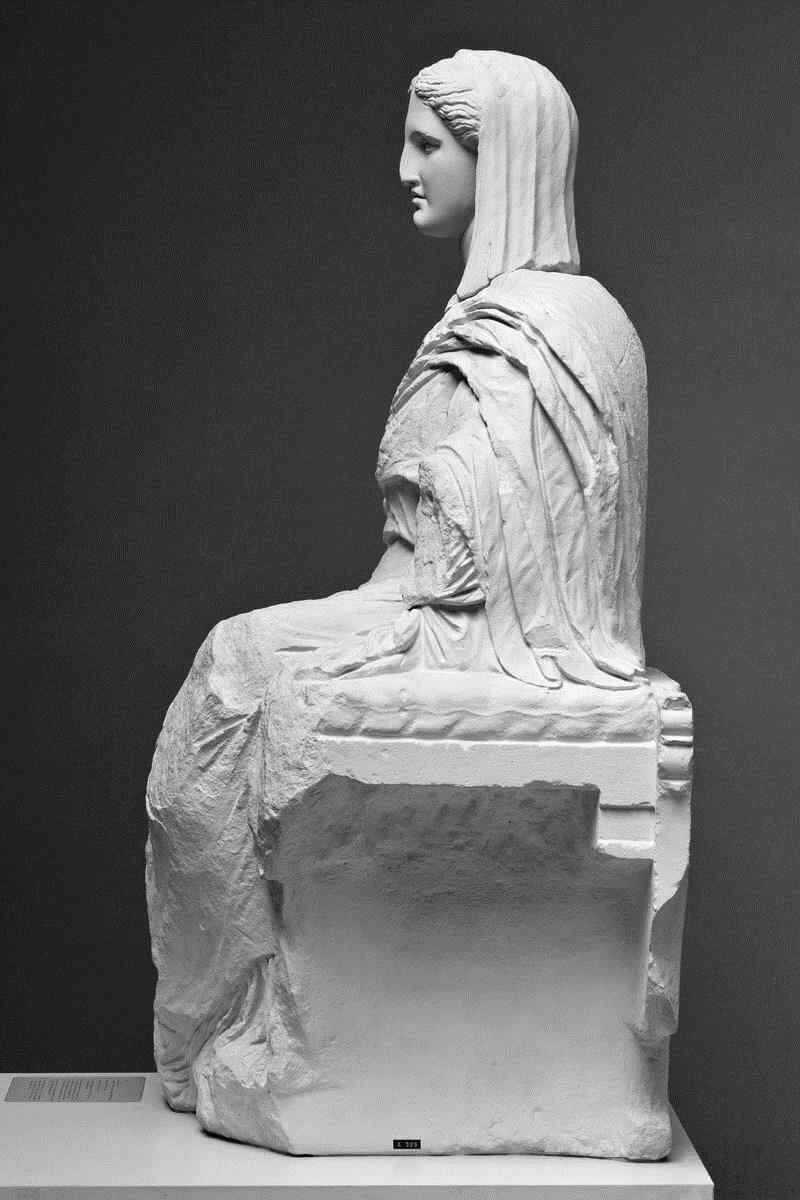
24. Demeter of Cnidos. (British Museum.)
It breathes the same spirit. The next is the Hermes of Olympia:
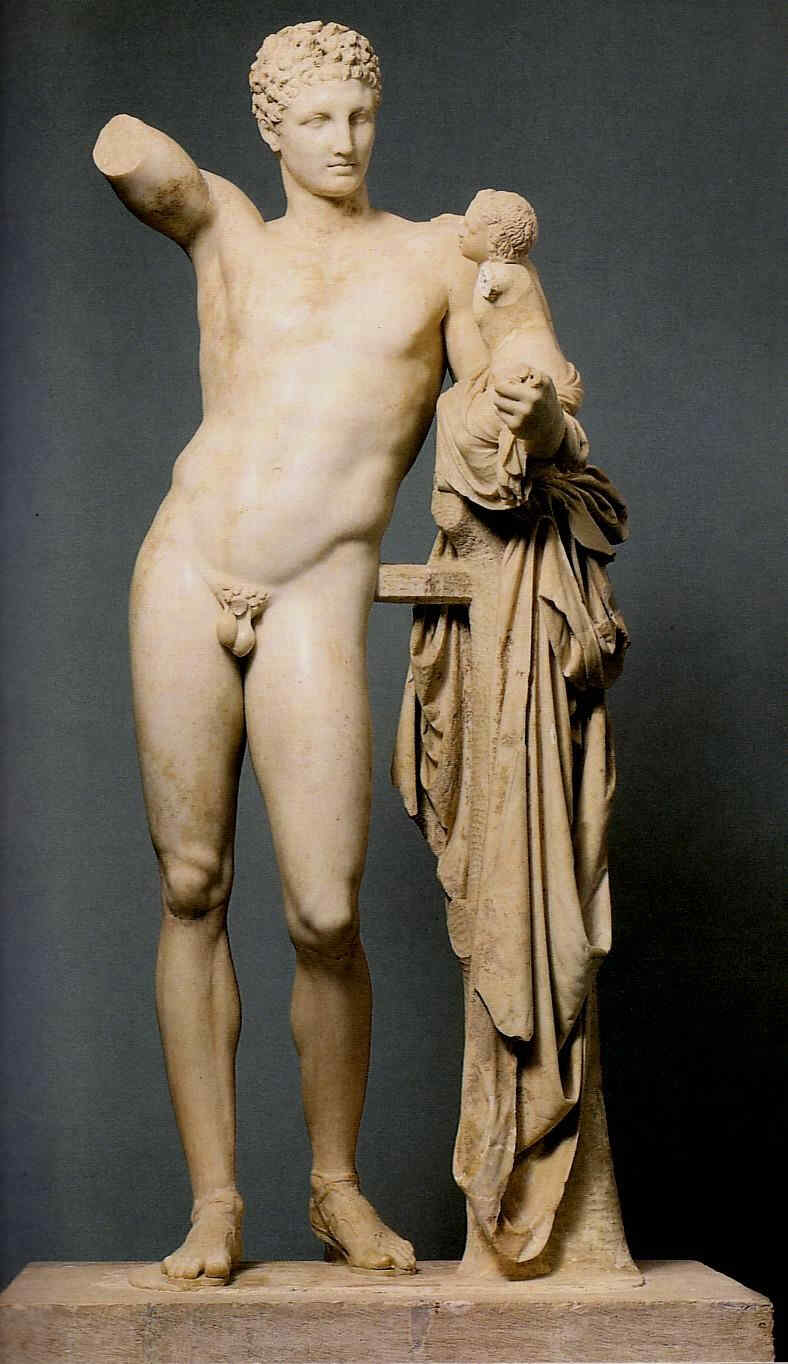
25. Hermes of Olympia, (By Praxiteles.)—holding the Dionysos child in his left hand.
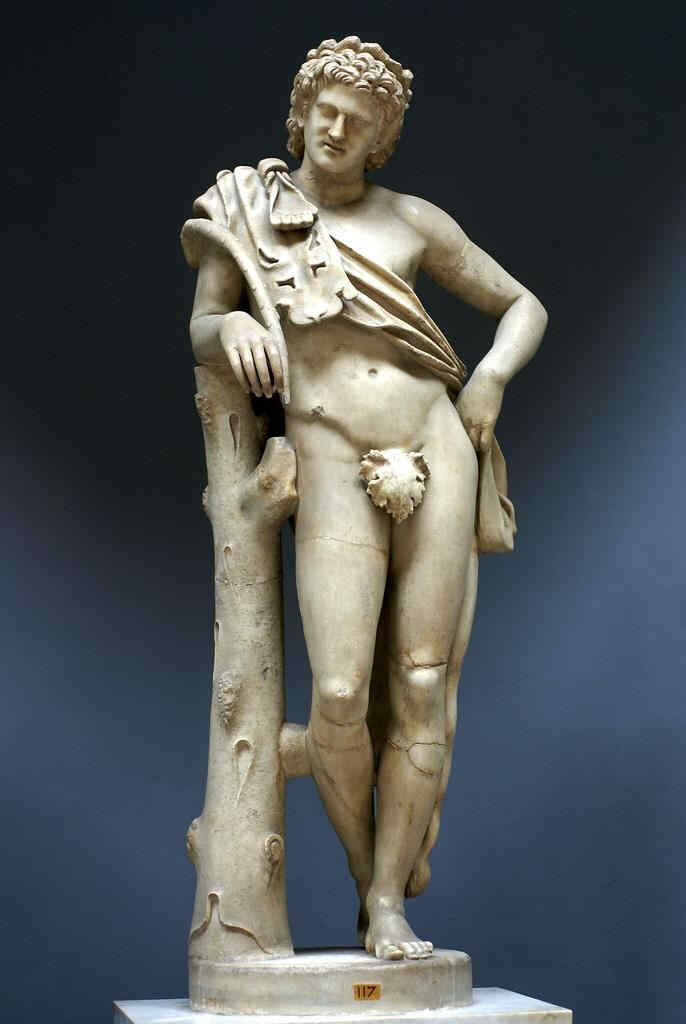
26. Satyr, by Praxiteles. (Capitol. Rome.)
To the same epoch belongs the famous Niobe Group,—Niobe losing all her children through the wrath of Apollo.
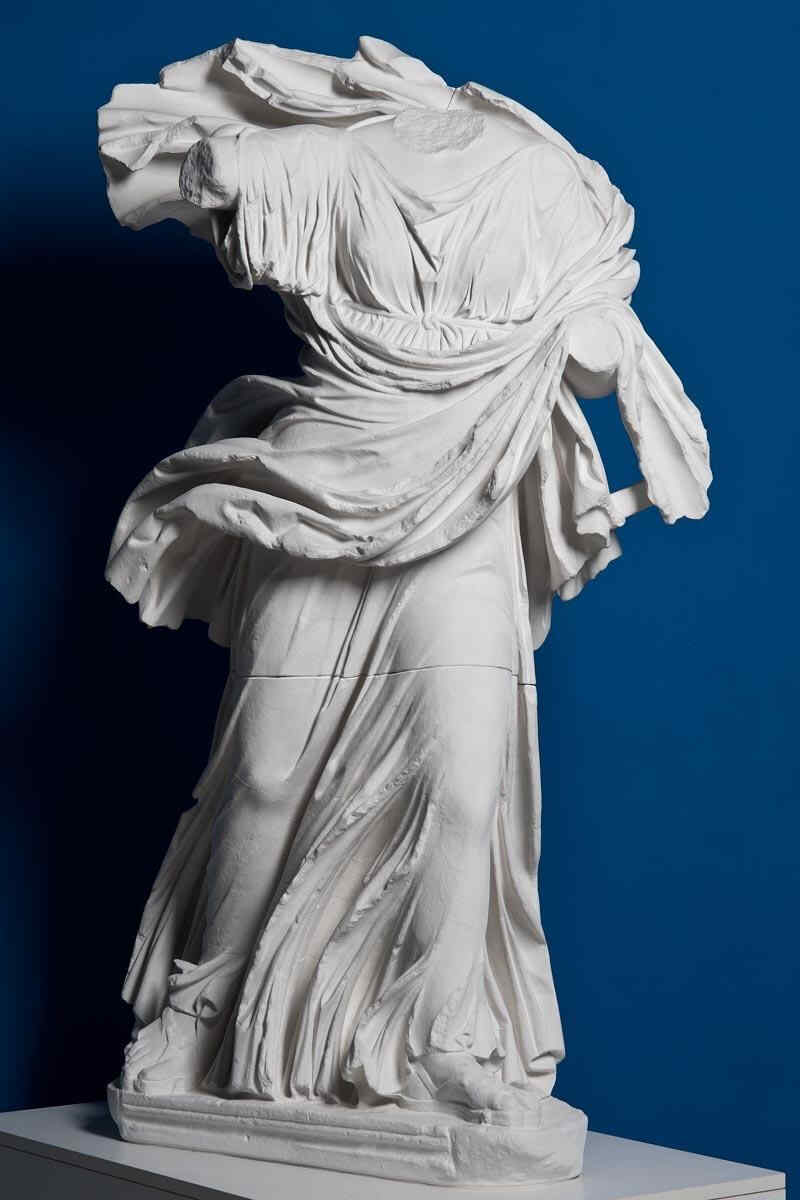
27. Figure in Flight, from the Niobe Group. (Vatican. Rome.)
Going on into the 4th century, we come into the Alexandrian age. Lysippus actually worked in the service of Alexander the Great.
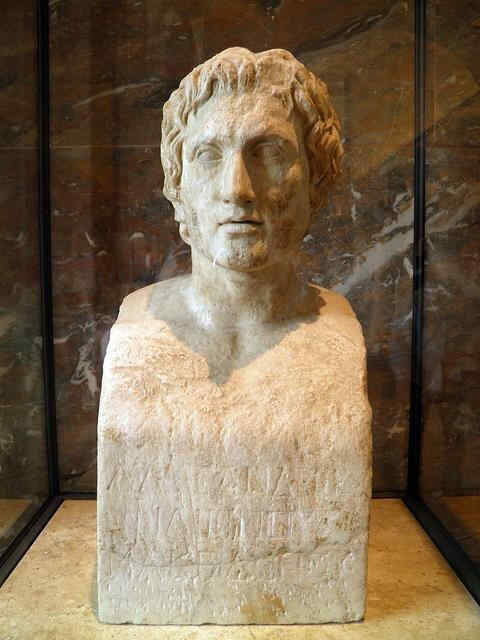
28. Bust of Alexander. (Louvre. Paris.)
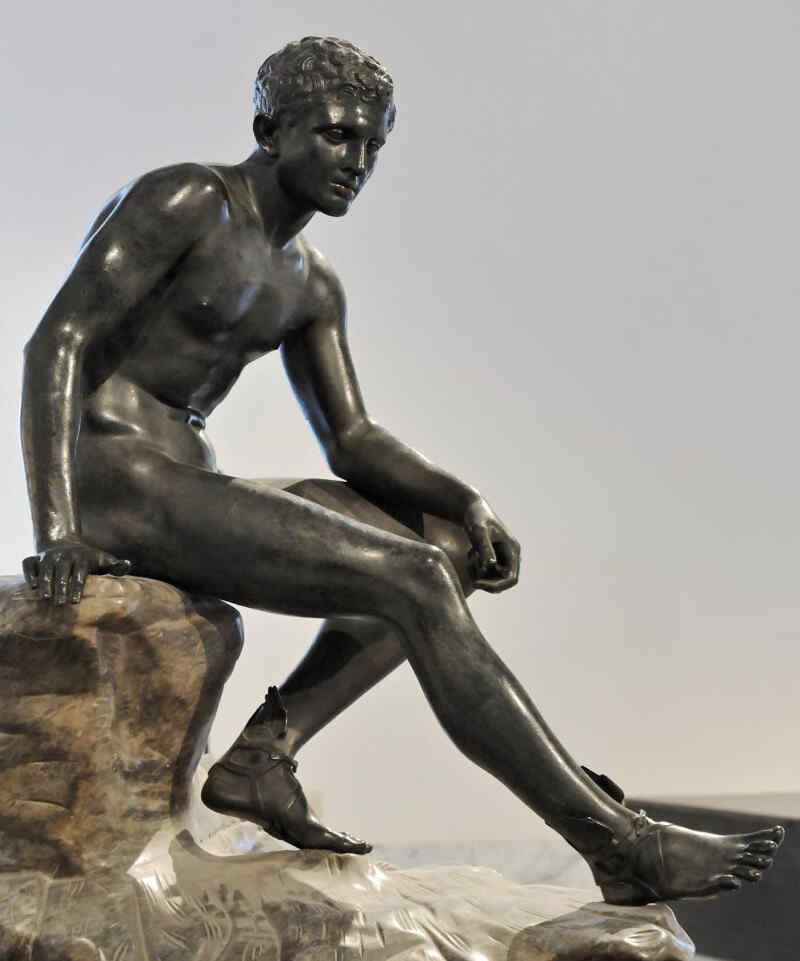
29. Hermes. (Museum. Naples.)
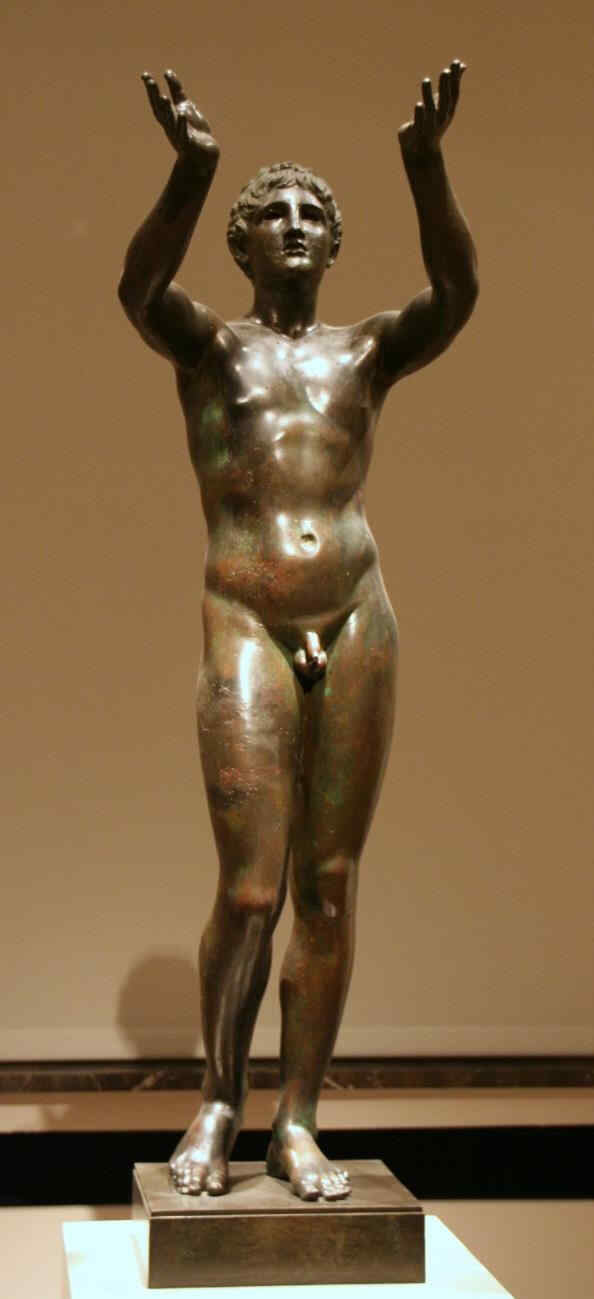
30. Youth, in Adoration. (By Lysippus.) (Berlin.) His arms are lifted up to Heaven in reverence, in prayer.
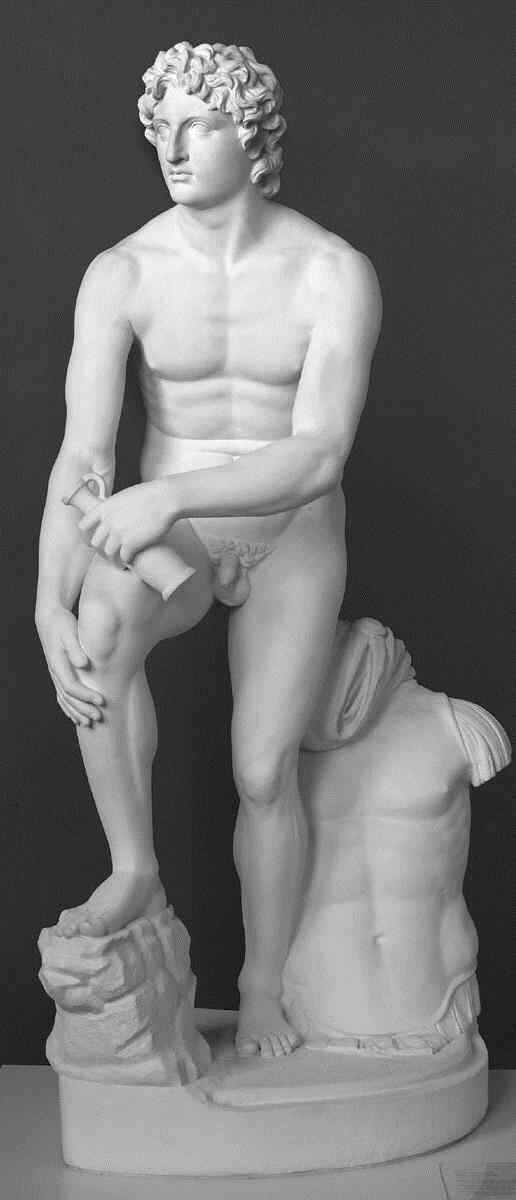
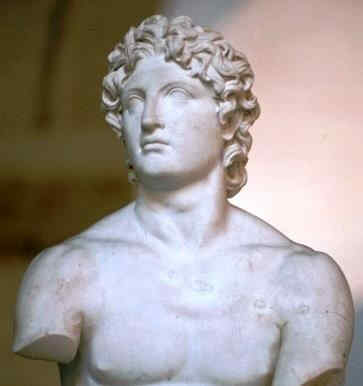
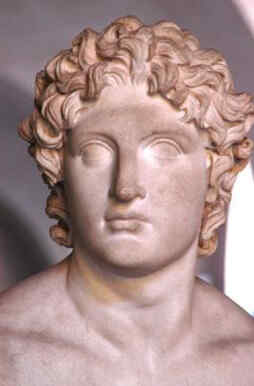
31. Alexander the Great. (Munich.)
Here we already see the descent of Art from the Typical to the Individual—though in the Grecian Art the process nowhere went as far as in the later epochs.
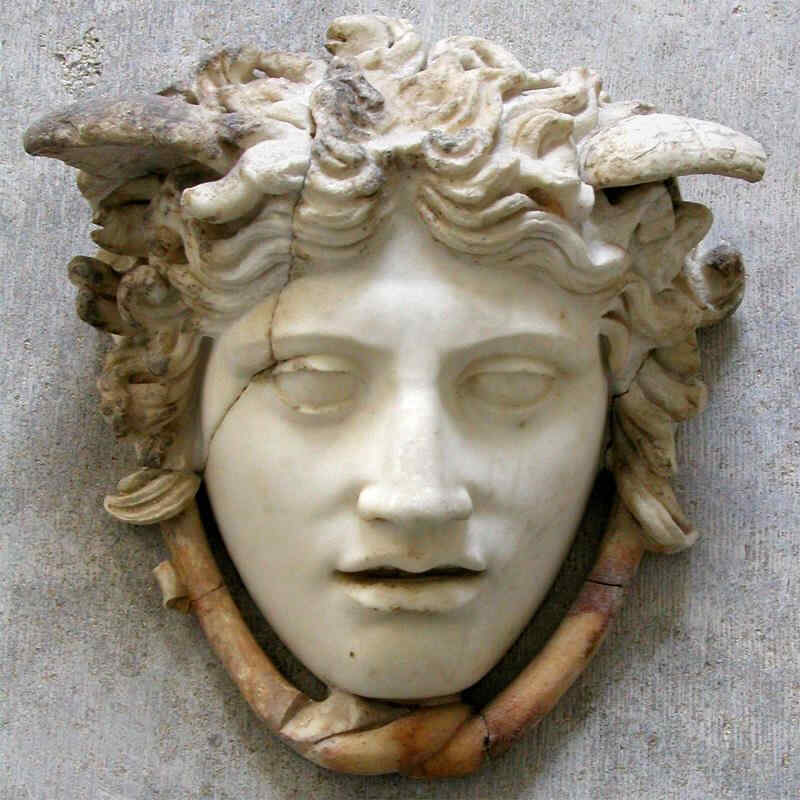
32. Medusa Head. (Glyptothek. Munich.)
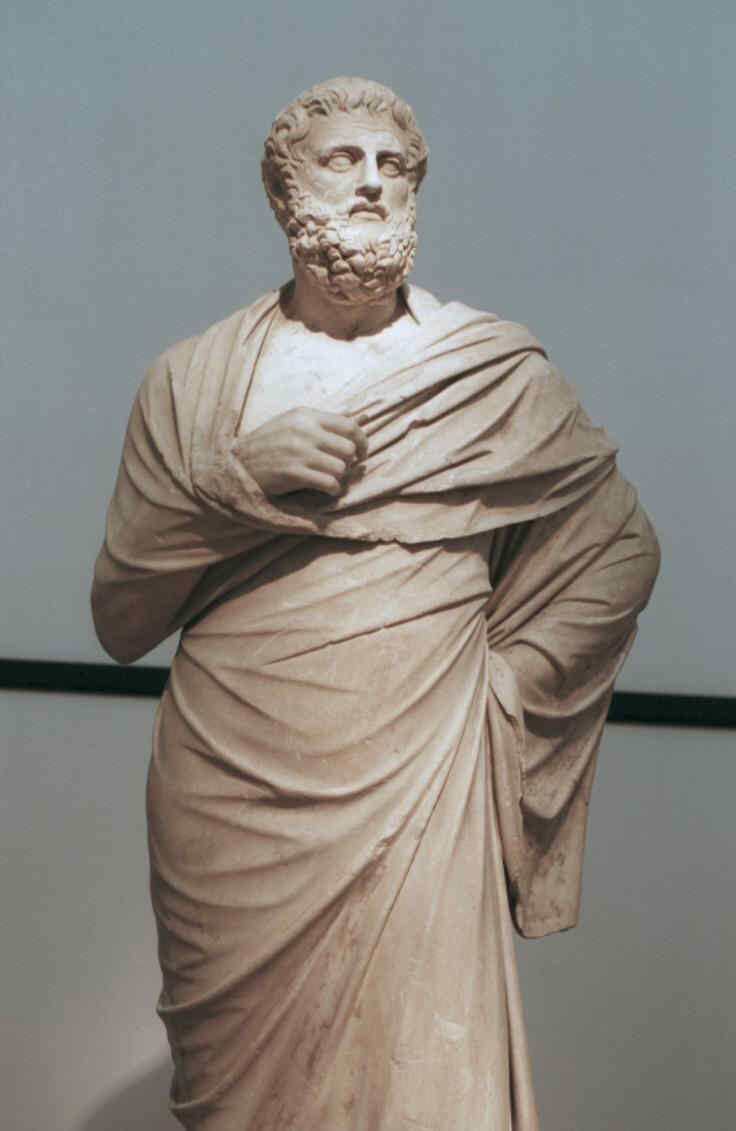
33. Sophocles. (Vatican. Rome.)
This status reaches back again to the best, ideal tradition of the older times; it reminds us of the Golden Age. We might equally well entitle it: The Poet, as such. This is symbolised by the rolls of script which are put there of set purpose. Compare this with the figures that now follow, tending more or less towards a portrait likeness in each case. You will see how they strive away from the ideal type, towards the quality of portraiture.
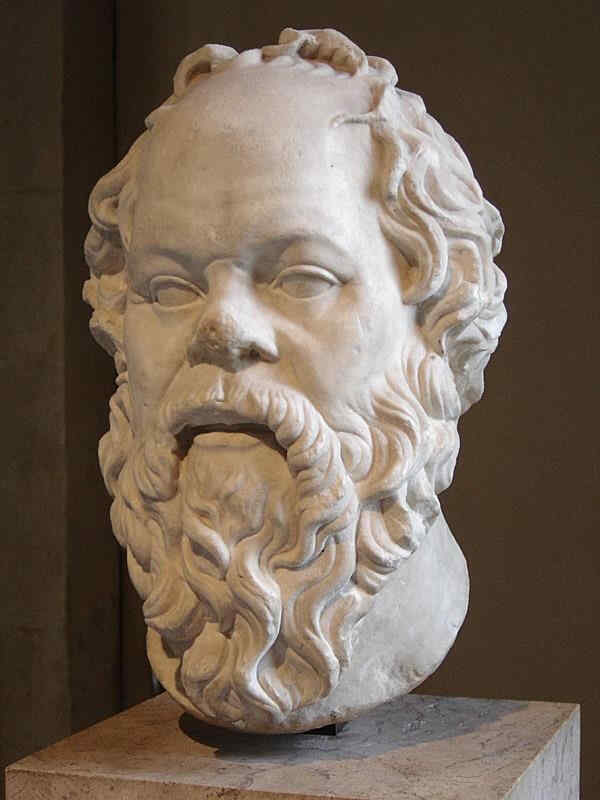
34. Socrates.
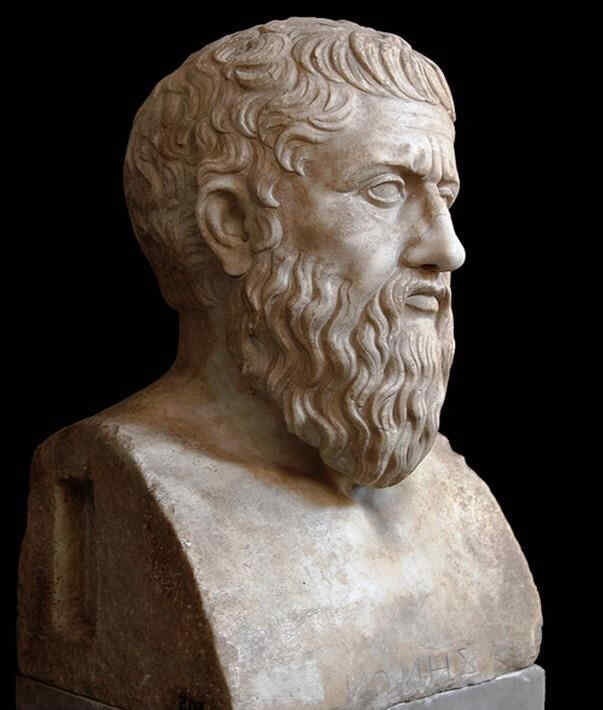
35. Plato. (Vatican. Rome.)
Of course, these portraits are not done from the model, but still there is an attempt at a human likeness—by which I do not mean to say that they are really like the original.
These remarks will refer especially to the Homer which will now follow:—
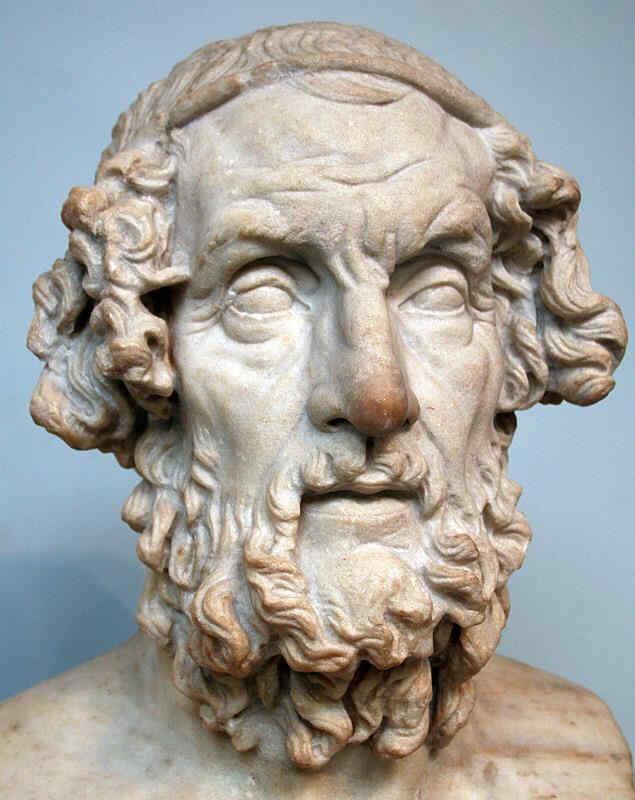
36. Homer. (Museum. Naples.)
Now we gradually approach the 2nd century.
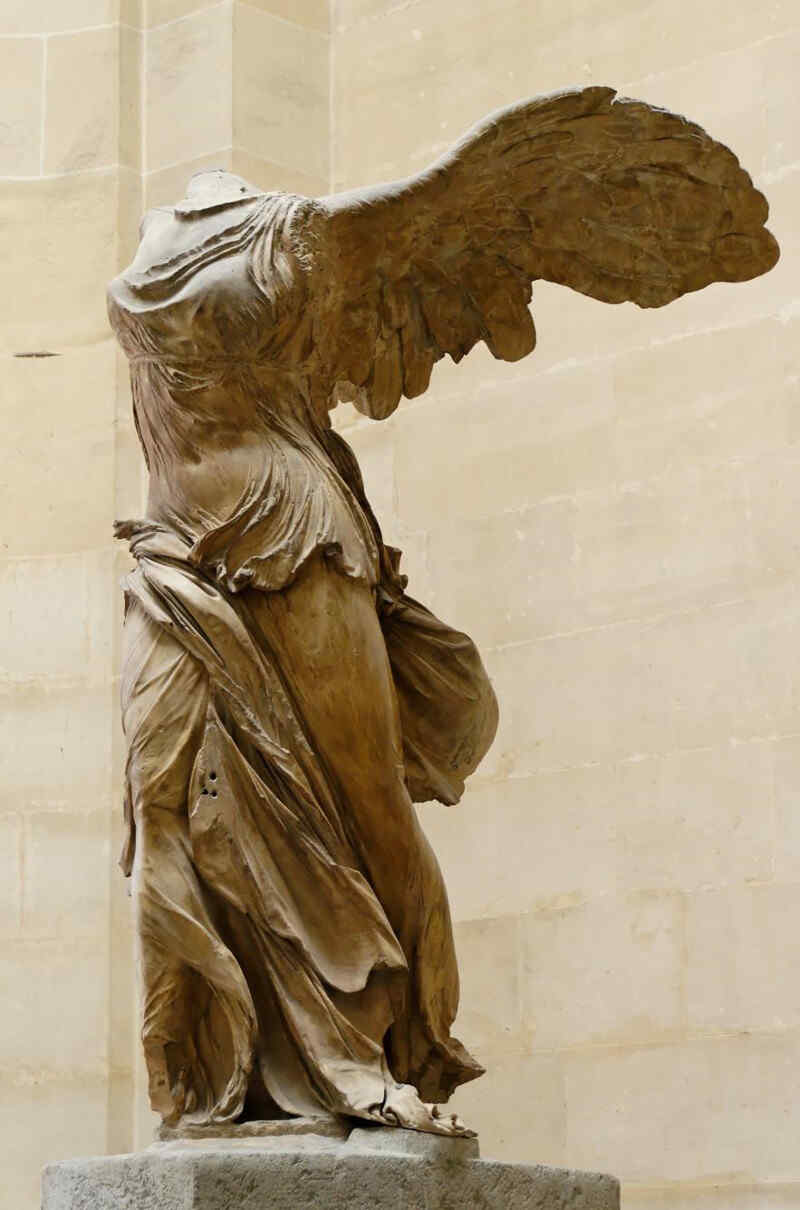
37. The Victory of Samothrace. (Louvre. Paris.)

38. The Venus of Milo. (Louvre. Paris.)
This famous work does, indeed, preserve the tradition of the Golden Age, although it belongs to a later period.
In the next picture, on the other hand, we see a fresh attempt to bring in movement:—
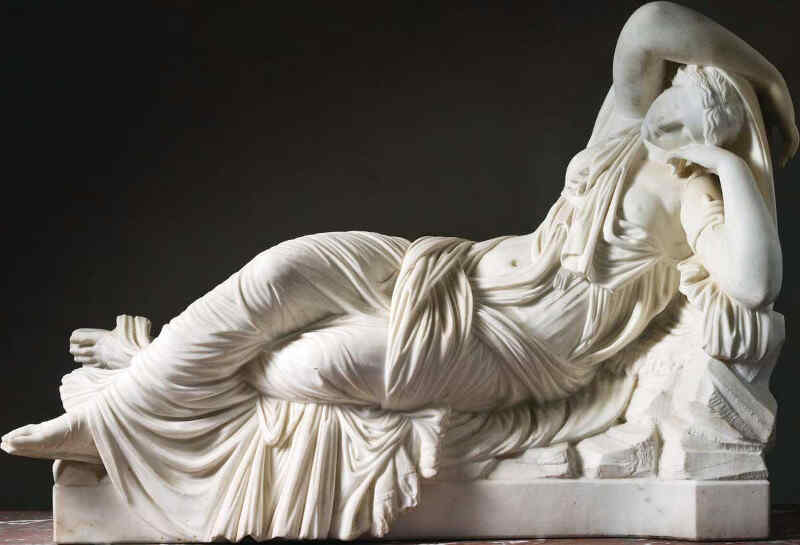
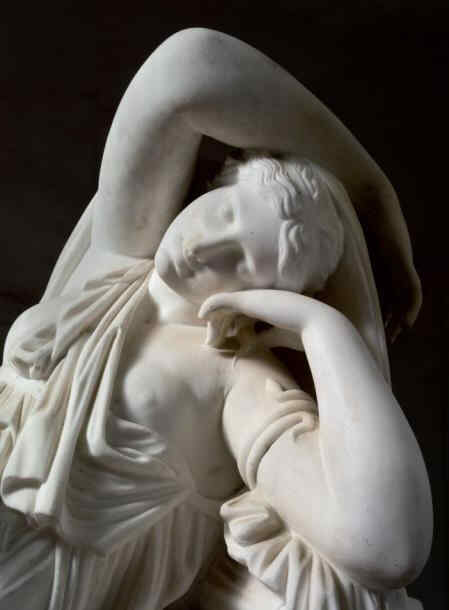
39. Sleeping Ariadne.
This is probably a work of the same period, but you will see a distinct contrast between the two.
And now we come towards the last century before the birth of Christ. We come to the School of Rhodes.
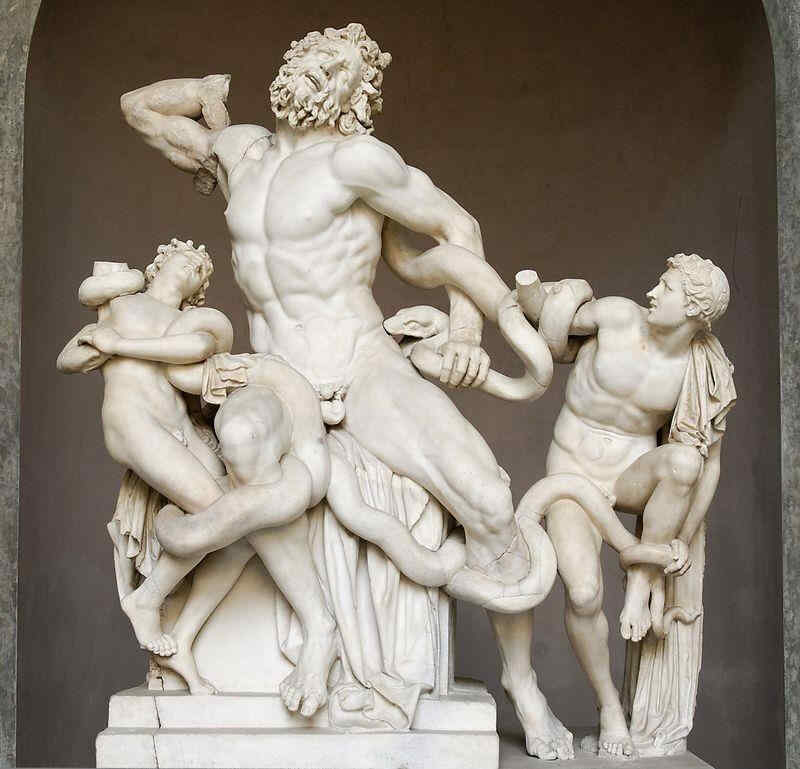
40. Laocoön. (Vatican. Rome.)
This is the famous Laocoön group—the starting-point, as you know, of many an artistic discussion, ever since Lessing's Laocoön of the 18th century. It is the work of three sculptors of the School of Rhodes. Lessing's writings on this subject are, indeed, most interesting. He tried to show, you will remember, how the poet describes is not placed before the eyes. We must call it to life in our imaginations. Whereas what the plastic artist has created is there before our eyes. Therefore, says Lessing, what the plastic artist portrays must contain far more repose; it must represent moments which can at least be imagined—for a single moment—in repose.
Much has been said and written about this Laocoon group, especially in relation to Lessing's explanations. It is interesting how the aestheticist, Robert Zimmermann,—without, of course, having any knowledge of Spiritual Science—arrived at an explanation which needs, no doubt, to be supplemented, but which was none the less correct for an age that had not Spiritual Science. His explanation contains—albeit only as an instinctive suggestion—some element of what I have been setting forth today. We see the priest, Laocoon, with his two sons, wound around by the serpents and going towards their death. Now we cannot but be struck by the peculiar way in which the body has been moulded. Much has been written on this subject. Robert Zimmermann rightly pointed out: The whole representation is such that we have before us the very moment where the life (or, as we should say, the etheric body) is already fleeing away. It is already a moment of unconsciousness. Hence the artist represents it as though the body of Laocoon were already falling asunder. That is the marvellous quality about this figure. The body is already being differentiated into its parts. Thus even in this late product we see how the Greek was aware of the etheric body. He brings to expression the actual moment where life is passing into death. It is the quick withdrawal of the etheric body through the shock—the shock that is expressed by the awful snakes coiling around. This effect of the etheric body withdrawing from the physical, and the physical falling asunder, is the characteristic thing in the Laocoon; not the other things that are so often said, but the peculiar way the body becomes differentiated. We could not imagine the body thus, unless we conceived it as the moment when the etheric body is drawing away.
And now two more examples—imitations of earlier works, perhaps, which have, none the less, made a great impression on later students of Art.
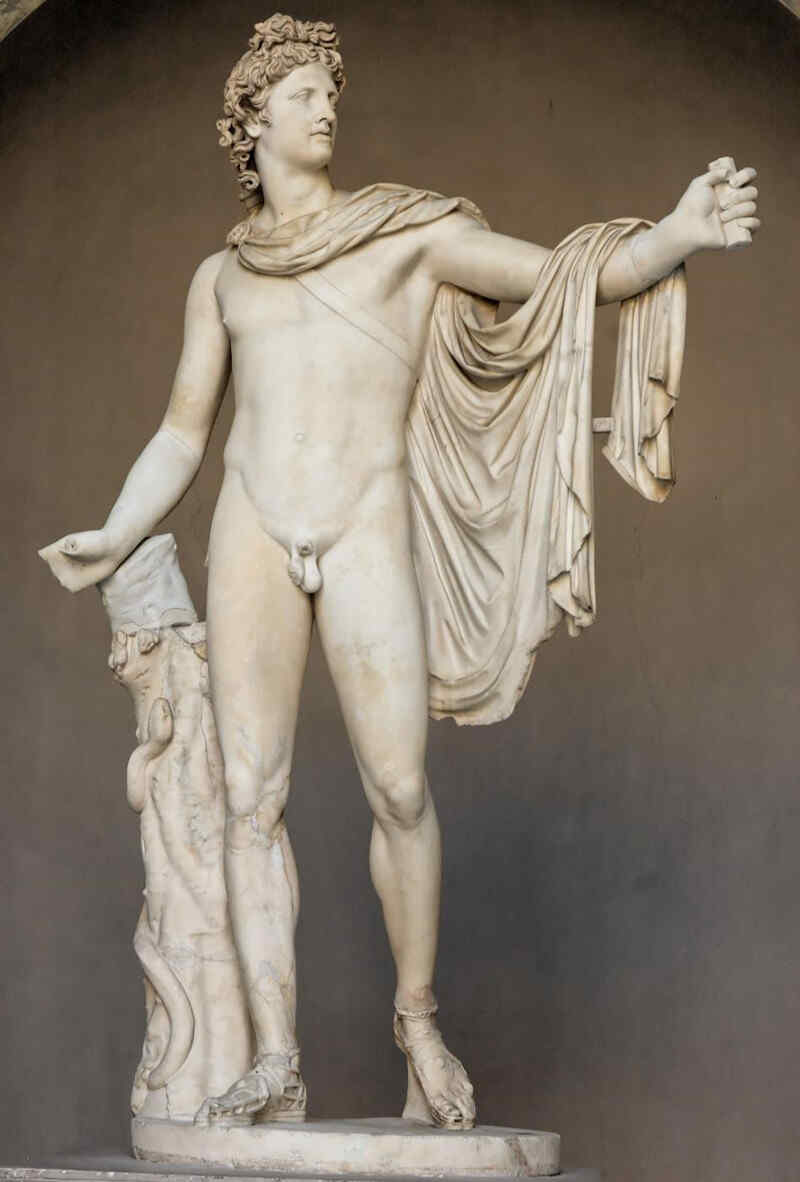
41. Apollo Belvedere. (Vatican. Rome.)
This is the famous Apollo Belvedere—Apollo represented as a kind of battle-hero.
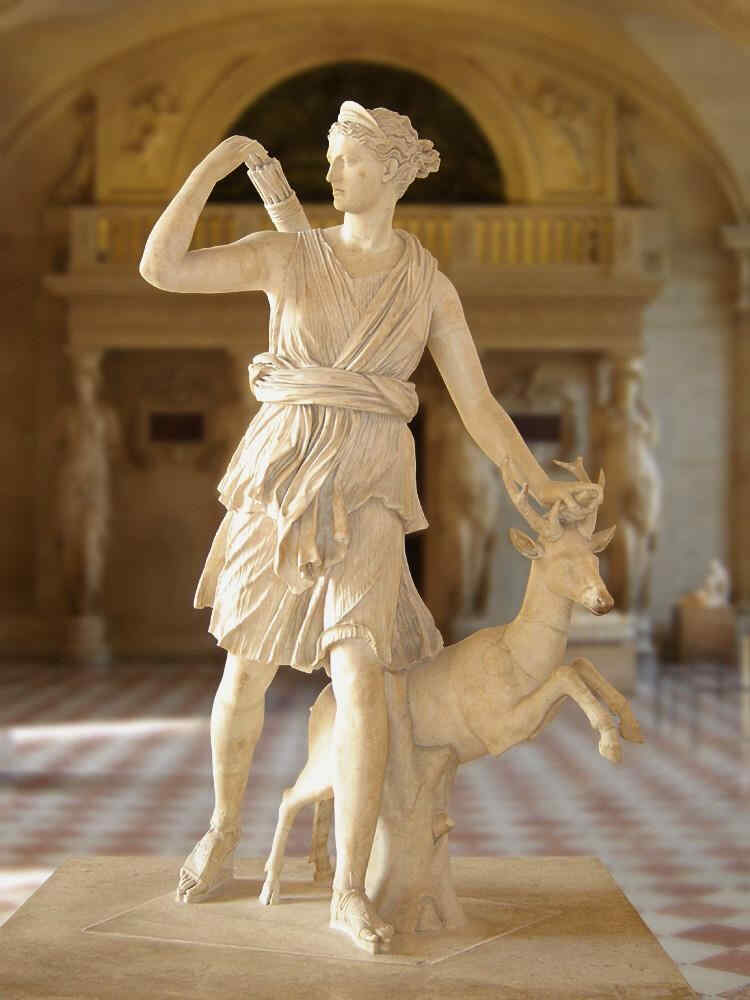
42. Artemis. (Louvre. Paris.)
This, too, will be a later imitation of an earlier work.
Now, as we know, the Art of the ancient Greece gradually drew near its decline, when Greece was subjugated by Rome. In Rome, to begin with, there was a kind of imitation of the Greek Art. It was carried across to Rome, but it was soon submerged in the widespread unimaginativeness of the Roman people, to which we have frequently referred.
The next centuries, as you know ... were to a large extent a dark and troubled age for our evolution. Then a new age began. I will only repeat quite briefly:—In the 12th and 13th centuries in Italy, when through manifold circumstances they rediscovered some of the ancient works of Art that had been buried in the early Middle Ages, the contemplation of the ancient works kindled the rise of a new Art, which grew in time into the Art of the Renaissance. From the 13th century onwards, artists would educate themselves by means of the Antique—the works of Art that had been found or excavated, though the number at that time was relatively small.
We will now consider this re-discovery of the ancient Art in the period immediately preceding the Renaissance. In Niccola Pisano in the 13th century we find a wonderfully refined spirit who waxed enthusiastic over the relics of Greek Art, and tried to create once more in the spirit of the Greeks—out of his own imagination fructified, as it were, by the Greek Art itself.
Our first picture is the famous pulpit in the Baptistery at Pisa; note the reliefs in the upper portion:—
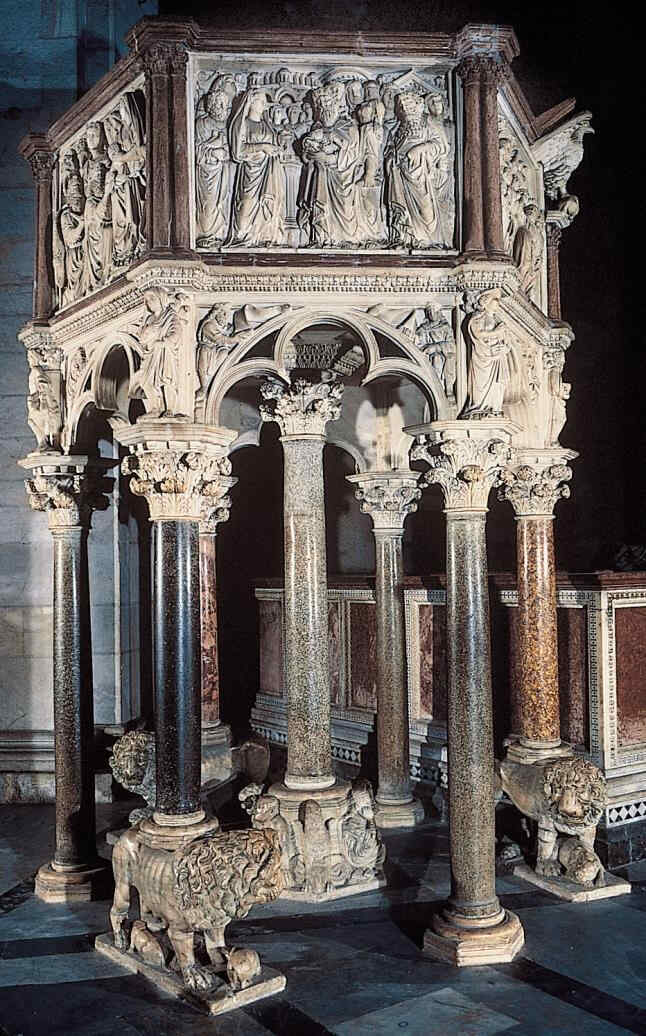
43. Niccola Pisano. Pulpit in the Baptistery at Pisa.
The pulpit is supported by antique columns between which are Gothic arches. Underneath are also lion figures; above are the relief in which he expressed so wonderfully what he owed to the inspiration of the antique. Niccola Pisano worked until the end of the 13th century.
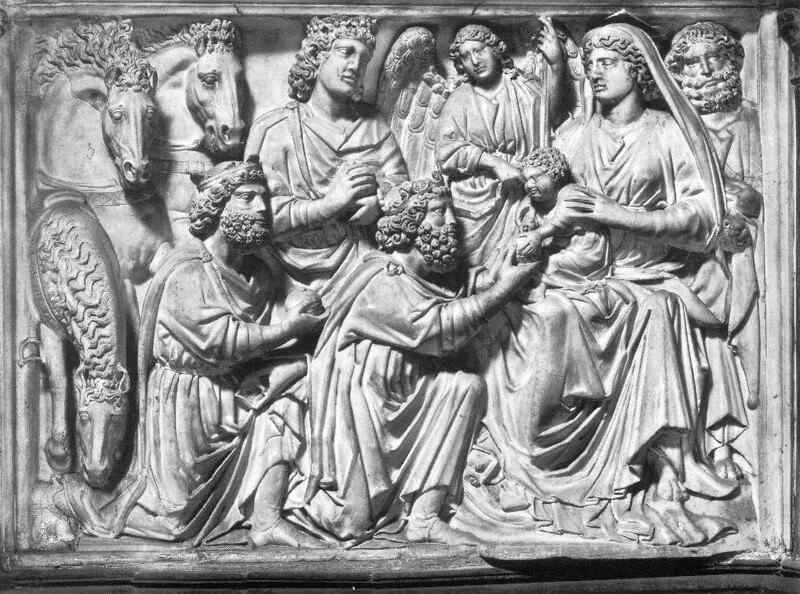
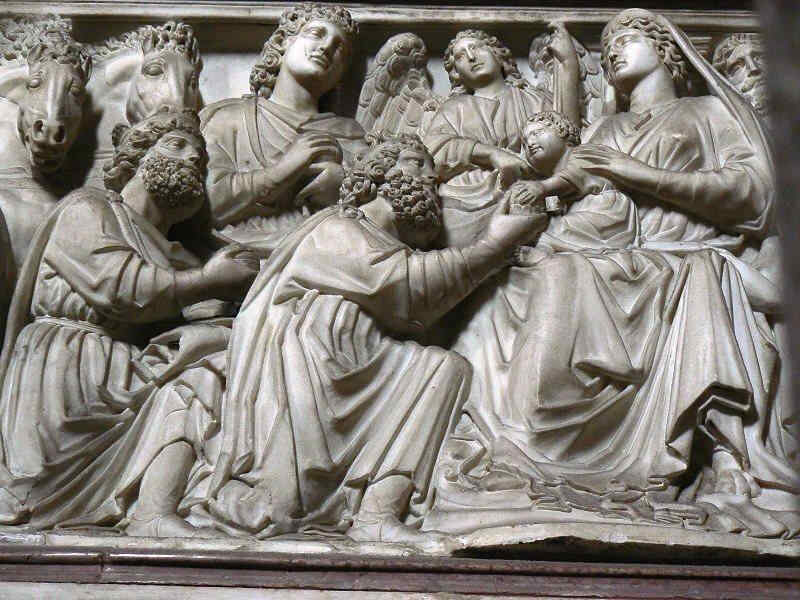
44. Niccola Pisano. Adoration by the Three Wise Men. (Relief. Details of the above.)
Another representation of the same subject:—
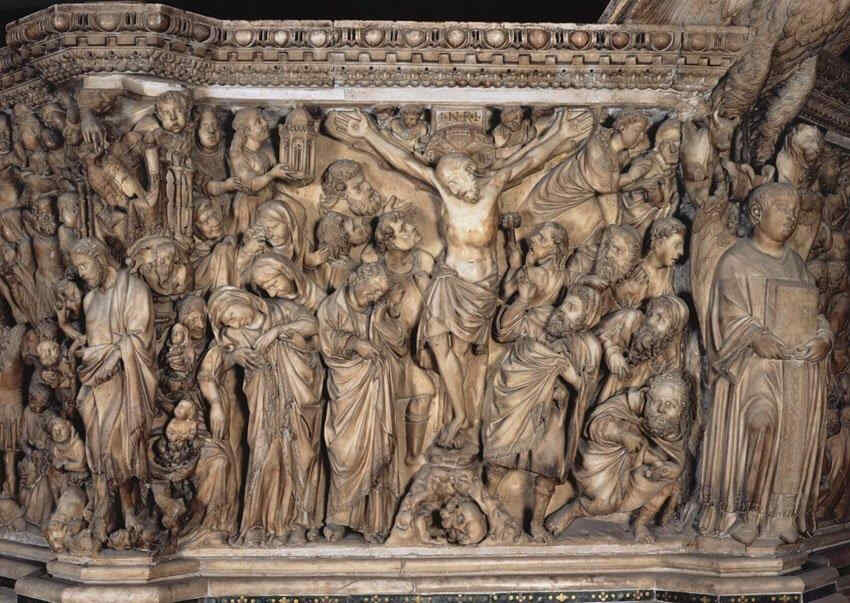
45. Niccola Pisano: The Crucifixtion. (Relief. Pulpit in the Cathedral at Siena.)
We now go on to Giovanni Pisano. In his works you will observe already a far greater element of movement. A certain quietude pervades all the figures of Niccola Pisano.
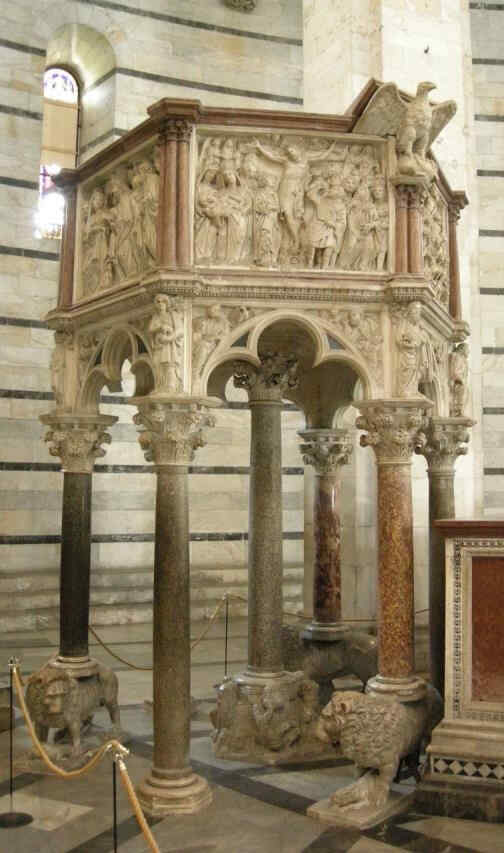
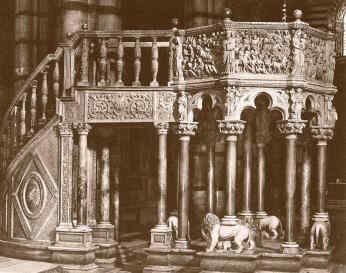
46. Giovanni Pisano. Pulpit. (San Andrea. Pistoja.)
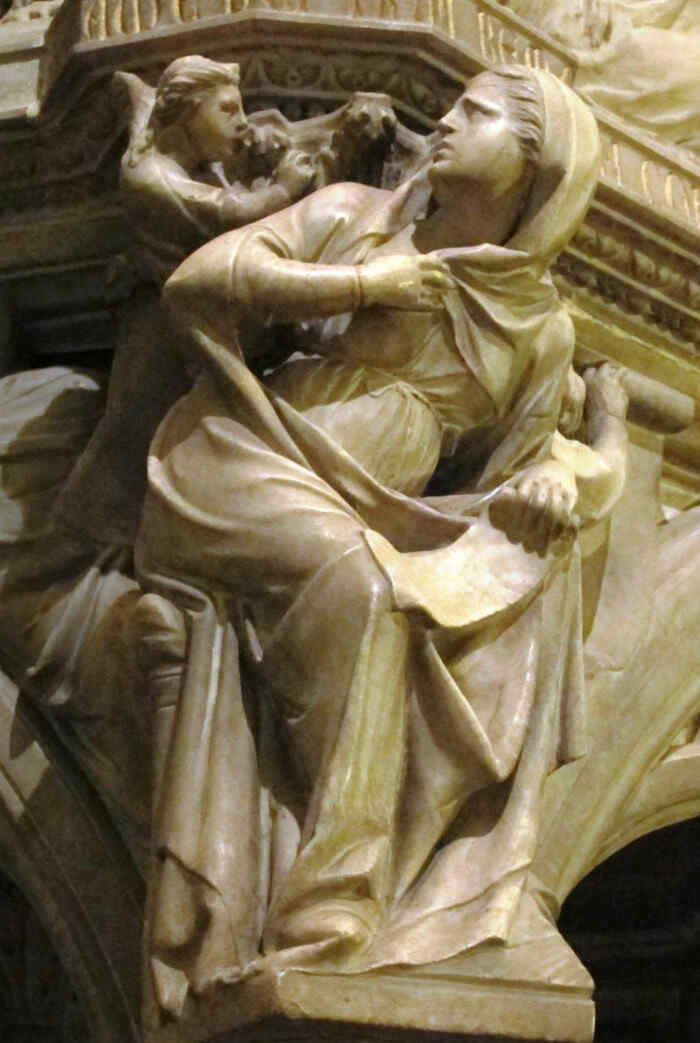
47. Giovanni Pisano. Capital from the above Pulpit.
Truly, it was due to the stimulus and inspiration of the Antique, arising, to begin with, in the Pisanos, that the Christian Art afterwards became able to express its motifs so perfectly as it did in
the Renaiscance.
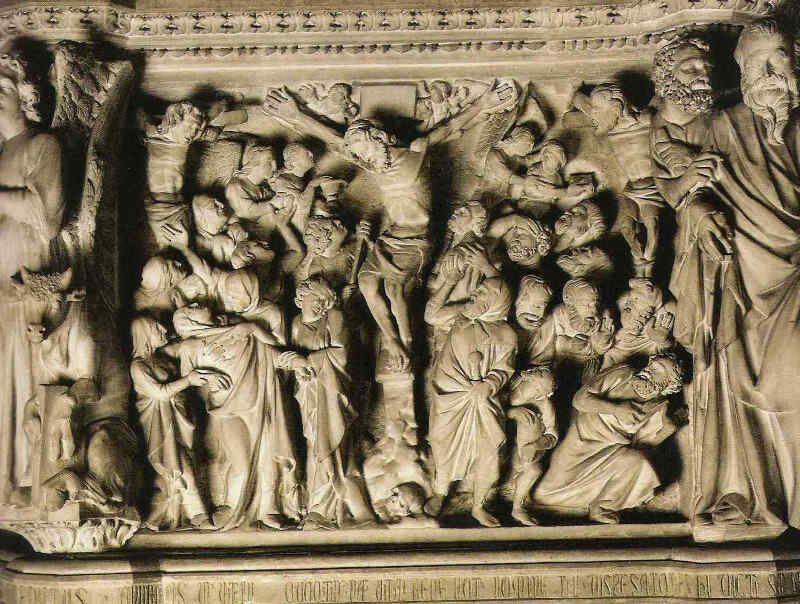
48. Giovanni Pisano. Bas-Relief from the same Pulpit.
The next two are by Giovanni Pisano:—
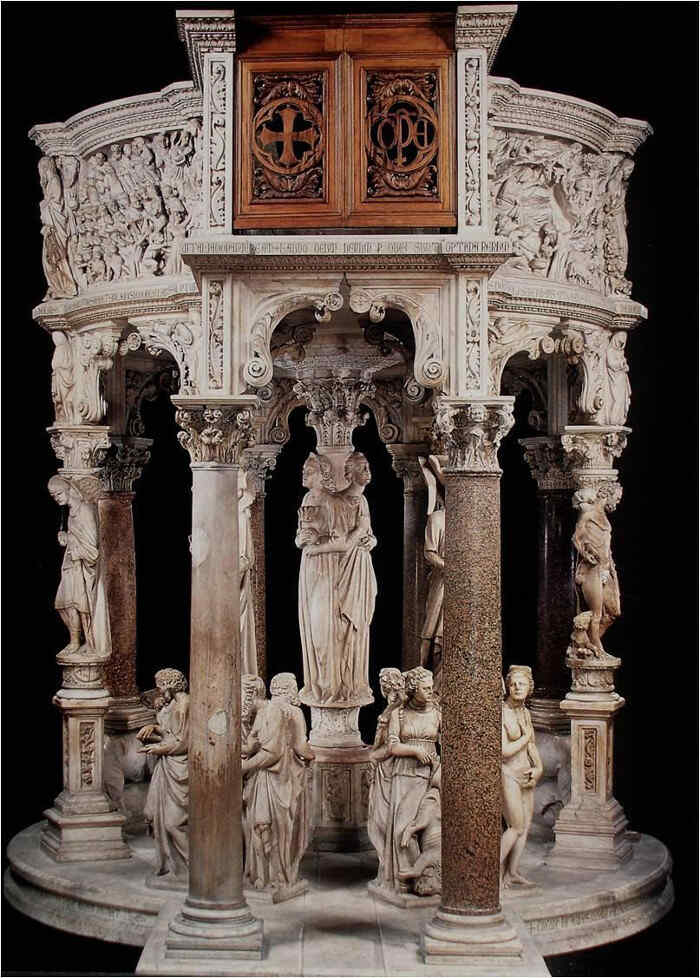
49. Giovanni Pisano. Pulpit in the Cathedral at Pisa.
We see at the same time how naturally the Antique grew together with the Gothic.
And two Madonnas from him:

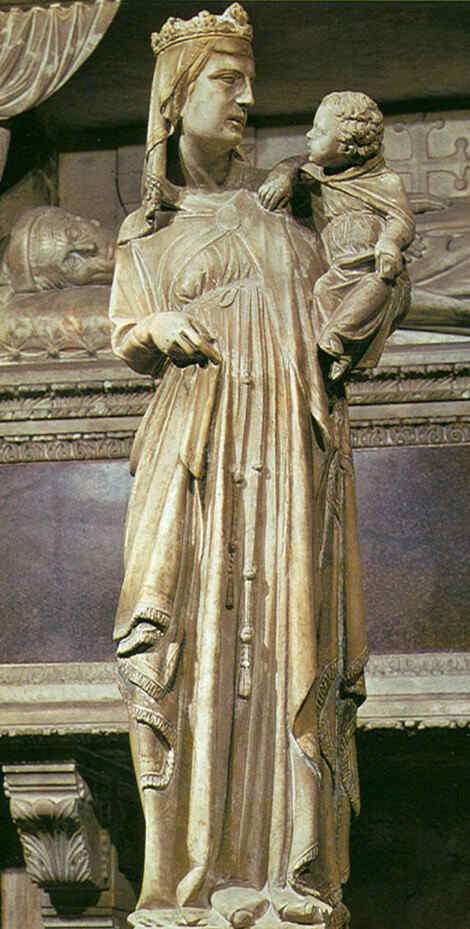
51. Giovanni Pisano. Madonnas. (Berlin and Padua.)
And now we have a sample of the work of Andrea Pisano, who was summoned to do one of the Bronze gates of the Baptistery at Florence.
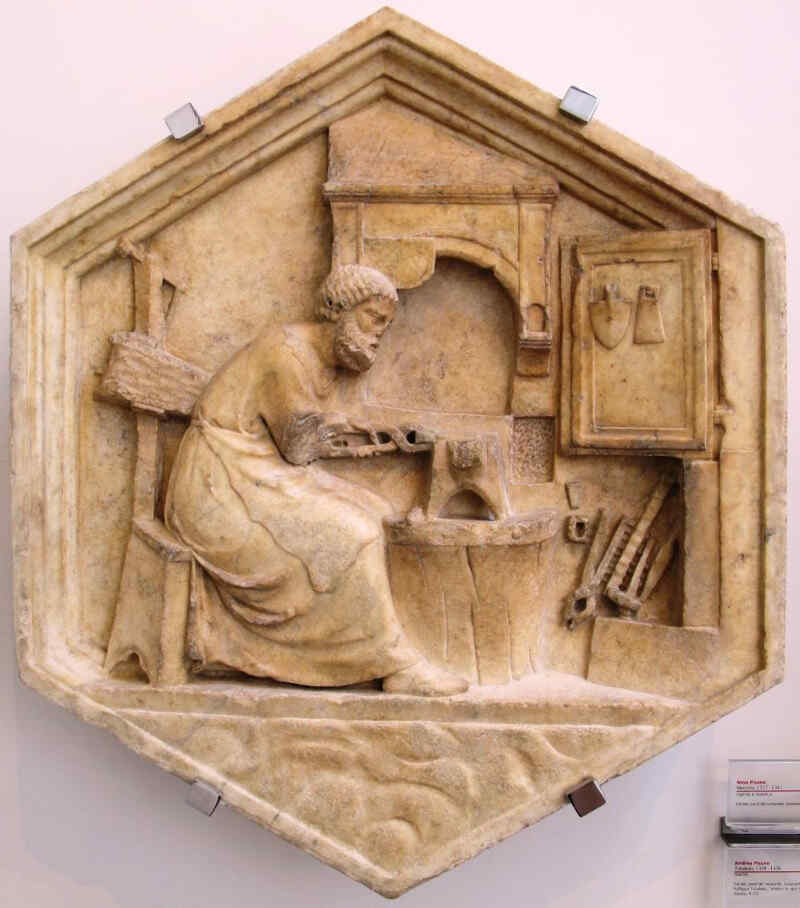
52. Andrea Pisano. Tubal Cain. (Campanile. Florence.)
A Bas-Relief representing Tubal Cain, inventor of the craft of metallurgy according to the Bible, the Old Testament.
We have thus approached the 15th century, and we come to Ghiberti, the great artist who at the age of twenty years was already able to compete with the others in designing the doors of the Baptistery in Florence.
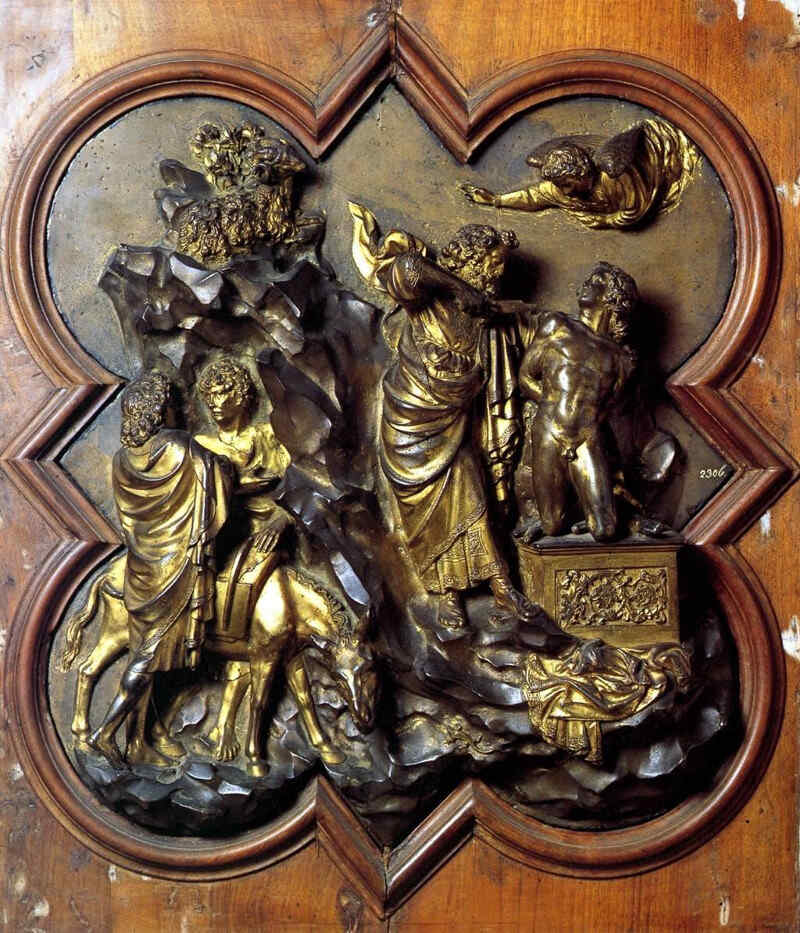
53a. Ghiberti. The Offering of Isaac. (Baptistry. Florence.)
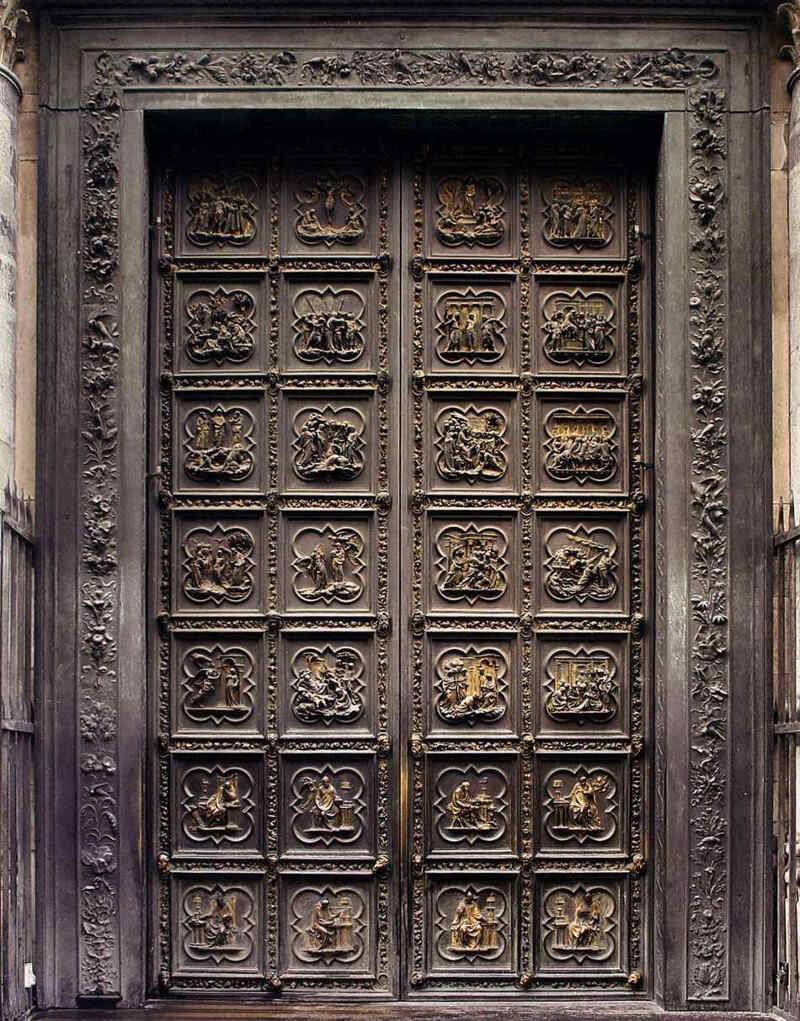
53b. Ghiberti. Northern Door of the Baptistery in Florence.
At the early age of twenty he was already allowed to do the Northern Portals. From a simple goldsmith's apprentice he grew to be one of the very greatest artists. These bas-reliefs of the doors of the Baptistery in Florence are, of their kind, among the greatest things in the whole evolution of Art. Afterwards the Eastern door was also given to him to do. It represents scenes from the Old Testament. Michelangelo said that these were worthy to be the gates of Paradise. [Note:the doors at the Florence Baptistery were moved causing some confusion as to where the works of Ghiberti and Andrea Pisano are located. – e.Ed.]
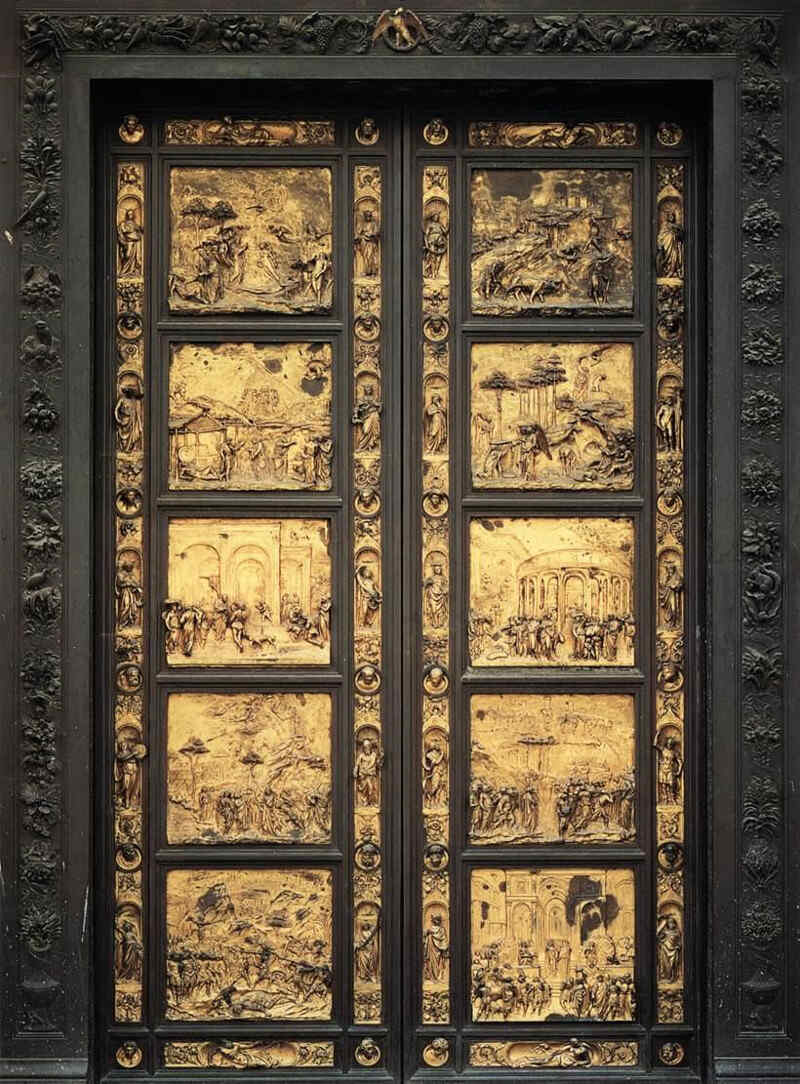
54. Ghiberti. The Gates of Paradise. (Baptistery. Florence.)
This work had, indeed, a great influence on the whole Art of Michelangelo himself. Even in the details we can recognise certain motifs in Michelangelo's paintings, which he took from these bronze reliefs.
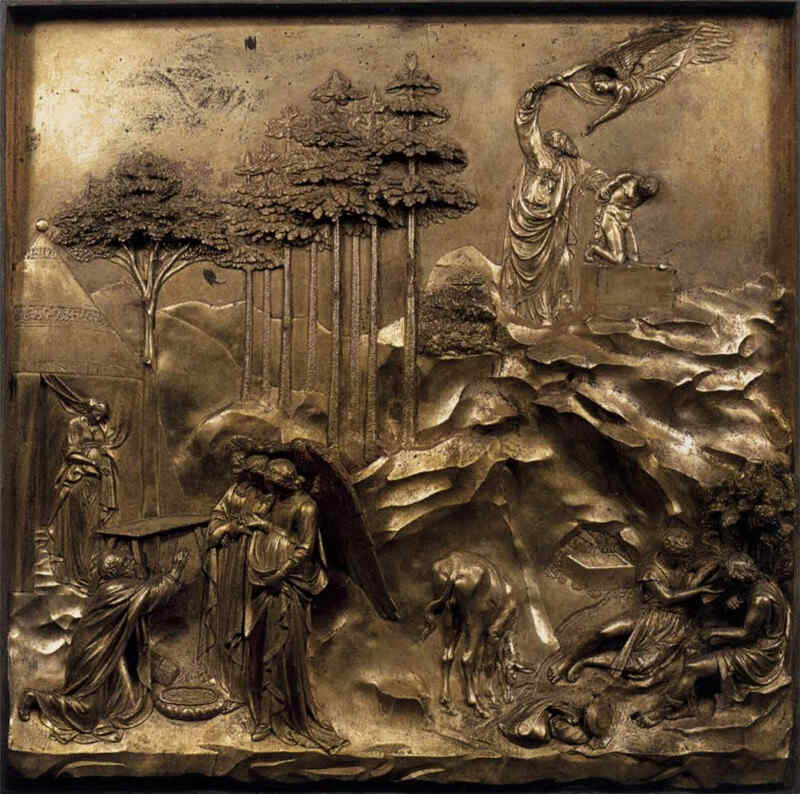
55a. Ghiberti. Sacrifice of Isaac. (Detail from the 'Gates of Paradise.')
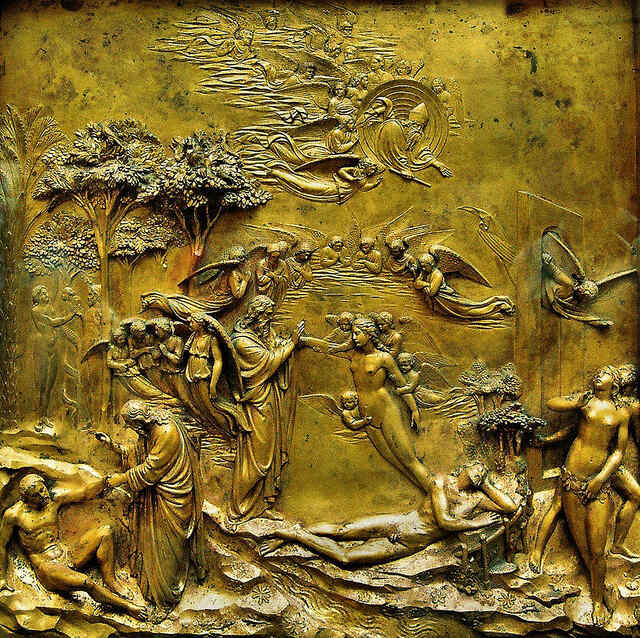
55b. Ghiberti. Creation of Man. (Detail from the 'Gates of Paradise.')
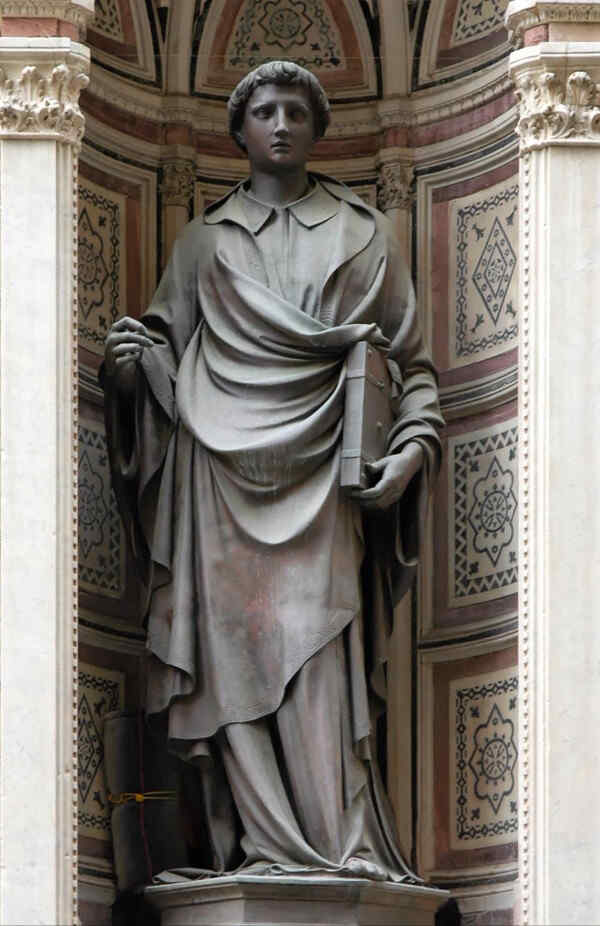
56. Ghiberti. St. Stephen
These works of Ghiberti's were undoubtedly due to a faithful contemplation of the Antique.
We will now insert the Art of the della Robbias. To begin with:—
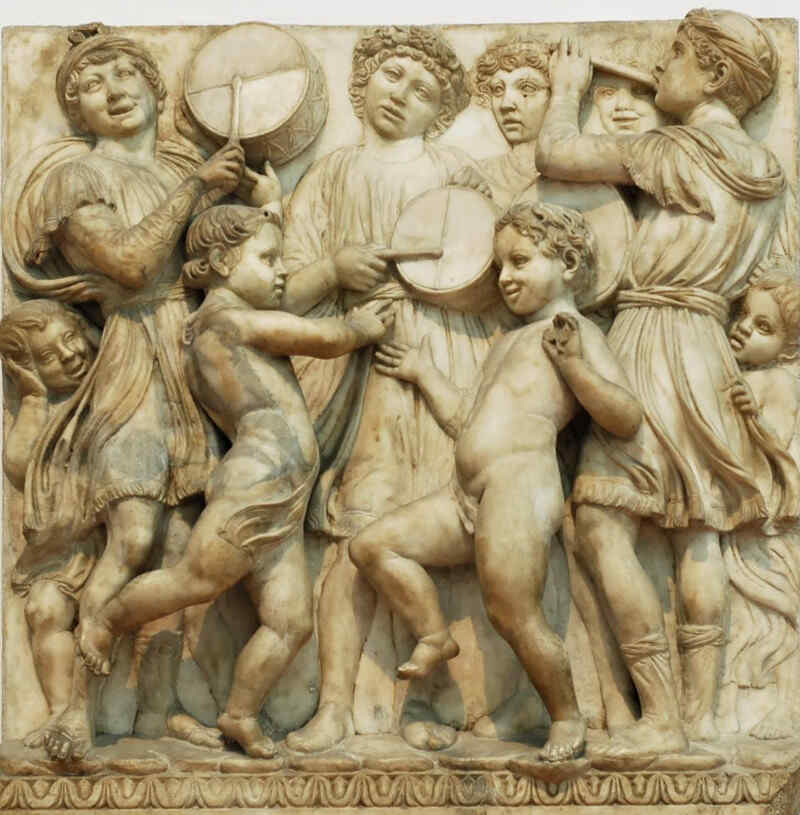
57. Luca della Robbia. Dancing Boys. (Cathedral. Florence.)
The della Robbias are famous as the inventors of a special art—the use of burnt clay as a material. To a large extent their works were done in this material.
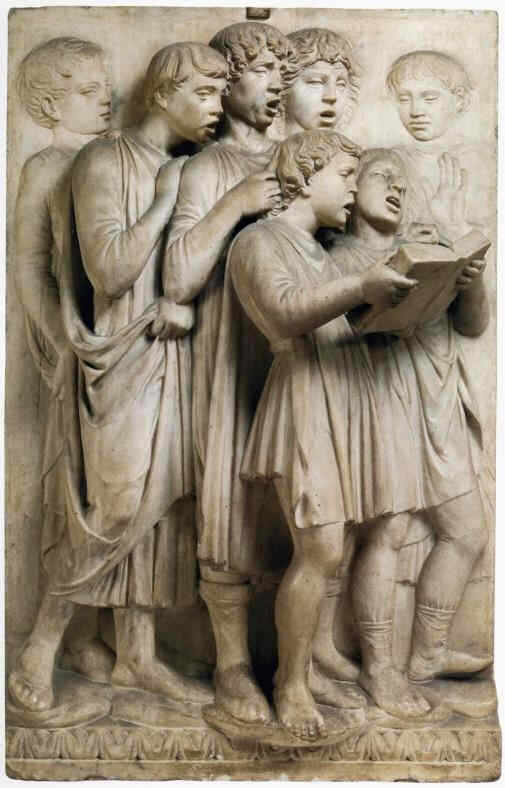
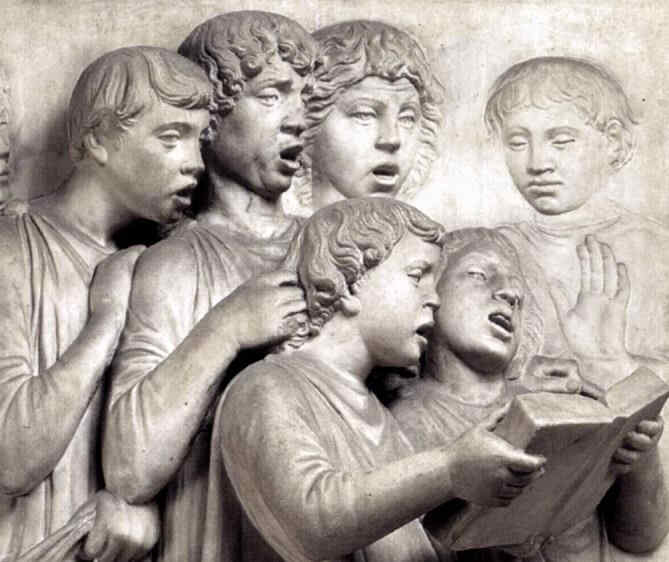
58. Luca della Robbia. Singing Boys. (Cathedral. Florence.)
Luca della Robbia covers practically the whole period of the 15th century.
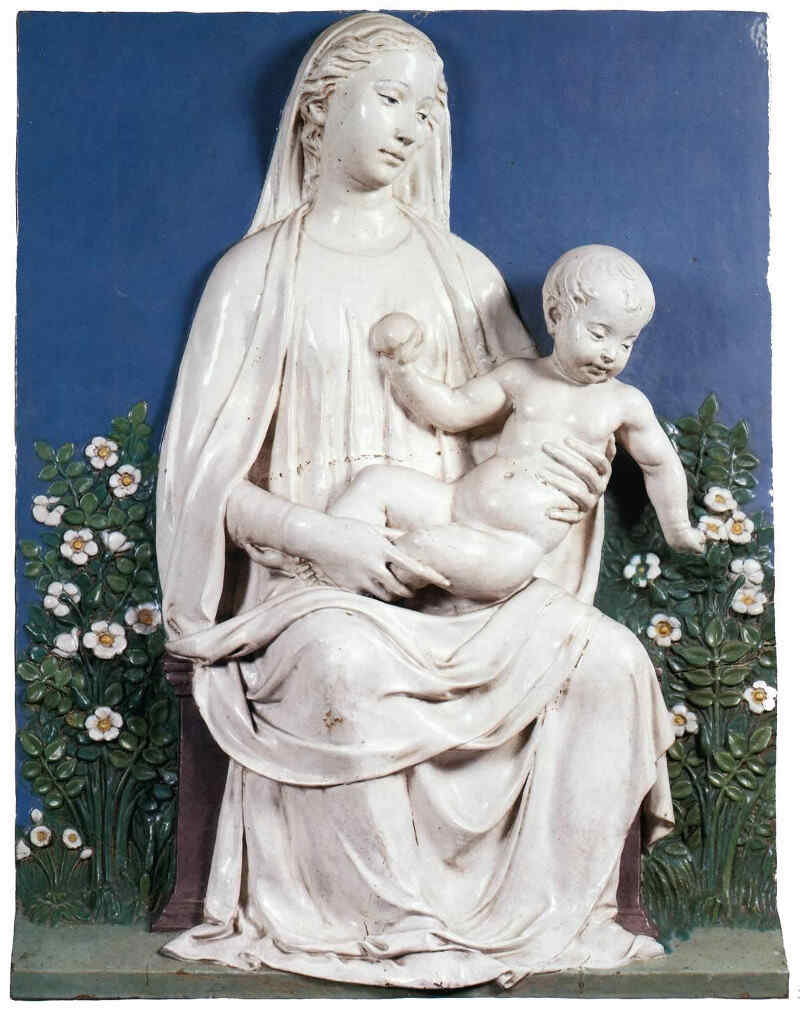
59. Luca della Robbia. Madonna in the Bower of Roses. (Museo Nazionale. Florence. )
Observe once more the age that we have now come into. The Art of antiquity that had been derived from immediate inner experience—experience of the Etheric—works as a great stimulus and inspiration. Yet at the same time the Art of this age is founded on what is seen—the faithful representation of what is actually seen. It is no longer based on something felt and sensed inwardly. It is very interesting to receive the impression of the two epochs, one after the other, in this way.
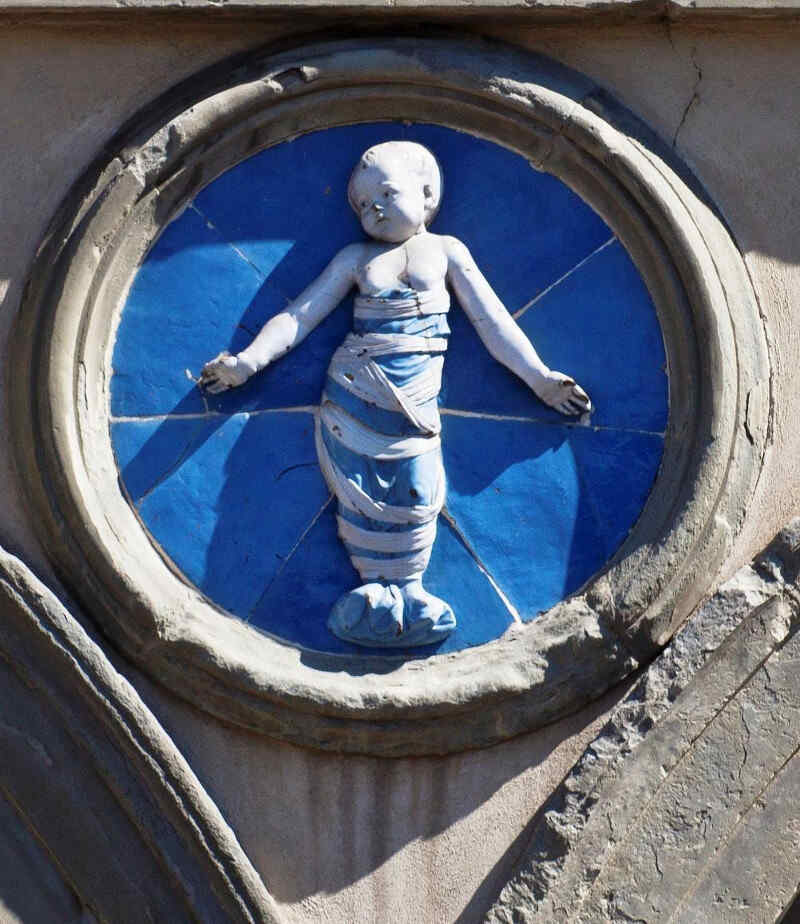
60. Andrea della Robbia. Bambino. (Spedale degli Innocenti. Florence.)
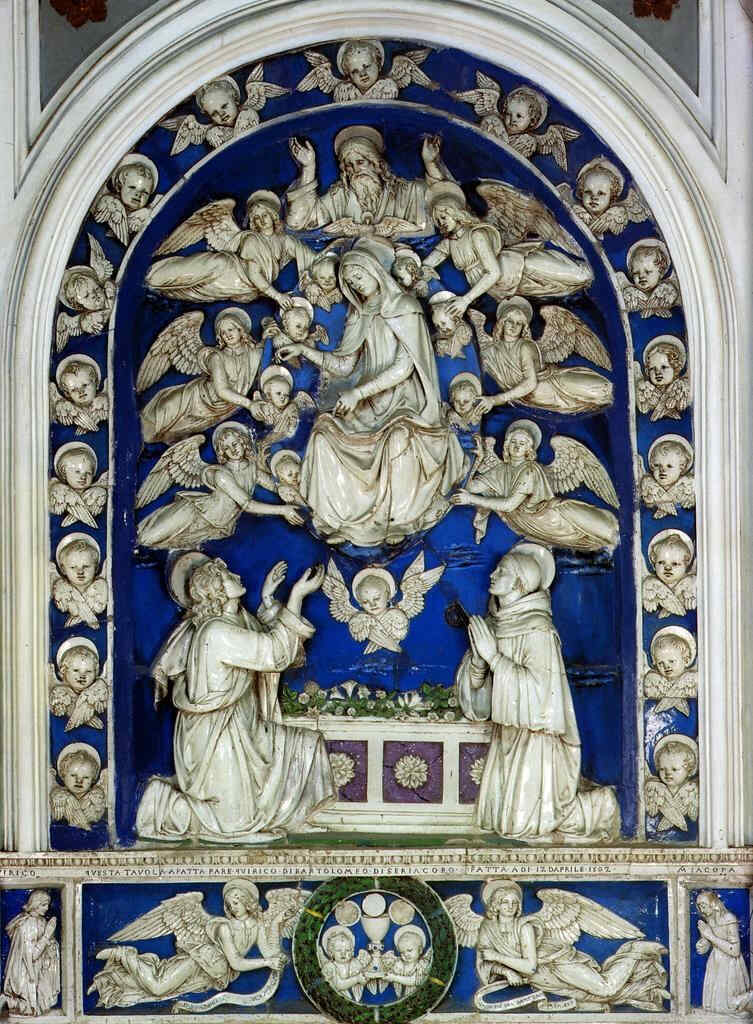
61. Madonna (della Cintola Fojano). Andrea della Robbia.
The Madonna is shown in the spiritual world.
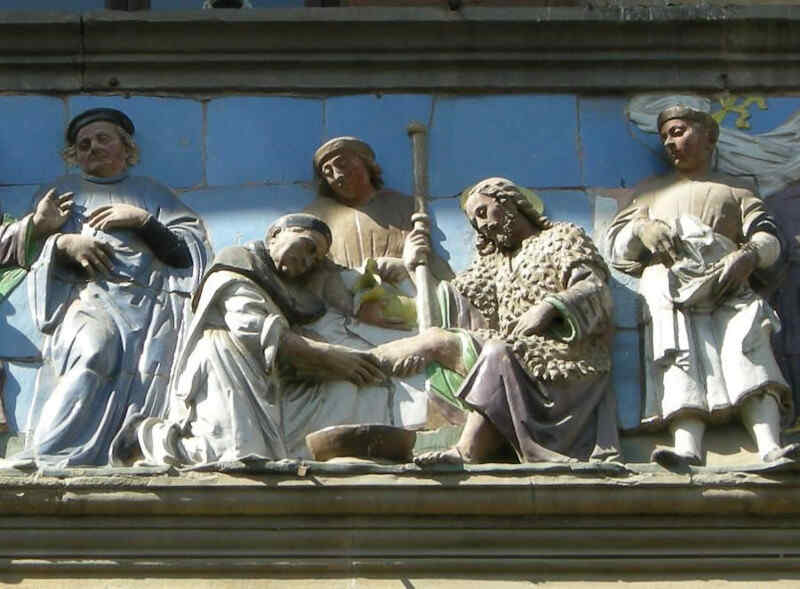
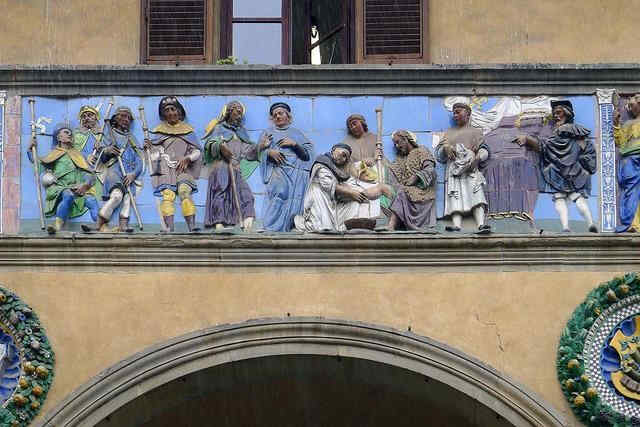
62. Giovanni della Robbia. Reception of the Pilgrims and Washing of the Feet. (Hospital. Pistoja.)
We now go on to Donatello, who was born in 1386. In him we observe the influence of the Antique combined already with a decided tendency to Naturalism. His vision has a naturalistic stamp. Donatello enters lovingly and sympathetically into Nature. But while he becomes a real naturalist, he derived his technique from what his predecessors had evolved out of the old tradition.
His naturalism went so far that his friend and companion in his strivings, Brunelleschi, seeing a Christ that Donatello attempted, exclaimed; “That is not a Christ that you are doing, that is a peasant:” Donatello at first did not understand what he meant. The anecdote is interesting, if not historically true; it gives us a right impression of the relation between the two artists—the contrast between the two artists—the contrast between Donatello and Brunelleschi with his high idealism—immersed as he was in the contemplation of the Antique, in its rebirth. Brunelleschi thereupon himself undertook to model the Christ. Donatello—for they lived together—had gone out to buy things for their breakfast. He returned with all the dainties for their common meal wrapped up in a kind of pinafore. Just as he entered, Brunelleschi unveiled his Christ. Donatello gaped with wide open mouth, and his astonishment was such that he dropped all the breakfast on the ground. What Brunelleschi had achieved was a revelation to him. We cannot say that the impression he experienced went very deep. None the less, Brunelleschi undoubtedly had an ennobling influence on him. The above story goes on to relate, Donatello was so overwhelmed that he even imagined the breakfast had disappeared. “What have we now to eat?” he said. “We'll just pick the things up again,” said Brunelleschi. “I see I shall never be able to do any more than peasants,” said Donatello.
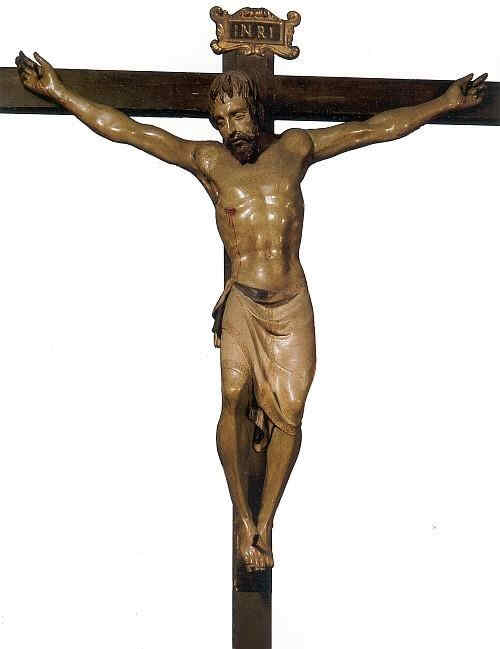
Donatello. Crucifix. (Florence.)
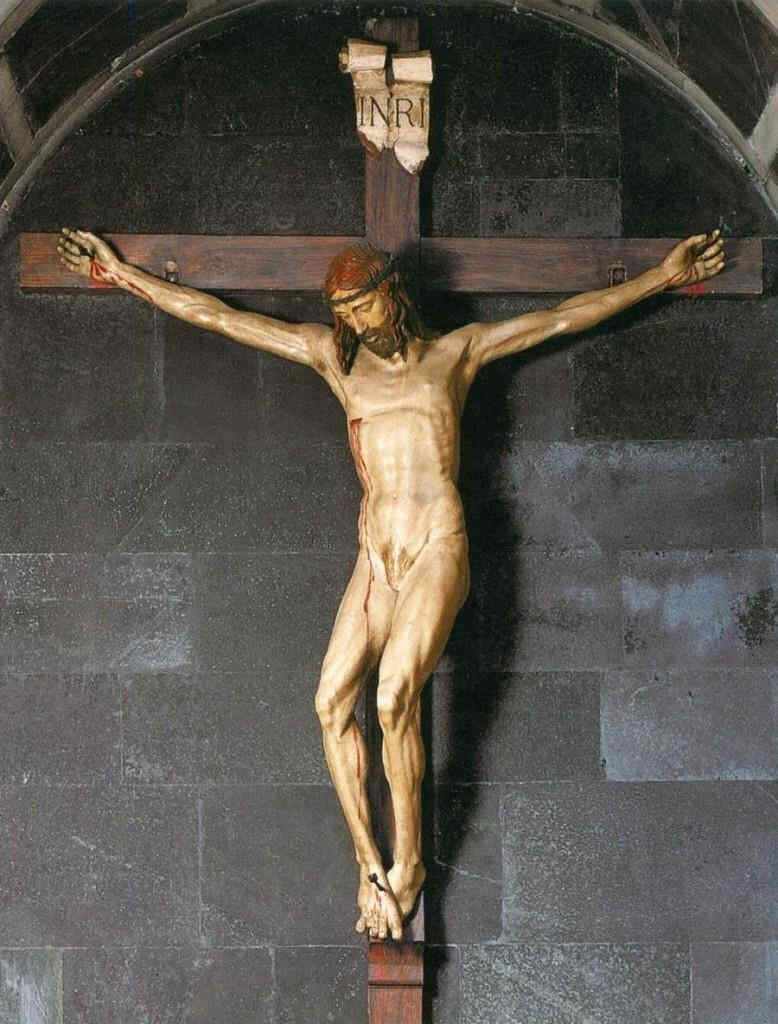
Filippo Brunellesco. Crucifix. (Florence.)
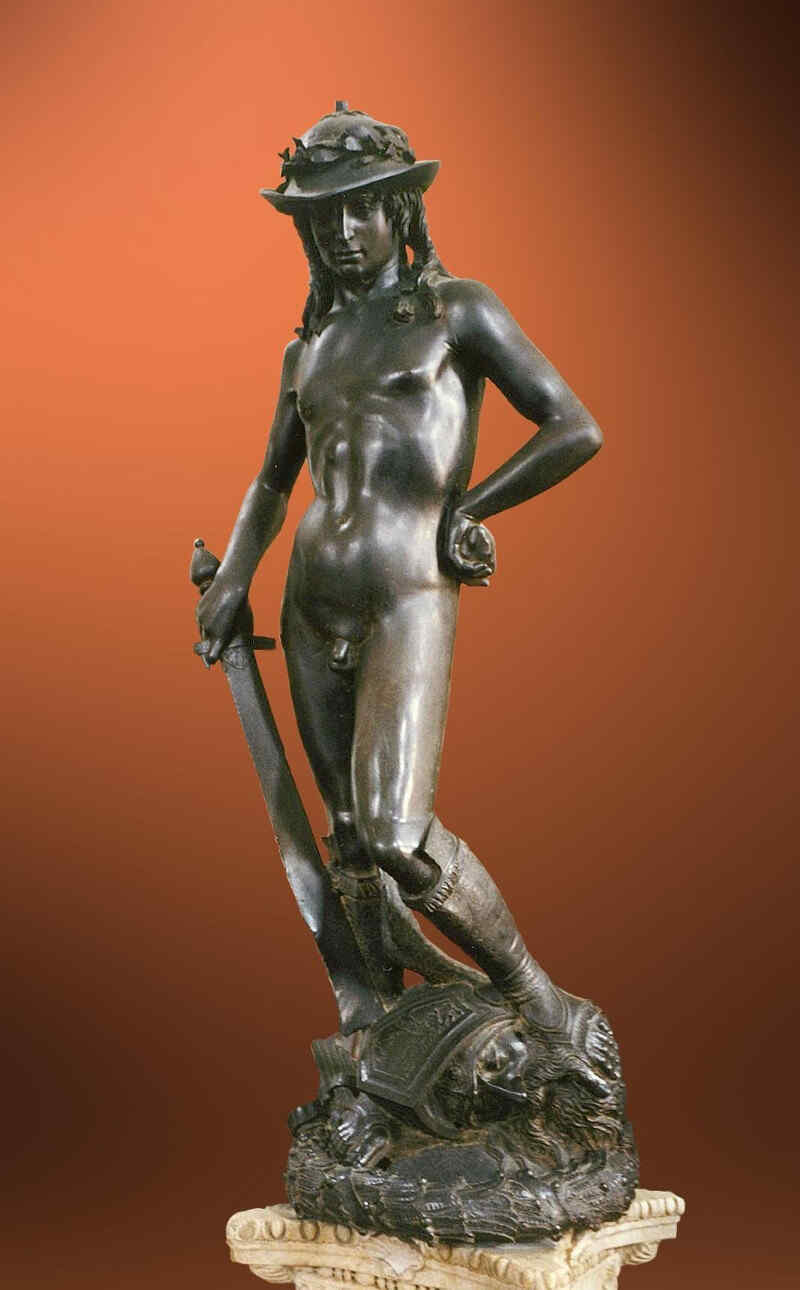
63. Donatello. David. (Museo Nazionale, Florence.)
And now we come to the beautifully self-contained marble statues by Donatello in Florence, showing his ability—out of his naturalistic vision—to create human figures strong and firm, even as he wanted them, their feet firmly planted on the ground.
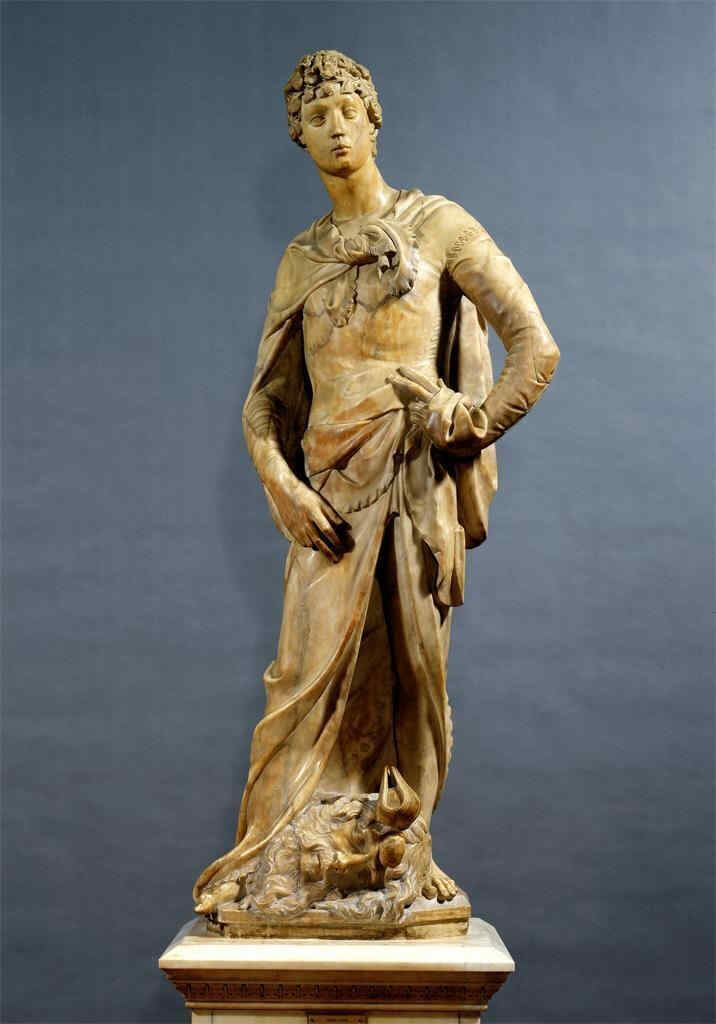
64. Donatello. David. (Florence.)
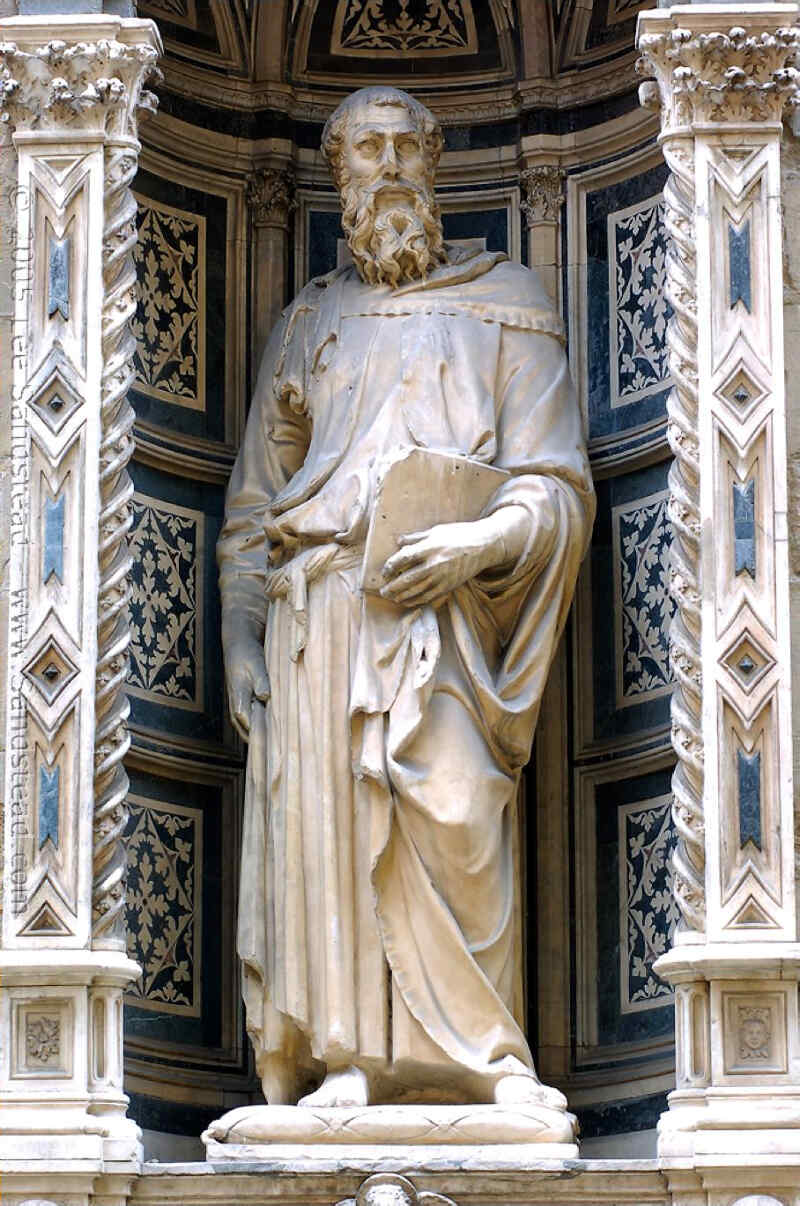
65. Donatello. St. Peter. (Or San Michele. Florence.)
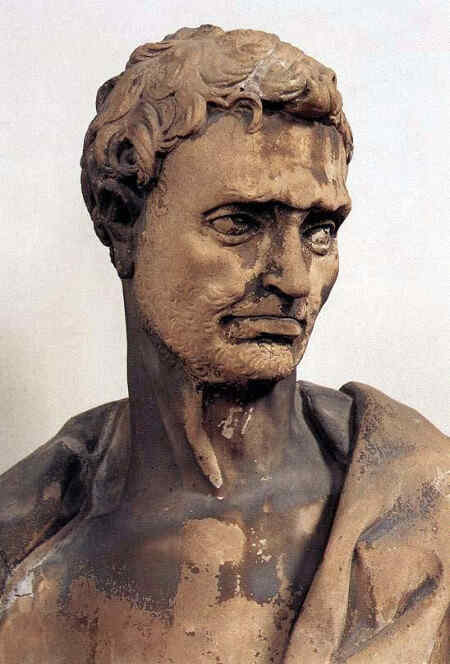
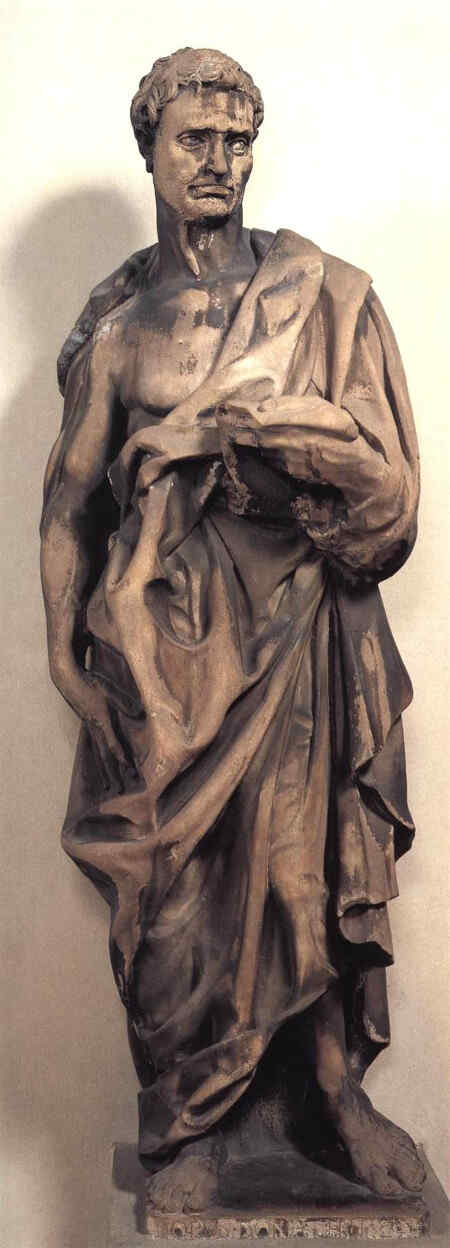
66. Donatello. Jeremiah. (Campanile. Florence.)
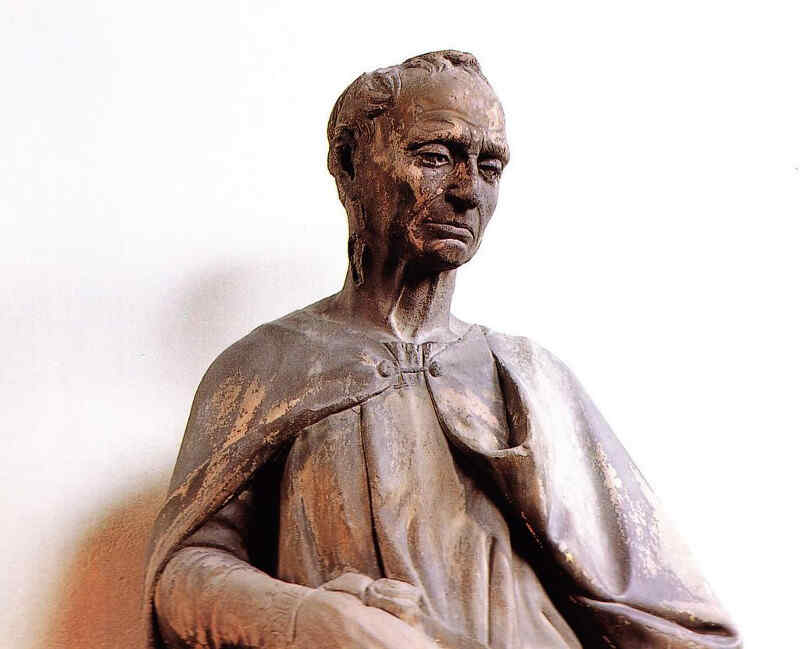
Habbakuk
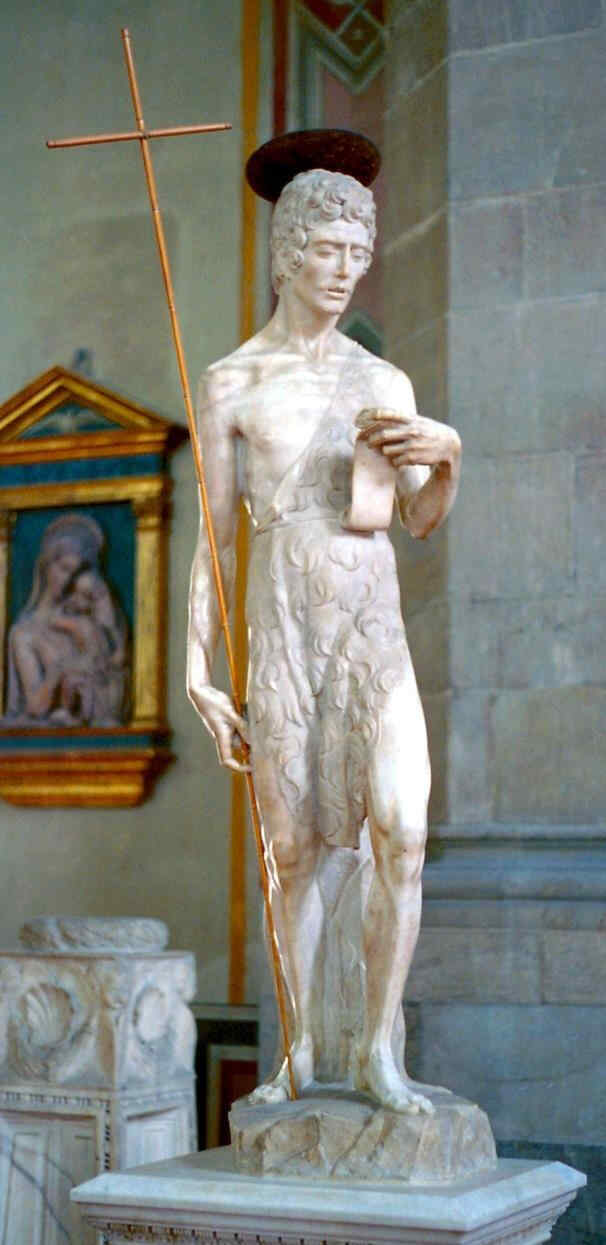
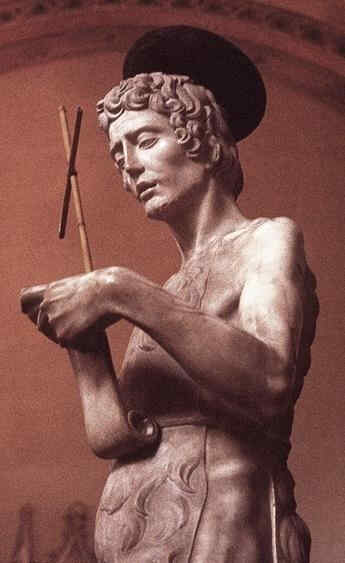
67. Donatello. St. John Baptist. (Campanile. Florence.)
In Donatello Naturalism certainly finds its way in. It is not the inner soul that we found in the Northern sculpture, but a decidedly naturalistic vision of what the outer senses see.
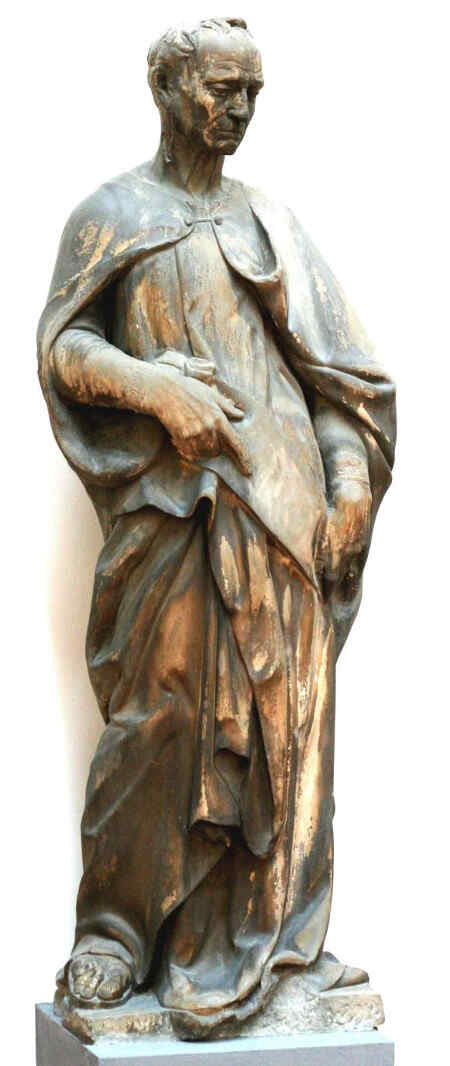
69. Donatello. Habakkuk. (Campanile. Florence.)
Niccola Pisano and Donatello were two artists who powerfully influenced Michelangelo. Those who afterwards saw what Michelangelo created—especially in his early period—remembered Donatello and coined the phrase which then became current: Donatello Michelangelosed or Michelangelo Donatelloised.
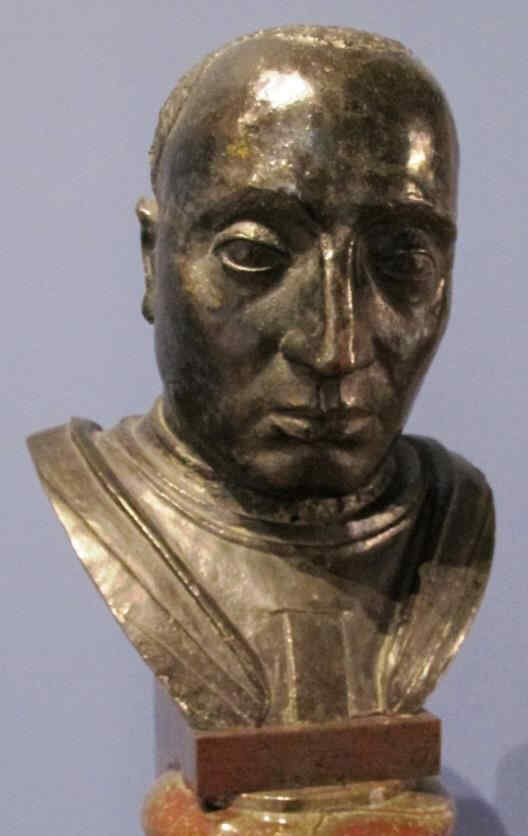
70. Donatello. Lodovico III Gonzaga
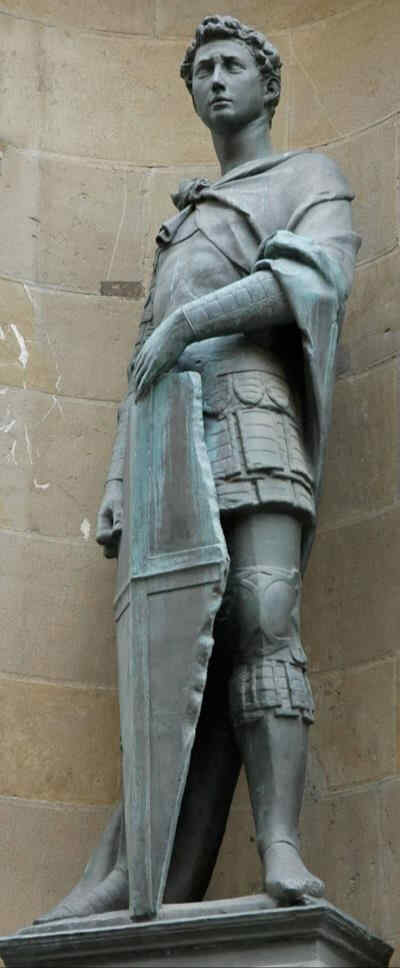
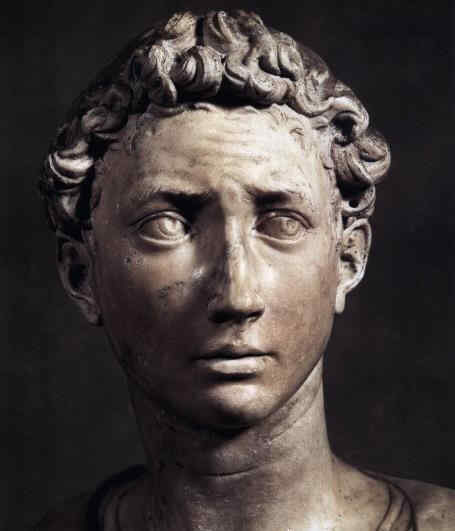
71. Donatello. St. George. (Florence.)
Most characteristic is this St. George by Donatello. All the power of his naturalism is in it. Such works of Art arose out of the freedom of the free city of Florence, which also gave birth to Michelangelo.
By a wider historic necessity—a cosmopolitan historic necessity, we might say,—it was in Italy that the Antique came to life again. On the other hand, the naturalistic tendency everywhere was bound up with the mood and feeling that arose in the culture of the Free Towns or Cities. Here, as in the North—though in different ways, of course, according to the different characters of the people,—we find this element arising out of the life of the free cities, where man became conscious of his dignity, his freedom, his individual being. In the characteristic works of Art which we found in the Netherlands and other Northern parts, we were reminded again and again of the life of the free cities and the feeling that pervaded them. And so it is here, when we look at this figure of a man, so firmly established in the world of space, this Florentine St. George. We cannot but think of the civilisation of the Free Cities, whose atmosphere made such a thing possible.
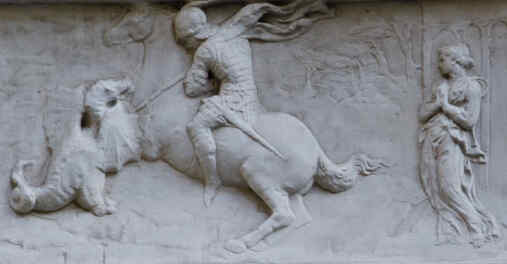
72. Donatello. Bas-Relief. St. George and the Dragon. (From the Base of the St. George Statue.)
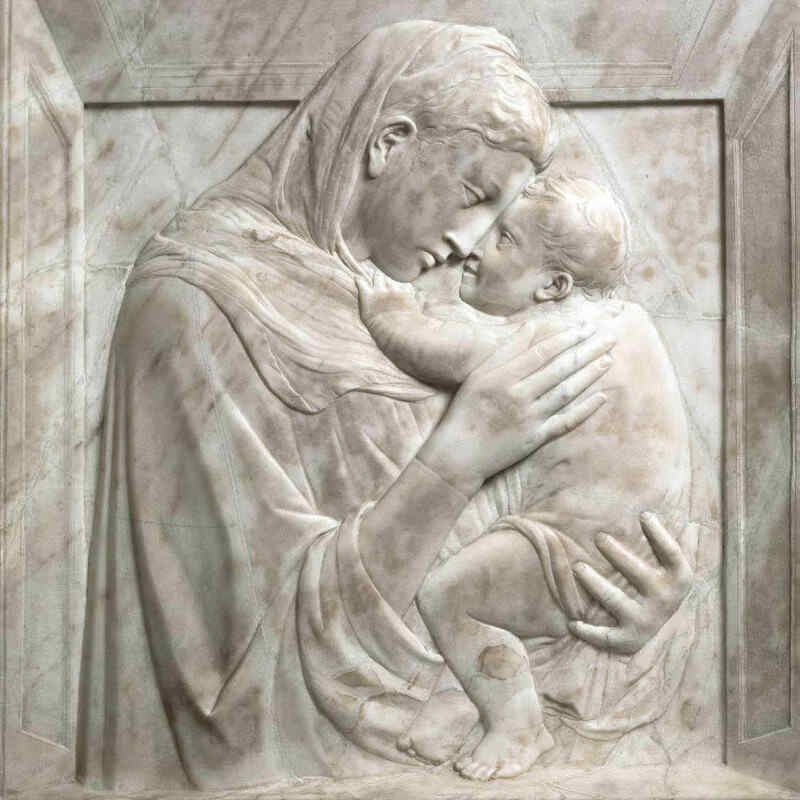
73. Donatello. Madonna Pazzi. (Berlin.)
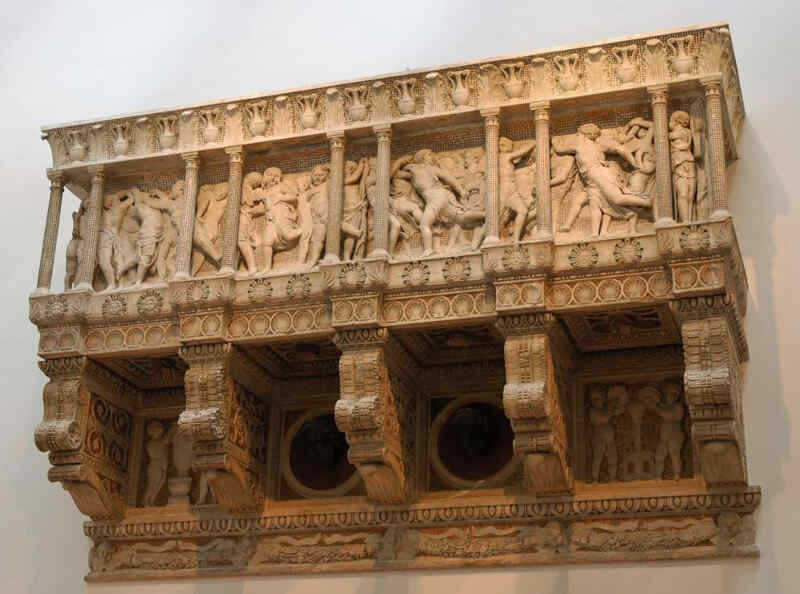
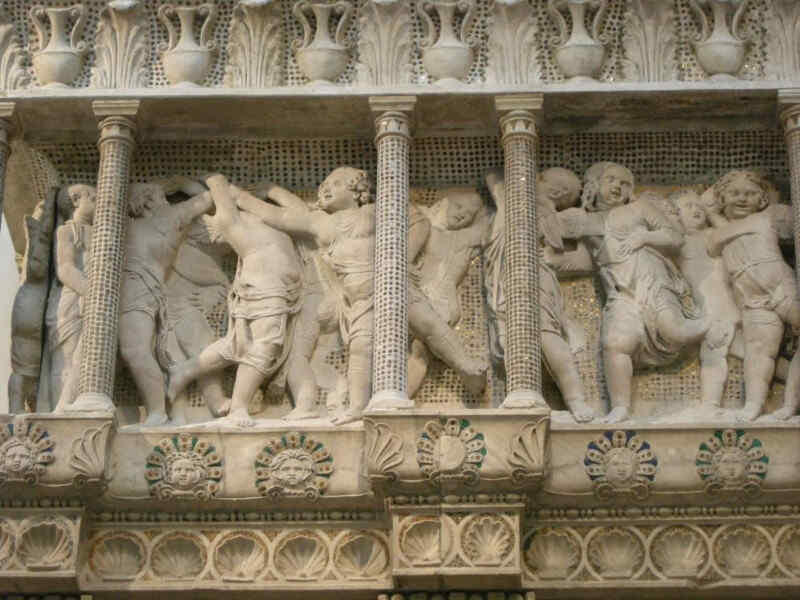
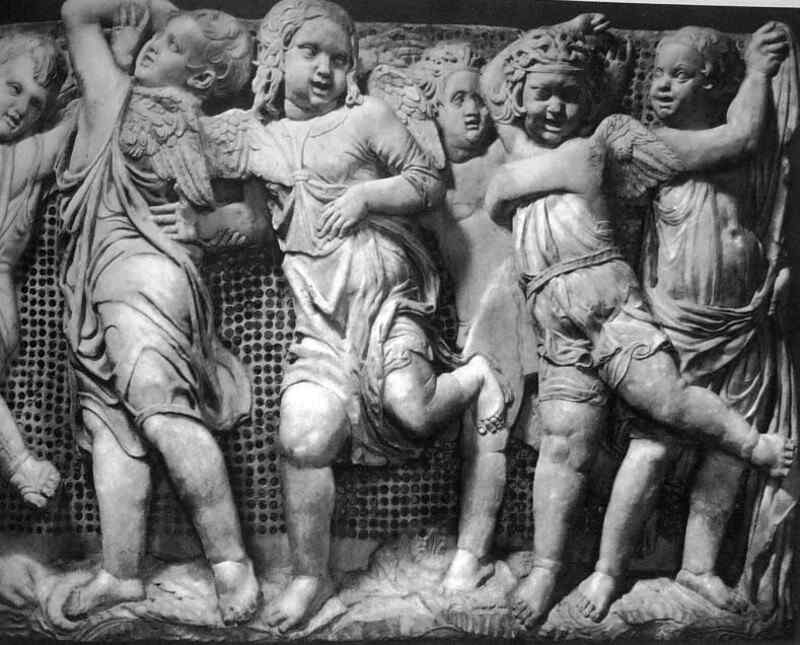
74. Donatello. Bas-Relief. Angels Singing. (Uffizi. Florence.)
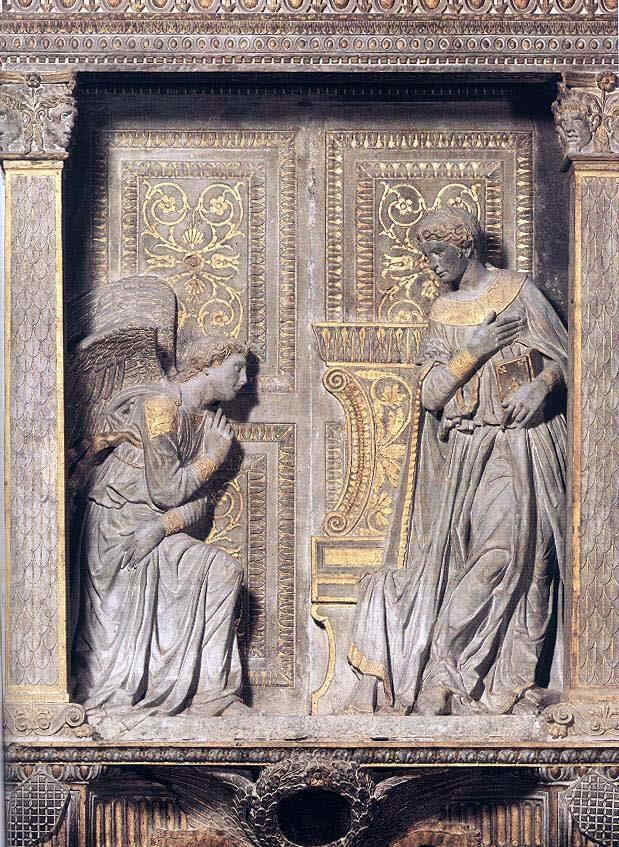
75. Donatello. Annunciation. (Santa Croce. Florence.)
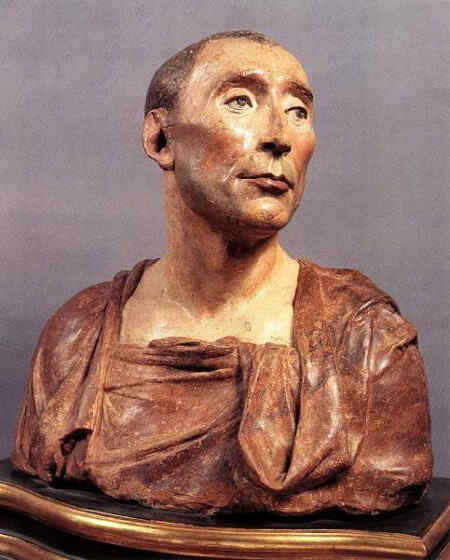
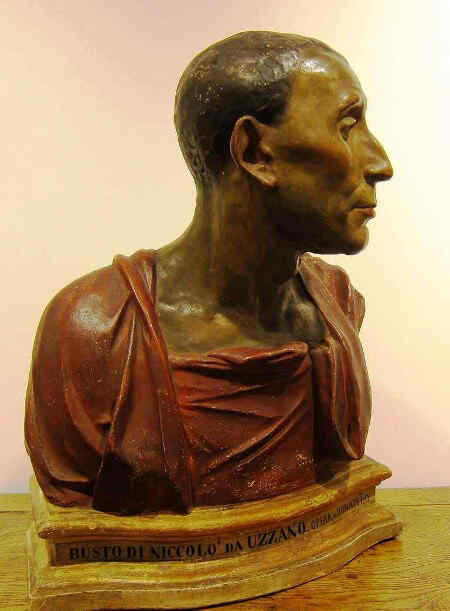
76. Donatello, Portrait of Niccolo da Uzzano.
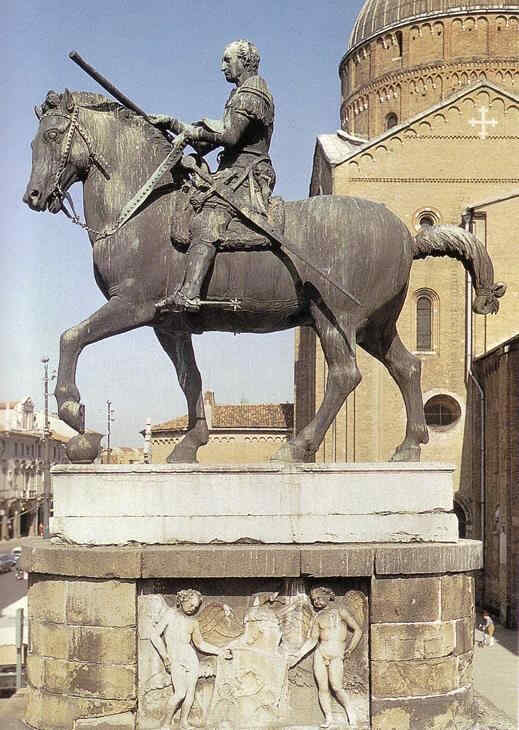
Donatello. Gattamelata.
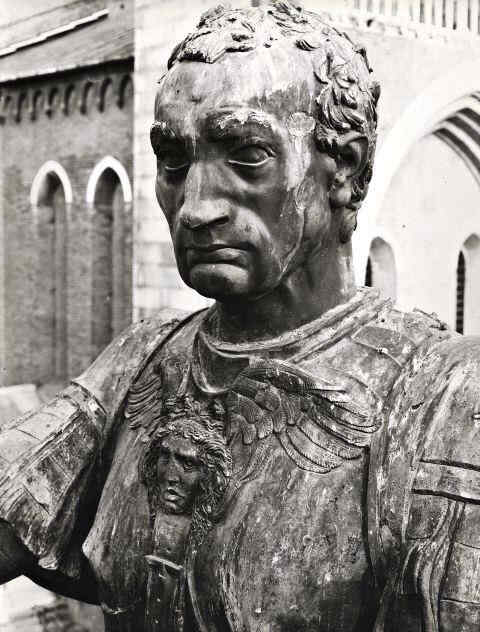
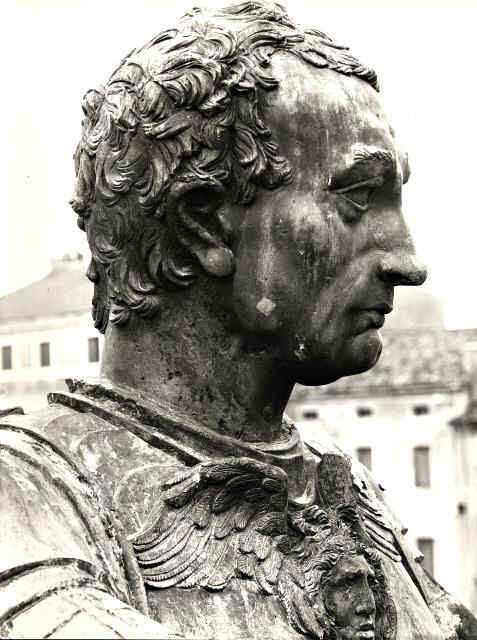
Donatello. Gattamelata.
Finally, we will show some examples of Verrocchio—teacher of Leonardo and Perugino—in his capacity as a sculptor. First the famous equestrian statue:—
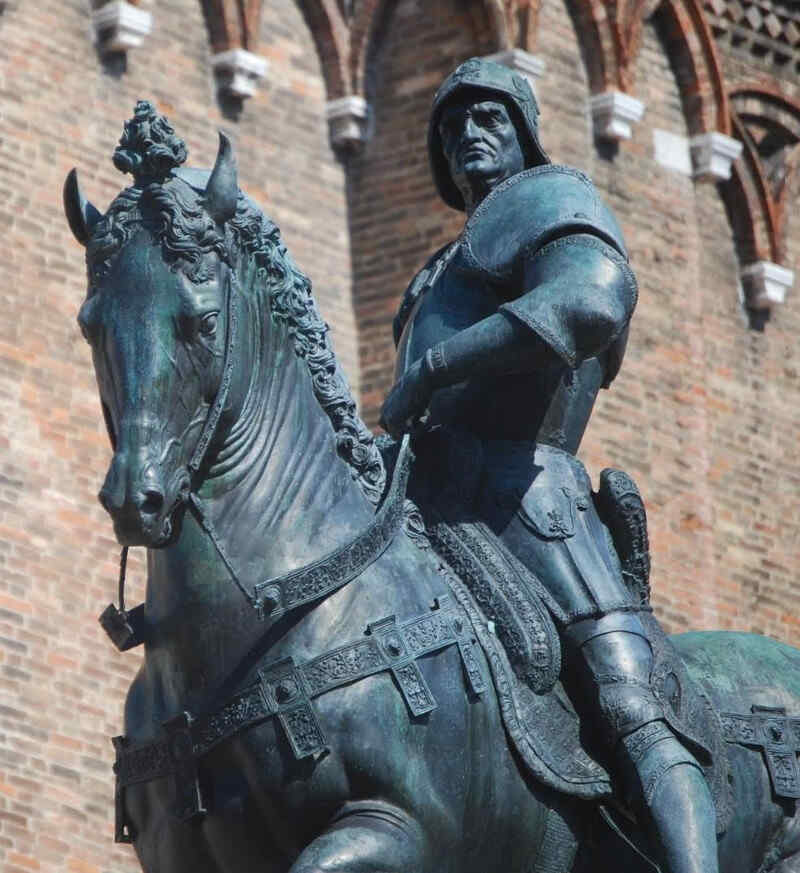
77. Verrocchio. Bertolomeo Colleoni. (Venice.)
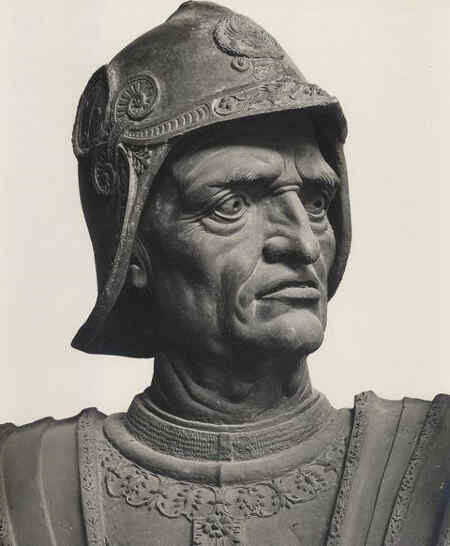
79. Verrocchio. Head and Shoulders. (Detail of the above.)
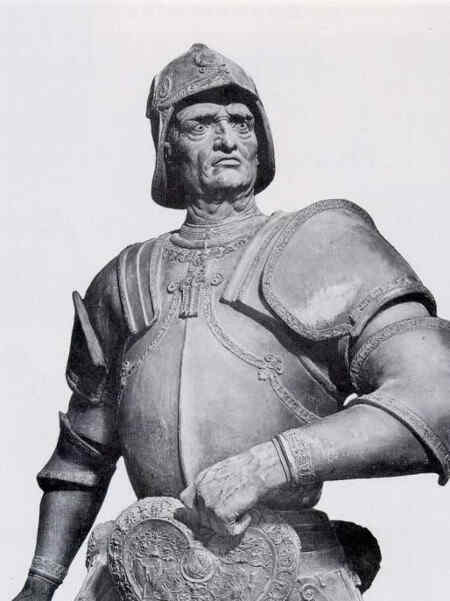
80. Verrocchio. Guiliano de Medici. (Paris.)
And in conclusion:—
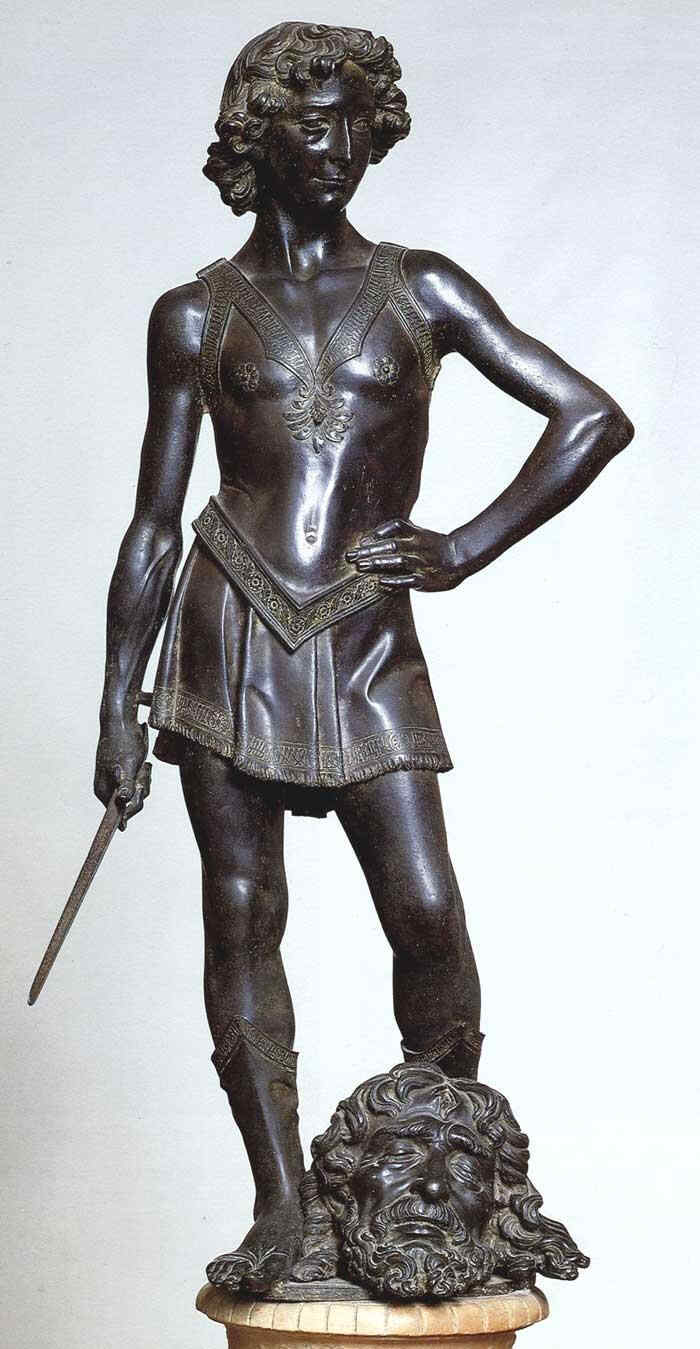
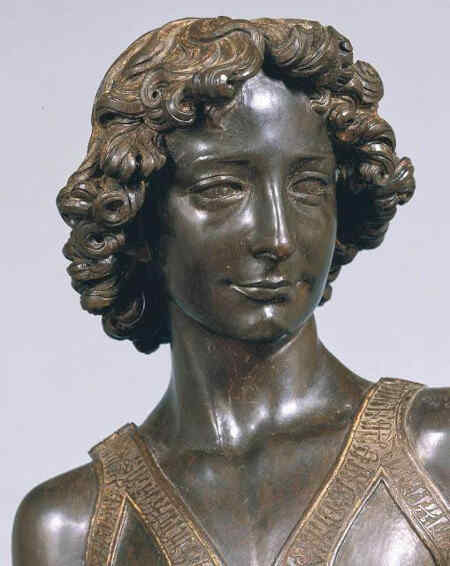
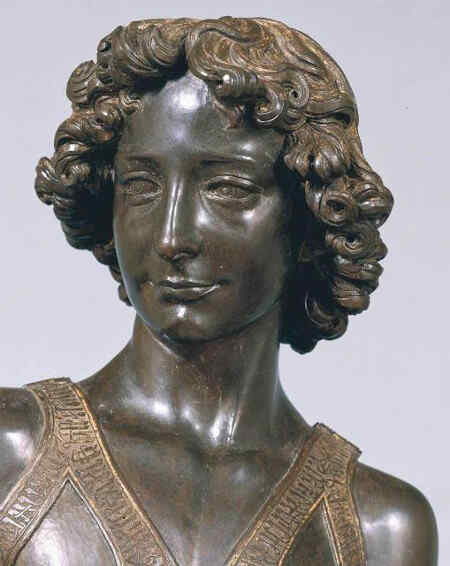
81. Verrocchio. David. (Museo Nazionale. Florence.)
And so, my dear friends, we have had before us the artists of the pre-Renaissance. They entered deeply into the Antique and brought it forth again, in a time when men no longer lived within the soul in the same inward way as did the ancients. They brought to life again in outer vision, contemplation, what the ancients had felt and known inwardly—what they had feelingly known, knowingly felt, I should say. Moreover, they united this with the element which had to come in the 5th Post-Atlantean epoch—the element of naturalism, with clear outward vision. They thus became the fore-runners of the great artists of the Renaissance—of Leonardo, of Michelangelo, and, through Perugino, of Raphael himself. For all these were influenced directly by the Art of the precursors, whose works we have seen today. They stood, undoubtedly, on the shoulders of these artists of the pre- Renaissance period, the early Renaissance.
It is interesting to see, in relation to this figure, for example, how quickly they progressed in that time. Compare this David with the David by Michelangelo. Here you still see a comparative inability to dramatise the theme—to take hold of it in movement. Michelangelo, on the other hand, in his David, has seized the very essence of dramatic movement; he has caught the actual moment of resolve to go out against Goliath.
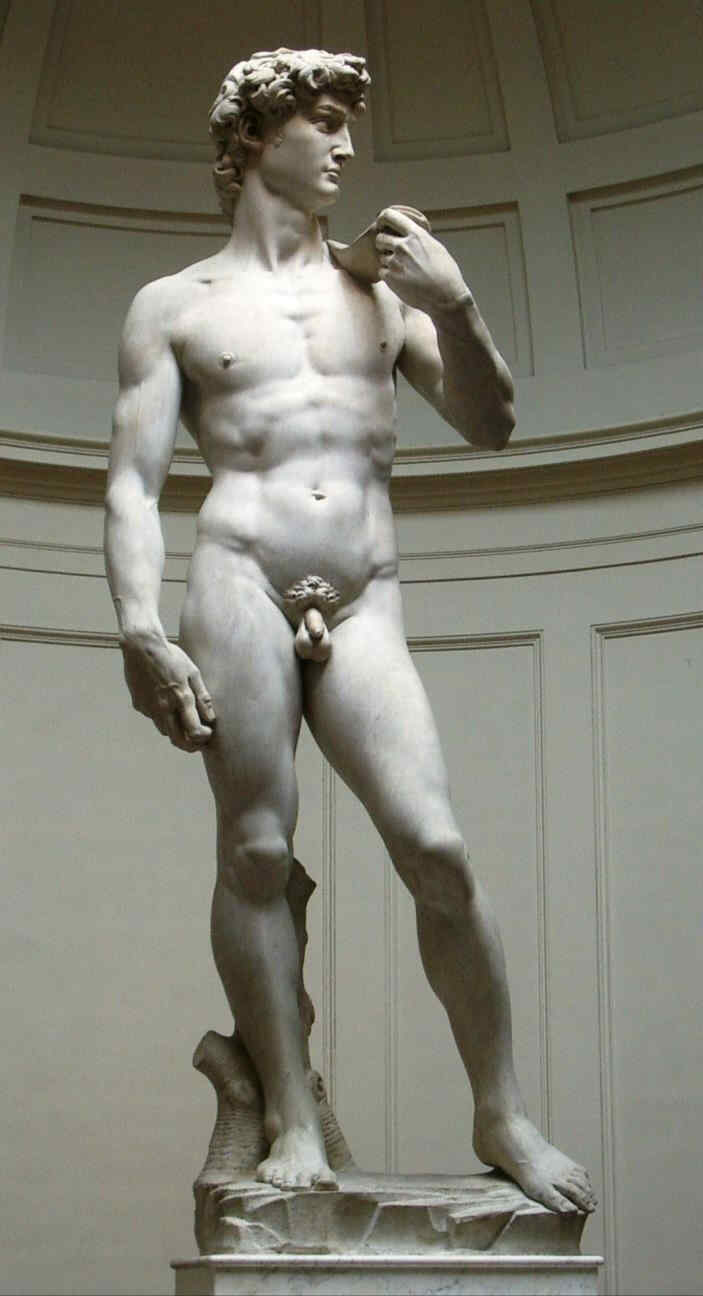
82. Michelangelo. David, Marble Statue (Florence, Academy)
Thus we have tried to bring these things to some extent before our souls:—On the one hand what radiates from the Greek Art itself, and on the other, its lighting-up-again in the age when Humanity was trying to find the life of Art once more with the help of the Greek Art which came to life again.
9. Griechische und Römische Plastik Renaissance-Plastik
Das Wiedererleben der Kunst des vierten nachatlantischen Zeitraumes in der Kunst des fünften:
Ich habe öfter den Ausspruch zitiert, den Goethe getan hat, als er in Italien den Nachklang empfand vom Wesen der griechischen Kunst. Und heute, wo wir beabsichtigen, Ihnen einzelnes vorzuführen von Abbildungen der griechischen Plastik, darf an diesen Ausspruch Goethes wohl erinnert werden. Goethe schrieb von Italien aus an Weimarische Freunde, daß er beim Anblick der griechischen Kunst, die er also in dem, was von ihr in Italien zu sehen oder wenigstens zu erahnen war, kennengelernt hatte, zu der Überzeugung gelangt sei, daß die Griechen nach denselben Gesetzen beim Schaffen ihrer Kunstwerke verfuhren, nach denen die Natur selbst verfährt, und denen er auf der Spur sei.
Dieser Ausspruch schien mir immer von einer tieftragenden Bedeutung zu sein. Goethe ahnte damals, daß in den Griechen etwas lebte, was in intimer Verbindung steht mit den Gesetzen der Welt. Und Goethe hat sich ja schon vor seiner Italienreise vielfach angestrengt, die Gesetzmäßigkeit des Werdens der Welt kennen zu lernen, am meisten durch seine Metamorphosenlehre, mit der er verfolgte, wie die verschiedenen Formen der Natur auf gewisse typische Grundformen zurückgehen, in denen sich die geistige Gesetzmäßigkeit ausspricht, die hinter den Dingen liegt. Er ging ja aus, wie Sie wissen, von der Botanik, von der Pflanzenlehre; er versuchte zu schauen, wie im Wachsen der Pflanzen sich immer ein Organ, dessen Grundform er in dem Blatt erkannte, umwandelt, metamorphosiert, wie alle Organe Umgestaltungen des einen Organes sind. Und von da ausgehend suchte er wieder zu erkennen, wie alle Pflanzen die Offenbarung einer einzelnen Urform, der Urpflanze sind.
In gleicher Weise suchte er einen gesetzmäßigen Faden durch die Tierwelt hindurch. Wir haben ja über diese Bestrebungen Goethes öfter gesprochen; aber man stellt sich das, was er beabsichtigte, zumeist nicht lebendig genug vor; man stellt sich die Dinge, so wie man ja heute gewöhnt ist, sich die Dinge vorzustellen, abstrakt vor, nicht konkret. Goethe wollte, wenn ich den Ausdruck gebrauchen darf, das Leben des Lebendigen in seiner gesetzmäßigen Metamorphose überall auch lebendig erfassen. Er wollte ergründen, wie Natur im Schaffen lebt. Damit steuerte er ja in der Tat auf dasjenige hin, was für die Erkenntnis des fünften nachatlantischen Zeitraumes so charakteristisch sein muß, wie das, was der Grieche erfaßte und in seiner Kunst zum Ausdruck brachte, für den vierten nachatlantischen Zeitraum charakteristisch ist.
Ich habe in dieser Hinsicht öfters darauf aufmerksam gemacht, daß man in der Blütezeit der griechischen Kunst und namentlich, soweit sie uns erhalten ist, in der Blütezeit der griechischen Plastik sehen kann, wie aus ganz anderen Voraussetzungen heraus künstlerisch geschaffen wird als später. Der Grieche hatte - wenn wir es in unserer konkreten Art ausdrücken, so müssen wir so sagen — ein Gefühl, wie der Ätherleib in seiner lebendigen Kraftnatur und Beweglichkeit den Formen und Bewegungen des physischen Leibes zugrunde liegt, wie in den Formen des physischen Leibes sich der Ätherleib abbildet, offenbart, wie in den Bewegungen des physischen Leibes das, was im Ätherleib kraftet, sich zum Ausdruck bringt. Die griechische Turnkunst, Athletik war darauf aufgebaut, denjenigen, die an ihr teilnahmen, wirklich ein Gefühl zu geben von dem, was unsichtbar im Sichtbaren des Menschen lebt. So wollte der Grieche auch nachbilden in seiner Plastik, was er in sich selber erlebte. Das ist -— wir haben das schon angedeutet — später anders; später ist das so, daß man abbildete, was das Auge sah, was man vor sich hatte. Der Grieche bildete das ab, was er in sich fühlte. Er arbeitete nicht in demselben Sinn nach Modell, wie später nach Modell gearbeitet wurde, ob mehr oder weniger deutlich oder undeutlich, darauf kommt es nicht an. Dieses Nach-Modell-Arbeiten ist erst eine Eigentümlichkeit des fünften nachatlantischen Zeitraumes. Aber es muß sich herausbilden im fünften nachatlantischen Zeitraum eine Anschauung der Natur, die eben ihren lebendigen Anfang genommen hat in Goethes Metamorphosenlehre. Allerdings, heute stehen solcher Auffassung noch gewichtige Hindernisse entgegen. Heute stehen auch auf diesem Gebiete die Vorurteile des Materialismus einer gesunden Auffassung des Daseins gegenüber. Diese gesunde Auffassung des Daseins muß sich herausarbeiten mit der Überwindung dieser Hindernisse. Wir erleben es ja in unserer Zeit, obwohl es noch nicht so bemerkt wird, daß, man kann sagen geradezu solche Bestrebungen und Tendenzen sich geltend machen, welche auf eine Verbarbarisierung gerade des Künstlerischen hinauslaufen. Goethe hat in einer sehr schönen Weise den Zusammenhang geschaut zwischen der Wahrheit im Erkennen und der Wahrheit im Können, in der Kunst, weil ihm das Erkennen eben ein lebendiges Leben im Geiste war.
Zu diesen Hindernissen auf diesem Gebiete gehört dasjenige, was man, wenn man tiefer hineinsieht in alle Impulse des Fortschrittes unserer Kultur und in alle Impulse des Hemmens unserer Kultur, bezeichnen kann als jene Veraffung, Affenhaftmachung unserer Kultur, die man gewöhnlich heute als Sport bezeichnet. Der Sport ist ein Ergebnis der materialistischen Weltanschauung, welches, man könnte sagen den andern Pol darstellt zur naturwissenschaftlichen Auffassung des Menschen. Auf der einen Seite arbeitet man dahin, den Menschen nur als einen vollkommeneren Affen zu begreifen, und auf der anderen Seite arbeitet man dahin, ihn zu einem fleischfressenden Affen zu machen durch die Bestrebungen, die man in vieler Beziehung als sportliche Bestrebungen bezeichnet. Diese beiden Dinge gehen durchaus parallel. Wenn man auch selbstverständlich heute gerade in den sportlichen Bestrebungen einen großen Fortschritt sieht, sogar in ihnen oftmals sieht ein Aufleben des alten Griechentums, so sind diese sportlichen Bestrebungen in ihrem Wesen doch nichts anderes, als das Hinarbeiten zum Ideal der Veraffung des Menschengeschlechtes. Und was aus dem Menschen allmählich entstehen kann auf dem Wege des Sports, das ist eben ein veraffter Mensch, der sich dadurch wesentlich unterscheiden wird von den wirklichen Affen, daß der wirkliche Affe ein Pflanzenfresser ist, während dieser veraffte Mensch eben ein fleischfressender Affe sein wird.
Die Dinge, die heute als Hemmnisse unserer Kultur vorliegen, die muß man zuweilen grotesk bezeichnen, sonst bezeichnet man sie nicht stark genug, daß sie dem heutigen Menschen ein wenig einleuchten können. Es entspricht ja auch sehr gut allen Tendenzen unserer Zeit, auf der einen Seite theoretisch hinzuarbeiten auf die Erfassung des Menschen als eines vollkommeneren Affen und auf der anderen Seite auf die reale Herausarbeitung der Affenhaftigkeit des Menschen. Von jenem Menschen, der als ein Ideal den extremen Sportbewegungen zugrunde liegt, wird in der Tat kein Naturforscher anders sagen können, als daß er im wesentlichen ein Dependance-Produkt der Affenhaftigkeit ist. Über diese Dinge alle muß man richtig denken, wenn man überhaupt zu einigem Verständnis kommen will der Edelformen der Menschlichkeit, welche dem Blütenalter der griechischen Kunst zugrunde liegen. Der Mensch mußte ja allerdings im fünften nachatlantischen Zeitraum gewissermaßen herausgehen aus seinem Leben im Geistigen. Der Grieche lebte noch im Geistigen. Wenn er die Hand bewegte, so wußte er, daß das Geistige, das heißt, der Ätherleib sich bewegt. Und daher war er auch als schöpferischer Künstler gewissermaßen bestrebt, in dem, was er dem physischen Stoff mitteilte, Ausdruck zu schaffen für dasjenige, was er fühlte in sich als Bewegung des Ätherleibes. Auf dem Umwege der Anschauung, verbunden mit der lebendigen Imagination des Webens des ätherischen im Organischen — was eben Goethe elementar angestrebt hat in seiner Metamorphosenlehre -, auf diesem Umwege muß es dahin kommen, daß die höhere Stufe, die eben der fünften nachatlantischen Zeit entsprechende Stufe, die von Erkenntnis durchdrungene Stufe des alten Griechentums wieder auflebt.
Weil Goethe mit seinem ganzen Wesen so darinnen wohnt in diesem Streben nach lebendiger Auffassung des Geistigen in der Welt, deshalb wollte er sich erfrischen und erkraften an demjenigen, was ihm durch das Studium der griechischen Kunst zugänglich werden konnte. Nun, diese griechische Kunst - man muß vielleicht ganz ausgehen von solchen Vorstellungen, wie wir sie eben hingestellt haben, wenn man sie in ihrer Eigenartigkeit, in ihrem durchaus charakteristischen Hervorgehen aus der Seelenstimmung des vierten nachatlantischen Zeitraumes verstehen will. Es ist interessant zu sehen, wie in dieser Beziehung die griechische Kunst ihren Weg macht. Es ist ja außerordentlich wenig von den Originalwerken eigentlich erhalten; das meiste ist ja erhalten nur in späteren Nachbildungen. Und aus diesen späteren Nachbildungen haben Leute wie Winckelmann versucht, in großartiger Weise das Wesen der griechischen Kunst zu erkennen; dieses Wesen der griechischen Kunst, das sie versuchten in Worte zu fassen, Winckelmann, Lessing und Goethe in dieser zweiten Hälfte des 18. Jahrhunderts, in der man eben versuchte, zurückzugehen auf das Wesen der griechischen Kunst. Dieses Wesen der griechischen Kunst, es kann, wenn es erfaßt wird, Rettung bringen vor den Gefahren des Materialismus.
Nun würde es natürlich heute viel zu weit führen, würde ich geradezu historisch, geisteswissenschaftlich-historisch auch nur einen ganz flüchtigen Umriß geben wollen über die Entwickelung der griechischen Kunst. Wir wollen uns vielmehr zunächst einiges davon, soweit es sein kann, ansehen. Nur so viel sei gesagt: Selbst in den bis ins 5., selbst zum Ende des 6. Jahrhunderts v. Chr. zurückgehenden Überresten der griechischen Kunst zeigt sich, daß das schon zugrunde liegt, wovon ich gesprochen habe, wenn auch in dieser Zeit der Grieche noch nicht die Möglichkeit hatte, das, was er in sich erlebte, auch wirklich durch den Stoff zum Ausdruck zu bringen. So sieht man selbst in den unvollkommenen älteren Formen, daß dem künstlerischen Schaffen eben das lebendige Gefühl des inneren Webens des Ätherleibes zugrunde liegt. Dadurch konnte auch der Grieche den Weg finden, die menschliche Gestalt so wunderbar zu erheben ins Göttliche. Der Grieche war sich ja klar darüber, daß seinen Göttergestalten Wesenhaftigkeit zugrunde liegt in der ätherischen Welt. Daraus entwickelte sich mehr oder weniger instinktiv — denn mehr oder weniger instinktiv war alles in dieser Zeit — das Bedürfnis, die Götterwelt und alles, was zusammenhängt mit der Götterwelt, so darzustellen, daß die äußere Gestalt idealisiert-menschlich ist; aber dieses IdealisiertMenschliche, das war es nicht, worauf es eigentlich ankam; das ist nur der Ausdruck für ein Zeitalter, das die Tiefe der Sache gar nicht erfaßt hat, das die äußere Gestalt idealisiert-menschlich darstellt, das aber durch diese idealisierte Menschengestalt sich zum Ausdruck bringt, was eben im ätherischen Leben webt und wogt. Wir sehen daher, daß sich aus einer gewissen Steifigkeit, die wir in den ersten Darbietungen sehen werden, dann in dem griechischen Zeitalter der Grieche die Möglichkeit entwickelt, wirklich das ätherische Menschliche in dem äußeren physischen Leiblichen zur Darstellung zu bringen. Sie werden sehen, wenn Sie die allerersten Abbildungen verfolgen, daß da noch etwas Steifes darinnen ist, daß aber schon in der Gestaltung der Gliedmaßen zu erkennen ist, wie diese Gestaltung hervorgeht aus einem Verständnis des ätherisch Bewegten.
Und wenn wir dann vorschreiten bis zu Myron und von ihm Kunstwerke uns vor die Seele rücken, da werden wir sehen, wie das, was erst nur in der Gestaltung des Gliedlichen zum Ausdruck kommt, übergeht auf ein Ergriffenwerden des ganzen Körpers. Bei Myron bereits sehen wir, wie, wenn ein Arm bewegt ist, wenn ein Arm in Bewegung dargestellt wird, wie das etwas bedeutet für den ganzen Atmungsapparat, für die Gestaltung der Brustform. Der ganze Mensch ist innerlich erfühlt, ist innerlich empfunden. Das muß natürlich im allerhöchsten Maße dann bei Phidias und seiner Schule und bei Polyklet der Fall gewesen sein, die das Blütezeitalter der griechischen Kunst darstellen.
Dann finden wir, wie allmählich die Kunst, ich möchte sagen: von der hohen Empfindung des Ätherischen herabsteigt, nicht indem sie außer acht läßt das Ätherische, aber indem sie versucht, die Formen der Natur zu bezwingen, so, daß die Formen der Natur treuer zum Ausdruck kommen, ich möchte sagen menschlicher, weniger göttlich zum Ausdruck kommen, und dennoch ein Ausdruck sind des Ätherisch-Lebendigen in dem Leiblichen. Es wird uns bei dem Anblick der einzelnen Kunstwerke weniger darauf ankommen, die einzelnen Künstler zu besprechen, sondern uns vorzuführen das allmähliche Wachsen der griechischen Kunst. Ob wir dann sprechen bei den letzten Produktionen, wie das in der Kunstgeschichte üblich ist, von einem Wiederherabgehen der griechischen Kunst, darauf kommt es weniger an. Dadurch, daß in der älteren Zeit gewissermaßen die Leiblichkeit mehr in der Lage aufgefaßt wird, ist ausgegossen über der älteren griechischen Kunst eine gewisse Ruhe. Die Bewegung ist so aufgefaßt, wie sie in die Ruhe gekommen ist; so daß wir, wenn wir die Gestalten der älteren griechischen Kunst sehen, das Gefühl haben: der Künstler war bestrebt, die Leiblichkeit so darzustellen, daß die Lage, in der die betreffende Gestalt war, dauernd war. Später bestreben sich die Künstler, ich möchte sagen, einer größeren Dramatik. Sie halten mehr den Moment fest, der in der fortgehenden Bewegung sich ergibt. Dadurch kommt etwas Bewegteres in die spätere Kunst hinein. Ob man das nun einen Niedergang nennen will, oder nur eine spätere Entwickelungsphase, ist ja schließlich eben bloß von der menschlichen Willkür abhängig.
Nach diesen paar Bemerkungen wollen wir uns nun einzelne Kunstwerke ansehen. Dasjenige, was noch zu sagen ist, können wir ja in Anlehnung an die einzelnen Kunstwerke selber sagen.
Sie sehen zunächst aus der ältesten Zeit, etwa um 560 vor Christus, diese Apollo-Figur,
Griechische Plastik, 6. Jh. v. Chr.
568 «Apoll von Tenea» 5682” Seitenansicht
eine Jünglingsgestalt, an der Sie wirklich noch, ich möchte sagen das volle Erfassen der Leiblichkeit sehen, das Ausgegossensein des Ätherischen in der Gliedlichkeit.
Man wird einmal erkennen, daß der ja oft hervorgehobene Zug dieser ältesten griechischen plastischen Kunst - um die Mundpartie das «Lächeln», wie man es nennt - aus dem Bestreben hervorgeht, nicht den toten Menschen, also bloß den physischen Leib darzustellen, sondern wirklich das innere Leben zu erfassen. In der älteren Zeit konnte man das noch nicht anders als durch diesen Zug darstellen.
Und nun wollen wir Ihnen zwei Proben bringen von dem dorischen Aphaia-Tempel zu Ägina:
569 Griechische Plastik, 5. Jh. v. Chr. Sterbender Krieger
Die Kunstwerke sind ausgeführt worden als ein Dankopfer für die Schlacht von Salamis und stellen im wesentlichen Kampfszenen vor, beherrschend das Ganze, wie wir dann sehen werden, die Gestalt der Athene. Diese liegende, sterbende Gestalt ist eine schöne Probe der Gestalten, die sich an diesem Tempel finden. Das Ganze stellt Giebelfiguren dar und ist besonders interessant durch das Kompositionelle der Sache, das mit vollständiger Symmetrie ausgeführt worden ist, links und rechts die Gestalten in sehr schöner Symmetrie.
Dann aus der entsprechenden Gruppe des anderen Giebels:
571 Griechische Plastik, 5. Jh. v. Chr. Pallas Athene
570* Aphaia-Tempel: Der Westgiebel. Rekonstruktion von Furtwängler
Da sind wir im Anfange des 5. Jahrhunderts.
Nun schreiten wir im 5. Jahrhundert weiter.
572* Griechische Plastik, 5. Jh. v. Chr. Jünglingskopf (sog. «Blonder Kopf»)
Da haben wir zunächst einen Wagenlenker aus Delphi,
573 Griechische Plastik, 5. Jh. v. Chr. Wagenlenker
und jetzt eine Wettläuferin,
574 Griechische Plastik, 5. Jh. v. Chr. Wertläuferin
aber wohl schon aus der Mitte des Jahrhunderts.
Und dann bitte ich Sie, zu beachten, wie bei Myron - da kommen wir schon in das Zeitalter, das man bezeichnen kann als das Blütezeitalter -, wie bei Myron die Behandlung des Leibes eine ganz andere wird, wie er nicht mehr in der Gliedlichkeit aufgeht, was sogar hier (574) noch der Fall ist, sondern wie er den ganzen Leib im Zusammenhang mit den Gliedern zu behandeln weiß:
575 Kopie nach Myron Diskuswerfer
So stehen wir damit in der Mitte des 5. Jahrhunderts und finden in einer solchen Gestalt wahrhaftig schon eine hohe Vollendung in derjenigen Richtung gerade, die wir versuchten zu charakterisieren.
Und nun kommen wir, das heißt, wir sind schon darin, ins Perikleische Zeitalter. Von der Zeit des Phidias, von dem ja leider in Wirklichkeit wenig vorhanden ist, haben Sie hier die sogenannte «Athena Lemnia»,
576 Kopie nach Phidias Athena Lemnia
577 Kopie nach Phidias Athena Lemnia, Halbprofil
die um 450 entstanden ist und deren Marmorkopie sich in Dresden befindet.
Dann eine Kopie nach der Athena Parthenos:
578 Kopie nach Phidias Athena Parthenos
579 Kopie nach Phidias Athena Parthenos
Und nun einige Proben von dem berühmten Parthenon. Sie können in jeder Kunstgeschichte nachlesen die interessante Geschichte dieser ParthenonFiguren. Es sind ja die wesentlichsten davon wohl verlorengegangen, und wir haben nur eine Vorstellung davon dadurch, daß sie von dem Franzosen Carrey gezeichnet worden sind gegen Ende des 17. Jahrhunderts,
580* Zeichnungen nach dem Ost- und Westgiebel des Parthenon und dem Parthenonfries von J. Carrey
bevor sie noch durch die Venezianer kaputt gemacht worden sind; und nur Reste sind dann gefunden worden am Ende des 18. Jahrhunderts durch Lord Elgin.
581 Griechische Plastik, 5. Jh. v. Chr. Drei Göttinnen vom Östgiebel des Parthenon
Das sind die sogenannten «Tau-Schwestern» vom Ostgiebel des Parthenon, denen durch die herabkommenden Genien die Geburt der Athene mitgeteilt wird. - Dann haben wir vom Westfries zwei Jünglinge auf Rossen.
582 Griechische Plastik, 5. Jh. v. Chr. Jünglinge auf Rossen
Man kann annehmen, daß wohl zumeist im persönlichen Beisein des Phidias diese Dinge von seinen Schülern ausgeführt worden sind. Und nun noch vom Ostfries die Poseidon-Figuren:
583 Griechische Plastik, 5. Jh. v. Chr. Sitzende Götter
Mit Phidias war in der Tat alles Typische der griechischen Kunst gegeben, alles das, was so als der Stempel, als die Signatur der Leiblichkeit, wie sie darzustellen ist durch die Kunst, aufgedrückt war; so daß die Art, wie Phidias und seine Schüler gesehen haben, dann nachgelebt hat, lange, lange nachgelebt hat. Man sagte, die Linienführung des Antlitzes, Bewegung der Gliedmaßen und dergleichen und Wallung der Kleider müsse so sein, wie sie in dieser Idealzeit der Kunst ausgebildet worden ist. Und das pflanzte sich durch alle Traditionen weiter fort, selbst in diejenigen Zeiten hinein, in denen nur in äußerlicher Weise das noch nachgeahmt werden konnte, was in der Blütezeit der griechischen Kunst lebendig gelebt hat und eben leider in seinen Hauptsachen zugrunde gegangen ist. Es ist ja heute nicht möglich, durch Anschauung eine Vorstellung zu bekommen gerade von den größten, von den weltüberragenden Meisterwerken des Phidias. Und es ist sehr bedeutsam, daß in der Zeit des 18. Jahrhunderts, als durch Winckelmann angeregt Goethe und andere sich in das Wesen der griechischen Kunst vertieften, sie ja nur eindringen konnten im Grunde genommen durch schlechte Imitationen, durch später entstandene Imitationen. Es gehörte ein großes Ahnungsvermögen dazu, dazumal einzudringen durch diese Imitationen in das Wesen der Kunst. Und derjenige, der sich bemüht, über diese Dinge die Wahrheit zu fühlen, der muß sich sagen, daß in der Zeit, in der Goethe jung war, in der er Italien bereiste, noch ein ganz anderes instinktives SichHineinfühlen in die Kunst vorhanden war als dann im 19. oder gar im 20. Jahrhundert. Nur dadurch ist es möglich geworden, daß aus jenen späten Nachahmungsprodukten jene Auffassung der griechischen Kunst hervorgegangen ist, die aus Winckelmann, aus Goethe leuchtete.
Sehen Sie sich zum Beispiel das Bildwerk an, das jetzt kommt und das ja in Rom zu sehen ist, den Zeuskopf, den sogenannten Zeus von Otricoli —
584 Griechische Plastik, 4. Jh. v. Chr. Zeus von Otricoli
da finden Sie etwas, worinnen man sehen kann die Fortsetzung des Typus, der in Phidias’ Zeitalter schon geschaffen worden ist, aber selbstverständlich in späterer Nachahmung, hier noch sogar mit einer gewissen Großartigkeit nachgeahmt. -— Weniger großartig wurde dann nachgeahmt dasjenige, was Polyklet als den Hera-Typ ausgearbeitet hat; und bis zur, ich möchte sagen Leerheit, bis zur schalen Nachahmung, etwa so, wie die Dinge schon erinnern etwas ans Modejournal, ist ja dann die unter diesen Gestalten stehende Pallas Athene, die berühmte Pallas Athene von Rom,
585 Griechische Plastik, 4. Jh. v. Chr. Athena Giustiniani
die auch den Typus der Athene späterer Nachahmung zeigt und von der man nur ahnen kann, auf welche großartigen Dinge diese spätere Nachahmung zurückgeht. Hat man in dem Zeuskopf (584) das zu sehen, was sich fortgepflanzt hatte in Phidias, so in dem nächsten, in dem Hera-Kopf, dasjenige, was Polyklet geschaffen hat als Hera-Ideal, das wir Ihnen gleich im Zusammenhange damit zeigen:
586 Römische Plastik Juno Ludovisi
587 Römische Plastik Juno Ludovisi im Profil
Nun gehen wir wiederum zurück zu den Bildern in Olympia, im Westgiebel, die ja auch in ihrer Komposition großartig sind:
588 Griechische Plastik, 5. Jh. v. Chr. Kampf der Kentauren und Lapithen, Teil: Die geraubte Braut
Und nun noch eine andere Gruppe, eine Einzelfigur:
589 Griechische Plastik, 5. Jh. v. Chr. Kampf der Kentauren und Lapithen, Mittelfigur: Apollon
Und nun aus Phidias’ Schule das «Orpheus-Relief»:
590 Kopie nach Phidias Weiherelief mit Orpheus, Eurydike und Hermes
Wir erinnern uns, daß Phidias ja von seinen Mitbürgern beschuldigt worden ist, Gold gestohlen zu haben aus dem in Gold und Elfenbein auszuführenden Athene-Standbild, und daß er deshalb ins Gefängnis geworfen worden ist von seinen «dankbaren» Mitbürgern.
591 Griechische Plastik, 5. Jh. v. Chr. Kopf des Perikles
Eine Büste des Perikles, durchaus eine Idealauffassung dieser Persönlichkeit, über das Porträtmäßige weit hinausgehoben.
Und nun etwas, was wohl ein Jugendwerk des Phidias ist, eine Amazone.
592 Kopie nach Phidias Amazone
Jetzt können wir den Polyklet einschalten und haben hier eine Amazone.
594 Kopie nach Polyklete Amazone
In Myron und Phidias - und deren Schülern natürlich — haben wir wohl die Persönlichkeiten der Künstler der höchsten Blüte der griechischen Kunst zu sehen, die Bildner auch der Traditionen der griechischen Kunst.
Noch eine Wiederholung der ersten «Amazone» sei an diese Stelle gestellt:
593 Kopie nach Phidias Amazone
Und nun, nur um zu zeigen, daß man ungefähr in dieser Zeit auch etwas Genremäßiges gut zustande brachte, den «Dornauszieher»,
595 Griechische Plastik, römische Kaiserzeit Dornauszieher
ein Knabe, der sich aus der Fußsohle einen Dorn auszieht.
Nun dringen wir allmählich in das Zeitalter ein, auf das ich vorhin aufmerksam zu machen versucht habe, indem ich sagte: es wird die ganze Auffassung heruntergerückt ins mehr Menschliche, wenn es auch noch göttliche Gestalten sind, wie hier die Aphrodite.
596 Kopie nach Praxiteles Aphrodite von Knidos
Das ganz Erhabene der früheren Künstler wird mehr ins Menschliche heruntergerückt. Bei Praxiteles (596) können wir dies bereits beobachten.
Damit stehen wir also schon im 4. Jahrhundert, und im Zusammenhange damit sei die Demeter von Knidos gezeigt,
597 Griechische Plastik, 4. Jh. v. Chr. Demeter von Kniidos
die denselben Geist atmet.
Ferner der olympische Hermes des Praxiteles,
598 Praxiteles Hermes mit dem kleinen Dionysos
der das Dionysos-Kind in der linken Hand hat.
Und nun noch ein Satyr des Praxiteles:
599 Griechische Plastik, 4. Jh. v. Chr. Ausruhender Satyr
Dieser Zeit gehört nun auch die berühmte «Niobe-Gruppe» an, wie Niobe ihre sämtlichen Kinder verliert durch die Rache des Apollo.
600 Griechische Plastik, 4. Jh. v. Chr. Flüchtende Niobide
Und indem wir im 4. Jahrhundert weiterschreiten, kommen wir allmählich schon ins Alexandrinische Zeitalter hinein zu Lysipp, der dann geradezu im Dienste Alexanders arbeitet, Alexanders des Großen:
601 Kopie nach Lysipp (?) Alexander der Große
Dann ein Hermes:
602 Kopie nach Lysipp Ruhender Hermes
Dann ein Knabe mit andächtig zum Himmel erhobenen Händen:
603 Griechische Plastik, 4. Jh. v. Chr. Betender Knabe
Und ein Medusenhaupt:
604 Griechische Plastik, römische Kaiserzeit Medusenhaupt («Medusa Rondanini»)
Dann eine Statue:
605 Griechische Plastik, 4. Jh. v. Chr. Alexander der Große
Wir sehen eben die Kunst nun vom Typischen etwas ins Individuelle heruntergehen, allerdings im Griechischen, in der griechischen Kunst nirgends so weit wie in späteren Zeitaltern. - Und die Sophokles-Statue,
606 Griechische Plastik, 4. Jh. v. Chr. Sophokles-Statue
die durchaus aber an die allerbeste, idealste Tradition der ältesten Zeit, der Blütezeit heranreicht, erinnert. Man könnte ebensogut sagen, der Dichter als solcher ist dargestellt, was symbolisch angedeutet ist durch die Rollen, die Schriftrollen, die mit Absicht angebracht sind.
Wenn Sie diese Figur vergleichen mit mehr oder weniger nach Porträtähnlichkeit strebenden Gestalten, die jetzt kommen, so werden Sie sehen, daß eben allerdings aus dem Ideal heraus gestrebt wird, alles etwas porträtähnlicher zu machen: Sokrates,
607 Kopie nach Lysipp Sokrates
ebenso dann Plato.
608 Griechische Plastik, 4. Jh., v. Chr. Plato
Sie sind natürlich nicht nach dem Modell abgenommen, aber es ist eben versucht, sie menschlich-ähnlich zu machen, womit nicht behauptet sein soll, daß sie original-ähnlich sind. Dies wird insbesondere natürlich zu sagen sein mit Bezug auf Homer, der jetzt folgt:
609 Griechische Plastik, 3.-1. Jh. v. Chr. Homer
Damit haben wir uns allmählich dem 2. Jahrhundert genähert.
610 Griechische Plastik, 3.-1. Jh. v. Chr. Nike von Samothrake
Und nun die berühmte Venus von Milos,
611 Griechische Plastik, 3.-1. Jh. v. Chr. Venus von Milo oder Aphrodite von Melos
die allerdings, wenn sie auch dieser späteren Zeit angehört, durchaus die Tradition des Blütezeitalters bewahrt. -— Dagegen werden Sie an dem nächsten Werk sehen, wie Bewegung zu geben versucht wird: Ariadne,
612 Griechische Plastik, römische Kaiserzeit Schlafende Ariadne
die ja wohl aus etwas späterer Zeit ist; aber wir können sie doch als einen Gegensatz anschauen.
Und nun kommen wir gegen das letzte Jahrhundert vor Christi Geburt, zu der Rhodischen Schule, zu der berühmten Laokoon-Gruppe,
613 Agesandros, Athanadros und Polydoros Laokoon-Gruppe
von der Sie ja wissen, daß seit dem 18. Jahrhundert, seit Lessings berühmtem «Laokoon», viele Kunstbesprechungen von ihr ausgegangen sind. Es ist außerordentlich interessant, in Lessings Erörterung, anknüpfend an diese LaokoonGruppe, die von drei Künstlern der Rhodischen Schule herrührt, sich hineinzufinden. Es ist, wie Sie ja vielleicht wissen, von Lessing versucht worden zu zeigen, wie der Dichter, der die Szene schildert, in der Lage ist, sie ganz anders zu schildern, weil man das, was er darstellt, nicht vor Augen hat, sondern sich nur in der Phantasie lebendig zu machen hat, während man eben das, was der bildende Künstler darstellt, vor Augen hat. Und daher müsse, was der bildende Künstler darstellt, eine viel größere Ruhe in sich tragen, müsse Momente darstellen, die gewissermaßen als ruhende Momente wenigstens imaginiert werden können.
Nun, es ist viel - gerade mit Anlehnung an Lessings Auseinandersetzungen — über diese Laokoon-Gruppe gesprochen worden. Und interessant ist es, daß, ohne natürlich irgend etwas von Geisteswissenschaft zu kennen, in der Mitte des 19. Jahrhunderts der Ästhetiker Robert Zimmermann zu der ja zweifellos zu ergänzenden, aber für jene Zeit und ohne Geisteswissenschaft immerhin richtigsten Erklärung gekommen ist, weil in dieser Erklärung etwas von dem liegt - wenn auch nur instinktiv angedeutet -, was ich heute ausgeführt habe. Wir sehen ja den Priester Laokoon mit seinen Söhnen, durch die Schlangen umwunden und dem Tode entgegengehend. Nun wird zweifellos in dieser Darstellung die eigentümliche Ausgestaltung gerade des Leibes auffallen. Über diese Ausgestaltung des Leibes ist ja viel geschrieben worden. Nun hat Robert Zimmermann, der Ästhetiker, mit Recht darauf aufmerksam gemacht, daß die ganze Darstellung so ist, daß man eigentlich den Moment vor sich hat, wo das Leben - wir würden also sagen: der Ätherleib - schon im Entfliehen ist. Schon eigentlich ist ein Moment der Bewußtlosigkeit da. Daher stellt der Künstler die Sache so dar, daß der Leib des Laokoon wie in Teile
Knnurisht Diiinnlf Stainar Marhisce \amasmaltiinma Diiirb: 209% Eritn:NnN27 auseinanderfällt. Und das ist das Geistvolle an dieser Sache: dieses Differenziertwerden des Leibes in seine Teile. Gerade an diesem Spätprodukt der griechischen Kunst kann man sehen, wie der Grieche sich bewußt war des Ätherleibes, indem er in dem Moment, in welchem das Leben übergeht in den Tod, wirklich die Wirkung des Sich-Zurückziehens des Ätherleibes durch den Schock, der durch die Umwindung der Schlangen ausgedrückt wird, zum Ausdruck bringt, wie er gleichsam diese Wirkung des Sich-Zurückziehens des Ätherleibes von dem physischen Leib, dieses Zerfallen, dieses Auseinanderfallen des physischen Leibes und des Ätherleibes zum Ausdruck bringt. Das ist das Charakteristische bei dem «Laokoon», nicht die anderen Dinge, die sehr häufig gesagt werden, sondern dieses Differenziertwerden des Leiblichen. Der Leib wäre durchaus so nicht zu denken, wenn nicht der Moment ins Auge gefaßt würde des also Sich-schon-Zurückziehens des Ätherleibes.
Und nun noch zwei Proben von Nachahmungen vielleicht älterer Vorbilder, die aber gerade großen Eindruck gemacht haben auf die späteren Kunstbetrachter. Der berühmte Apollo von Belvedere,
614 Kopie nach Leochares Apollo von Belvedere
als eine Art Kampfheld dargestellt. Und dann die Artemis,
615 Griechische Plastik, römische Kaiserzeit Artemis von Versailles
die auch älter ist, in späterer Nachbildung.
Wir wissen ja, die griechische Kunst geht allmählich ihrem Dämmerungszeitalter entgegen, als Griechenland von Rom unterjocht wird. In Rom haben wir es ja zunächst zu tun mit einer Art Nachahmung der griechischen Kunst, mit einem Übertragen, aber mit einem allmählichen Versinken in der Ihnen öfter geschilderten allgemeinen Phantasielosigkeit des römischen Volkstums. Die nächsten Jahrhunderte, die auf das griechische Dämmerungszeitalter folgen, also das römische Zeitalter, sind ja vielfach trübe Zeitalter für unsere Entwickelung. Und ein neues Zeitalter beginnt wiederum - ich will das nur kurz erwähnen - im 12., 13. Jahrhundert in Italien, als man durch verschiedene Umstände die von dem früheren Mittelalter verschütteten Kunstwerke zum Teil wiederum auffindet. An der Anschauung dessen, was aus dem Altertum wieder aufgefunden wird, entsteht um diese Zeit dann eine neue Kunst, die allmählich zur Renaissancekunst wird. Die Künstler bilden sich namentlich vom 13. Jahrhundert ab in Italien durchaus an der Antike nach den aufgefundenen, damals in sehr geringer Zahl sogar noch aufgefundenen Kunstwerken, die ausgegraben werden. Und da sehen wir dann - und wir wollen jetzt übergehen zu diesem, ich möchte sagen Wiedererheben der alten Kunst im VorRenaissancezeitalter - im 13. Jahrhundert in Niccolö Pisano zunächst einen außerordentlich feinen Künstler, der sich zu begeistern weiß an den aufgefundenen Resten der griechischen Kunst und aus der eigenen Phantasie heraus durch die Befruchtung durch die griechische Kunst, ich möchte sagen in dem Geiste dieser Kunst wiederum zu schaffen versucht. - Hier haben Sie von ihm die Kanzel im Baptisterium zu Pisa mit den Kanzelreliefs:
616 Niccolò Pisano Marmorkanzel mit Reliefs
Die Kanzel selber wird von antiken Säulen getragen, zwischen denen gotische Bogenverbindungen sind; an den Säulen unten zum Teil auch Löwen, und oben die Kanzelreliefs, in denen Niccolö Pisano das, was er den Anregungen der Antike verdankte, zum Ausdruck gebracht hat. Niccolö Pisano wirkt bis gegen das Ende des 13. Jahrhunderts. Ein Detail aus dieser Kanzel:
617 Niccolò Pisano Kanzel-Relief: Die Anbetung der Könige
Von ihm ist auch ein anderes Kanzel-Relief aus dem Dom zu Siena:
618 Niccolò Pisano Kanzel-Relief: Die Kreuzigung
Und jetzt gehen wir zu Giovanni Pisano, bei dem Sie beobachten wollen, bitte, wie eine viel größere Bewegung hineinkommt. Bei Niccolö Pisano haben wir noch eine gewisse Ruhe über den Figuren ausgegossen.
620 Giovanni Pisano Kanzel-Architravfiguren: Die zweite Sibylle
Daß nun also die christliche Kunst in die Lage kommt, wirklich ihre Motive mit einer solchen Vollkommenheit auszudrücken, wie es dann in der Renaissancekunst geschieht, das ist durchaus der Anregung der Antike zu verdanken, die zuerst bei diesen Pisanos hervorgetreten ist.
Nun noch ein Relief aus derselben Kanzel:
621 Giovanni Pisano Kanzel-Relief: Die Kreuzigung
Und nun von ihm die Kanzel aus dem Dom zu Pisa:
622 Giovanni Pisano Marmorkanzel
623 Giovanni Pisano Marmorkanzel, Rekonstruktions-Modell von 1872
Wir sehen zugleich, wie hier naturgemäß die Antike in die Gotik gewissermaßen hineinwächst. - Und nun eine Madonna von ihm:
624 Giiovanni Pisano Madonna
Eine andere Madonnenstatue:
625 Giovanni Pisano Madonna dell’ Arena
Und nun kommen wir zu einer Probe von Andrea Pisano, der berufen worden ist, eines der Bronzetore des Baptisteriums zu Florenz zu bilden. Hier haben wir von ihm eine Darstellung des biblischen, alttestamentlichen Erfinders der Erzwaren am Campanile des Domes in Florenz:
626 Andrea Pisano Tubalkain
Damit sind wir herangekommen bis ans 15. Jahrhundert und finden dann Ghiberti, den großen Künstler, der dreiundzwanzigjährig bereits mitkonkurrieren durfte bei der Ausschreibung für die Türen des Baptisteriums in Florenz
628 Lorenzo Ghiberti Die Opferung Isaaks
und dreiundzwanzigjährig zunächst die nördlichen Türen des Baptisteriums machen durfte,
629 Lorenzo Ghiberti Bronzetüren
der sich emporgeschwungen hat von dem einfachen Goldschmiedlehrling zu einem der größten Künstler. Diese Reliefdarstellungen an den Türen des Baptisteriums von Florenz gehören eigentlich in ihrer Art zu den größten Meisterwerken der Kunstentwickelung.
Später wurden ihm dann übertragen die östlichen Türen des Baptisteriums,
630 Lorenzo Ghiberti «Paradiesestüren»
die das Alte Testament darstellen und von denen Michelangelo ja gesagt hat, daß sie würdig wären, «die Pforte des Paradieses» zu bilden, die auch einen tiefen Einfluß gehabt haben auf die ganze Kunst des Michelangelo, so daß man wiedererkennen kann gewisse Motive bis in Einzelheiten hinein in der Michelangeloschen Malerei, die er aufgenommen hat von diesen Reliefdarstellungen, von diesen Bronzetüren.
Nun noch ein Relief von diesen östlichen Türen:
631 Lorenzo Ghiberti «Paradiestür», Teil: Die Opferung Isaaks
Und eine Erzstatue von der Hand dieses Meisters:
627 Lorenzo Ghiberti Hl. Stephanus
Was Ghiberti also so arbeitet, das beruht durchaus auf treulicher Anschauung der Antike.
Und jetzt wollen wir einfügen die Kunst der della Robbias, zunächst des Luca della Robbia:
632 Luca della Robbia Marmorrelief einer Sängertribüne: Tanzende Knaben
Die Robbias sind ja besonders dadurch berühmt geworden, daß sie die besondere Kunst, gebrannten Ton als Material zu benützen und dann farbig zu glasieren, erfunden haben, so daß ein großer Teil ihrer Kunstwerke dann in diesem Material ausgeführt ist.
Ein anderes Detailbild von dieser Sängertribüne:
633 Luca della Robbia Marmorrelief einer Sängertribüne: Singende Knaben
Luca della Robbia füllt nahezu ganz das 15. Jahrhundert aus. Nun noch eine Madonna von ihm:
634 Luca della Robbia Madonna im Rosenhag
Sie sehen nun, wie wir hier in das Zeitalter gelangt sind, in dem zwar die Kunst, die aus dem unmittelbaren inneren Erleben, aus dem ätherischen Erleben geschöpft ist, im eminentesten Sinne anregend wirkt, wo aber die Kunst durchaus auf der Anschauung, auf der Nachbildung der Anschauung beruht, nicht mehr auf dem Innerlich-Erfühlten. Deshalb ist es ganz interessant, diese zwei Zeitalter so unmittelbar hintereinander auf sich wirken zu lassen.
Jetzt folgt Andrea della Robbia mit dem «Bambino».
636 Andrea della Robbia Bambino
Und nun von diesem eine Madonna:
635 Andrea della Robbia Madonna della Cintola
Das Relief stellt sie dar in der geistigen Welt.
Und nun von Giovanni della Robbia ein farbiges Friesrelief:
638 Giovanni della Robbia Die Aufnahme und Fußwaschung der Pilger
639 Giovanni della Robbia Teil von 638
Jetzt schreiten wir weiter zu dem 1386 geborenen Donatello, wobei wir bemerken wollen, wie sich bei ihm verbindet nun mit der Beeinflussung durch die Antike ein ganz entschiedenes Hinneigen bereits zum Naturalismus, eine naturalistische Ausprägung der Anschauung. Bei Donatello tritt es ganz deutlich hervor: eine Art liebevolle Vertiefung in die Natur, so daß er auf der einen Seite eigentlich Naturalist wird und nur eben das Können aus dem, was sich unter den Vorgängern, die wir eben gesehen haben, entwickelt, aus der Tradition schöpft. Sein Naturalismus ging so weit, daß, als sein zeitgenössischer, mitstrebender Freund Brunellesco von ihm einen «Christus» sah,
640” Doonatello Kruzifixz
dieser behauptete: «Du machst eigentlich keinen Christus, du machst bloß einen Bauern!» - Zunächst verstand der Donatello gar nicht, was er damit meinte. Mit dieser Anekdote - sie ist sehr interessant, wenn auch nicht historisch treu, so doch typisch - ließe sich das ganze Verhältnis zwischen dem idealisierenden und ganz in der Anschauung, in dem Wiederaufleben der Antike stehenden Brunellesco und Donatello charakterisieren; sie ist typisch für diesen Gegensatz. Brunellesco läßt sich dann herbei, seinerseits einen «Christus» zu machen.
641” Filippo Brunellesco Kruzifix
Er bringt diesen Christus zu Donatello, als dieser eben für das Frühstück der beiden eingekauft hat, die miteinander wohnten und miteinander frühstückten. Donatello kommt mit einer Art Schürze, mit all den schönen Sachen, die sie nun zusammen frühstücken wollen. Und während er noch alles das in der Schürze hat, das ganze Frühstück da, enthüllt Brunellesco seinen «Christus», und Donatello riß so den Mund auf und bekam einen solchen Schrekken, daß er das ganze Frühstück zu Boden fallen ließ. Es war für ihn eine Offenbarung, was Brunellesco gemacht hatte. Einen sehr überwältigenden Einfluß hat er dadurch nicht erfahren, aber immerhin, ein gewisser veredelnder Einfluß ist für ihn von Brunellesco doch ausgegangen. Und über diese Szene wird weiter erzählt, daß Donatello so bestürzt war, daß er glaubte, das Frühstück sei überhaupt verschwunden. «Was essen wir jetzt?» sagte er. Darauf Brunellesco: «Wir werden halt die Sachen wieder aufheben.» — Donatello aber meinte kopfschüttelnd: «Ich sehe ein, ich werde niemals etwas anderes können als Bauern machen. »
Hier sehen Sie nun den Versuch eines Davids des Donatello:
642 Donatello David (Marmorstatue)
Und hier einen anderen «David»:
643 Donatello David (Bronzestatue)
Und nun kommen wir zu den wunderbar in sich geschlossenen Marmorfiguren von Donatello in Florenz, die so recht zeigen, wie er durchaus aus seinem Naturalismus, aus seiner naturalistischen Anschauung heraus in die Möglichkeit versetzt war, feste menschliche Gestalten, wie er sie bilden wollte, hinzustellen, ich möchte sagen auf die Beine so, daß sie mit aller Kraft dastehen.
Donatello
644 Jeremias 647 Prophet mit Schriftrolle, Brustbild
645 Petrus 648 Johannes d. T. (Johannes Martelli)
646 Prophet mit Schriftrolle
Hier lebt sich eben bei Donatello der Naturalismus hinein. Es ist nicht jene Seele, die wir bei der nordischen Skulptur gefunden haben, aber eine entschiedene naturalistische Anschauung dessen, was der Sinn sieht, was der vergeistigte Sinn sieht.
In Niccolò Pisano und in Donatello haben wir zwei Künstler, die im eminentesten Sinn dann auf Michelangelo Einfluß genommen haben und auf ihn gewirkt haben. Diejenigen, die dann später sahen, was Michelangelo geschaffen hat, namentlich in seiner ersten Zeit, und sich an Donatellos Schöpfungen erinnerten, die haben ja das Wort geprägt, das dazumal gesprochen worden ist: entweder Michelangelosierter Donatello -— oder Donatellosierter Michelangelo!
649 Donatello (?) Lodovico III. Gonzaga 650 Donatello St. Georg
Besonders charakteristisch ist dieser St. Georg von Donatello; die ganze naturalistische Kraft liegt darin, die ihm eigen war.
Solche Kunstwerke entstanden aus der Freiheit von Florenz, aus der ja auch erwuchs dann Michelangelo. Und wenn wir auf der einen Seite sehen, wie wir, ich möchte sagen durch eine allgemeinere historische Notwendigkeit, kosmopolitischere, historische Notwendigkeit das Aufleben der Antike in Italien finden, so finden wir überall die Hinneigung zum naturalistischen Element verbunden mit der Stimmung, die aufkommt in der Freien-Städte-Kultur. Sowohl hier wie im Norden finden wir, natürlich verschiedenartig, je nach dem Charakter der Völker ausgebildet, das Gleiche heraufkommen aus der Freien-Städte-Kultur heraus, wo der Mensch sich seiner Würde, seiner Freiheit und seines Wesens bewußt wird in dieser Städte-Freiheit. Man kann gar nicht anders als so, wie man bei Kunstwerken, die wir für die niederländischen, für die nordischen Gegenden charakteristisch gefunden haben, wie wir da immer erinnern mußten an die Freie-Städte-Kultur und ihre Stimmung, so kann man gar nicht anders, als bei einem solchen, fest in den Raum hineingestellten Mann, wie diesem St. Georg in Florenz (650), an die Freie-StädteKultur denken, deren Atmosphäre das möglich machte.
Nun eine Sängertribüne mit Reliefen:
652 Donatello Sängertribüne
Und ein Relief daraus:
653 Donatello Tanzende Knaben, Teil von 652
Eine «Verkündigung»:
651 Donatello Die Verkündigung an Maria
Nun eine Madonna:
654 Donatello Madonna Pazzi
Nun eine Portrait-Büste:
655 Donatello Niccolö da Uzzano
Dann das Reiterstandbild in Padua:
656 Donatello Erasmo Gattamelata
657 Donatello Erasmo Gattamelata, Teil von 656
Und zum Schlusse wollen wir Ihnen noch vorführen den Lehrer Lionardos und Peruginos, Verrocchio, als bildenden Künstler. Zunächst die berühmte Reiterstatue in Venedig:
658 Andrea Verrocchio Bartolomeo Colleoni
659 Andrea Verrocchio Bartolomeo Colleoni, Brustbild, Teil von 658
Dann haben wir noch den «David»:
660 Andrea Verrocchio David
Damit haben wir die Künstler der Vor-Renaissance vor uns gehabt, die durch ihre Vertiefung in die Antike einerseits das Heraufheben der Antike geführt haben in die Zeit, in der man nicht mehr innerlich in der Seele so lebte wie in antiken Zeiten, sondern in der Anschauung wieder aufleben lassen mußte, was man in der Antike innerlich instinktiv gefühlt hat, eigentlich besser: fühlend gewußt hat, wissend gefühlt hat; die Künstler, die andererseits dies mit dem verbanden, was kommen mußte im fünften nachatlantischen Zeitalter, aus der Anschauung heraus verbanden mit dem Naturalismus, und die dadurch die Vorgängerschaft bildeten zu den großen Renaissancekünstlern Lionardo, Michelangelo und - durch Perugino - auch Raffael, die ja alle unter dem unmittelbaren Einfluß der Kunstwerke dieser Vorgänger standen.
Sie standen ja durchaus auf den Schultern dieser Vor-Renaissance-Künstler. Und es ist interessant, zum Beispiel gleich dieser Gestalt gegenüber zu sehen, wie damals rasch fortgeschritten wurde. Wenn Sie diesen «David» (660) vergleichen mit dem «David» von Michelangelo,
660a* Michelangelo David
so werden Sie sehen, wie hier verhältnismäßig noch ein Unvermögen da ist zu dramatisieren, die Bewegung zu ergreifen, während Michelangelo gerade in seinem «David» (660a) das Allerhöchste an Bewegung erfaßt hat, nämlich: festzuhalten den Entschluß des David, gegen den Goliath loszugehen.
Damit haben wir also versucht, uns ein wenig vor die Seele zu führen, was einerseits strahlt aus der griechischen Kunst und andererseits wiederum aufleuchtet von dieser griechischen Kunst in der Zeit, als die Menschheit versuchte, die Kunst wiederum zu finden mit Hilfe des Auflebens des griechischen Könnens.
9. Greek and Roman Sculpture Renaissance Sculpture
The revival of the art of the fourth post-Atlantean epoch in the art of the fifth:
I have often quoted Goethe's statement when he felt the echo of the essence of Greek art in Italy. And today, as we intend to show you some examples of Greek sculpture, it is fitting to recall Goethe's statement. Goethe wrote from Italy to friends in Weimar that, upon seeing Greek art, which he had come to know in what could be seen or at least imagined in Italy, he had come to the conclusion that the Greeks proceeded according to the same laws in creating their works of art as nature itself, and that he was on the trail of these laws.
This statement always seemed to me to be of profound significance. Goethe sensed at the time that there was something alive in the Greeks that was intimately connected with the laws of the world. Even before his trip to Italy, Goethe had made many efforts to understand the laws governing the world's development, most notably through his theory of metamorphosis, with which he traced how the various forms of nature can be traced back to certain typical basic forms in which the spiritual laws underlying things are expressed. He started from as you know, from botany, from the study of plants; he tried to see how, in the growth of plants, an organ whose basic form he recognized in the leaf always transforms, metamorphoses, how all organs are transformations of the one organ. And starting from there, he sought to recognize again how all plants are the revelation of a single archetype, the archetypal plant.
In the same way, he sought a lawful thread running through the animal world. We have often spoken about Goethe's endeavors in this regard, but most people do not imagine what he intended vividly enough; they imagine things as we are accustomed to imagining them today, abstractly, not concretely. Goethe wanted, if I may use the expression, to grasp the life of living beings in its lawful metamorphosis everywhere in a living way. He wanted to fathom how nature lives in creation. In doing so, he was indeed heading toward what must be as characteristic of the knowledge of the fifth post-Atlantean epoch as what the Greeks grasped and expressed in their art is characteristic of the fourth post-Atlantean epoch.
In this regard, I have often pointed out that in the heyday of Greek art, and especially in the heyday of Greek sculpture, as far as it has been preserved for us, we can see how artistic creation was based on completely different premises than later on. The Greeks had — if we express it in our concrete way, we must say — a feeling of how the etheric body, in its living power and mobility, underlies the forms and movements of the physical body, how the etheric body is reflected in the forms of the physical body, revealed how what is powerful in the etheric body expresses itself in the movements of the physical body. Greek gymnastics and athletics were based on giving those who participated in them a real sense of what lives invisibly in the visible human being. In this way, the Greeks also wanted to reproduce in their sculpture what they experienced within themselves. As we have already indicated, this changed later; later, people depicted what the eye saw, what was in front of them. The Greeks depicted what they felt within themselves. They did not work from models in the same sense as was later done, whether more or less clearly or indistinctly; that is not important. This working from models is only a peculiarity of the fifth post-Atlantean period. But in the fifth post-Atlantean epoch, a view of nature must develop that has just taken its living beginning in Goethe's theory of metamorphosis. Admittedly, today there are still significant obstacles to such a view. Today, the prejudices of materialism stand in the way of a healthy view of existence in this area as well. This healthy view of existence must be worked out by overcoming these obstacles. We are experiencing in our time, although it is not yet noticed, that such aspirations and tendencies are asserting themselves, which amount to a barbarization of the artistic in particular. Goethe saw in a very beautiful way the connection between truth in knowledge and truth in skill, in art, because for him knowledge was a living life in the spirit.
One of the obstacles in this area is what, if we look more deeply into all the impulses of progress in our culture and all the impulses of inhibition in our culture, can be described as the monkey-like nature of our culture, which is commonly referred to today as sport. Sport is a result of the materialistic worldview, which, one might say, represents the opposite pole to the scientific view of man. On the one hand, people work toward understanding man as nothing more than a more perfect ape, and on the other hand, they work toward turning him into a carnivorous ape through endeavors that are in many respects referred to as sporting endeavors. These two things go hand in hand. Even though today we naturally see great progress in sporting endeavors, and often even see in them a revival of ancient Greek culture, these sporting endeavors are in essence nothing more than working toward the ideal of turning the human race into apes. And what can gradually emerge from humans through sport is precisely an ape-like human being, who will differ significantly from real apes in that real apes are herbivores, while these ape-like humans will be carnivorous apes.
The things that today stand in the way of our culture must sometimes be described as grotesque, otherwise they are not described strongly enough to make them somewhat comprehensible to modern man. It is also very much in keeping with all the tendencies of our time to work theoretically, on the one hand, toward the understanding of man as a more perfect ape and, on the other hand, toward the actual elaboration of man's ape-like nature. No natural scientist can say anything other than that the human being who is the ideal underlying extreme sports movements is essentially a product of ape-like characteristics. One must think correctly about all these things if one wants to gain any understanding of the noble forms of humanity that underlie the heyday of Greek art. In the fifth post-Atlantean epoch, human beings had to leave their life in the spiritual realm, so to speak. The Greeks still lived in the spiritual realm. When they moved their hand, they knew that the spiritual, that is, the etheric body, was moving. And therefore, as creative artists, they were also striving, in a sense, to create an expression in what they communicated to physical matter expression to what they felt within themselves as the movement of the etheric body. By way of the detour of intuition, combined with the living imagination of the weaving of the etheric into the organic — which was precisely Goethe's fundamental aim in his theory of metamorphosis — this detour must lead to the revival of the higher stage, the stage corresponding to the fifth post-Atlantic epoch, the stage of ancient Greek civilization permeated by knowledge.
Because Goethe dwells with his whole being in this striving for a living understanding of the spiritual in the world, he wanted to refresh and strengthen himself with what was accessible to him through the study of Greek art. Well, this Greek art — one must perhaps start entirely from such ideas as we have just presented if one wants to understand it in its uniqueness, in its thoroughly characteristic emergence from the soul mood of the fourth post-Atlantean epoch. It is interesting to see how Greek art makes its way in this regard. Very little of the original works has actually been preserved; most of it has been preserved only in later reproductions. And from these later reproductions, people like Winckelmann have attempted to recognize the essence of Greek art in a magnificent way; this essence of Greek art, which they tried to put into words, Winckelmann, Lessing, and Goethe in the second half of the 18th century, when people were trying to go back to the essence of Greek art. This essence of Greek art, if grasped, can bring salvation from the dangers of materialism.
Now, of course, it would be going too far today if I were to attempt to give even a very brief historical, humanities-historical outline of the development of Greek art. Instead, let us first look at some of it, as far as possible. Suffice it to say that Even in the remains of Greek art dating back to the 5th and even the end of the 6th century BC, it is evident that what I have been talking about is already present, even though at that time the Greeks did not yet have the opportunity to express what they experienced within themselves through material means. Thus, even in the imperfect older forms, one can see that artistic creation is based on the living feeling of the inner weaving of the etheric body. This enabled the Greeks to find a way to elevate the human form so wonderfully into the divine. The Greeks were well aware that their gods were based on beings in the etheric world. From this developed more or less instinctively — for everything was more or less instinctive in those days — the need to represent the world of the gods and everything connected with it in such a way that the outer form was idealized and human; but this idealized humanity was not what really mattered; it is only the expression of an age that did not grasp the depth of the matter, that depicts the outer form in an idealized human way, but that expresses through this idealized human form what is weaving and surging in the etheric life. We see, therefore, that out of a certain stiffness, which we will see in the earliest representations, then in the Greek era the Greeks developed the ability to truly represent the etheric human in the outer physical body. If you follow the very first illustrations, you will see that there is still something stiff in them, but that the formation of the limbs already shows how this formation arises from an understanding of etheric movement.
And when we then move on to Myron and bring his works of art before our soul, we will see how what is initially expressed only in the design of the limbs is transferred to a stirring of the whole body. In Myron, we already see how, when an arm is moved, when an arm is depicted in motion, this has significance for the entire respiratory system, for the design of the chest. The whole human being is felt inwardly, is sensed inwardly. This must of course have been the case to the highest degree with Phidias and his school and with Polykleitos, who represent the heyday of Greek art.
Then we find how art gradually descends, I would say, from the high feeling of the ethereal, not by disregarding the ethereal, but by attempting to conquer the forms of nature, so that the forms of nature are expressed more faithfully, I would say more human, less divine, and yet still an expression of the ethereal-living in the physical. When viewing the individual works of art, it will be less important for us to discuss the individual artists than to demonstrate the gradual growth of Greek art. Whether we then speak of the last productions, as is customary in art history, of a decline in Greek art, that is less important. Because in earlier times physicality was understood in a more situational way, a certain calmness pervades older Greek art. Movement is perceived as having come to rest, so that when we see the figures of older Greek art, we have the feeling that the artist strove to depict physicality in such a way that the position in which the figure was found was permanent. Later, artists strive for, I would say, greater drama. They capture more of the moment that arises in the ongoing movement. This brings something more dynamic into later art. Whether one wants to call this a decline or merely a later phase of development is ultimately a matter of human arbitrariness.
After these few remarks, let us now look at individual works of art. We can say what remains to be said by referring to the individual works of art themselves.
First, you see this figure of Apollo from the earliest period, around 560 BC.
Greek sculpture, 6th century BC.
568 “Apollo of Tenea” 5682" Side view
a youthful figure in which you can still see, I would say, the full grasp of physicality, the outpouring of the ethereal in the limbs.
One will eventually recognize that this often emphasized feature of the oldest Greek plastic art—the “smile” around the mouth, as it is called—arises from the endeavor not to represent the dead human being, that is, merely the physical body, but to truly capture the inner life. In earlier times, this could not be represented in any other way than through this feature.
And now let us show you two examples from the Doric temple of Aphaia in Aegina:
569 Greek sculpture, 5th century BC. Dying Warrior
The works of art were created as a thank offering for the Battle of Salamis and essentially depict battle scenes, dominated, as we shall see, by the figure of Athena. This reclining, dying figure is a beautiful example of the figures found in this temple. The whole depicts pediment figures and is particularly interesting because of its composition, which has been executed with complete symmetry, with the figures on the left and right in very beautiful symmetry.
Then from the corresponding group on the other pediment:
571 Greek sculpture, 5th century BC. Pallas Athena
570* Temple of Aphaia: The west pediment. Reconstruction by Furtwängler
Here we are at the beginning of the 5th century.
Now we move on to the 5th century.
572* Greek sculpture, 5th century BC. Head of a young man (known as the “Blond Head”)
First we have a charioteer from Delphi,
573 Greek sculpture, 5th century BC. Charioteer
and now a female runner,
574 Greek sculpture, 5th century BC Female runner
but probably from the middle of the century.
And then I ask you to note how, in Myron's work — here we are already entering what can be described as the heyday — how Myron treats the body in a completely different way, how he no longer focuses on the limbs, which is still the case here (574), but how he knows how to treat the whole body in connection with the limbs:
575 Copy after Myron Discobolus
So we find ourselves in the middle of the 5th century and truly find in such a figure a high degree of perfection in the very direction we have been trying to characterize.
And now we come, that is, we are already in, the Periclean age. From the time of Phidias, of whom unfortunately little actually remains, you have here the so-called “Athena Lemnia,”
576 Copy after Phidias Athena Lemnia
577 Copy after Phidias Athena Lemnia, half profile
which was created around 450 and whose marble copy is located in Dresden.
Then a copy after Athena Parthenos:
578 Copy after Phidias Athena Parthenos
579 Copy after Phidias Athena Parthenos
And now some samples from the famous Parthenon. You can read about the interesting history of these Parthenon figures in any art history book. The most important ones have been lost, and we only have an idea of what they looked like because they were drawn by the Frenchman Carrey at the end of the 17th century.
580* Drawings based on the east and west pediments of the Parthenon and the Parthenon frieze by J. Carrey
before they were destroyed by the Venetians; only remnants were then found at the end of the 18th century by Lord Elgin.
581 Greek sculpture, 5th century BC. Three goddesses from the east pediment of the Parthenon
These are the so-called “Tau sisters” from the east pediment of the Parthenon, who are informed of the birth of Athena by the descending genies. - Then we have two young men on horses from the west frieze.
582 Greek sculpture, 5th century BC. Young men on horses.
It can be assumed that these works were mostly executed by Phidias' students in his personal presence. And now, from the east frieze, the figures of Poseidon:
583 Greek sculpture, 5th century BC Seated gods
With Phidias, everything typical of Greek art was indeed present, everything that was imprinted as the stamp, as the signature of physicality, as it is to be represented through art; so that the way Phidias and his students saw things lived on, lived on for a long, long time. It was said that the lines of the face, the movement of the limbs and the like, and the flow of the clothes had to be as they had been developed in this ideal period of art. And this continued to be passed down through all traditions, even into those times when only the outward appearance of what had been alive in the heyday of Greek art could be imitated, while its main elements had unfortunately been lost. Today, it is not possible to to gain an impression of the greatest, world-renowned masterpieces of Phidias through observation. And it is very significant that in the 18th century, when Goethe and others, inspired by Winckelmann, immersed themselves in the essence of Greek art, they could only penetrate it through poor imitations, through imitations that were created later. It took great intuition to penetrate the essence of art through these imitations at that time. And anyone who endeavors to feel the truth about these things must tell themselves that in the time when Goethe was young, when he traveled through Italy, there was still a completely different instinctive empathy with art than there was in the 19th or even the 20th century. Only in this way was it possible for those late imitations to give rise to the conception of Greek art that shone forth from Winckelmann and Goethe.
Take, for example, the sculpture that is coming up next, which can be seen in Rome, the head of Zeus, the so-called Zeus of Otricoli —
584 Greek sculpture, 4th century BC. Zeus of Otricoli
you will find something in which you can see the continuation of the type that was already created in Phidias' age, but of course in later imitation, here even imitated with a certain grandeur. — Less magnificently imitated was what Polykleitos had developed as the Hera type; and to the point of, I would say, emptiness, to the point of hollow imitation, somewhat reminiscent of a fashion magazine, is the Pallas Athena standing below these figures, the famous Pallas Athena of Rome.
585 Greek sculpture, 4th century BC. Athena Giustiniani
which also shows the type of Athena later imitated, and one can only guess at the magnificent things to which this later imitation can be traced back. If the head of Zeus (584) shows what was perpetuated in Phidias, then the next one, the head of Hera, shows what Polykleitos created as the ideal Hera, which we will show you in connection with this in a moment:
586 Roman sculpture Juno Ludovisi
587 Roman sculpture Juno Ludovisi in profile
Now let us return to the images in Olympia, in the west pediment, which are also magnificent in their composition:
588 Greek sculpture, 5th century BC Battle of the Centaurs and Lapiths, detail: The Stolen Bride
And now another group, a single figure:
589 Greek sculpture, 5th century BC. Battle of the Centaurs and Lapiths, central figure: Apollo
And now, from Phidias' school, the “Orpheus relief”:
590 Copy after Phidias' relief with Orpheus, Eurydice, and Hermes
We remember that Phidias was accused by his fellow citizens of stealing gold from the statue of Athena, which was to be made of gold and ivory, and that he was therefore thrown into prison by his “grateful” fellow citizens.
591 Greek sculpture, 5th century BC. Head of Pericles
A bust of Pericles, certainly an idealized conception of this personality, far removed from portraiture.
And now something that is probably an early work by Phidias, an Amazon.
592 Copy after Phidias Amazon
Now we can bring in Polykleitos and here we have an Amazon.
594 Copy after Polykleitos Amazon
In Myron and Phidias—and their students, of course—we can see the personalities of the artists at the height of Greek art, the creators of the traditions of Greek art.
Another repetition of the first “Amazon” should be placed here:
593 Copy after Phidias Amazon
And now, just to show that around this time, something genre-like was also successfully produced, the “Thorn Puller,”
595 Greek sculpture, Roman Imperial period Thorn Puller
a boy pulling a thorn out of the sole of his foot.
Now we are gradually entering the age that I tried to draw attention to earlier when I said that the whole concept is brought down to a more human level, even if the figures are still divine, as in the case of Aphrodite here.
596 Copy after Praxiteles' Aphrodite of Cnidus
The sublime nature of earlier artists is being brought down to a more human level. We can already observe this in Praxiteles (596).
This brings us to the 4th century, and in connection with this, Demeter of Cnidus is shown,
597 Greek sculpture, 4th century BC. Demeter of Cnidus
which embodies the same spirit.
Furthermore, Praxiteles' Olympian Hermes,
598 Praxiteles Hermes with the infant Dionysus
who holds the infant Dionysus in his left hand.
And now a satyr by Praxiteles:
599 Greek sculpture, 4th century BC. Resting satyr
The famous “Niobe Group” also belongs to this period, depicting Niobe losing all her children through Apollo's revenge.
600 Greek sculpture, 4th century BC Fleeing Niobids
And as we move on into the 4th century, we gradually enter the Alexandrian era with Lysippus, who worked directly in the service of Alexander the Great:
601 Copy after Lysippus (?) Alexander the Great
Then a Hermes:
602 Copy after Lysippus Resting Hermes
Then a boy with his hands raised devoutly to the sky:
603 Greek sculpture, 4th century BC Praying boy
And a Medusa head:
604 Greek sculpture, Roman Imperial period Head of Medusa (“Medusa Rondanini”)
Then a statue:
605 Greek sculpture, 4th century BC Alexander the Great
We now see art moving away from the typical and toward the individual, although in Greek art this shift is nowhere as pronounced as in later periods. - And the statue of Sophocles,
606 Greek sculpture, 4th century BC. Statue of Sophocles
which, however, is reminiscent of the very best, most ideal tradition of the earliest times, the heyday. One could just as well say that the poet as such is depicted, which is symbolically indicated by the scrolls, the scrolls that are deliberately attached.
If you compare this figure with figures that strive more or less for portrait likeness, which are now coming, you will see that the ideal is indeed to make everything a little more portrait-like: Socrates,
607 Copy after Lysippus Socrates
and Plato as well.
608 Greek sculpture, 4th century BC Plato
Of course, they are not modeled after real people, but an attempt has been made to make them human-like, which is not to say that they resemble the originals. This is particularly true of Homer, who follows now:
609 Greek sculpture, 3rd-1st century BC Homer
This brings us gradually closer to the 2nd century.
610 Greek sculpture, 3rd-1st century BC Nike of Samothrace
And now the famous Venus de Milo,
611 Greek sculpture, 3rd-1st century BC Venus de Milo or Aphrodite of Melos
which, although it belongs to this later period, certainly preserves the tradition of the golden age. -— In contrast, in the next work you will see how an attempt is made to convey movement: Ariadne,
612 Greek sculpture, Roman Imperial period Sleeping Ariadne
which is probably from a slightly later period; but we can still regard it as a contrast.
And now we come to the last century before Christ, to the Rhodian school, to the famous Laocoön group,
613 Agesandros, Athanadros, and Polydoros Laocoön Group
which, as you know, has been the subject of many art discussions since the 18th century, since Lessing's famous “Laocoön.” It is extremely interesting to delve into Lessing's discussion of this Laocoön group, which originates from three artists of the Rhodian school. As you may know, Lessing attempted to show how the poet who describes the scene is able to describe it in a completely different way, because what he depicts before his eyes, but only has to bring it to life in his imagination, whereas what the visual artist depicts is right before our eyes. And therefore, what the visual artist depicts must have a much greater calmness within it, must depict moments that can at least be imagined as moments of calm.
Well, much has been said about this Laocoön group, especially with reference to Lessing's discussions. And it is interesting that, without of course knowing anything about the humanities, in the middle of the 19th century the aesthetician Robert Zimmermann came up with an explanation that undoubtedly needs to be supplemented, but which was nevertheless the most correct explanation for that time and without the humanities, because this explanation contains something — even if only instinctively hinted at — of what I have explained today. We see the priest Laocoon with his sons, entwined by snakes and facing death. Now, the peculiar design of the body in particular will undoubtedly strike us in this depiction. Much has been written about this design of the body. Robert Zimmermann, the aesthetician, has rightly pointed out that the entire depiction is such that we are actually witnessing the moment when life—we would say: the etheric body—is already fleeing. A moment of unconsciousness is already present. Therefore, the artist depicts the scene in such a way that Laocoon's body appears to be falling apart.
Knnurisht Diiinnlf Stainar Marhisce \amasmaltiinma Diiirb: 209% Eritn:NnN27. And that is the spiritual aspect of this matter: this differentiation of the body into its parts. It is precisely in this late product of Greek art that one can see how the Greeks were aware of the etheric body, in that at the moment when life passes into death, they really expressed the effect of the etheric body withdrawing through the shock expressed by the coiling of the snakes. how they express, as it were, this effect of the etheric body withdrawing from the physical body, this disintegration, this falling apart of the physical body and the etheric body. That is what is characteristic of the “Laocoön,” not the other things that are very often said, but this differentiation of the physical body. The body would be quite inconceivable if the moment of the etheric body already withdrawing were not taken into account.
And now two more examples of imitations of perhaps older models, but which made a great impression on later art viewers. The famous Apollo Belvedere,
614 Copy after Leochares' Apollo of Belvedere
depicted as a kind of warrior hero. And then Artemis,
615 Greek sculpture, Roman Imperial period Artemis of Versailles
which is also older, in a later replica.
We know that Greek art is gradually approaching its twilight age when Greece is subjugated by Rome. In Rome, we are initially dealing with a kind of imitation of Greek art, with a transfer, but with a gradual sinking into the general lack of imagination of Roman folklore, which I have often described to you. The centuries following the Greek twilight age, i.e., the Roman age, are in many ways a dark period for our development. And a new age begins again—I will only mention this briefly—in the 12th and 13th centuries in Italy, when, due to various circumstances, some of the works of art buried by the earlier Middle Ages are rediscovered. Based on the observation of what was rediscovered from antiquity, a new art form emerged around this time, which gradually became Renaissance art. From the 13th century onwards, artists in Italy modeled their work entirely on antiquity, based on the few works of art that had been excavated and were still being discovered at that time. And then we see—and let us now move on to what I would call the revival of ancient art in the pre-Renaissance era—in the 13th century, Niccolò Pisano, an extraordinarily refined artist who was inspired by the discovered remains of Greek art and, drawing on his own imagination and fertilized by Greek art, I would say in the spirit of this art. Here you have his pulpit in the baptistery in Pisa with the pulpit reliefs:
616 Niccolò Pisano marble pulpit with reliefs
The pulpit itself is supported by ancient columns, between which there are Gothic arches; at the bottom of the columns there are also lions, and at the top are the pulpit reliefs, in which Niccolò Pisano expressed what he owed to the inspiration of antiquity. Niccolò Pisano was active until the end of the 13th century. A detail from this pulpit:
617 Niccolò Pisano Pulpit relief: The Adoration of the Magi
He also created another pulpit relief in Siena Cathedral:
618 Niccolò Pisano Pulpit relief: The Crucifixion
And now we move on to Giovanni Pisano, where you will see how a much greater sense of movement is introduced. With Niccolò Pisano, there was still a certain calmness emanating from the figures.
620 Giovanni Pisano Pulpit Architrave Figures: The Second Sibyl
The fact that Christian art is now able to express its motifs with such perfection, as is the case in Renaissance art, is entirely due to the inspiration of antiquity, which first emerged in the work of these Pisanos.
Now another relief from the same pulpit:
621 Giovanni Pisano Pulpit relief: The Crucifixion
And now the pulpit from Pisa Cathedral by him:
622 Giovanni Pisano Marble pulpit
623 Giovanni Pisano Marble pulpit, reconstruction model from 1872
We can also see how, naturally, antiquity grows into Gothic art, so to speak. - And now a Madonna by him:
624 Giovanni Pisano Madonna
Another Madonna statue:
625 Giovanni Pisano Madonna dell' Arena
And now we come to a sample by Andrea Pisano, who was commissioned to create one of the bronze doors of the Baptistery in Florence. Here we have a representation by him of the biblical, Old Testament inventor of metalworking on the campanile of Florence Cathedral:
626 Andrea Pisano Tubalkain
This brings us to the 15th century, where we find Ghiberti, the great artist who, at the age of twenty-three, was already allowed to compete in the competition for the doors of the Baptistery in Florence.
628 Lorenzo Ghiberti The Sacrifice of Isaac
and, at the age of twenty-three, was initially allowed to make the northern doors of the baptistery,
629 Lorenzo Ghiberti Bronze doors
who rose from being a simple goldsmith's apprentice to one of the greatest artists. These reliefs on the doors of the Baptistery of Florence are actually among the greatest masterpieces of artistic development of their kind.
Later, he was commissioned to create the eastern doors of the Baptistery,
630 Lorenzo Ghiberti “Paradise Doors”
which depict the Old Testament and which Michelangelo said were worthy of forming “the gates of paradise,” also had a profound influence on Michelangelo's entire art, so that certain motifs can be recognized in detail in Michelangelo's paintings, which he took from these reliefs, from these bronze doors.
Now another relief from these eastern doors:
631 Lorenzo Ghiberti “Paradise Door,” detail: The Sacrifice of Isaac
And a bronze statue by this master:
627 Lorenzo Ghiberti St. Stephen
Ghiberti's work is thus based entirely on a faithful interpretation of antiquity.
And now let us add the art of the della Robbias, starting with Luca della Robbia:
632 Luca della Robbia Marble relief of a singers' gallery: Dancing Boys
The Robbias became particularly famous for inventing the special art of using fired clay as a material and then glazing it with color, so that a large part of their works of art were then executed in this material.
Another detailed image of this singers' gallery:
633 Luca della Robbia Marble relief of a singers' gallery: Singing boys
Luca della Robbia fills almost the entire 15th century. Now another Madonna by him:
634 Luca della Robbia Madonna in a rose garden
You can now see how we have arrived at an age in which art, drawn from immediate inner experience, from ethereal experience, has an eminently stimulating effect, but in which art is based entirely on observation, on the reproduction of observation, and no longer on inner feeling. That is why it is so interesting to let these two eras follow each other in such close succession.
Now Andrea della Robbia follows with the “Bambino.”
636 Andrea della Robbia Bambino
And now a Madonna by him:
635 Andrea della Robbia Madonna della Cintola
The relief depicts her in the spiritual world.
And now a colored frieze relief by Giovanni della Robbia:
638 Giovanni della Robbia The Reception and Washing of the Pilgrims' Feet
639 Giovanni della Robbia Part of 638
Now we move on to Donatello, born in 1386, noting how his work combines the influence of antiquity with a decided inclination toward naturalism, a naturalistic expression of his worldview. This is very clear in Donatello: a kind of loving immersion in nature, so that on the one hand he actually becomes a naturalist and only draws on the skills developed by his predecessors, whom we have just seen, from tradition. His naturalism went so far that when his contemporary and fellow artist Brunelleschi saw his “Christ,” he claimed, “You're not actually making Christ, you're just making a peasant!” At first, Donatello understood Brunelleschi's criticism, but he was not deterred.
640” Donatello Crucifix
he claimed: “You're not actually making a Christ, you're just making a peasant!” At first, Donatello did not understand what he meant. This anecdote—which is very interesting, if not historically accurate, but typical nonetheless—characterizes the entire relationship between Brunelleschi and Donatello, who idealized and was completely immersed in the revival of antiquity. It is typical of this contrast. Brunelleschi then sets out to make a “Christ” of his own.
641” Filippo Brunelleschi Crucifix
He brings this Christ to Donatello, who has just bought breakfast for the two of them, as they lived together and had breakfast together. Donatello arrives wearing a kind of apron, carrying all the beautiful things they are about to eat for breakfast. And while he still has everything in his apron, the whole breakfast there, Brunelleschi unveils his “Christ,” and Donatello opens his mouth and is so shocked that he drops the whole breakfast on the floor. What Brunelleschi had done was a revelation to him. It did not have a very overwhelming influence on him, but Brunelleschi did have a certain ennobling influence on him. And the story goes on to say that Donatello was so dismayed that he thought the breakfast had disappeared altogether. “What are we going to eat now?” he said. Brunelleschi replied, “We'll just pick it all up again.” But Donatello shook his head and said, “I realize I'll never be able to do anything but make peasants.”
Here you can see Donatello's attempt at a David:
642 Donatello David (marble statue)
And here is another “David”:
643 Donatello David (bronze statue)
And now we come to Donatello's wonderfully self-contained marble figures in Florence, which really show how his naturalism, his naturalistic view, enabled him to create solid human figures, as he wanted to create them, I would say on their feet, so that they stand there with all their strength.
Donatello
644 Jeremiah 647 Prophet with scroll, bust
645 Peter 648 John the Baptist (Johannes Martelli)
646 Prophet with scroll
Here, naturalism comes to life in Donatello's work. It is not the soul that we found in Nordic sculpture, but a decidedly naturalistic view of what the senses see, what the spiritual senses see.
In Niccolò Pisano and Donatello, we have two artists who, in the most eminent sense, influenced Michelangelo and had an effect on him. Those who later saw what Michelangelo had created, especially in his early period, and remembered Donatello's creations, coined the phrase that was spoken at the time: either Michelangelo-ized Donatello — or Donatello-ized Michelangelo!
649 Donatello (?) Lodovico III Gonzaga 650 Donatello St. George
This St. George by Donatello is particularly characteristic; it embodies all the naturalistic power that was characteristic of him.
Such works of art arose from the freedom of Florence, from which Michelangelo also emerged. And when we see, on the one hand, how we find the revival of antiquity in Italy, I would say through a more general historical necessity, a more cosmopolitan historical necessity, we find everywhere a tendency toward the naturalistic element combined with the mood that arises in the culture of the free cities. Both here and in the north, we find, in different ways of course, depending on the character of the peoples, the same thing emerging from the culture of the free cities, where people become aware of their dignity, their freedom, and their essence in this urban freedom. One cannot help but think of the free city culture and its atmosphere when looking at works of art that we have found characteristic of the Dutch and Nordic regions, just as one cannot help but think of the free city culture and its atmosphere when looking at a man such as this St. George in Florence (650), one cannot help but think of the free city culture whose atmosphere made this possible.
Now a singers' gallery with reliefs:
652 Donatello Singers' Gallery
And a relief from it:
653 Donatello Dancing Boys, part of 652
An “Annunciation”:
651 Donatello The Annunciation to Mary
Now a Madonna:
654 Donatello Madonna Pazzi
Now a portrait bust:
655 Donatello Niccolö da Uzzano
Then the equestrian statue in Padua:
656 Donatello Erasmo Gattamelata
657 Donatello Erasmo Gattamelata, part of 656
And finally, we would like to show you the teacher of Lionardo and Perugino, Verrocchio, as a visual artist. First, the famous equestrian statue in Venice:
658 Andrea Verrocchio Bartolomeo Colleoni
659 Andrea Verrocchio Bartolomeo Colleoni, bust, part of 658
Then we have “David”:
660 Andrea Verrocchio David
So we have seen the pre-Renaissance artists who, through their immersion in antiquity, brought about the revival of antiquity at a time when people no longer lived inwardly in their souls as they had in ancient times, but had to revive in their minds what they had instinctively felt inwardly in antiquity, or rather, what they had sensed and known. felt with feeling, felt with knowledge; the artists who, on the other hand, connected this with what was to come in the fifth post-Atlantean epoch, connected it with naturalism out of their perception, and who thereby formed the precursors to the great Renaissance artists Leonardo, Michelangelo, and—through Perugino—also Raphael, all of whom were under the direct influence of the works of art of these predecessors.
They stood squarely on the shoulders of these pre-Renaissance artists. And it is interesting to see, for example, how rapidly progress was made at that time when comparing this figure with Michelangelo's “David.”
660a* Michelangelo David
you will see how there is still a relative inability here to dramatize, to capture the movement, while Michelangelo, precisely in his “David” (660a), has captured the highest form of movement, namely: to capture David's decision to go against Goliath.
We have thus attempted to convey a little of what radiates from Greek art on the one hand, and on the other hand, what shines forth from this Greek art at a time when humanity was trying to rediscover art with the help of the revival of Greek skill.