

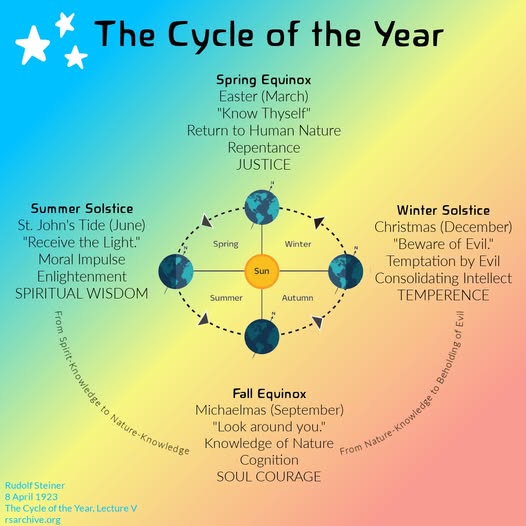
"Deviation from the moral impulses through the contemplation of evil, its overcoming through moderation—this was to come to man's consciousness just in the time following midwinter. Hence in this ancient wisdom all sorts of things were undertaken that induced men to atone for what they recognized as deviations from the moral impulses they had received through Enlightenment. With this, we approach spring, the spring equinox (see diagram). And just as here (see diagram: midsummer, autumn, midwinter) we have Enlightenment, Cognition, Temperance, so for the spring equinox we have what was perceived as the activity of repentance. And in place of Cognition, and correspondingly, Temptation through Evil, there now entered something which we could call the Return—the reversion—to man's higher nature through Repentance. Where we have written here (see diagram: midsummer, autumn, winter): Enlightenment, Cognition, Temperance, here we must write: Return to Human Nature.
If you look back once more to what was in the depths of winter the Temptation by Evil, you will have to say: At that time man felt as though he were lowered into the abysmal deeps of the Earth; he felt himself entrapped by Earth's darkness. Just as during the height of summer man was in a sense torn out of himself, his soul-nature being then lifted up above him, so now, in order not to be ensnared by Evil during the winter, his soul-being made itself inwardly free."
Rudolf Steiner, The Cycle of the Year, Lecture V, GA 223, 8 April 1923, Dornach.