

The Christmas Conference
GA 260
Part II. The Proceedings of the Conference
26 December 1923 10:00 a.m., Dornach
VII. Continuation of the Foundation Meeting
Dr. Steiner:
My dear friends!
We are in the middle of the reports by the General Secretaries and the representatives of the groups working in all kinds of places outside Dornach. In a moment we shall continue with these reports. But first I would like to speak a few words in the midst of these reports, words to which I am moved by what has been said in such a satisfactory way by these speakers. From what we have been told we may gather how very devoted is the work being carried on out there. We may add what we were told yesterday to the names I allowed myself to mention the day before. There, too, despite the ruins on which we stand, we may see what can encourage us during this Conference not to be pessimistic in any way but rather to strive actively for a genuine optimism.
During this Conference we must everywhere, in every realm, consider the activity of building-up rather than the activity of dismantling. So today, early on in the Conference, I want to suggest that we give it a certain definite direction. During the meetings of members over the next few days there will of course be opportunities for discussing various matters. But today, early on, I want to say the following: As we saw in the necessary content of the Statutes, we have to connect total openness with the Anthroposophical Society. Anything less, dear friends, is not permitted by the signs of the times. The present age can no longer tolerate any tendency towards secrecy. This presents us with a fundamental problem which we shall have to solve.
By this I do not mean that we shall have to discuss it a great deal during the Conference, for it is in our hearts that this fundamental problem will have to be solved. We must be absolutely clear about the fact that our Society, before all others, will be given the task of combining the greatest conceivable openness with true and genuine esotericism.
At first under the obstacles and hindrances of those terrible years of the war, but then also through all kinds of inner difficulties, we have indeed experienced the establishment of this problem in every direction. Indeed lately no meeting within the Anthroposophical Society has taken place which lacked, as it were, the backdrop—though unnoticed by many—of this problem: How can we combine full openness with the profoundest, most serious and inward esotericism? To achieve this it will be necessary to banish from our gatherings in the future anything which smacks in any way of the atmosphere of a clique. Anthroposophy does not need the atmosphere of a clique. When hearts truly understand Anthroposophy they will beat in unison without the need for heads to knock together. If we solve this purely human problem of letting our hearts sound in harmony with one another without the need for our heads to knock together, then from the human side we shall have done everything necessary, also in the leadership of the Anthroposophical Society, to prepare for the achievement of the things that have been depicted.
We must achieve these things; we must reach the point at which we can feel in all our deeds that we are connected with the spiritual world. This is the very aspect which must be different in the Anthroposophical Society from any other possible association in the present time. The difference must be that out of the strength of Anthroposophy itself it is possible to combine the greatest conceivable openness with the most genuine and inward esotericism. And in future this esotericism must not be lacking even in the most external of our deeds. There is in this field still a lot to learn from the past ten years.
What I am saying is also related to our responsibilities. Consider the following, my dear friends: We stand in the world as a small Society, and this Society has a peculiar destiny at present. Even if it wanted to, it could not reject this characteristic of openness which I have been emphasizing so strongly. It would be unable to reject it. For if out of some leaning of sympathy we were to decide today to work only inwardly with our groups, which would of course be very nice, if we were not to concern ourselves with the public at large, we would discover that there would soon be an increasingly inimical concern for us on the part of the public. The more we fail to concern ourselves with the signs of the times, the more will be the inimical concern for us on the part of everything that can possibly be against us. Only if we find the path, only if with courage we find the straight path to what we should do shall we succeed in navigating the ship of the Anthroposophical Society through the exceedingly stormy waves which surge and break around it. What we should do is the following: As a small Society we face the world, a world—you know the one I mean—which actually does not love us. It does not love us. This is a fact we cannot alter. But on the other hand there is no need to do anything on purpose to make ourselves unpopular. I do not mean this in a superficial sense but in a deeper sense of which I speak from the foundations of occult life. If we ask ourselves over and over again what we must do to make ourselves better liked by this circle or by that circle in the world, by any circle which does not like us today; if we keep asking ourselves how we should behave in this field or in that field so as to be taken seriously here or there; if we do this, we shall most certainly not be taken seriously. We shall only be taken seriously if at every moment in whatever we do we feel responsible towards the spiritual world. We must know that the spiritual world wants to achieve a certain thing with mankind at this particular moment in historical evolution; it wants to achieve this in the most varied realms of life, and it is up to us clearly and truly to follow the impulses that come from the spiritual world. Though this might give offence initially, in the long run it is the only beneficial way. Therefore we shall also only come to terms among ourselves if at every opportunity we steep ourselves in whatever impulses can come out of the spiritual world.
So now, having given these indications, which I shall bring to completion over the next few days, I once more want to repeat before you at least a part of those words which were spoken to you yesterday in accordance with the will of the spiritual world. May they stand as an introduction in our souls again today as we enter into our discussions.
Soul of Man!
Thou livest in the limbs
Which bear thee through the world of space
In the spirit's ocean-being.
Practise spirit-recalling in depths of soul,
Where in the wielding will
Of world-creating
Thine own I
Comes to being
Within God's I.
And thou wilt truly live
In the World-Being of Man.
Soul of Man!Thou livest in the beat of heart and lung
Which leads thee through the rhythm of time
Into the realm of thine own soul's feeling.
Practise spirit-awareness
In balance of the soul,
Where the surging deeds
Of the world's becoming
Thine own I
Unite
With the World-I.
And thou wilt truly feel
In the Soul-Weaving of Man.Soul of Man!
Thou livest in the resting head
Which from the grounds of eternity
Opens to thee the world-thoughts.
Practise spirit-beholding
In stillness of thought,
Where the eternal aims of Gods
World-Being's Light
On thine own I
Bestow
For thy free willing.
And thou wilt truly think
In the Spirit-Foundations of Man.
We can work rightly with words such as these, which are heard coming from the Cosmic Word, if we arrange them in our own soul in such a way that they cannot depart from us again. And it will be possible for them to be so arranged if, amongst all that has resounded, you first highlight that part which can give you the rhythm. Dear friends, let me write down here first of all the part that can indicate the rhythm:
In the first verse: Spirit-recalling,
in the second verse: Spirit-awareness,
in the third verse: Spirit-beholding.
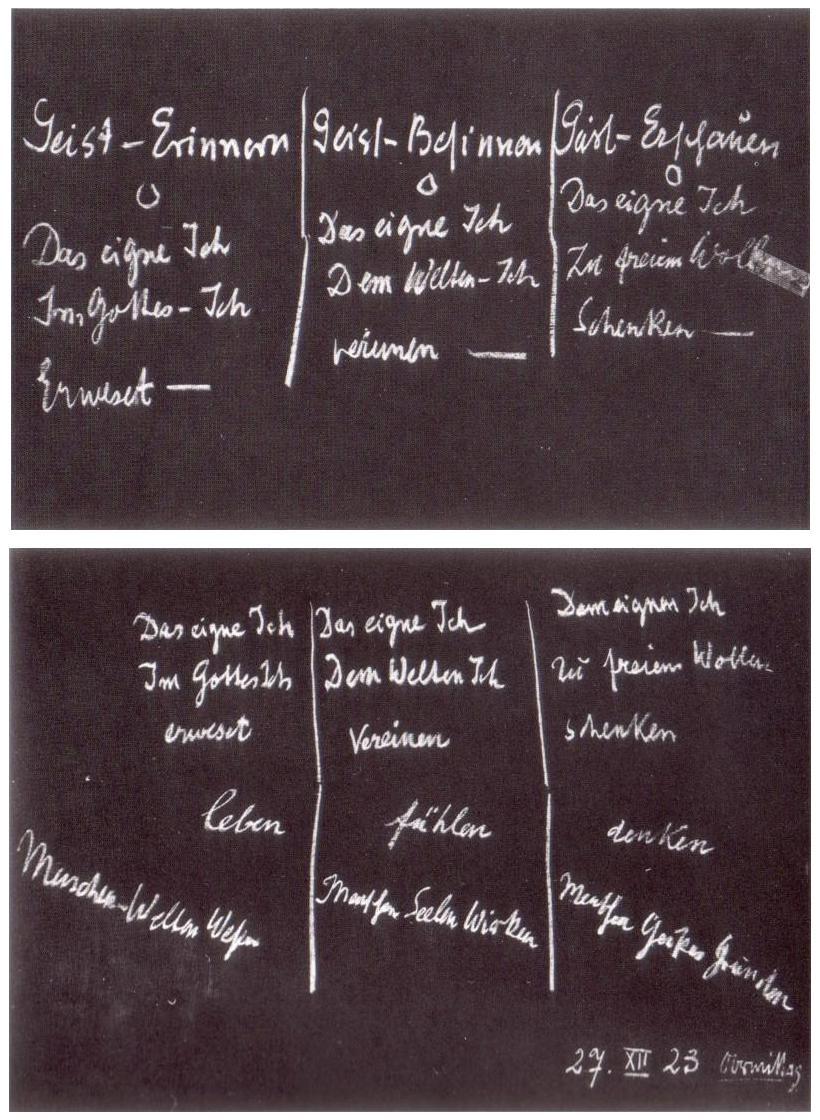
Contemplate this in its rhythmical connection with what is brought about in the human soul which is called upon, the human soul which is called upon by itself, through the words:
Thine own I
Comes to being
Within God's I—,
consider the rhythm linked with ‘spirit-awareness’ when you hear:
Thine own I
Unite
With the World-I—,
and the rhythm linked with ‘spirit-beholding’ when you hear:
On thine own I
Bestow
For thy free willing—.
Take in this way each phrase so that it can only stand as I have written it here. Take what comes rhythmically out of the Cosmic Rhythm: ‘own I within God's I’, ‘own I in the World-I’, ‘own I in free willing’. And take what rises up from ‘comes to being’ to ‘unite’ to ‘bestow’, where there is the transition to moral feeling. Feel the connection with ‘spirit-recalling’, ‘spirit-awareness’ and ‘spirit-beholding’. Then you will have in the inner rhythm what it is during these few days that the spiritual world is bringing to us to raise our hearts, to illumine our thinking, to give wings and enthusiasm to our willing.
I now have a telegram to read to you: ‘Christmas greetings, best wishes, Ethel Morgenstierne.’ And now may I ask the representative of Honolulu, Madame Ferreri, to speak.
Madame Ferreri reports.
Dr. Steiner: May I now ask the representative of Italy, Baroness de Renzis, to speak.
Baroness de Renzis reports.
Dr. Steiner: May I perhaps suggest that certain questions raised here, such as that of accepting applications for membership on the basis of correspondence only, and similar matters, shall be discussed later when we consider the Statutes.
Dr. Steiner: The Duke of Cesaro will also give a report concerning Italy on behalf of the Novalis Group in Rome.
The Duke of Cesaro reports.
Dr. Steiner: Now may I ask Fräulein Schwarz to speak on behalf of the other Italian group.
Fräulein Schwarz reports on behalf of the group in Milan.
Dr. Steiner: Now would the representative of the work in Yugoslavia, Herr Hahl, please speak.
Herr Hahl reports.
Dr. Steiner: May I ask the representative of the Norwegian Society, Herr Ingerö, to speak.
Herr Ingerö speaks.
Dr. Steiner: Now may I ask the representative of the Council of the Austrian Society, Count Polzer, to speak.
Count Polzer speaks.
Dr. Steiner: Now may I ask the representative of the group in Porto Alegre in Brazil, Dr Unger, to speak.
Dr. Unger: Allow me in a few words to carry out a commission which I was most delighted to accept. For quite some time we have been corresponding with friends over there, mostly from Germany, who had emigrated and had begun to work there anthroposophically. Herr Brandtner in particular has been writing lately. He has made great efforts to get something going in Porto Alegre. And connected with this, work is also going on in other South American towns which will gradually be co-ordinated so that independent centres from which to work may be set up there too. For this purpose Herr Mayen from Breslau was asked by the friends over there to go out, first of all to Rio. He will gradually take on work in a number of towns. I have been particularly asked to give voice to the sympathetic interest of the friends over there. Everything that comes to us from over there expresses the most intimate interest in all that has to do with Dornach and whatever continues to come from Dornach. As often as possible someone comes to Europe and we hope most fervently that anthroposophical life may soon start to blossom there in the most intensive way. Just as I bring greetings from our friends over there, so I hope that when I report back to Porto Alegre I may also be permitted to send them from here our good wishes for the prospering of the work in Porto Alegre.
Dr. Steiner: May I now ask the representative of the Swedish Anthroposophical Society, Fräulein Henström, to speak.
Fräulein Henström reports.
Dr. Steiner: May I now ask the representative of the Swiss Anthroposophical Society, Herr Aeppli, to speak.
Herr Aeppli reports.
Dr. Steiner: May I now ask the representative of the Council in Czechoslovakia, Dr Krkavec, to speak.
Dr. Krkavec reports.
Dr. Steiner: May I now ask the other representative of the Council in Czechoslovakia, Dr Eiselt, to speak.
Dr Eiselt reports.
Dr. Steiner: This brings the reports to a close. I believe I may be allowed to say that you are all, with me, exceedingly grateful to those who have given them. For they enable us to see that we have a foundation on which to base our new work, since now we know how much truly great, devoted and varied work is being done and has already been done in the Anthroposophical Society.
Now I should like to move on to the third point on our agenda, consideration of the Statutes. First the Statutes must be read out. Though you all have a copy, I would nevertheless like to ask that they be read out once more, so that we can then commence the discussion of each point. Would Dr Wachsmuth now please read the Statutes in accordance with point three of our agenda.
Dr. Wachsmuth reads out the Statutes of the Anthroposophical Society.
Dr. Steiner: As you will have gathered from various remarks I have made, it would be really good if on the one hand our meeting could be allowed to run as freely as possible amongst its individual members. However, on the other hand, if a proper discussion is to take place, it is necessary for us to be quite strict in conducting the debate. So please take this not as pedantry but as a necessity applicable to any gathering. Today we have run out of time, so I would ask you that we continue this meeting tomorrow after Dr Wachsmuth's lecture. Tomorrow morning at 10 o'clock Dr Wachsmuth will give his lecture. Then we shall break for a quarter of an hour before continuing the meeting. At this meeting I should like to conduct the proceedings as follows. Not in order to be pedantic but so that we can be as efficient as possible there will first be a kind of general debate on the Statutes, a debate in which first of all the whole attitude, meaning and spirit of the Statutes in general is discussed.
Then I shall ask you to agree to the Statutes in general, after which we shall open a detailed debate in which we take one Paragraph at a time, when contributors will be asked to speak only to the Paragraph under consideration. There will then be a concluding debate leading to the final adoption of the Statutes. This is how I would ask you to proceed tomorrow when we discuss the Statutes.
Now I have to announce that our Conference continues this afternoon with a eurythmy performance at 4.30 and my lecture at 8 o'clock this evening. Tomorrow at 10 o'clock we shall hear Dr Guenther Wachsmuth's lecture in the field of natural science about the face of the earth and the destiny of man. Then after a quarter of an hour's break we shall continue with this meeting.
I also have several more announcements to make. As I had to stress earlier, before we began our meeting, it is quite difficult, because there are so many of us—and it is of course wonderful that there are so many dear friends here—to hold this gathering together. You cannot tell, just by coming to the meetings, how difficult it is. Of course we are deeply sorry that the primitive quarters here are causing such discomfort and so many problems for our dear friends. Nevertheless, I have to ask that in future not more than three seats are held by any one person. I have to say this because it has happened that whole rows of seats have been held by a single person, and this has led to innumerable discussions with those who have come in later.
Then I should like to remind you of the wish we expressed earlier that the two front rows be reserved for those dear friends who are either disabled or deaf or need special consideration for any other reason. If there are any seats left in these two rows, which is sure to be the case, then please leave them free for the General Secretaries of the different countries and for the secretaries who might be accompanying them. It will become necessary in the next few days to have the General Secretaries together here where they can be seen rather than scattered all over the hall.
Thirdly I would perhaps like once more to ask our Dornach friends—truly I have nothing personal against them—to take their seats next door in the ‘summer villa’.44This designation for the extension built on to the carpentry workshop for the occasion of the Christmas Conference referred to ‘the chilly draught which blew there permanently’ (Ernst Lehrs Gelebte Erwartung, Stuttgart, 1979). I know it is most inhospitable in this rainy and snowy weather, but all we can do is ask our Dornach friends to put up with the rain so that the friends from further afield can sit here in the hall away from the rain.
Also I would like to mention that from today the upper canteen will be open in the evening for those friends who are quartered in the dormitories or other inhospitable places, so that they may have somewhere to go that is heated. Food and drink will not be served then, but I hope that the conversations that can take place there will be all the more stimulating and encouraging. So although it will not be possible to quench hunger and thirst, it will be possible to keep as warm as may be in the evenings after my lecture until 11 o'clock at night.
Furthermore I want to draw your attention to the following: Mr Pyle in the most admirable way has modelled a very fine money-box45On the basis of a pencil drawing by Rudolf Steiner. which he has had produced. You will find these money-boxes outside the doors. If you look at them carefully you will find that the beautiful forms tempt you to want to own such a money-box yourselves. They are for sale, so you can buy one and take it home and put something in it every day. When it is full you can use what you have collected to put towards the re-building of the Goetheanum, or for any other purposes related to the Goetheanum. Let me point out that even if you only put in 10 Rappen every day—think what you might spend this on each day—by the end of the year you will have saved quite a tidy sum. I can see my respected friends here are already working out how much! You will find that it will be a worthwhile amount. But I don't want to encourage you to put in only 10 Rappen. I would rather you put in whatever amount you consider proper, or whatever you feel obliged to put in even if you don't think it proper.
Those who find it difficult for one reason or another to take a money-box home with them will see that similar money-boxes have been set out here into which they may put something. Naturally if you do not have your own money-box to take home, it would be a good thing if you could delve deeply into your purse while you are here, so that these money-boxes may be filled. We shall have no trouble in seeing to it that they are rapidly emptied.
Finally I would please ask that spectators at the Christmas Plays refrain from booking their seats for the evening lectures.
You see, without all these many wishes—let us not call them prohibitions—we shall be unable to keep the Conference going in an orderly manner.
Now, my dear friends, I adjourn this meeting until the appointed hour tomorrow.
Fortsetzung der Gründungsversammlung
Thema: Die zukünftige Arbeit der Allgemeinen Anthroposophischen Gesellschaft und deren Ländergesellschaften. - Fortsetzung der Berichte der Generalsekretäre
Dr. Steiner:
Meine lieben Freunde!
Wir stehen mitten in den Berichten der Generalsekretäre und der Vertreter der Gruppen, die in den verschiedenen Gegenden draußen tätig sind. Wir werden sogleich diese Berichterstattung fortsetzen. Gestatten Sie nur, daß ich mitten in diese Berichterstattung hinein ein paar Worte spreche. Gerade dasjenige, was in so wirklich befriedigender Weise gestern von den einzelnen Berichterstattern gesagt worden ist, gibt mir dazu Veranlassung. Wir sehen aus dem, was uns da mitgeteilt worden ist, wie hingebungsvoll überall draußen gearbeitet wird, und wir dürfen dasjenige, was uns gestern berichtet worden ist, hinzuzählen zu den Namen, von denen ich vorgestern mir erlaubte zu sprechen und von denen wir glauben dürfen, daß sie trotz der Trümmer, auf denen wir stehen, anzusehen sind als dasjenige, was uns bei dieser Tagung nicht zu irgendeinem Pessimismus, sondern durchaus zu echtestem, weil vielleicht tatkräftigem Optimismus anfeuern kann.
Wir müssen bei dieser Tagung eigentlich überall, auf allen Gebieten, an den Aufbau und nicht an das Abtragen denken. Und deshalb möchte ich heute schon aufmerksam machen darauf, daß wir vielleicht sehen sollten, die ganze Tagung in einer gewissen Beziehung zu orientieren. Es wird sich die Möglichkeit bieten, noch in den nächsten Tagen bei unseren Mitgliederversammlungen selbstverständlich das eine oder das andere zu besprechen. Aber schon heute möchte ich dieses sagen: Wir konnten es ja aus den in ihrem Inhalte als eine Notwendigkeit sich ergebenden Statuten ersehen, daß wir mit der Anthroposophischen Gesellschaft die volle Öffentlichkeit verbinden müssen. Das geht, meine lieben Freunde, aus den Zeichen der gegenwärtigen Zeit heraus nicht anders. Alles Hineintauchen in irgend etwas Geheimnisvolles verträgt die heutige Zeit nicht mehr. Und daraus ergibt sich gerade für uns, ich möchte sagen, ein Grundproblem, das wir lösen müssen.
Ich meine nicht, daß wir während dieser Tagung sehr viel darüber zu debattieren brauchen, sondern wir müssen dieses Grundproblem in unseren Herzen lösen. Wir müssen uns klar sein darüber, daß gerade unserer Gesellschaft die Aufgabe zufallen wird, die denkbar größte Öffentlichkeit zu verbinden mit echter, wahrer Esoterik.
Ja, meine lieben Freunde, wir haben zunächst unter den Hemmnissen und Hindernissen der furchtbaren Kriegszeit und dann auch unter macherlei inneren Schwierigkeiten sozusagen die Aufstellung dieses Problems nach allen Seiten erlebt. Es gab im Grunde genommen keine der Versammlungen, die in der letzten Zeit innerhalb der Anthroposophischen Gesellschaft gehalten worden sind, in denen nicht wie ein Hintergrund, den allerdings viele nicht bemerkt haben, wie ein Hintergrund hinter allem das Problem stand: Wie verbinden wir die volle Öffentlichkeit mit der tiefsten, ernstesten, innerlichsten Esoterik? Dafür ist es notwendig, daß nun wirklich alle unsere Versammlungen in der Zukunft herausgehoben werden aus alledem, was man Vereinsmäßiges nennen kann. Anthroposophie braucht nicht das Vereinsmäßige im gewöhnlichen Sinne des Wortes. Wo Anthroposophie wirklich Verständnis findet in den Herzen, da werden diese Herzen zusammen schlagen können, ohne daß die Köpfe aneinanderstoßen. Und wenn wir dieses rein menschliche Problem lösen, daß die Herzen zusammenklingen können, ohne daß die Köpfe aneinanderstoßen, dann werden wir von der menschlichen Seite aus ja tatsächlich alles das getan haben, was notwendig ist, um uns vorzubereiten, auch in der Führung der Anthroposophischen Gesellschaft diese Dinge zu erreichen, die bezeichnet worden sind.
Und wir müssen sie erreichen, wir müssen es erreichen, daß wir bei allen unseren Handlungen die Empfindung haben können des Zusammenhanges mit der geistigen Welt. Denn das muß ja gerade der Unterschied sein zwischen unserer Anthroposophischen Gesellschaft und irgendeiner anderen Vereinigung, die es gegenwärtig geben kann. Der Unterschied muß der sein, daß aus der Kraft der Anthroposophie selber heraus diese Möglichkeit besteht, die denkbar größte Öffentlichkeit zu verbinden mit wahrster, innerlichster Esoterik. Und die Esoterik darf uns in der Zukunft auch bei den äußerlichsten Handlungen nicht fehlen. Wir müssen auf diesem Gebiete von den letzten zehn Jahren eben doch manches lernen.
Und dasjenige, was ich da sage, bezieht sich auch auf die Verantwortlichkeiten. Bedenken Sie, meine lieben Freunde, das Folgende: Wir stehen als eine kleine Gesellschaft in der Welt, und diese Gesellschaft hat in der Gegenwart ein merkwürdiges Schicksal. Sie könnte gar nicht, wenn sie auch wollte, diesen Charakter der Öffentlichkeit, den ich jetzt so besonders stark betone, ablehnen, sie könnte es nicht. Denn würden wir heute aus irgendeiner Sympathie heraus beschließen, in den Gruppen nur innerlich zu arbeiten, was ja gewiß sehr schön wäre, würden wir uns nicht um die Öffentlichkeit kümmern, so würden wir sehen, wie das noch immer mehr und mehr überhandnimmt, daß sich die Öffentlichkeit um uns im feindlichen Sinne bekümmert. Je mehr wir uns um dasjenige, was die Zeichen der Zeit sind, nicht kümmern, desto mehr wird sich im feindlichen Sinne dasjenige, was irgendwie nur dastehen kann als gegnerisch von uns, um uns bekümmern. Und nur wenn wir den Weg finden, mit Mut den geraden Weg finden zu dem Folgenden, dann wird es uns gelingen, das Schiff der Anthroposophischen Gesellschaft durch die heute um sie herum brandenden und wallenden sehr stürmischen Wogen hindurchzuleiten. Dasjenige, was wir finden müssen, ist dieses: Wir stehen als eine kleine Gesellschaft der Welt gegenüber, und die Welt - Sie wissen, welche ich meine - liebt uns eigentlich nicht. Sie liebt uns nicht. Das ist ein Faktum, an dem können wir nichts ändern. Aber wir brauchen auch nichts dazu zu tun, um uns möglichst unbeliebt zu machen. Ich meine das nicht im trivialen Sinne, sondern ich meine es in einem tieferen Sinne, der wirklich aus den Grundlagen des okkulten Lebens heraus gesprochen ist. Wenn wir immer wieder und wieder fragen: Was müssen wir gegenüber diesen oder jenen Kreisen in der Welt, die uns ja heute nicht lieben, unsererseits zu Liebe tun? Wie müssen wir uns verhalten auf diesem oder jenem Gebiete, damit wir da oder dort voll genommen werden? dann werden wir ganz sicher nicht voll genommen. Sondern wir werden nur voll genommen werden, wenn wir uns in jedem Augenblicke mit unserem Tun verantwortlich fühlen der geistigen Welt gegenüber, wenn wir wissen: Die geistige Welt will mit der Menschheit in dem gegenwärtigen Augenblicke der historischen Entwickelung etwas, will dieses Etwas auf den verschiedensten Gebieten des Lebens, und an uns ist es, klar und wahr den Impulsen aus der geistigen Welt heraus zu folgen. Wenn auch das Anstöße gibt für den ersten Augenblick, für die Dauer wird es das allein Heilsame sein. Und deshalb werden wir auch mit uns selbst nur zurechtkommen, wenn wir bei jeder Gelegenheit uns durchdringen mit demjenigen, was als Impulse aus der geistigen Welt kommen kann.
Deshalb möchte ich, nachdem ich diese Andeutungen, die ich in den nächsten Tagen vervollständigen werde, gesagt habe, auch heute vor Ihnen wiederholen wenigstens einen Teil der Worte, die mit dem Willen der geistigen Welt gestern zu Ihnen gesprochen worden sind, damit wir sie als Introduktion auch heute in unserer Seele haben, indem wir auf die Verhandlungen eingehen.
Menschenseele!
Du lebest in den Gliedern,
Die dich durch die Raumeswelt
Im Geistesmeereswesen tragen:
Übe Geist-Erinnern
In Seelentiefen,
Wo in waltendem
Weltenschöpfer-Sein
Das eigne Ich
Im Gottes-Ich
Erweset;
Und du wirst wahrhaft leben
Im Menschen-Welten-Wesen.Menschenseele!
Du lebest in dem Herzens-Lungen-Schlage,
Der dich durch den Zeitenrhythmus
Ins eigne Seelenwesensfühlen leitet:
Übe Geist-Besinnen
Im Seelengleichgewichte,
Wo die wogenden
Welten-Werde-Taten
Das eigne Ich
Dem Welten-Ich
Vereinen;
Und du wirst wahrhaft fühlen
Im Menschen-Seelen-Wirken.Menschenseele!
Du lebest im ruhenden Haupte,
Das dir aus Ewigkeitsgründen
Die Weltgedanken erschließer:
Übe Geist-Erschauen
In Gedanken-Ruhe,
Wo die ew’gen Götterziele
Welten-Wesens-Licht
Dem eignen Ich
Zu freiem Wollen
Schenken;
Und du wirst wahrhaft denken
In Menschen-Geistes-Gründen.
Und wir kommen mit solchen aus dem Weltenworte heraus gehörten Sprüchen zurecht, wenn wir sie in unseren eignen Seelen so gliedern, daß sie uns nicht verlassen können. Und sie werden sich gliedern können, wenn Sie herausheben zunächst aus dem, was also erklungen hat, dasjenige, was Ihnen den Rhythmus geben kann. Ich schreibe vor Sie hin, meine lieben Freunde, zunächst einen Teil dessen, was den Rhythmus geben kann:
In der ersten Strophe:
[Es wird gesprochen und an die Tafel geschrieben. Faksimile siehe Beilage 4, Tafel I. Zu Zeile 8 v.u. und 3 v.u. siehe den Hinweis.]
Geist-Erinnern,
in der zweiten Strophe:
Geist-Besinnen,
in der dritten Strophe:
Geist-Erschauen.
Das betrachten Sie im rhythmischen Zusammenhange mit dem, was da wird in der angerufenen, das heißt in der von sich selbst angerufenen Menschenseele, wenn es heißt:
Das eigne Ich
Im Gottes-Ich
Erweset —,
betrachten Sie den zusammenhängenden Rhythmus von «GeistBesinnen», wenn es da heißt:
Das eigne Ich
Dem Welten-Ich
Vereinen -,
und von «Geist-Erschauen», wenn es da heißt:
Das [Dem] eigne[n] Ich
Zu freiem Wollen
Schenken —.
[Tafelanschrift. Schreibweise hier und im folgenden gemäß der zweiten Handschrift]
| Geist-Erinnern O Das eigne Ich Im Gottes-Ich Erweset — |
Geist-Besinnen O Das eigne Ich Dem Welten-Ich Vereinen — |
Geist-Erschauen O Das [Dem] eigne[n] Ich Zu freiem Wollen Schenken — |
Nehmen Sie in diesem Zusammenhange jedes der einzelnen Worte also, daß es nur, wie es dasteht, dastehen kann. Nehmen Sie dasjenige, was aus dem Welten-Rhythmus heraus rhythmisiert: «eigne Ich im Gottes-Ich», «eigne Ich im Welten-Ich», «eigne Ich im freien Wollen», und nehmen Sie dasjenige, was aufsteigt von «Erweset» zu «Vereinen», zu «Schenken», wo es übergeht in die moralische Empfindung. Empfinden Sie den Zusammenhang mit dem «GeistErinnern», «Geist-Besinnen» und «Geist-Erschauen»: dann werden Sie in dem inneren Rhythmus dasjenige haben, was in diesen Tagen die geistige Welt wirklich zu uns bringt zur Erhebung unserer Herzen, zur Erleuchtung unseres Denkens, zur Beflügelung und Enthusiasmierung unseres Wollens.
Ich habe nun zu verlesen ein Telegramm: «Weihnachtsgrüße, Glückwünsche, Ethel Morgenstierne.» - Und ich werde nun bitten, das Wort erteilen zu dürfen dem Vertreter von Honolulu, Madame Ferreri.
Madame Ferreri berichtet.
Dr. Steiner: Ich darf nun vielleicht die Vertretung von Italien, Baronin de Renzis, bitten, das Wort zu ergreifen. Baronin de Renzis berichtet.
Dr. Steiner: Vielleicht darf ich sagen, daß solche Fragen, wie hier eine angeregt worden ist, bezüglich der Aufnahme von Personen nur durch Briefwechsel und dergleichen, dann bei der Beratung der Statuten, die nachher stattfinden wird, zu besprechen sein werden.
Dr. Steiner: Es ist über Italien noch zu berichten durch den Herzog von Cesaro für die Novalis-Gruppe zu Rom. Der Herzog von Cesaro erstattet Bericht.
Dr. Steiner: Darf ich nun das Wort für eine andere italienische Gruppe Fräulein Schwarz erteilen.
Fräulein Schwarz berichtet für die Mailänder Gruppe.
Dr. Steiner: Ich bitte jetzt den Vertreter der jugoslawischen Arbeit, Herrn Hahl, das Wort zu ergreifen.
Herr Hahl berichtet.
Dr. Steiner: Darf ich dem Vertreter der Norwegischen Gesellschaft, Herrn Ingerö, das Wort geben.
Herr Ingerö berichtet.
Dr. Steiner: Ich darf nun dem Vorstandsvertreter der Österreichischen Gesellschaft, Herrn Grafen Polzer, das Wort erteilen. Graf Polzer berichtet.
Dr. Steiner: Ich darf nun dem Vertreter der Gruppe Porto Alegre in Brasilien, Dr. Unger, das Wort erteilen.
Dr. Unger: Darf ich nur mit wenigen Worten mich eines Auftrags entledigen, den ich mit großer Befriedigung übernommen habe. Wir stehen seit längerer Zeit in Verbindung mit den Freunden drüben, da es hauptsächlich Deutsche waren, die hinüberwanderten und dort anthroposophisch zu arbeiten begannen. Insbesondere Herr Brandtner, der uns geschrieben hat in dieser letzten Zeit, er hat sich viel bemüht, drüben etwas in Gang zu bringen, in Porto Alegre. In Zusammenhang damit steht ja auch, daß in anderen südamerikanischen Städten Arbeit im Gange ist, die nach und nach sich zusammenschließen wird, um dort selbständige Ausgangspunkte wiederum zu schaffen. Zu diesem Zwecke wurde ja auch Herr Mayen aus Breslau von den Freunden drüben hinübergeholt, zunächst nach Rio; dann wird er allmählich seine Arbeit in verschiedenen Städten übernehmen. Es obliegt mir hier gerade, die Teilnahme der Freunde drüben zum Ausdruck zu bringen. Es ist aus allem, was von drüben kommt, hervorgehend die innigste Anteilnahme an allem, was sich gerade auf Dornach bezieht und was von Dornach weiterhin ausgeht. So oft es möglich ist, kommt ja jemand von dort nach Europa, und wir hoffen recht sehr, daß auch bald in intensivster Weise drüben das anthroposophische Leben aufblühen möge. Ich hoffe, daß, wenn ich zurückberichten darf nach Porto Alegre, ich gerade so, wie ich die Grüße der Freunde für hier von drüben zu überbringen habe, auch die Wünsche des Gedeihens der Arbeit in Porto Alegre hinübermelden darf.
Dr. Steiner: Ich darf der Beauftragten der Schwedischen Anthroposophischen Gesellschaft, Fräulein Henström, das Wort erteilen. Fräulein Henström berichtet.
Dr. Steiner: Ich darf nun dem Vertreter der schweizerischen Anthroposophischen Gesellschaft, Herrn Aeppli, das Wort erteilen. Herr Aeppli berichtet.
Dr. Steiner: Ich darf nun dem Vorstandsvertreter der T'schechoslowakei, Herrn Dr. Krkavec, das Wort erteilen.
Dr. Krkavec berichtet.
Dr. Steiner: Ich darf dem anderen Vorstandsvertreter der Tschechoslowakei, Herrn Dr. Eiselt, das Wort erteilen.
Dr. Eiselt berichtet.
Dr. Steiner: Die Berichterstattung ist damit zu Ende geführt, und ich glaube aussprechen zu dürfen, daß sie alle mit mir den verehrten Berichterstattern außerordentlich dankbar sind, namentlich dafür, daß wir nun unseren neuen Arbeiten eine Grundlage geben können, da wir ja nunmehr wissen, wieviel wirklich große, hingebungsvolle, mannigfaltige Arbeit in der Anthroposophischen Gesellschaft geleistet wird und schon geleistet worden ist.
Ich möchte nun den Übergang finden zum dritten Punkt unserer Tagesordnung, zur Beratung der Statuten. Es muß natürlich vorangehen eine Verlesung der Statuten. Obwohl dieselben in aller Hände sind, würde ich doch bitten, die Statuten noch einmal vorlesen zu dürfen, damit wir dann die entsprechenden Besprechungen einleiten können. Ich bitte Herrn Dr. Wachsmuth, nun die Statuten zur Verlesung zu bringen als den dritten Punkt der Tagesordnung.
Dr. Wachsmuth verliest die Statuten der Anthroposophischen Gesellschaft.
Dr. Steiner: Es ist ja, wie Sie entnommen haben werden den verschiedenen Ausführungen, die ich getan habe, wirklich gut, wenn wir auf der einen Seite möglichst frei die Versammlung in ihren einzelnen Mitgliedern in den nächsten Tagen walten lassen. Allein, gewisse Dinge sind, wenn eine Besprechung stattfinden soll, schon einmal notwendig, und daher bitte ich, es nicht als eine Pedanterie, sondern eben als die Notwendigkeit bei einer Versammlung anzusehen, wenn wir nun in der Folge wirklich recht exakt in der Führung der Debatte vorgehen wollen. Es ist ja heute nicht mehr möglich, die Versammlung fortzusetzen, da die Zeit um ist, und ich werde Sie daher bitten, die Fortsetzung der Versammlung morgen nach dem Vortrage von Dr. Wachsmuth ansetzen zu dürfen. Es wird also morgen um 10 Uhr der Vortrag von Dr. Wachsmuth stattfinden, und nach einer Viertelstunde Pause nach diesem Vortrage werden wir die Fortsetzung der Versammlung dann haben können. Bei dieser für morgen festgesetzten Versammlung werde ich dann bitten, die Führung der Debatte so einrichten zu dürfen, daß wir - wirklich nicht um etwas Pedantisches durchzuführen, sondern um möglichst sachlich sein zu können - zunächst eine Art Generaldebatte eröftnen über die Statuten, das heißt eine Debatte, in der die ganze Haltung, der Sinn und der Geist der Statuten im allgemeinen besprochen werden.
Dann werde ich mir erlauben, um Ihre Zustimmung zu den Statuten im allgemeinen zu fragen, und nachher wollen wir eine Art Spezialdebatte eröffnen, die darinnen bestehen soll, daß wir Paragraph für Paragraph vornehmen werden und dann Wortmeldungen für einen einzelnen Paragraphen entgegennehmen werden. Dann werden wir eine abschließende Debatte halten, um die Statuten völlig zur Annahme zu bringen. In dieser Weise bitte ich Sie, morgen vorgehen zu dürfen für die Beratung der Statuten.
Ich habe nun mitzuteilen, daß im weiteren Verlaufe der Tagung stattfinden wird heute nachmittag um 4 Uhr 30 eine EurythmieVorstellung und abends um 8 Uhr mein Vortrag. Morgen um 10 Uhr wird stattfinden der Vortrag von Dr. Günther Wachsmuth auf dem Gebiete der Naturerkenntnis: «Erdenantlitz und Menschenschicksal», und dann wird nach einer Viertelstunde Pause die Fortsetzung dieser Versammlung erfolgen. Ferner habe ich noch einige Mitteilungen zu machen. Es ist ja, wie ich schon einleitend vor der Eröffnung der Versammlung betonen mußte, wirklich recht schwierig, bei einer so großen Anzahl, selbstverständlich erfreulich großen Anzahl lieber Freunde, die hier sind, die ganze Sache hier zusammenzuhalten. Man sieht das nicht, wenn man nur eben zu den Versammlungen kommt, wie schwierig es ist. Deshalb darf ich wohl bitten, trotzdem man es natürlich nur innigst bedauern kann, daß so viele Unbequemlichkeiten durch unsere primitive Einrichtung unseren lieben Freunden erwachsen, daß in der Zukunft von einer einzelnen Persönlichkeit niemals mehr als höchstens drei Plätze belegt werden. Ich muß das erwähnen aus dem Grunde, weil es vorgekommen ist, daß ganze Platzreihen von einem Einzelnen belegt worden sind. Das gibt unzählige Debatten derjenigen, die dann nachkommen.
Ferner möchte ich noch einmal auf den Wunsch aufmerksam machen, den wir ausgeprochen haben, die ersten zwei Reihen nur für diejenigen lieben Freunde zu reservieren, welche durch Lahmheit oder Schwerhörigkeit oder durch sonstige Gründe genötigt sind, eben eine größere Berücksichtigung zu erfahren. Wenn dann noch Plätze übrigbleiben, wie es ja der Fall sein wird, dann bitte ich, diese Plätze in den ersten zwei Reihen ausfüllen zu lassen von den Generalsekretären der einzelnen Länder und von denen, die diese Generalsekretäre wiederum als ihre Sekretäre bei sich haben. Es wird sich schon in den nächsten Tagen als eine Notwendigkeit herausstellen, daß die Generalsekretäre sozusagen übersichtlich bei der Hand sind, nicht im ganzen Saal zerstreut sind.
Als drittes darf ich vielleicht auch das geltend machen, daß noch einmal gebeten wird, es mögen die Dornacher Freunde - es ist ja wirklich nicht aus irgendeiner Rachsucht heraus — draußen Platz nehmen in der ja allerdings in dieser Regen- und Schneezeit unwirtlichen «Sommervilla»; aber wir können es schon nicht anders machen, als daß wir unsere Dornacher Freunde bitten, sich während dieser Zeit anregnen zu lassen, damit die auswärtigen Freunde hier im Saale sitzen können und hier eben nicht angeregnet werden.
Dann darf ich noch erwähnen, daß von jetzt ab abends die obere Kantine geöffnet sein wird für diejenigen Freunde, die in Massenquartieren oder dergleichen unwirtlich untergebracht sind, so daß man doch immer einen möglichen Aufenthaltsort finden wird, der geheizt sein wird. Allerdings, Speisen und Getränke werden nicht dort verabreicht werden in diesen Stunden, aber ich hoffe, um so anregendere und aufmunterndere Reden werden geführt werden. Also man wird, ohne daß man Hunger und Durst löschen kann, aber so warm als möglich, immer nach meinem Vortrag bis nachts 11 Uhr dort sich aufhalten können.
Ferner möchte ich noch auf das Folgende aufmerksam machen: Mr. Pyle hat in einer anerkennenswerten Weise eine sehr schöne Sparbüchse modelliert und ausführen lassen. Diese Sparbüchsen werden Sie draußen aufgestellt finden. Sie werden, wenn Sie sie genau betrachten, aus der Schönheit der Form heraus das Verlokkende empfinden, eine solche Sparbüchse selber zu besitzen. Man kann sie kaufen, sie ist hier käuflich vorhanden, kann sie mit nach Hause nehmen und kann jeden Tag in diese Sparbüchse etwas hineinlegen und es dann, wenn sie voll ist, herausnehmen, um es für den Wiederaufbau des Goetheanums oder überhaupt für Zwecke des Goetheanums verwenden zu lassen. Ich mache Sie darauf aufmerksam, daß wenn man jeden Tag nur 10 Rappen hineinlegt — denken Sie, für was man das im Tage ausgibt! so bildet das im Jahre eine ganz erkleckliche Summe. Ich sehe, hier rechnen bereits die verehrten Freunde! Sie werden sehen, daß dabei schon etwas Gutes herauskommt. Aber ich möchte nicht dadurch aufmuntern, bloß 10 Rappen hineinzulegen, sondern eben dasjenige hineinzulegen, was man für gut findet oder auch wofür man sich verpflichtet hält, selbst wenn man es nicht für gut findet.
Außerdem aber ist für jenen, der nun aus diesen oder jenen Gründen es zu unbequem findet, diese Sparbüchse mit nach Hause zu tragen, die Gelegenheit geboten, durch solche hier aufgestellte Sparbüchsen etwas in sie hineinzulegen. Da wird es ja allerdings dann gut sein, wenn man nicht eine eigene Sparbüchse hat, dann recht kräftig in die Börse zu greifen, um diese Sparbüchsen zu füllen. Wir werden schon für das schnelle Ausleeren sorgen.
Dann würde ich auch noch bitten, daß beim Besuch der Weihnachtspiele nicht Plätze belegt werden mögen für die Abendvorträge.
Sie sehen, wir müssen so viele — Verbote nennen wir’s aber nicht — Wünsche aussprechen, aber wir können sonst hier nicht Ordnung halten.
Damit, meine lieben Freunde, möchte ich die Versammlung bis morgen zu der Ihnen angegebenen Stunde vertagen.
Continuation of the Founding Meeting
Topic: The future work of the General Anthroposophical Society and its national societies. – Continuation of the reports by the General Secretaries
Dr. Steiner:
My dear friends!
We are in the middle of the reports from the general secretaries and the representatives of the groups working in various regions. We will continue with these reports in a moment. Allow me to say a few words in the middle of these reports. It is precisely what was said so satisfactorily yesterday by the individual reporters that prompts me to do so. From what has been communicated to us, we can see how devotedly people are working everywhere, and we can add what was reported to us yesterday to the names I mentioned the day before yesterday, and we can believe that, despite the ruins on which we stand, they can be regarded as something that can inspire us at this conference not with pessimism, but with genuine, perhaps even energetic optimism.
At this conference, we must think about building up rather than tearing down in all areas. And that is why I would like to draw your attention today to the fact that we should perhaps consider orienting the entire conference in a certain direction. There will of course be an opportunity to discuss one thing or another at our members' meetings in the next few days. But I would like to say this today: we could see from the statutes, which are necessary in terms of their content, that we must combine the Anthroposophical Society with full public visibility. My dear friends, given the signs of the times, there is no other way. The present age no longer tolerates any immersion in anything mysterious. And this presents us, I would say, with a fundamental problem that we must solve.
I do not mean that we need to debate this at length during this conference, but we must solve this fundamental problem in our hearts. We must be clear that it is precisely our society that will have the task of combining the greatest possible publicity with genuine, true esotericism.
Yes, my dear friends, we have experienced the emergence of this problem from all sides, first under the constraints and obstacles of the terrible war years and then also under various internal difficulties. Basically, there has been no meeting held recently within the Anthroposophical Society in which the problem has not been present as a background, unnoticed by many, behind everything else: How do we connect the full public with the deepest, most serious, most inner esotericism? To this end, it is necessary that all our future meetings be lifted out of everything that can be called club-like. Anthroposophy does not need the club-like in the ordinary sense of the word. Where anthroposophy really finds understanding in hearts, these hearts will be able to beat together without heads colliding. And if we solve this purely human problem, that hearts can beat together without heads colliding, then we will indeed have done everything necessary on the human side to prepare ourselves to achieve these things, which have been described, in the leadership of the Anthroposophical Society as well.
And we must achieve them; we must achieve it so that in all our actions we can have the feeling of connection with the spiritual world. For that must be the difference between our Anthroposophical Society and any other association that may exist at present. The difference must be that the power of anthroposophy itself makes it possible to combine the greatest possible publicity with the truest, most inner esotericism. And esotericism must not be lacking in our future actions, even the most outward ones. We have much to learn in this area from the last ten years.
And what I am saying here also applies to responsibilities. Consider the following, my dear friends: we are a small society in the world, and this society currently has a remarkable destiny. Even if it wanted to, it could not reject this character of publicness that I am now emphasizing so strongly; it could not do so. For if we were to decide today, out of some sympathy, to work only internally in the groups, which would certainly be very nice, if we were not to concern ourselves with the public, we would see how this would increasingly take over, how the public would concern itself with us in a hostile sense. The more we ignore the signs of the times, the more those who are hostile to us will concern themselves with us in a hostile sense. And only if we find the courage to take the straight path to what follows will we succeed in guide the ship of the Anthroposophical Society through the very stormy waves that are surging and swirling around it today. What we must realize is this: we stand before the world as a small society, and the world—you know what I mean—does not really love us. It does not love us. That is a fact, and we cannot change it. But we also don't need to do anything to make ourselves as unpopular as possible. I don't mean this in a trivial sense, but in a deeper sense that really comes from the foundations of occult life. If we ask again and again: What must we do on our part to show love to these or those circles in the world that do not love us today? How must we behave in this or that area so that we are taken seriously there? then we will certainly not be taken seriously. Rather, we will only be taken seriously if we feel responsible to the spiritual world in every moment of our actions, if we know: The spiritual world wants something from humanity at this moment in historical development, wants this something in the most diverse areas of life, and it is up to us to follow the impulses from the spiritual world clearly and truthfully. Even if this causes some initial resistance, in the long run it will be the only thing that is beneficial. And that is why we will only be able to cope with ourselves if we allow ourselves to be permeated at every opportunity by what may come as impulses from the spiritual world.
Therefore, after I have made these remarks, which I will complete in the next few days, I would like to repeat to you today at least some of the words that were spoken to you yesterday with the will of the spiritual world, so that we may have them in our souls as an introduction today as we enter into the proceedings.
Human soul!
You live in the limbs
That carry you through the spatial world
In the spiritual sea of being:
Practice spiritual remembrance
In the depths of the soul,
Where in the ruling
Being of the Creator of Worlds
Your own self
In the God-Self
Exists;
And you will truly live
In the human-world-being.Human soul!
You live in the heart-lung beat,
Which guides you through the rhythm of time
Into your own soul-being-feeling:
Practice spiritual reflection
In the balance of the soul,
Where the surging
World-becoming-deeds
The self
Unite with the world-self;
And you will truly feel
In the workings of the human soul.Human soul!
You live in a resting mind,
Which, from the depths of eternity,
Opens up the thoughts of the world to you:
Practice spiritual vision
In the tranquility of thought,
Where the eternal goals of the gods
Bestow the light of the world's essence
To the self
For free will
They give;
And you will truly think
In human-spirit foundations.
And we can cope with such sayings heard from the world word if we structure them in our own souls in such a way that they cannot leave us. And they will be able to be structured if you first highlight from what has been said that which can give you the rhythm. I will write down for you, my dear friends, first a part of what can give the rhythm:
In the first stanza:
[It is spoken and written on the board. See facsimile in Appendix 4, Table I. See note on lines 8 and 3 from the bottom.]
Spirit-remembrance,
in the second stanza:
Spirit-contemplation,
in the third stanza:
Spirit-vision.
Consider this in rhythmic connection with what happens in the invoked, that is, in the human soul invoked by itself, when it says:
The own I
In the God-I
Be —,
consider the connected rhythm of “spiritual contemplation” when it says:
The own I
With the world I
Unite —,
and of “spiritual vision” when it says:
The [own] self
To free will
Give —.
[Table inscription. Spelling here and in the following according to the second manuscript]
| Spirit-remembering O The self In the God-self Be — |
Spirit-contemplating O The self With the world-self Unite — |
Spirit-Contemplation O The [Own] Self To free Willing Giving — |
In this context, take each of the individual words so that they can only stand as they are written. Take what is rhythmic from the rhythm of the world: “own self in the God-self,” “own self in the world-self,” “own self in free will,” and take what rises from ‘being’ to “uniting,” to “giving,” where it transitions into moral feeling. Feel the connection with “spirit-remembering,” “spirit-contemplation,” and “spirit-vision”: then you will have in your inner rhythm that which the spiritual world truly brings to us these days to uplift our hearts, to enlighten our thinking, to inspire and enthuse our will.
I now have a telegram to read: “Christmas greetings, congratulations, Ethel Morgenstierne.” - And I will now ask the representative from Honolulu, Madame Ferreri, to take the floor.
Madame Ferreri reports.
Dr. Steiner: I would now like to ask the representative from Italy, Baroness de Renzis, to take the floor. Baroness de Renzis reports.
Dr. Steiner: Perhaps I may say that questions such as the one raised here, concerning the admission of persons solely through correspondence and the like, will have to be discussed during the deliberations on the statutes, which will take place afterwards.
Dr. Steiner: There is still to be reported on Italy by the Duke of Cesaro for the Novalis Group in Rome. The Duke of Cesaro will give his report.
Dr. Steiner: The Duke of Cesaro will now report on Italy on behalf of the Novalis Group in Rome. The Duke of Cesaro will now give his report.
Dr. Steiner: I would now like to give the floor to Miss Schwarz, representing another Italian group.
Miss Schwarz will report on behalf of the Milan Group.
Dr. Steiner: I now ask the representative of the Yugoslavian work, Mr. Hahl, to take the floor.
Mr. Hahl reports.
Dr. Steiner: May I now give the floor to the representative of the Norwegian Society, Mr. Ingerö. Mr. Ingerö reports.
Dr. Steiner: I now give the floor to the representative of the Austrian Society, Count Polzer. Count Polzer reports.
Dr. Steiner: I would now like to give the floor to the representative of the Porto Alegre group in Brazil, Dr. Unger.
Dr. Unger: Allow me to say a few words about a task that I have undertaken with great satisfaction. We have been in contact with our friends over there for quite some time, as it was mainly Germans who emigrated there and began to work anthroposophically. In particular, Mr. Brandtner, who has written to us recently, has made great efforts to get things going over there, in Porto Alegre. In connection with this, work is also underway in other South American cities, which will gradually join forces to create independent starting points there. For this purpose, Mr. Mayen from Breslau was brought over by our friends there, first to Rio; then he will gradually take over his work in various cities. It is my duty here to express the participation of our friends over there. Everything that comes from over there shows the deepest interest in everything that relates to Dornach and continues to emanate from Dornach. As often as possible, someone comes from there to Europe, and we very much hope that anthroposophical life will soon flourish in the most intensive way over there. I hope that when I report back to Porto Alegre, just as I have to convey the greetings of our friends over there to those here, I may also convey the wishes for the prosperity of the work in Porto Alegre.
Dr. Steiner: I would like to give the floor to the representative of the Swedish Anthroposophical Society, Miss Henström. Miss Henström reports.
Dr. Steiner: I now give the floor to the representative of the Swiss Anthroposophical Society, Mr. Aeppli.
Mr. Aeppli reports.
Dr. Steiner: I now give the floor to the representative of the Executive Council of Czechoslovakia, Dr. Krkavec.
Dr. Krkavec reports.
Dr. Steiner: I now give the floor to the other representative of the Executive Council of Czechoslovakia, Dr. Eiselt.
Dr. Eiselt reports.
Dr. Steiner: The reports are now complete, and I believe I can say that you all join me in expressing our deep gratitude to the esteemed rapporteurs, particularly for enabling us to establish a foundation for our new work, as we now understand the truly significant, dedicated, and diverse work that is being and has been accomplished within the Anthroposophical Society.
I would now like to move on to the third item on our agenda, the discussion of the statutes. Of course, this must be preceded by a reading of the statutes. Although everyone has a copy, I would nevertheless ask that the statutes be read aloud once more so that we can then begin the relevant discussions. I would ask Dr. Wachsmuth to read the statutes aloud as the third item on the agenda.
Dr. Wachsmuth reads out the statutes of the Anthroposophical Society.
Dr. Steiner: As you will have gathered from my various remarks, it is indeed a good thing if, on the one hand, we allow the assembly to function as freely as possible in its individual members over the next few days. However, certain things are necessary if a discussion is to take place, and I therefore ask you not to regard this as pedantry, but as a necessity for a meeting if we really want to proceed with the debate in a very precise manner. It is no longer possible to continue the meeting today, as the time is up, and I would therefore ask you to allow me to schedule the continuation of the meeting for tomorrow after Dr. Wachsmuth's presentation. Dr. Wachsmuth's presentation will therefore take place tomorrow at 10 a.m., and after a 15-minute break following this presentation, we will be able to continue the meeting. At tomorrow's meeting, I will ask to be allowed to conduct the debate in such a way that – not to be pedantic, but to be as objective as possible – we first open a kind of general debate on the statutes, that is, a debate in which the overall attitude, meaning, and spirit of the statutes are discussed in general terms.
I will then take the liberty of asking for your approval of the statutes in general, and afterwards we will open a kind of special debate, which will consist of going through the statutes paragraph by paragraph and then accepting comments on individual paragraphs. Then we will hold a final debate to bring the statutes to a complete conclusion. In this way, I ask your permission to proceed tomorrow with the discussion of the statutes.
I now have to announce that in the further course of the conference, there will be a eurythmy performance this afternoon at 4:30 p.m. and my lecture in the evening at 8 p.m. Tomorrow at 10 a.m., Dr. Günther Wachsmuth will give a lecture on the subject of nature knowledge: “The Face of the Earth and Human Destiny,” and then, after a 15-minute break, this meeting will continue. I also have a few more announcements to make. As I had to emphasize in my introduction before the opening of the meeting, it is really quite difficult to keep everything together with such a large number of dear friends here, which is of course a welcome thing. If you only come to the meetings, you don't see how difficult it is. Therefore, I must ask, even though we deeply regret that our primitive facilities cause so much inconvenience to our dear friends, that in the future no single person occupy more than three seats. I must mention this because it has happened that entire rows of seats have been occupied by a single person. This leads to countless debates among those who arrive later.
Furthermore, I would like to draw your attention once again to the request we have made to reserve the first two rows only for those dear friends who, due to lameness, hearing impairment, or other reasons, are in need of greater consideration. If there are still seats left, as will be the case, I would ask that these seats in the first two rows be filled by the secretaries-general of the individual countries and by those whom these secretaries-general have with them as their secretaries. In the next few days, it will become apparent that it is necessary for the secretaries-general to be clearly visible and not scattered throughout the hall.
Thirdly, I would like to ask once again that that our friends from Dornach – and this is really not out of any desire for revenge – take their seats outside in the “summer villa,” which is indeed inhospitable in this rainy and snowy season; but we have no choice but to ask our friends from Dornach to get wet during this time so that our friends from out of town can sit here in the hall and not get wet.
Then I may mention that from now on, the upper canteen will be open in the evenings for those friends who are housed in mass quarters or similar inhospitable accommodations, so that one will always be able to find a place to stay that is heated. However, food and drinks will not be served there during these hours, but I hope that all the more stimulating and encouraging conversations will take place. So, without being able to satisfy your hunger and thirst, but as warm as possible, you will always be able to stay there after my lecture until 11 p.m.
I would also like to draw your attention to the following: Mr. Pyle has designed and had made a very beautiful money box in a commendable manner. You will find these money boxes set up outside. If you look at them closely, you will be tempted to own such a money box yourself because of the beauty of its design. You can buy them; they are available for purchase here. You can take them home with you and put something in them every day, and then, when they are full, take them out and use the money for the reconstruction of the Goetheanum or for the purposes of the Goetheanum in general. I would like to point out that if you put in just 10 cents every day — think about what you spend that on in a day! — it will add up to a considerable sum over the course of a year. I see that my dear friends are already doing the math! You will see that something good will come of it. But I do not want to encourage you to put in only 10 cents, but rather to put in whatever you think is good or whatever you feel obligated to give, even if you do not think it is good.
In addition, for those who, for one reason or another, find it inconvenient to carry this money box home with them, there is an opportunity to put something in it by means of the money boxes set up here. Of course, if you don't have your own money box, it would be good to dig deep into your wallet to fill these money boxes. We will make sure that they are emptied quickly.
I would also ask that when attending the Christmas plays, seats for the evening lectures are not occupied.
As you can see, we have to express so many — let's not call them prohibitions — requests, but otherwise we cannot maintain order here.
With that, my dear friends, I would like to adjourn the meeting until tomorrow at the time indicated to you.