

The History of Art
GA 292
2 January 1917, Dornach
7. Representations of the Nativity
Today—since Dr. Trapesnikoff has ordered them—we will show you some pictures arranged from a different point of view than in our former lectures; more from the point of view of subject-matter. The pictures today will relate especially to the birth of Christ Jesus, the Adoration by the Shepherds and by the Three Wise Men, and finally the Flight into Egypt. Comprising an evolution through several centuries, they will bring before our souls, from another aspect, that which is living in the Old Christmas Plays of which we have been speaking in the last lectures. We shall thus be concerned today, not in the first place with the artistic elements, as such, but with the treatment of a certain theme in the history of Art, and I will therefore speak not so much of the evolution of artistic principles, but draw your attention to some other points of view which may be of interest in relation to these pictures. You will, however, bear in mind the general lines of development of Christian Art, which we have described in the past lectures of this series. You will observe the same great trend of evolution, as we pass from the artistic representations of the early Christian centuries into the times of the Renaissance. First you will see the more typical representations of an early time. These, as we have seen, were still under the influence of Revelations from the Spiritual World. Less concerned with naturalistic expressions of form and color, they try to reproduce the spiritual Imaginations, revealed out of the Spiritual World. Thenceforward you will see this Christian Art evolve towards Naturalism, that is, towards a certain reproduction of that which may be called reality from the point of view of the physical plane. As we follow the evolution of this Art, the sacred personalities stand before us in a more and more human form.
We shall first show some pictures relating more especially to the Birth of Christ. Then we shall show the Adoration of the Child by the Shepherds; indeed, these two, to some extent, will go together. The next series of pictures will deal mainly with the story of the Three Wise Men of the East—the Magi. Here I beg you to observe how the two streams evolve: the stream of St. Luke's Gospel, as we may call it, and that of the Gospel of St. Matthew. They are the streams which take their start from the two Jesus Children. Artistically, too, we can recognise the difference. The Adoration by the Shepherds—all that is more or less related to this theme—could best be understood (understood, that is to say, by the inner feelings) under the influence of what remained from those Northern Mysteries whose center, as I told you, was in Denmark. This stream is connected with all that related to the Birth of Jesus—springing forth, as it were, with Jesus, out of the earthly evolution, out of the spiritual beings that are bound up with the life of Nature.
In the Adoration by the Magi, on the other hand—the mission of the Three Wise Men from the East—we always find a direct expression of the “Gnostic” stream. Under the influence of the “Star”—which means, something that is made known out of the Cosmos—the Wise Men draw near to the Christ Who heralds His approach and develops in the Zarathustra Jesus. In all that is connected with the Adoration by the Three Wise Men, we have, therefore the Gnostic stream: the consciousness that the Christ-Event was a cosmic one; that a fertilisation of the Earth had taken place out of the Cosmos.
Our friends have been kind enough to put up here a drawing of the Three Wise Men. The picture is taken from an old Gospel Book. We see them looking up in adoration, that is, in quest of spiritual knowledge, by striving upward with all their inner being, and looking up to the Star wherein the Spirit Who shall liberate the Earth draws near.
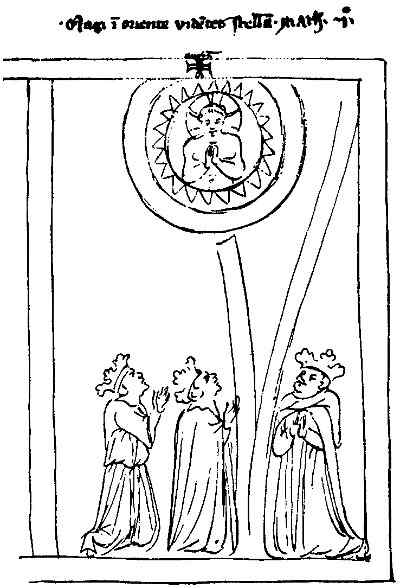
1. Three Wise Men.
It may truly be said that this stream, which finds expression in St. Matthew's Gospel, was less and less understood in the further course of centuries. True, it also came to life, as you know, in the Old Christmas Plays. But the appearance of the Three Wise Men of the East cannot really be understood with the same understanding, as the appearance of Jesus to the Shepherds according to St. Luke's Gospel. For the latter is a simple understanding of the heart, of inner feeling; while the understanding which we must bring to bear on all that is connected with the Wise Men from the East must needs be of a “Gnostic” character. All that is signified by the Wise Men “following the Star” will only come into the consciousness of humanity again when—not the Gnosis this time, it is true—but anthroposophical Spiritual Science gains acceptance.
Finally, we shall show some pictures of the Flight into Egypt. This, too, is connected with the “Gnostic” Revelation concerning Jesus Christ. We cannot speak of it at great length today; we may return to it another time.
To begin with, it is important here, again, to realise that there is a certain underlying composition in all that the Gospels contain. The composition is always important. We need only faithfully follow the Gospel narrative. The Flight into Egypt appears in direct connection with the Mission of the Three Wise Men. It happens, as it were, on the basis of what was first undertaken by the Three Wise Men. This bears witness to the fact that the Gospel is taking into account the connection with all that was related about Egypt in the Old Testament. Moses was learned in the Wisdom of the Egyptians. Now we are told in the Gospel that the Three Wise Men of the East came to the birthplace of Christ Jesus, led by the Star which is really the Star of Christ. But it goes on to relate that something now had to take place which did not entirely accord, as it were, with the course of the Star; something which was not in the consciousness of the Wise Men themselves—for so the Gospel explicitly tells us. Here we are shown one of those cases where the astrological determination, as it were, of certain great events has to be broken through. How precisely the astrological determination corresponds to what is known of the historic facts—you could see this from the instance which we spoke of recently. Our friends drew up the Horoscope for that point in the course of Time which was indicated as the day of Christ Jesus's Death.
But we see that the Jesus Child, in whom the Zarathustra Soul was living, had to be taken out of the domain of this Star. He was taken into Egypt, and from Egypt He was then led back again into the realm of the Star. In this is contained the whole Mystery of the ebbing away of that ancient stream of evolution which had grown atavistic in the Egyptian Gnosis. The new Revelation had to enter once more into a certain union with the Old in order that it might free itself consciously.
These are the underlying Mysteries, and though they are little recognised, none the less they lie inherent in the composition. I may take this opportunity to point out once more, how important it is to pay attention to the composition when we read the Gospels. For the text is frequently corrupt and can only be read in its true form by those who are able to read with the help, if I may say so, of the Occult Text. Notably in the translations, naturally enough, the text is often quite unintelligible. But in the composition (compare my Lecture Cycle held in Cassel on the Gospel of St. John)—in the composition there is something which will strike any reader immediately, if he reads the Gospel carefully.
One more remark I would like to make, before we go on to show the pictures. The materialistic consciousness of our age has altogether lost the point of view which would indicate such inner connections as underlie the revelation to the Three Wise Men. Whatever goes by the name of Astrology today has fallen into the hands of utter dilettanti, who carry on all kinds of nonsense and abuses with it. Few people nowadays are in true earnest when they speak of that relation of the Earth to the Cosmos which finds expression in actual physical relationships—in the constellations of the Stars. On the other hand, for the official Science of today Astrology of whatever kind is a mere antiquated superstition.
Nevertheless, the knowledge of these things did not decay or die out absolutely until the 18th century. Even as late as the 18th century people still spoke of something which is of extreme importance if we wish to understand the deep, deep truths that underlie the appearance of the Three Wise Men. In the 18th century, those who had still preserved some knowledge of the old Initiations spoke of the significance of the physical constellations. But not only so: they also spoke of the significance of invisible constellations. Even in the 18th century it was expressly stated in certain circles who possessed Initiation Knowledge. “There are also Stars which only the Initiate can see.” This is a true statement, and this, above all, must be taken into account if we wish to understand why it was that “Imaginations” appeared to the Shepherds, while “Stars” appeared to the Three Wise Men. Such is the indication: The Revelation came to the Shepherds inasmuch as they still had dreamlike clairvoyance in the old atavistic sense. But the Wise Men of the East had their knowledge through the ancient Science that had been handed down. Through this they knew of the relation between the Cosmos, the Heavens and the Earth. Through this they knew—could calculate, as it were—what was drawing near.
Hence we can see in the evolution of these pictures—and you will now have opportunity to observe it for yourselves—we see, with all the transition to Naturalism, the pictorial representations growing less and less adequate to the theme of the Wise Men. For the Wise Men or Magi, the most ancient and typical representations are the most fitting. For the real truth that is intended in this story is lifted right out of the earthly domain. On the other hand, the representations of Jesus grow the more intimate and tender, the more naturalistic they become. For in this case the naturalistic quality is fitting. All that goes out to meet the approaching Christ from the physical plane—all that is connected, therefore, with the life of Nature—is naturally best portrayed by such means.
We will now go on to the pictures, first of the Nativity itself and of the Adoration by the Shepherds, and then of the Three Wise Men or Kings.
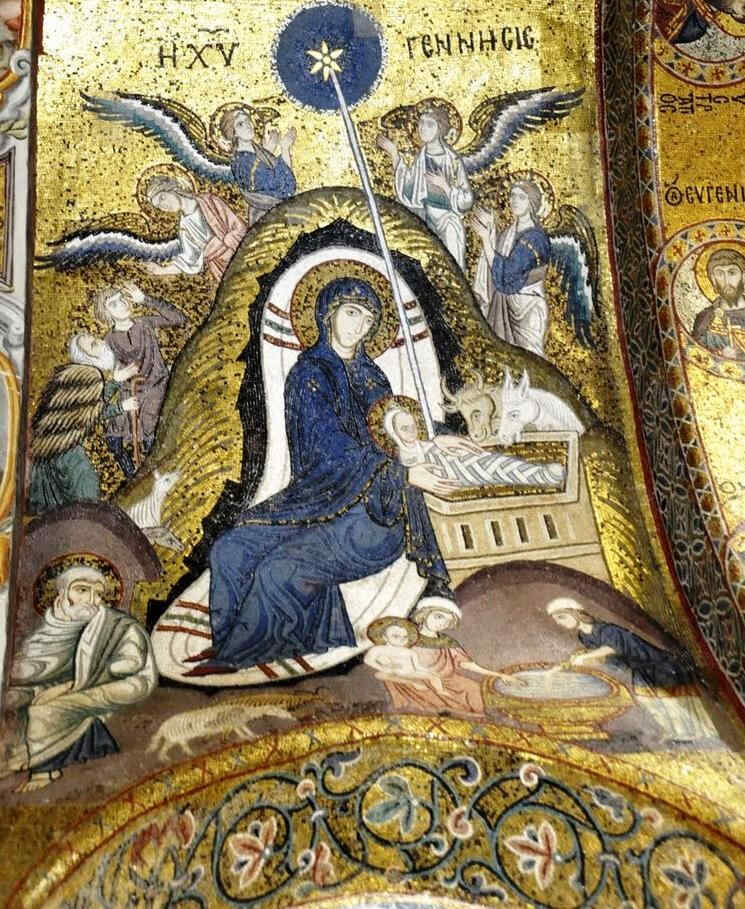
2. The Nativity. (mosaic) (Palermo, Chiesa della Martorana.)
In these old compositions, as you see, everything is conceived in typical form—based on the typical representations of the ancient Myths which came over largely from the East. In a most natural way the typical representations of the Myth grew into the representations of the Christian theme. The Orpheus type, for instance, the type of the Good Shepherd, was handed down from earlier representations of Myth or Cult or Ritual, and taken to represent the new impulse, the Christ event; and so it was with many another theme and composition.
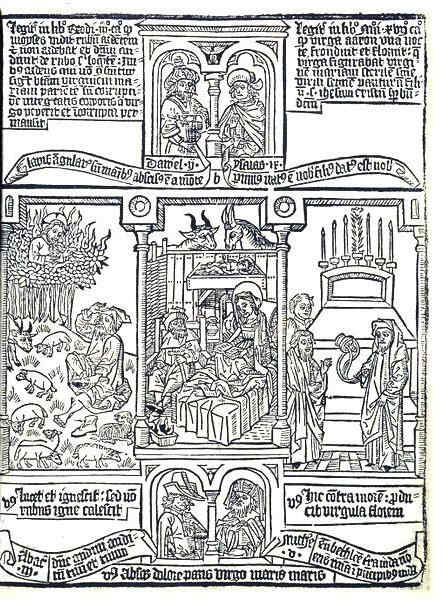
3. A Page of the Biblia Pauperum. 1st Edition. (15th century) The Nativity, etc. (German Woodcuts.)
These early Bibles generally showed parallel representations from the Old and New Testaments. They bore in mind that the New Testament is the fulfilment of the Old; this idea is brought out again and again in these “Bibles of the Poor.” The Nativity, which interests us mainly now, is shown in the middle of the page.
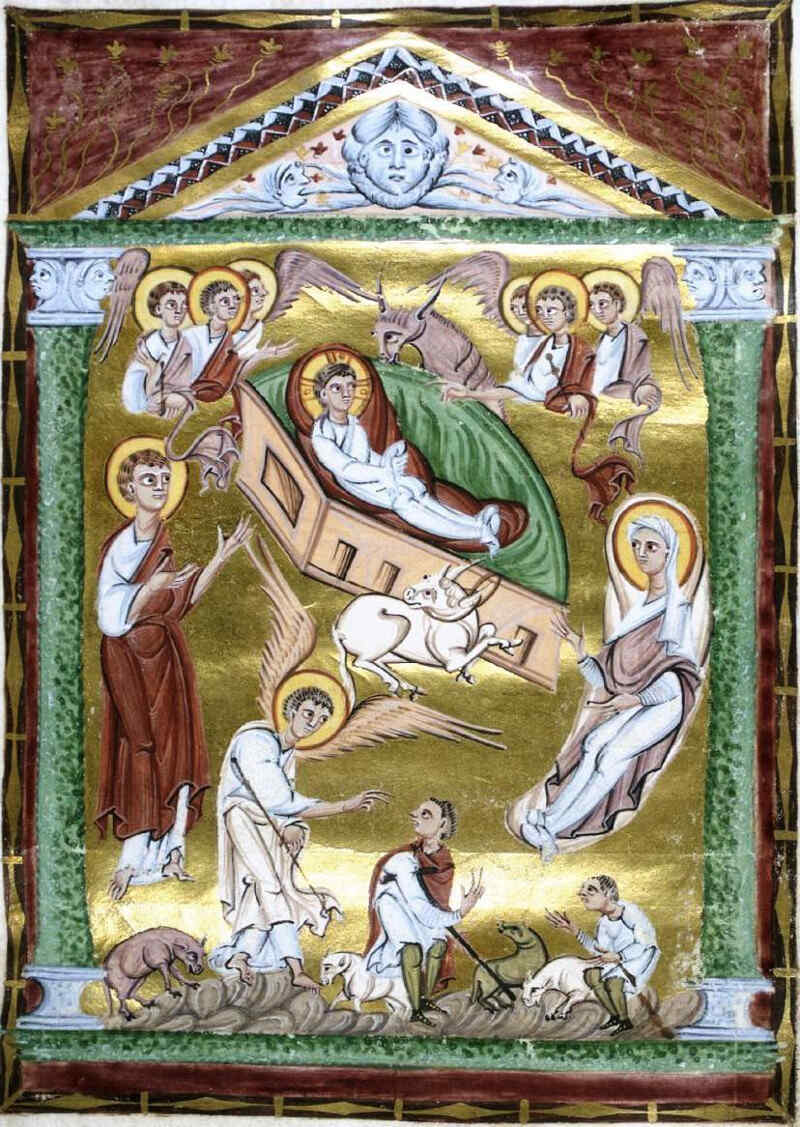
4. The Nativity, 11th Century. (Limburg Monestary.)
This is at Cologne. Beneath is the Flight into Egypt; the two are together in this slide. Apart from this one, we shall show the Flight into Egypt at the end of the lecture. Here you have a beautifully naive conception of the Nativity. You will feel the connection of it with what is given in the old Christmas Plays with which we are familiar. Though the latter belong, of course, to a later time, nevertheless they are from earlier Christmas Plays which are no longer extant.
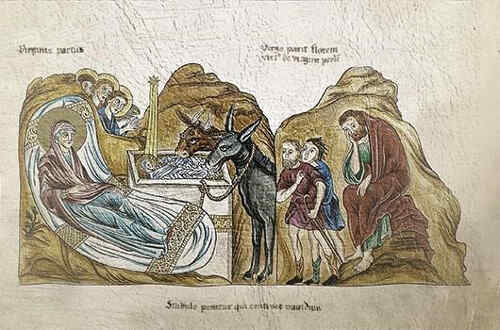
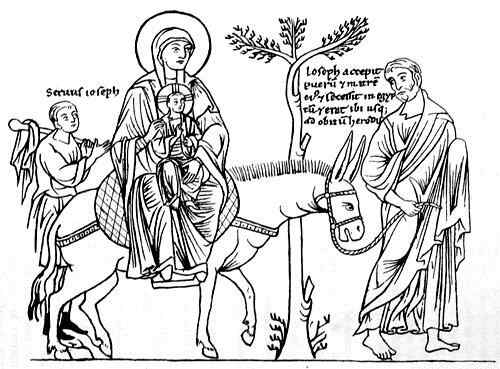
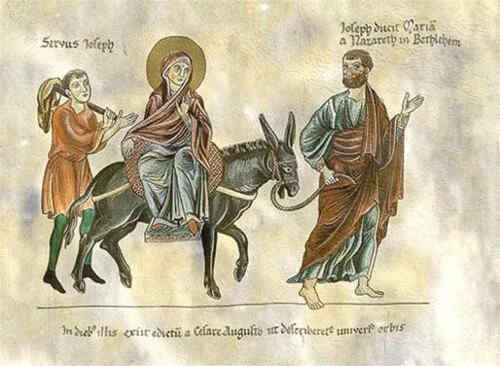
5. The Flight into Egypt. (Evangeliar of the 12th century. Cathedral of Cologne.)
It is interesting to see, all around the picture, representations of what was cosmically connected with the Event, showing how they were still aware of the spiritual relationships. And now we will take the same motif as it appears in the work of Niccola Pisano.
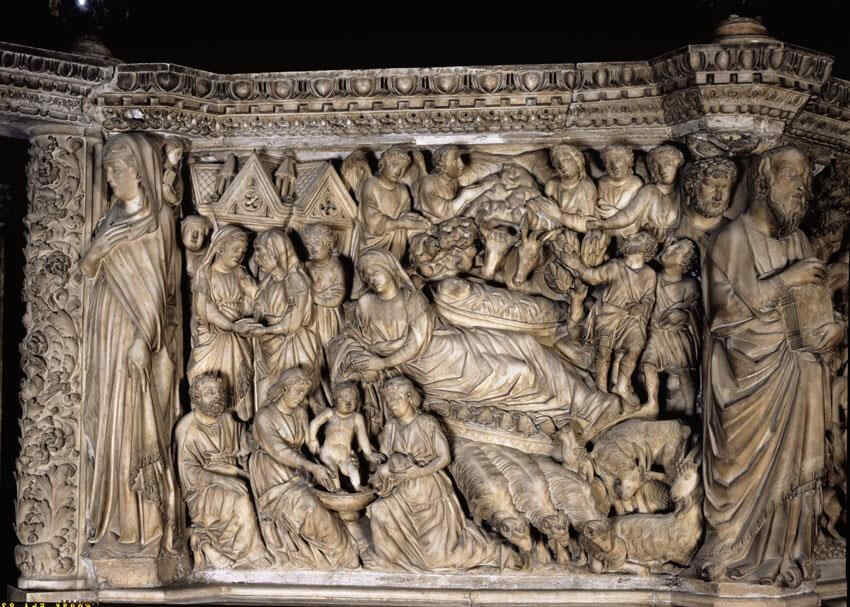
6. Niccola Pisano. The Nativity. (Baptistery at Pisa.)
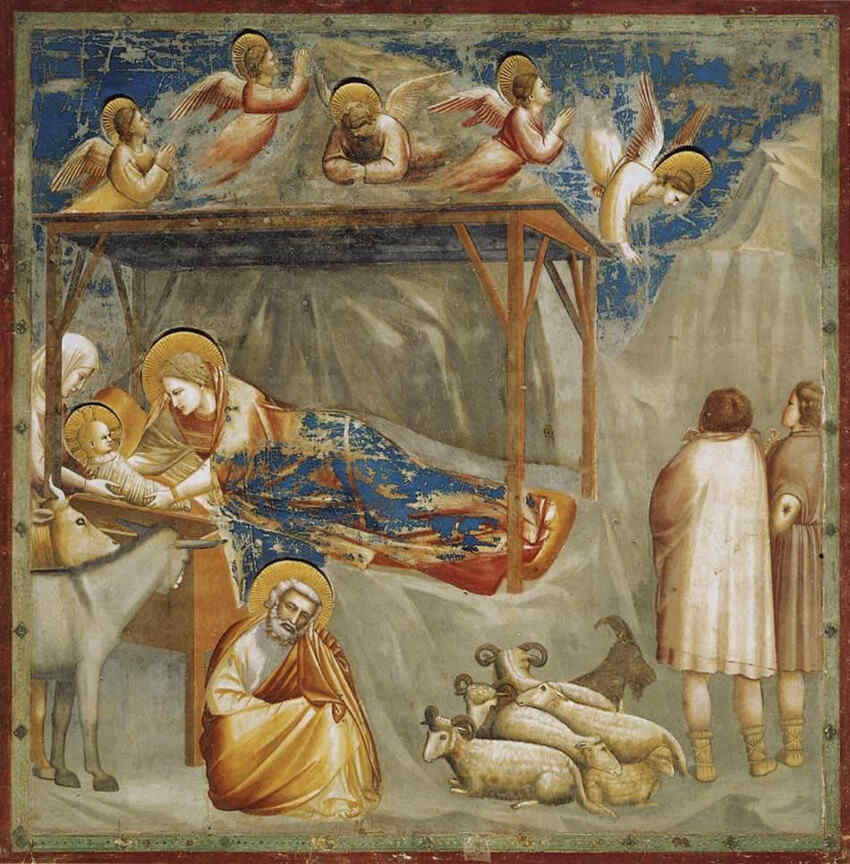
7. Giotto. The Nativity. (San Francesco. Assisi.)
You see how the representations of the theme are gradually passing into Naturalism.
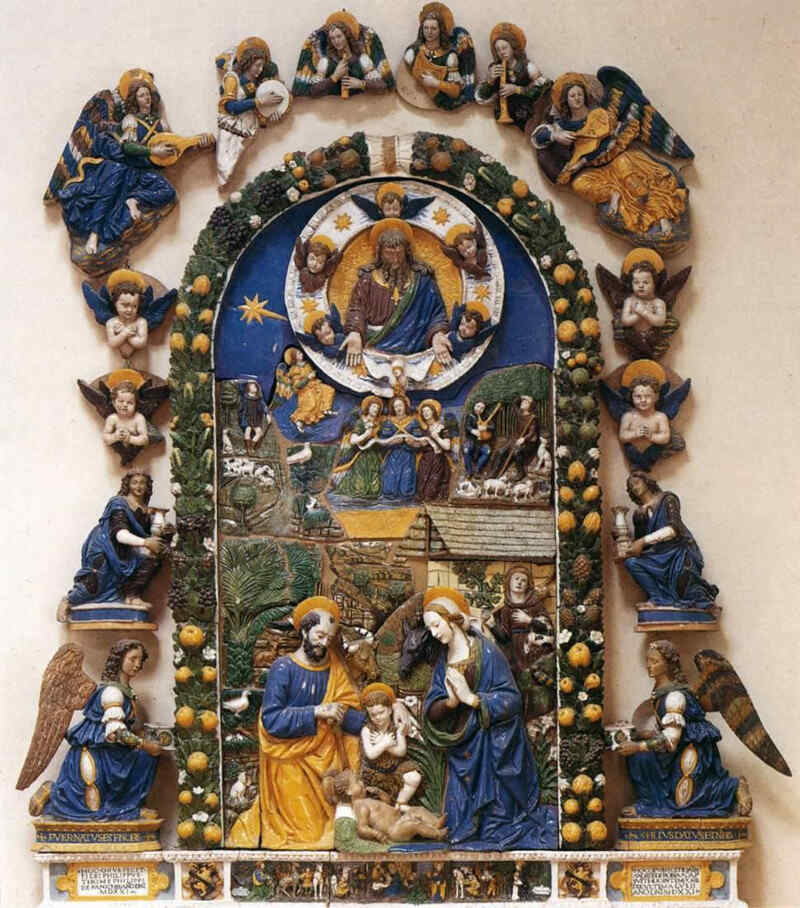
8. della Robbia. The Nativity. (Hamburg. Altarpiece.) (National Museum. Florence.)
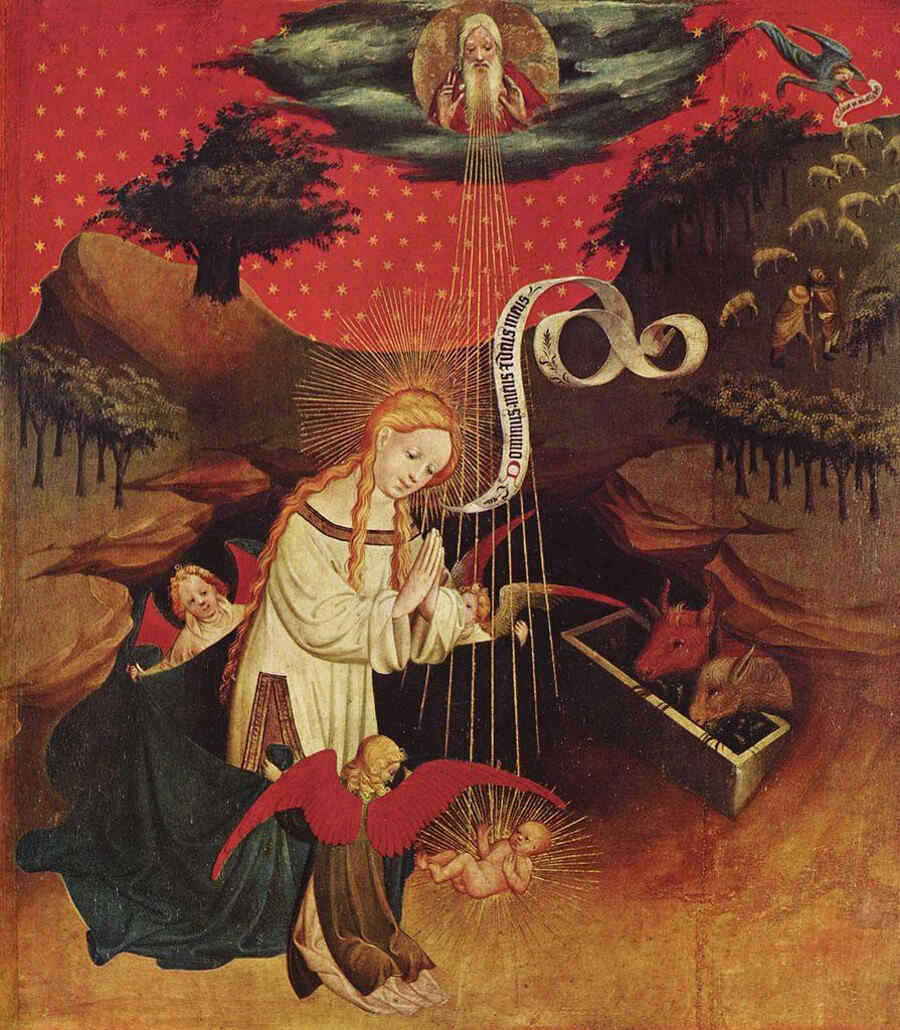
9. Meister Francke. The Nativity. (Hamburg.)
This picture is at Hamburg; I remember having seen it there myself not long ago.
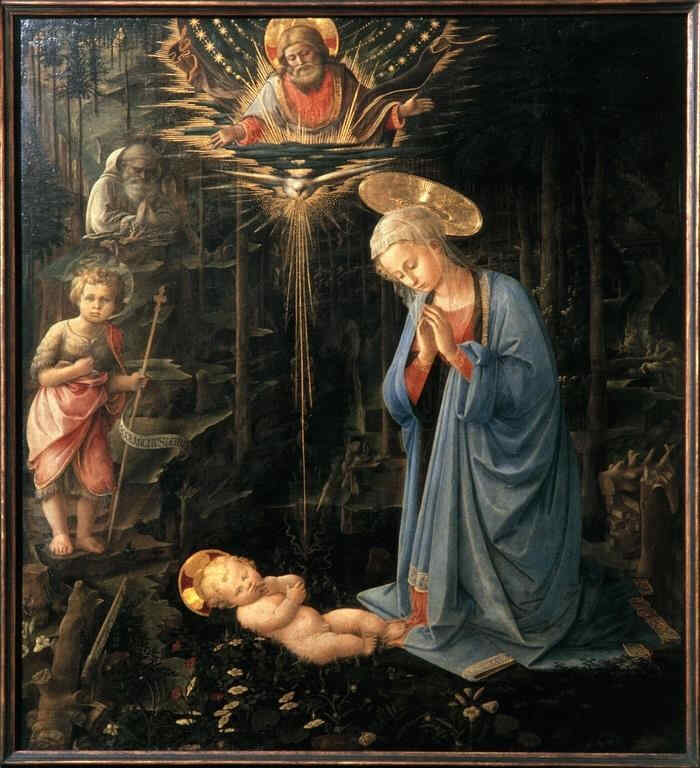
10. Philippo Lippi. The Nativity. (Cathedral at Spoleto.)
You really see how in the course of time Naturalism takes hold of it more and more.
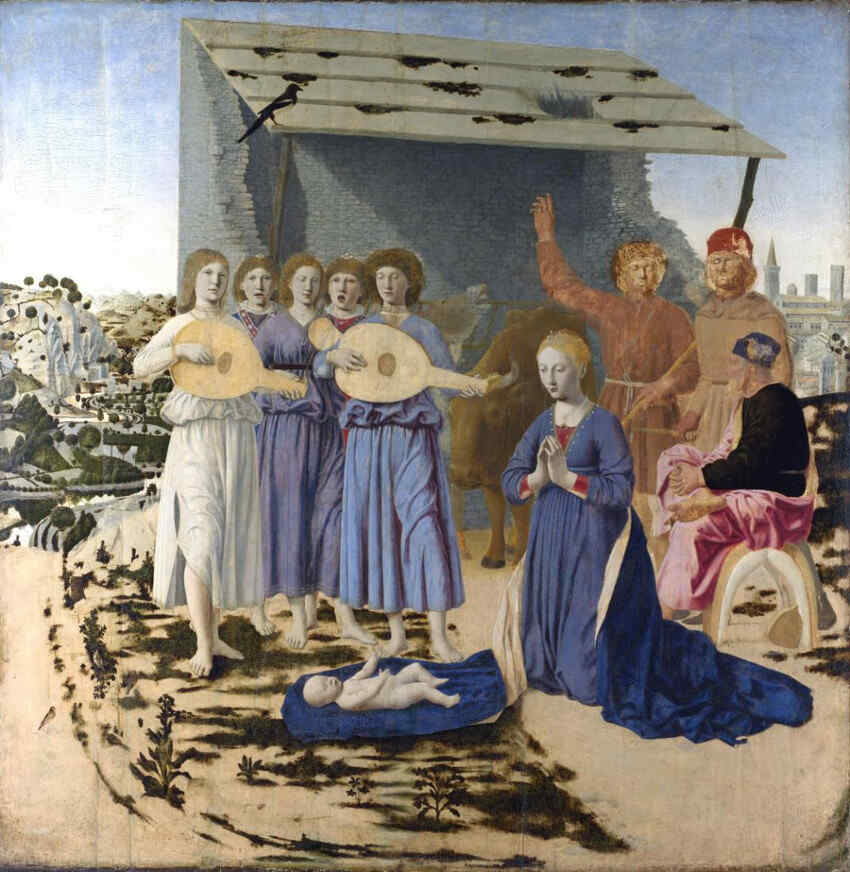
11. Piero della Francesca. The Nativity. (National Gallery. London.)
Here we are in the fifteenth century once more; and we now go on to Correggio.
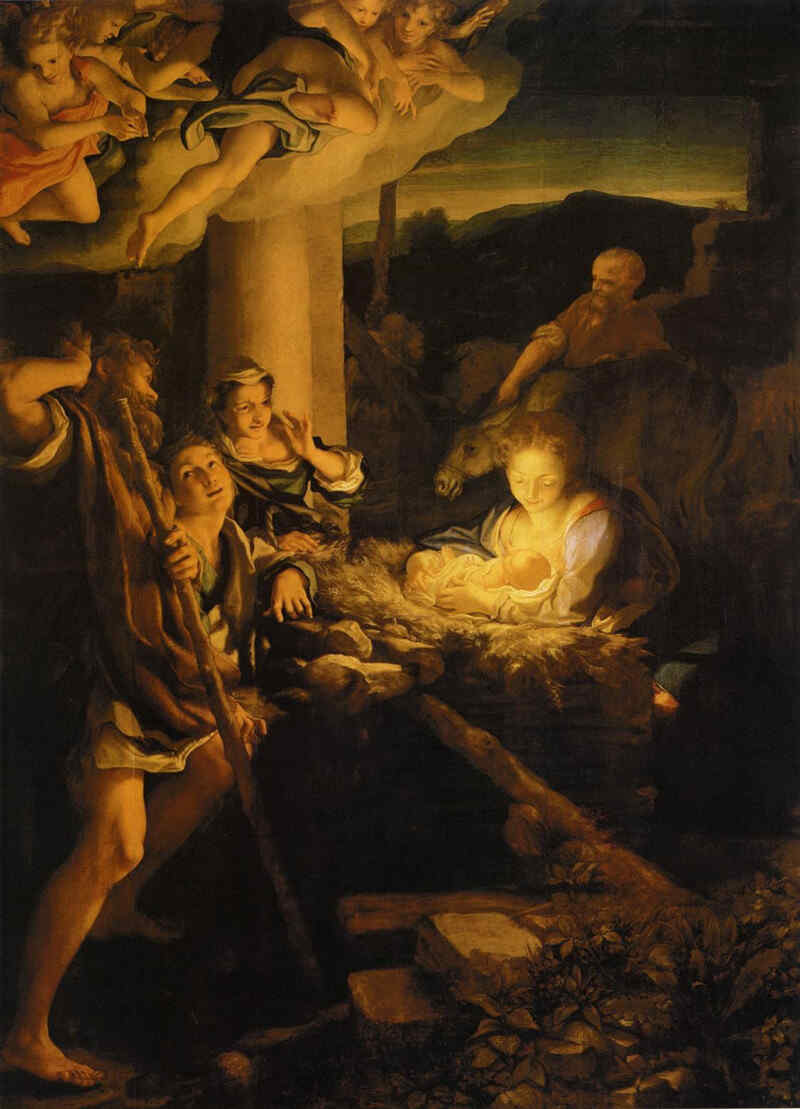
12. Correggio. Holy Night. (Dresden.)
We pass again to the more Northern Masters, whose names you know. First we have a work of Schongauer' s.
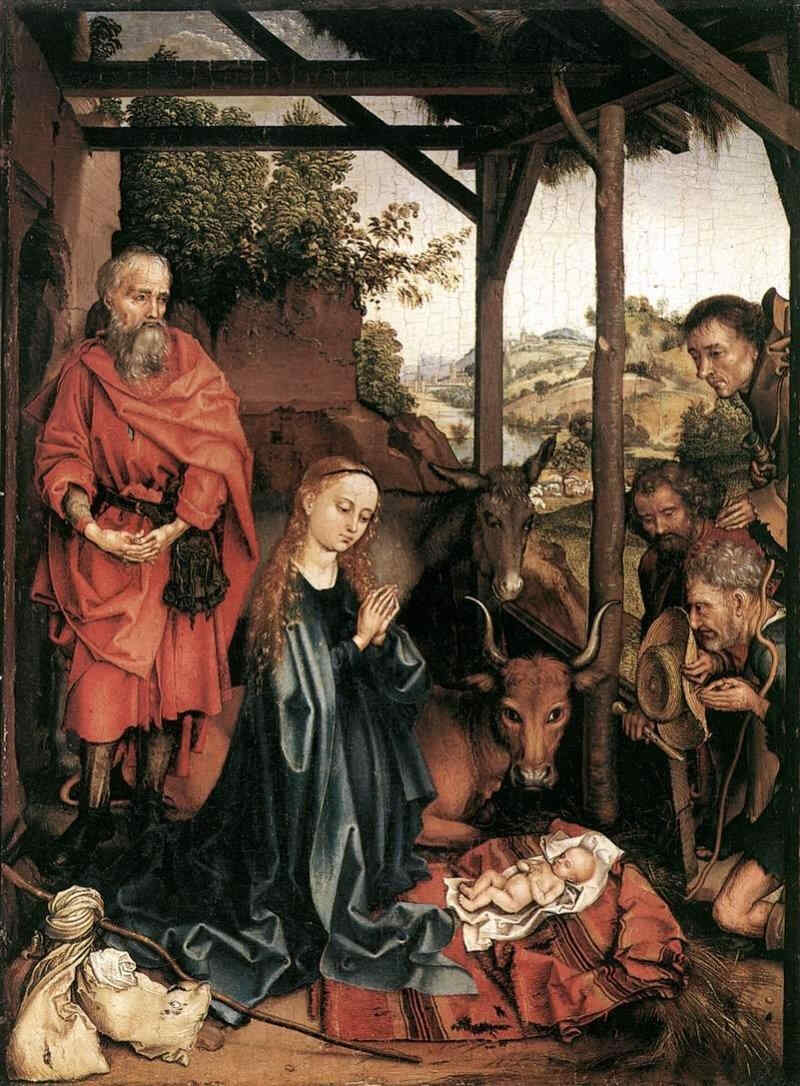
13. Martin Schongauer. The Nativity. (Alto Pinakothek. Munich.)
Most interesting to see the Italian and the Northern Masters one after the other. In the former you still find a stronger adherence to ideal types, while here there is more individualisation—creation out of inwardness of soul, as we have seen before. Down to the tiny feet, all is pervaded with feeling, albeit the artistic perfection is not so great as in the Southern Masters.
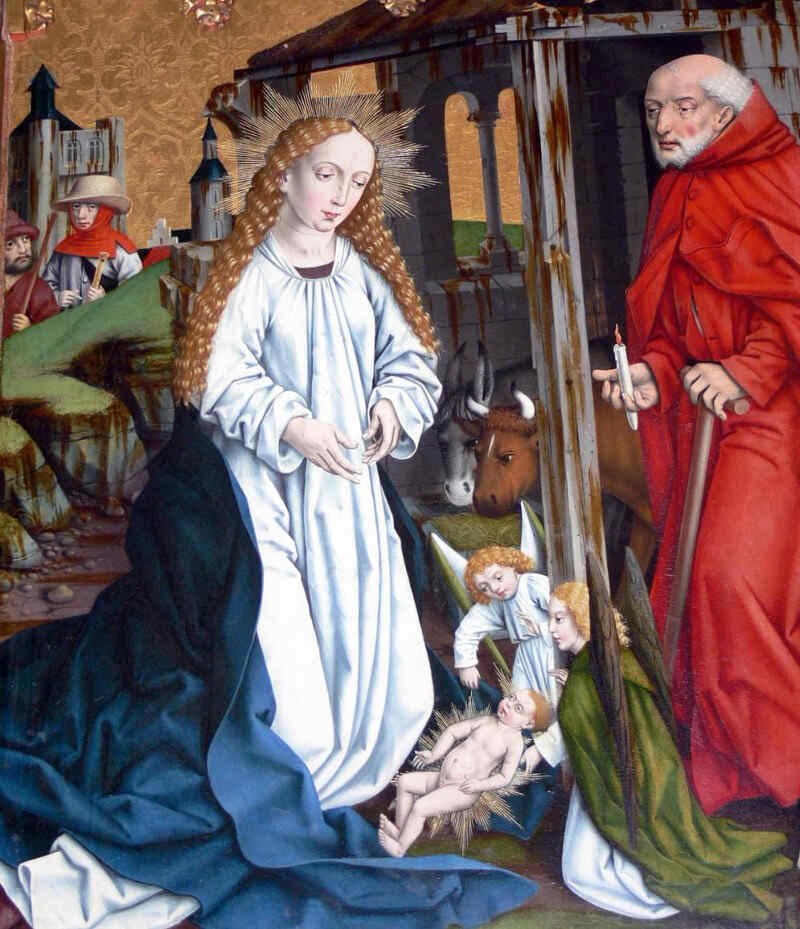
14. Herlin. Nativity from the Altar of St. George. (Museum at Nordlingen.)
We come now to the turn of the 15th and 16th centuries, to Albrecht Dürer.
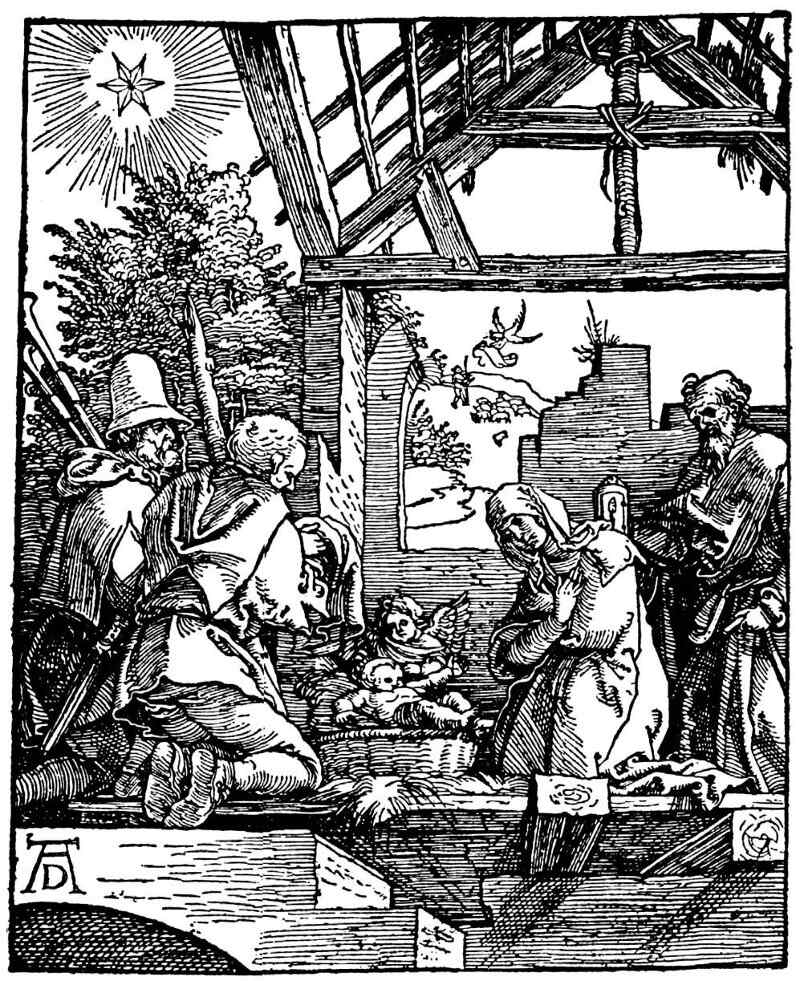
15. Dürer. The Nativity. (Alto Pinakothek. Munich.)
See how the Art is taken hold of here by all that I described to you—the working out of the element of light. It is most interesting to study this in Dürer.
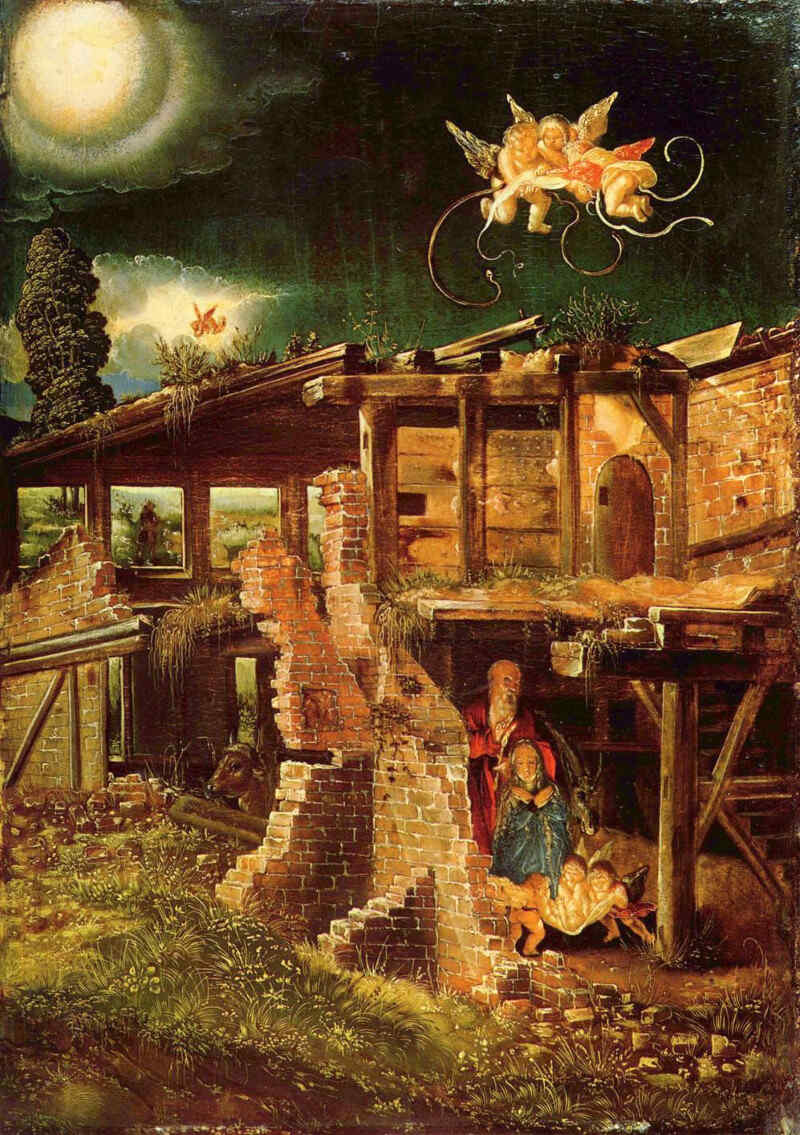
16. Altdorfer. The Holy Night. (Berlin.)
Altdorfer was Dürer's successor in Nuremberg.
We shall now give a series of pictures relating mainly to the Adoration by the Shepherds. First, some older Miniatures from Bible and Gospel Manuscripts.
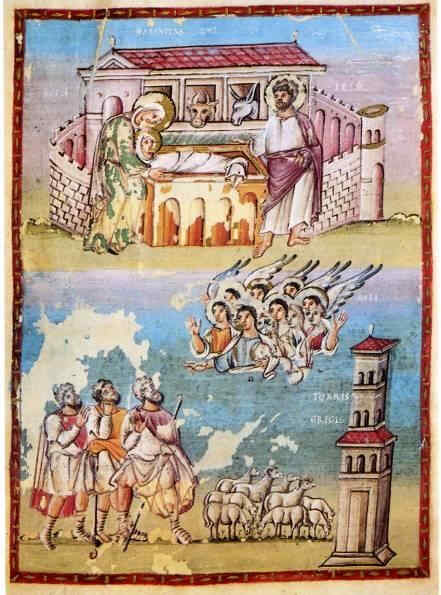
17. Nativity and Annunciation to the Shepherds. (Codex Egberti. Trier. 10th century.)
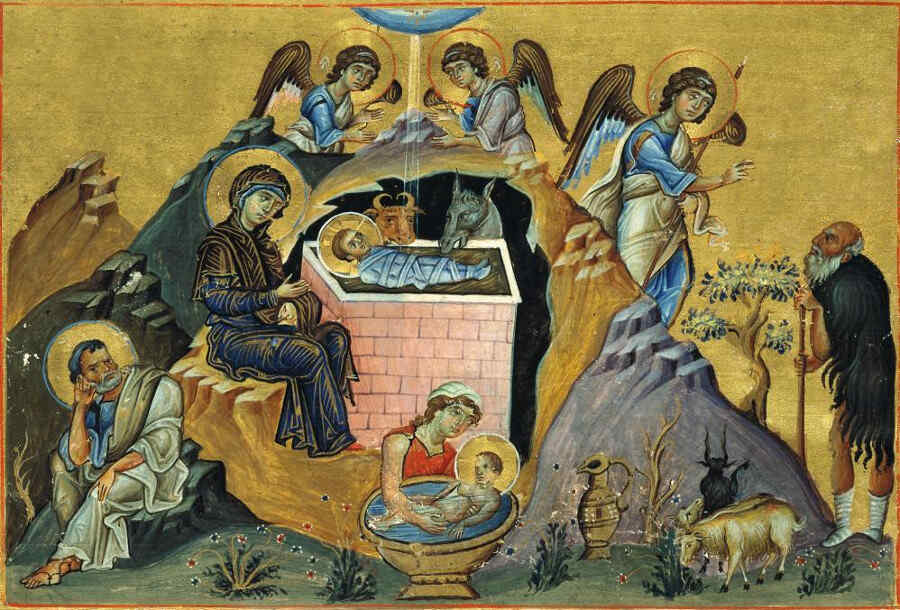
18. Nativity and Annunciation to the Shepherds, from Menologion of Basil II (Vatican. Rome. 11th Century.)
We go on to the Italian representations of the Adoration of the Child by the Shepherds.
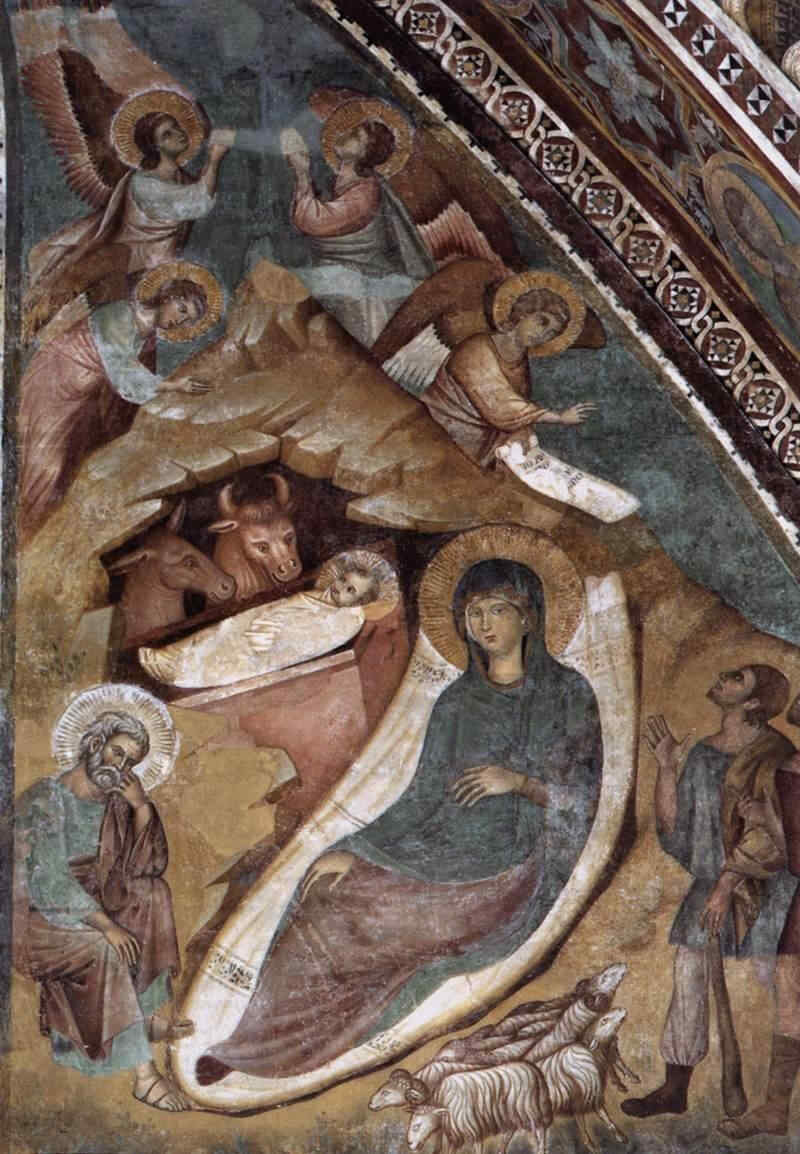
19. Cimabue. Adoration by the Shepherds. (Assisi.)
With Cimabue, as you know, we find ourselves in the 13th century. We go on into the 15th and come to Ghirlandajo, the Master of whom we lately spoke.
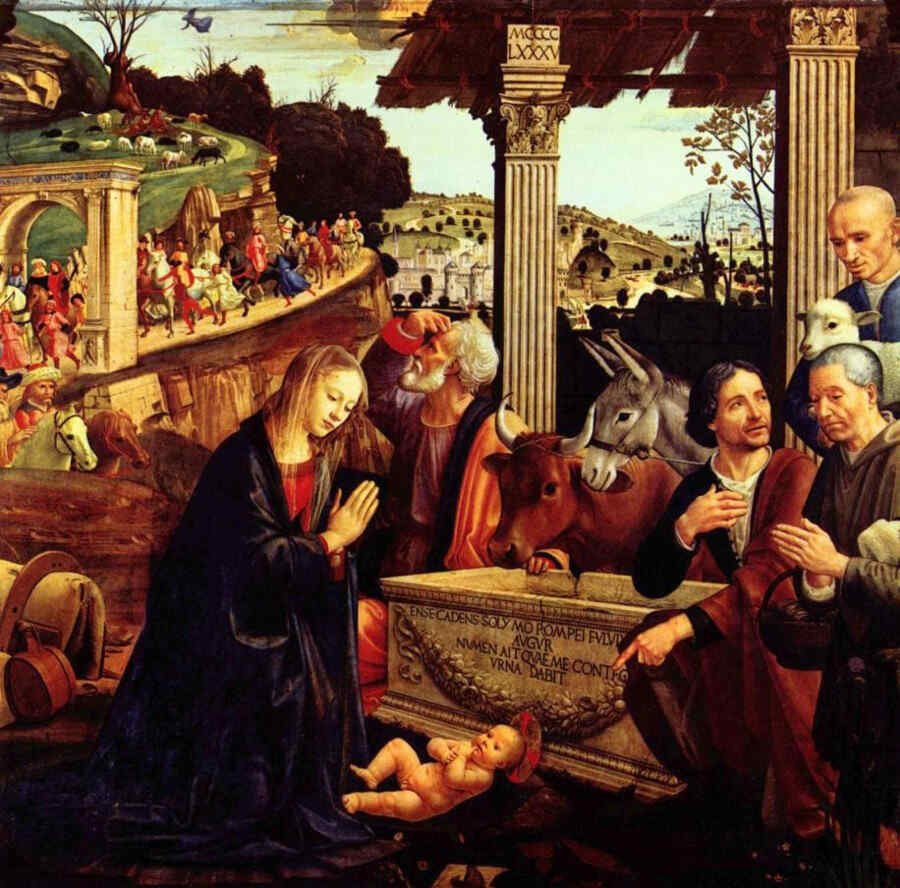
20. Ghirlandajo. Adoration by the Shepherds. (Akademia. Florence.)
Another Master of the 15th century is Piero di Cosimo.
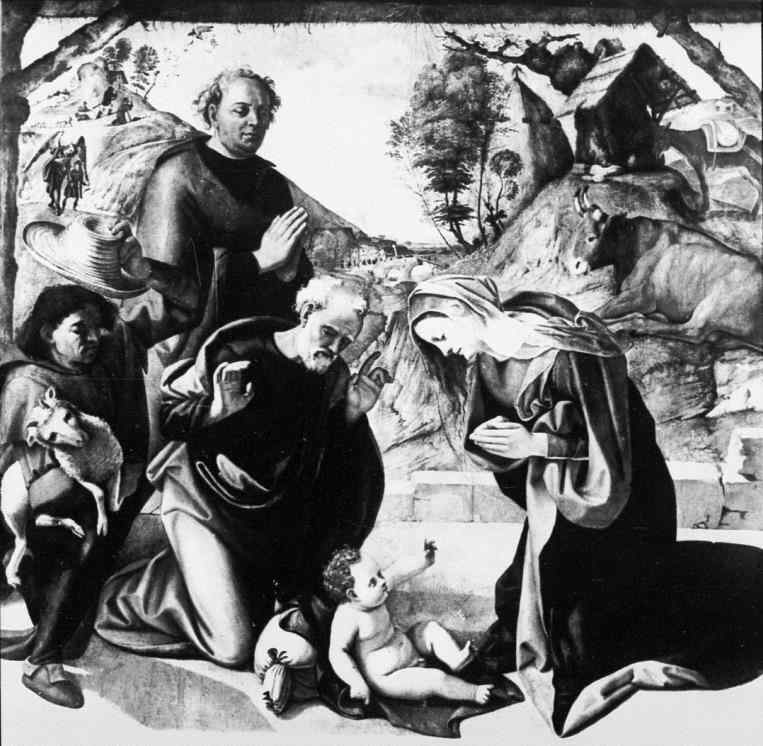
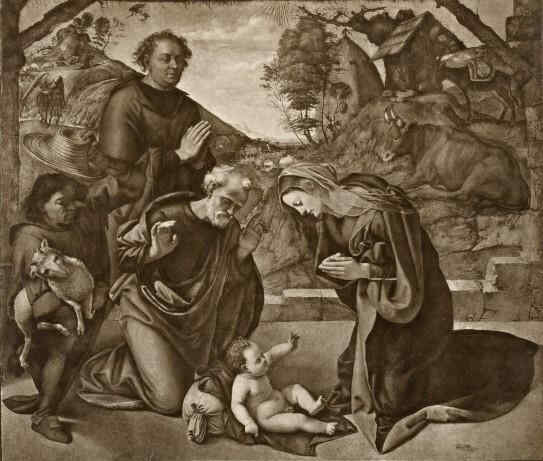
21. Piero di Cosimo. Adoration by the Shepherds. (Berlin.)
And now we come to the Art of the Netherlands, with which we are familiar.
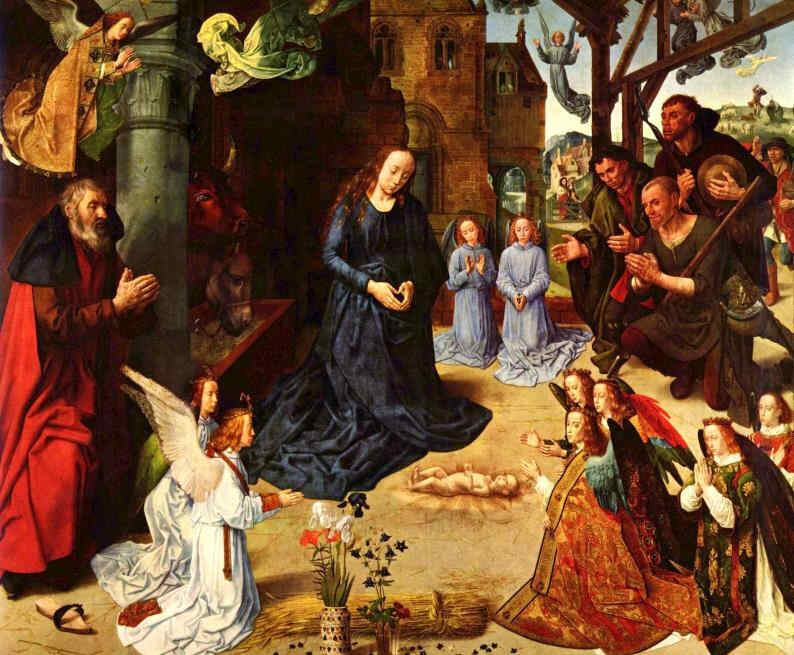
22. Hugo van der Goes. Adoration of the Child. (Uffizi. Florence.)
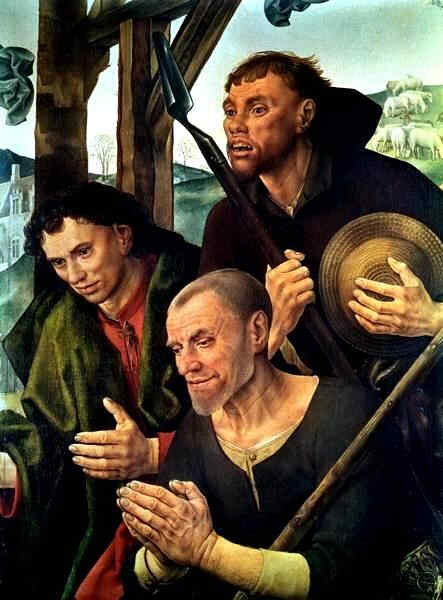
23. Hugo van der Goes. Adoration of the Child. (detail.)
Finally we give two works by Rembrandt.
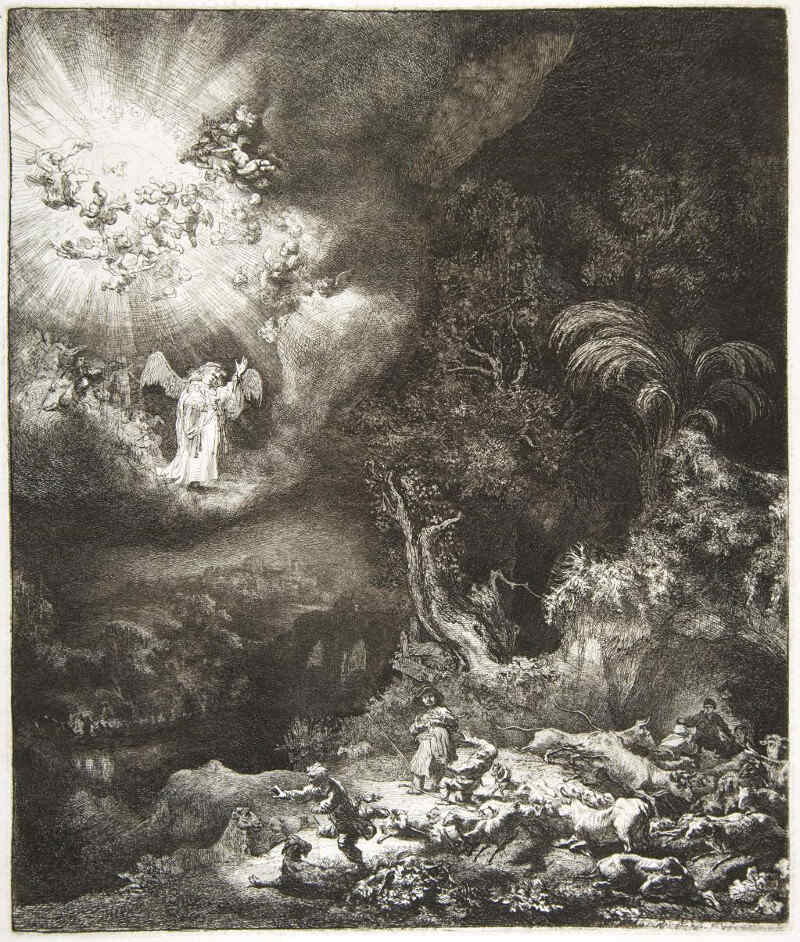
24. Rembrandt. Adoration by the Shepherds. (In the Lantern Light. Etching, about 1652.)
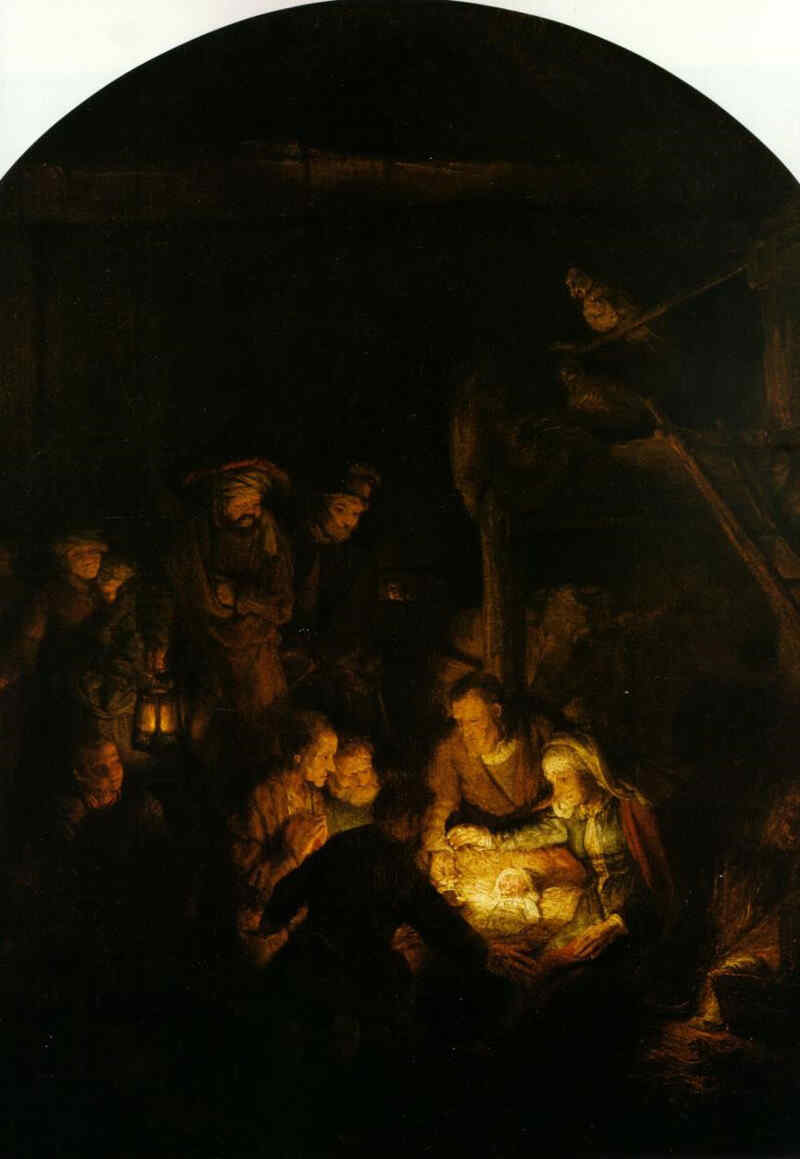
25. Rembrandt. Adoration by the Shepherds. (Alte Pinakothek. Munich.)
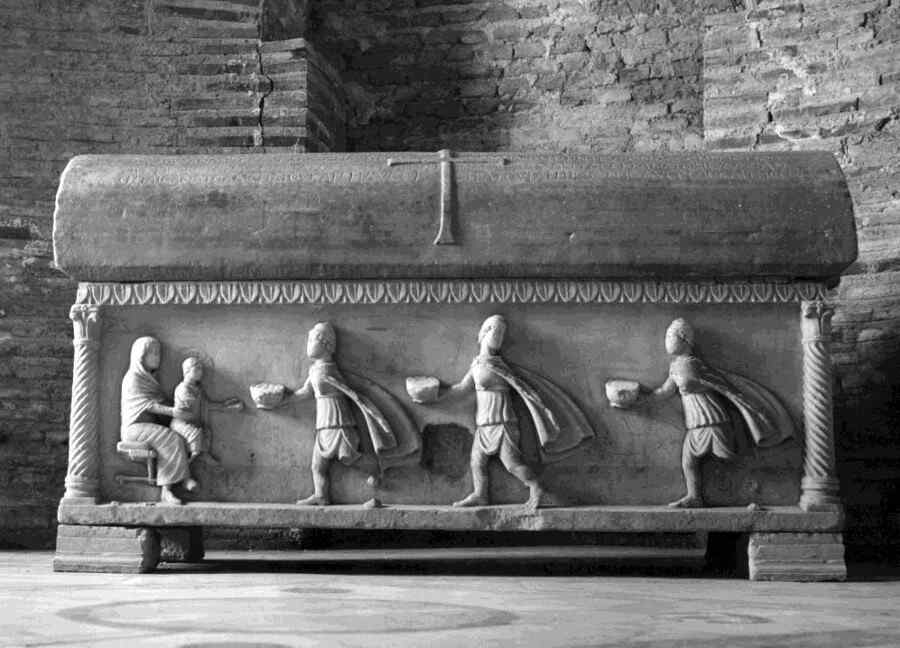
We now go on to the pictures representing the Adoration by the Three Wise Men. To begin with, an old Mosaic, of the 6th century.
26. Mosaic. Chiesa della Martotana. Palermo. Three Wise Men.
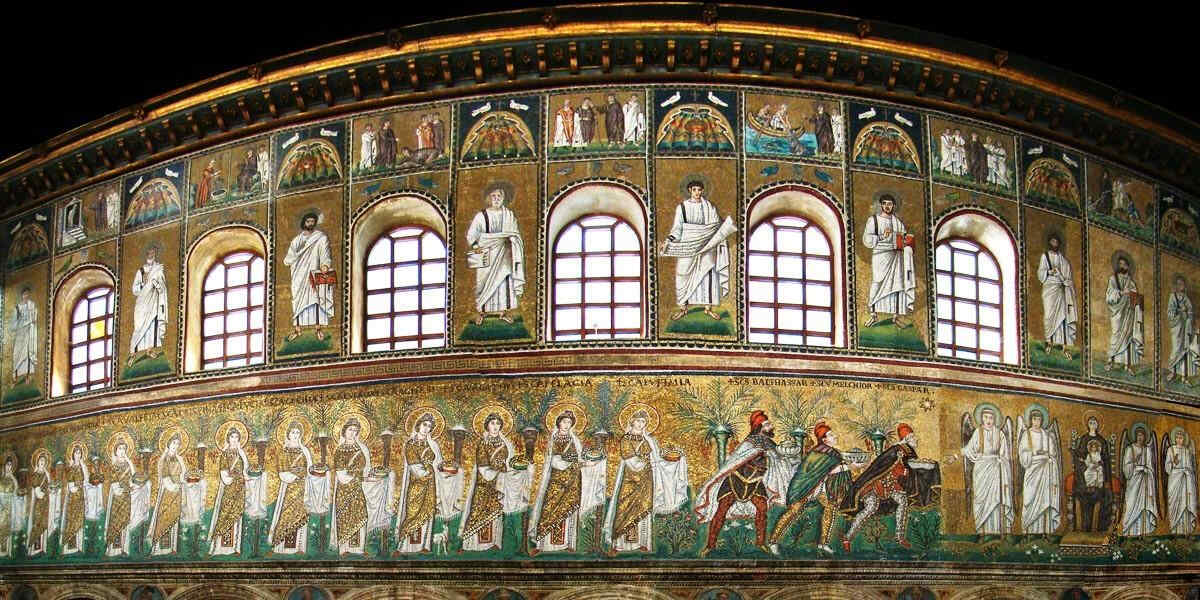
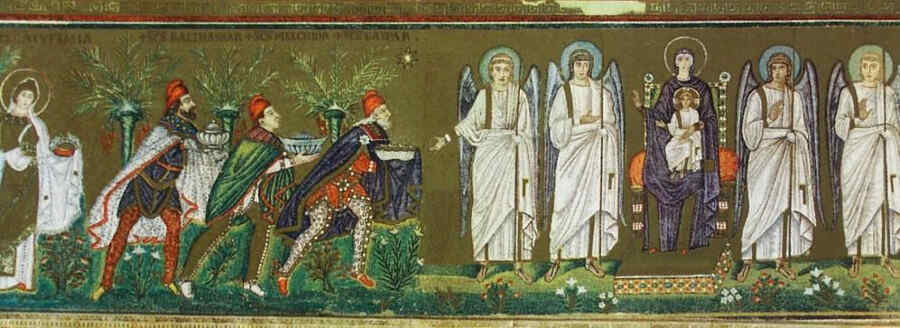
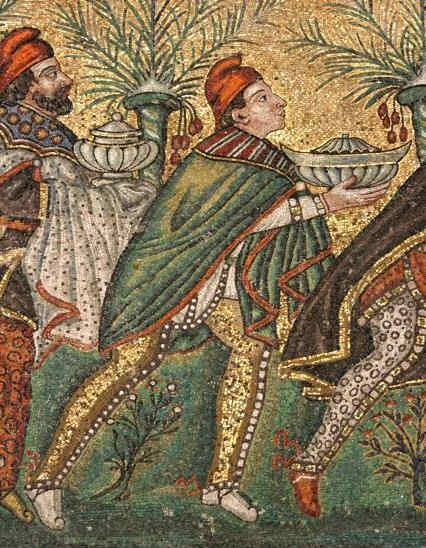
27. Mosaic. Sant Apollinare Nuovo. Ravenna.
In these older pictures the events are shown thoroughly in connection with the Spiritual World—remote from all Naturalism, lifted into a higher sphere.
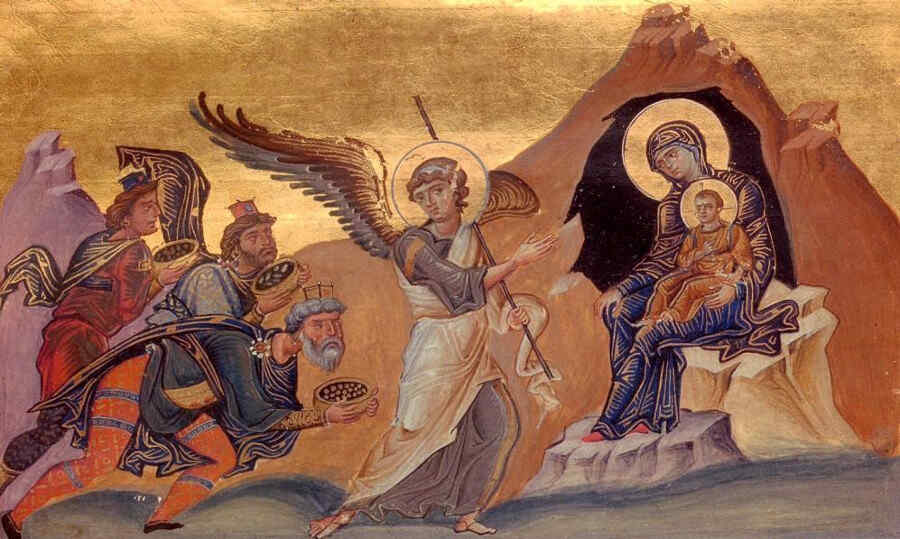
28. Nativity and Adoration by the Wise Men. (Menologium Basilius. Vatican. 11th century)
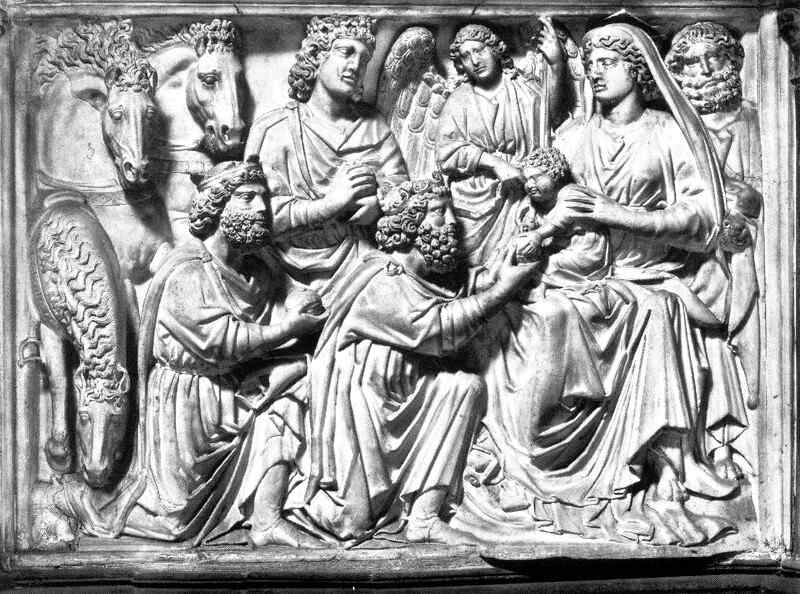
29. Niccola Pisano. Adoration by the Wise Men. (Baptistery at Pisa.)
This is the famous Golden Gate at Freiberg, second half of the 12th century:
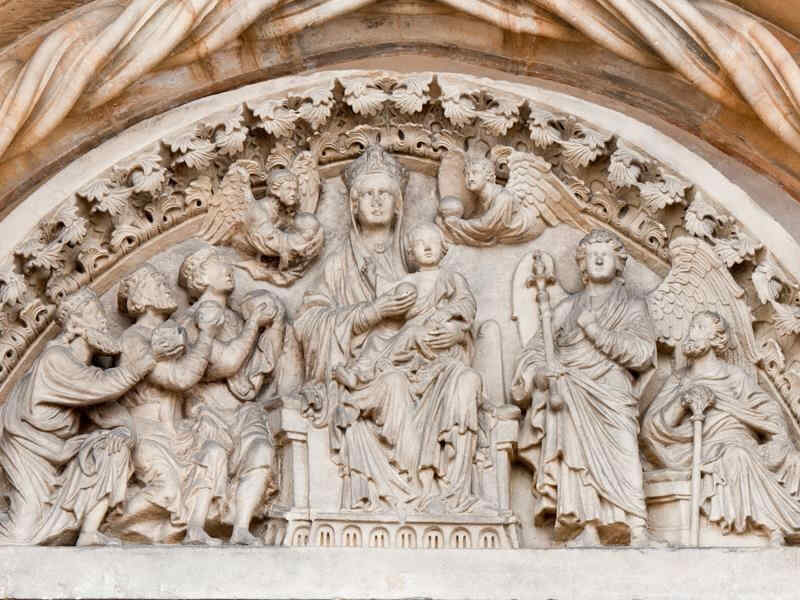
30. Adoration by the Three Wise Men. (Cathedral of Freiberg. The Golden Gate.)
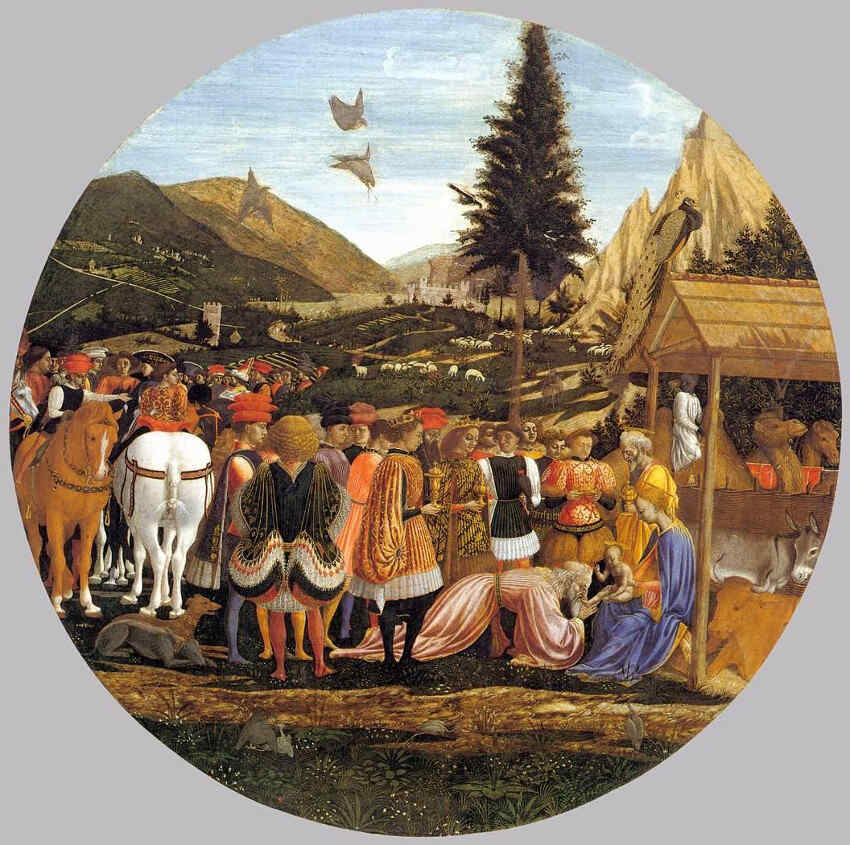
31. Domenico Veneziano. Adoration by the Wise Men. (Berlin.) Formerly attributed to Pisanello (Vittore Pisano).
We go on to the 15th, to Stephen Lochner:
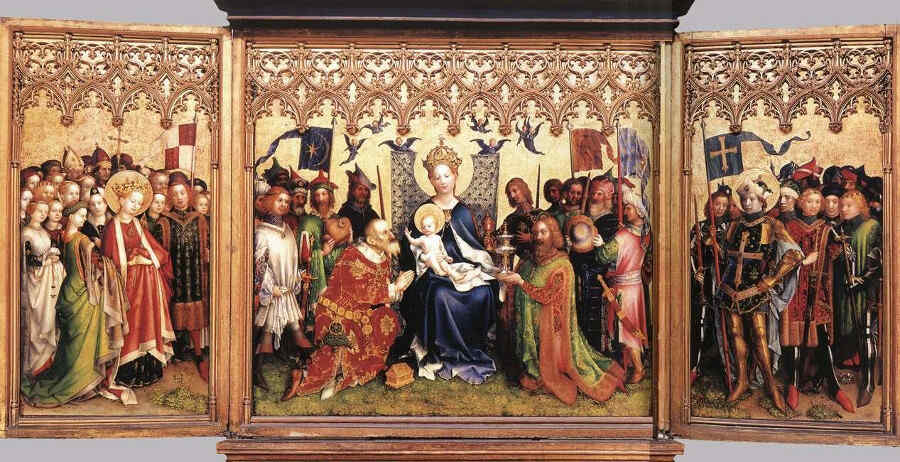
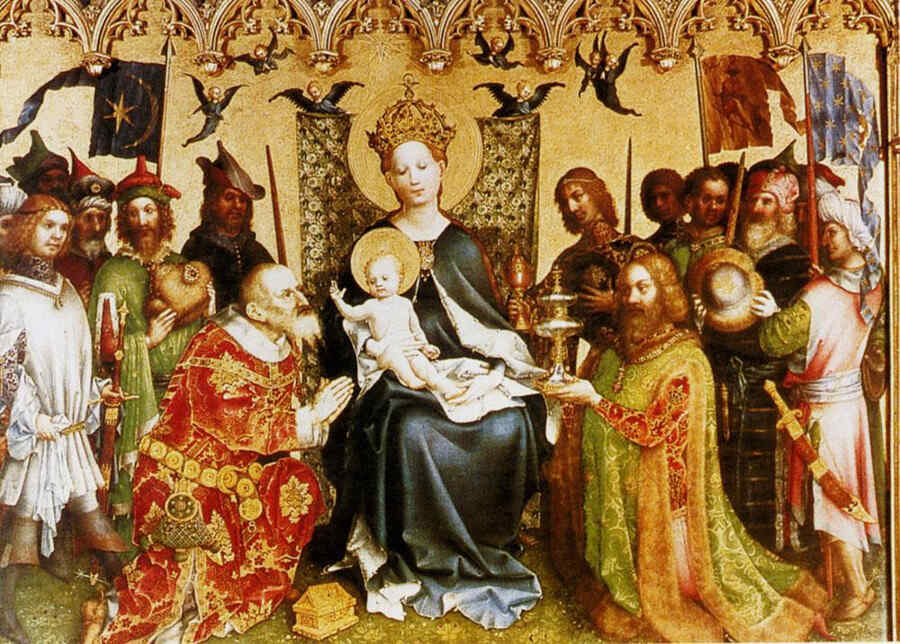
32. Stephen Lochner. Adoration by the Three Wise Men. (Cathedral of Cologne.)
The next is by Gentile da Fabriano, also of the 15th century.
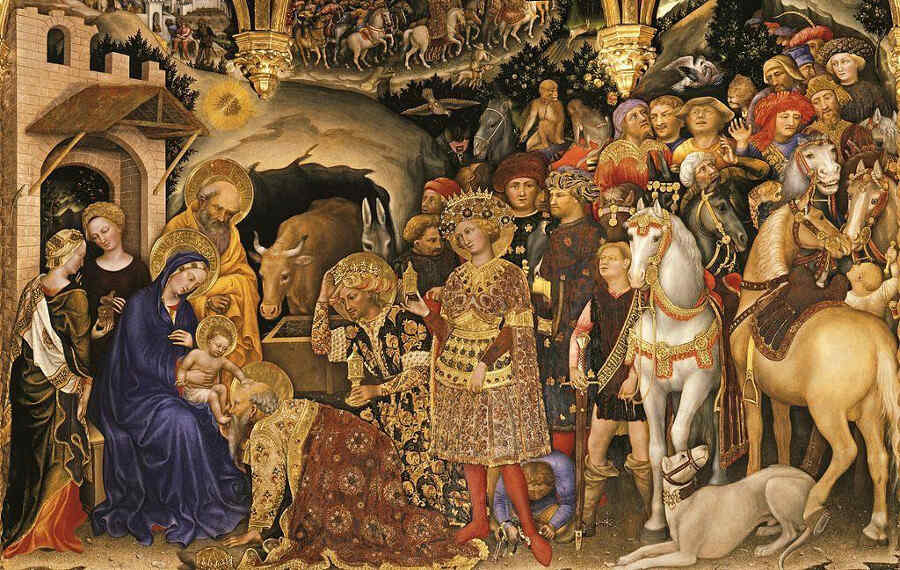
33. Gentile da Fabriano. Adoration of the Child. (Florence.)
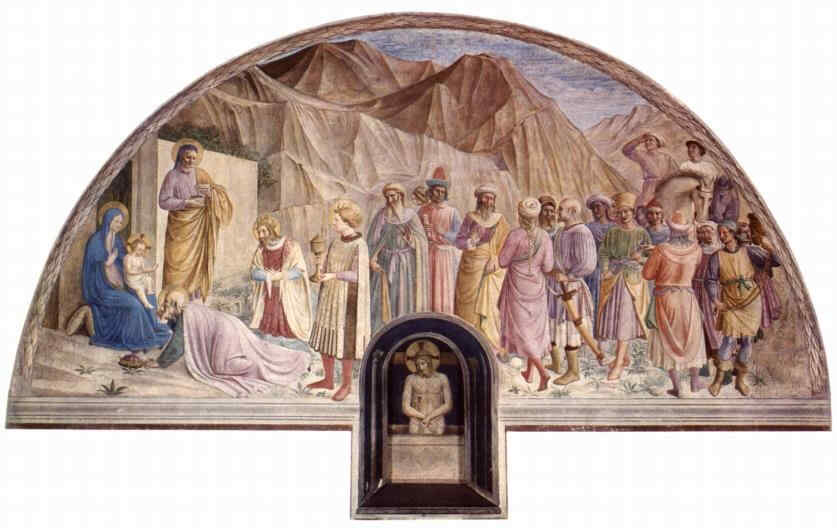
34. Fra Angelico. Adoration of the Kings. (St. Marco. Florence.)
Fra Angelico is as tender and lovely in this as in all other subjects.
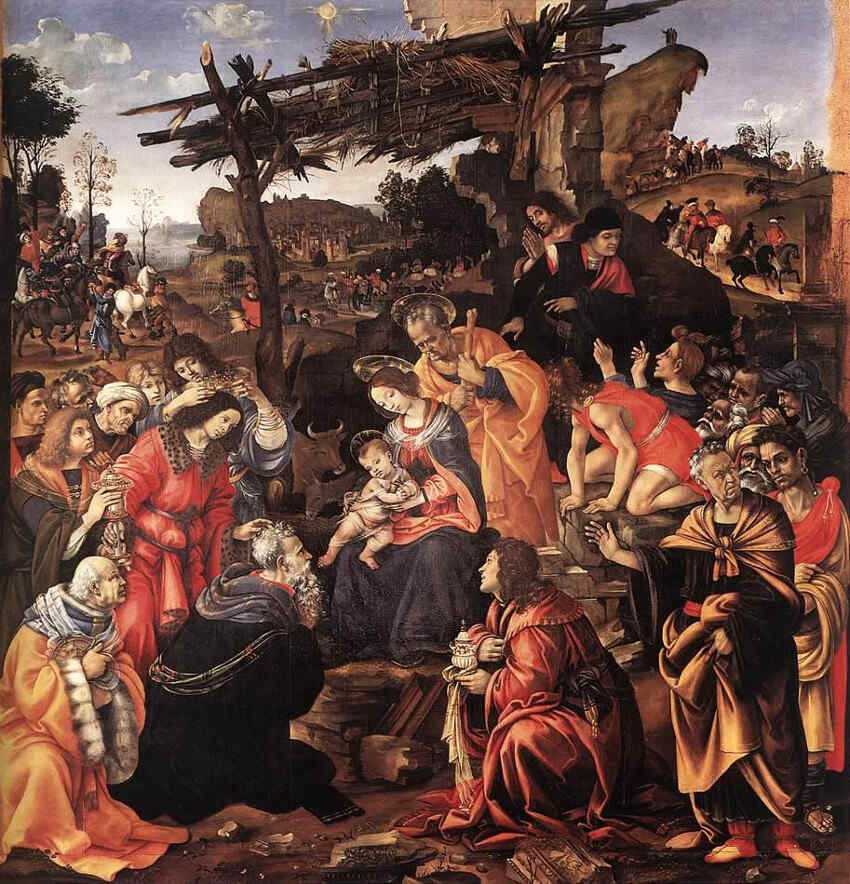
35. Filippo Lippi. Adoration by the Wise Men.
Whichever subject it is, you see how Naturalism progresses. This is especially interesting when one follows the treatment of one and the same subject through the centuries.
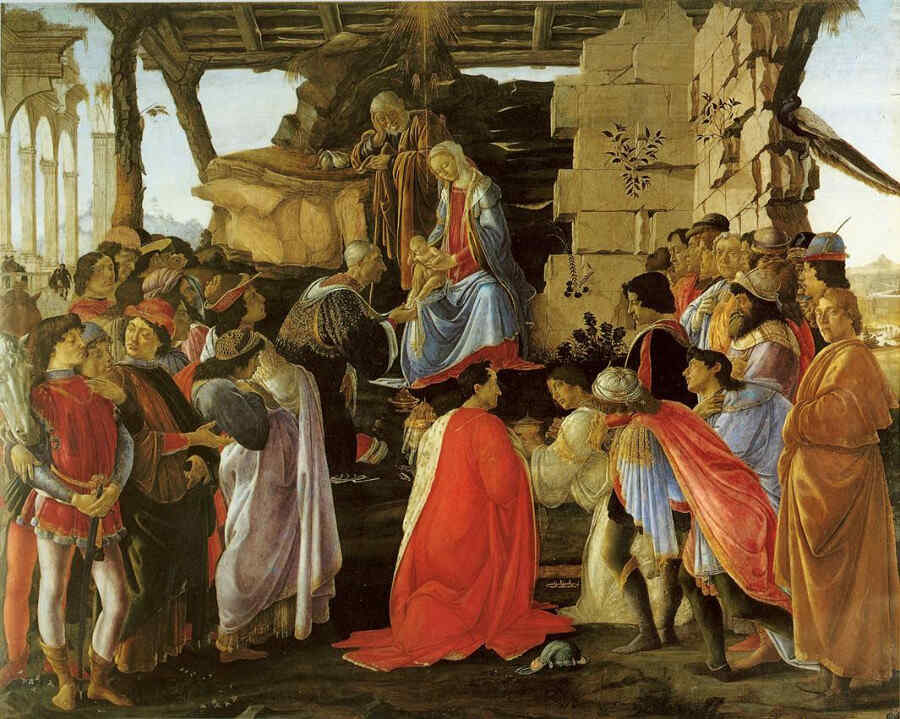
36. Sandro Botticelli. Adoration by the Wise Men. (Uffizi. Florence.)
Now we come to the second half of the 15th century.
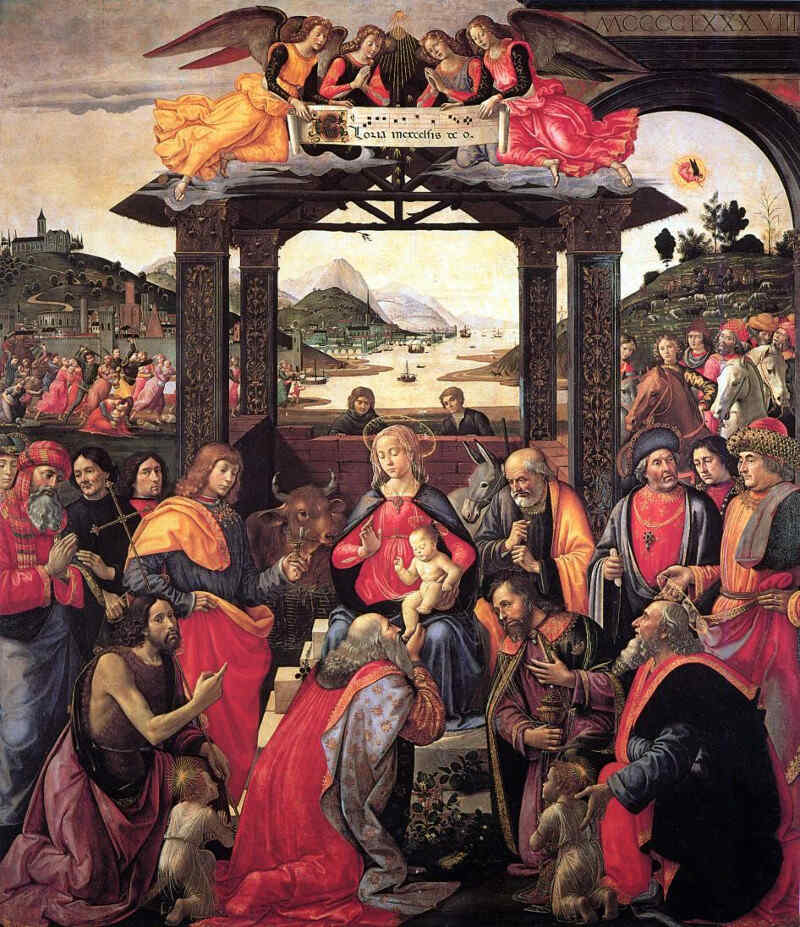
37. Ghirlandajo. Adoration by the Wise Men. (Spedale degli Innodenti. Florence.)
End of the 15th century:
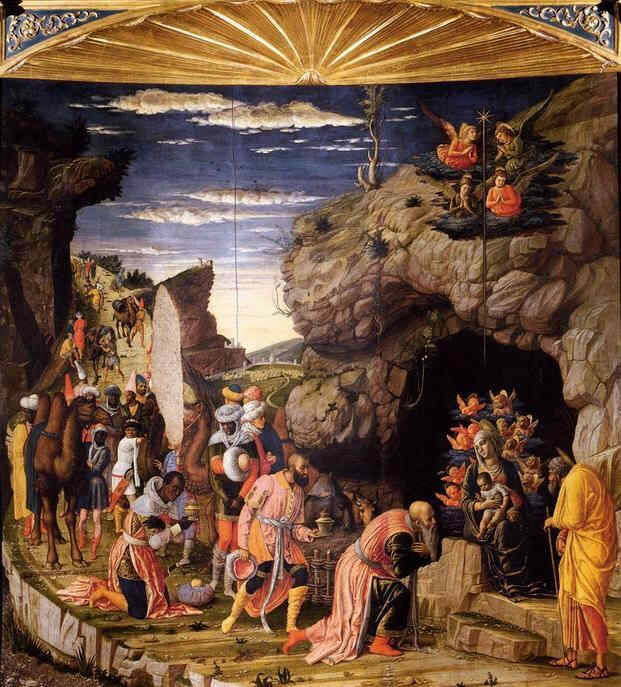
38. Mantegna. Adoration by the Wise Men. (Uffizi. Florence.)
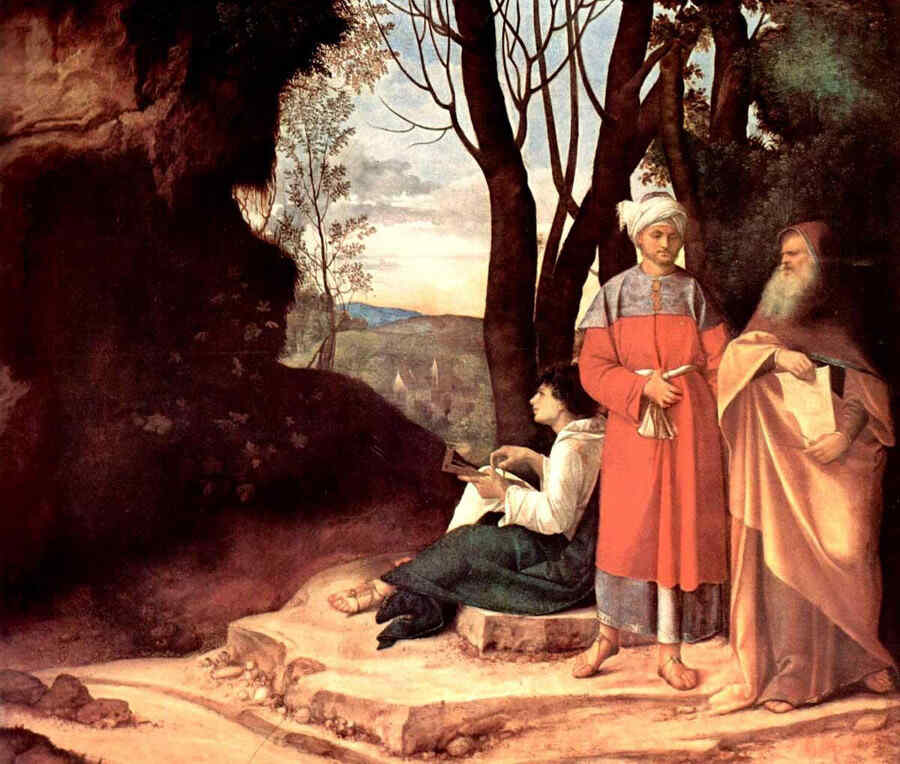
39. Giorgione. The Wise Men of the East. (Vienna.)

40. Giorgione. Adoration by the Wise Men. (National Gallery. London.)
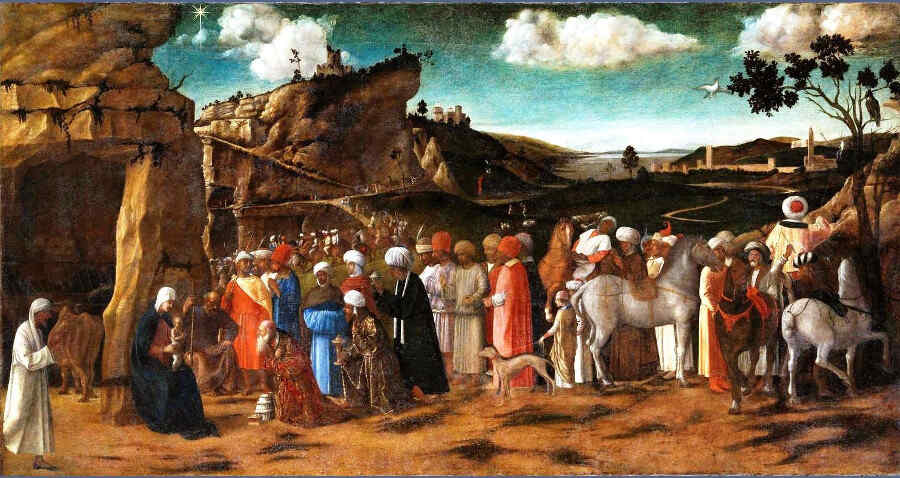
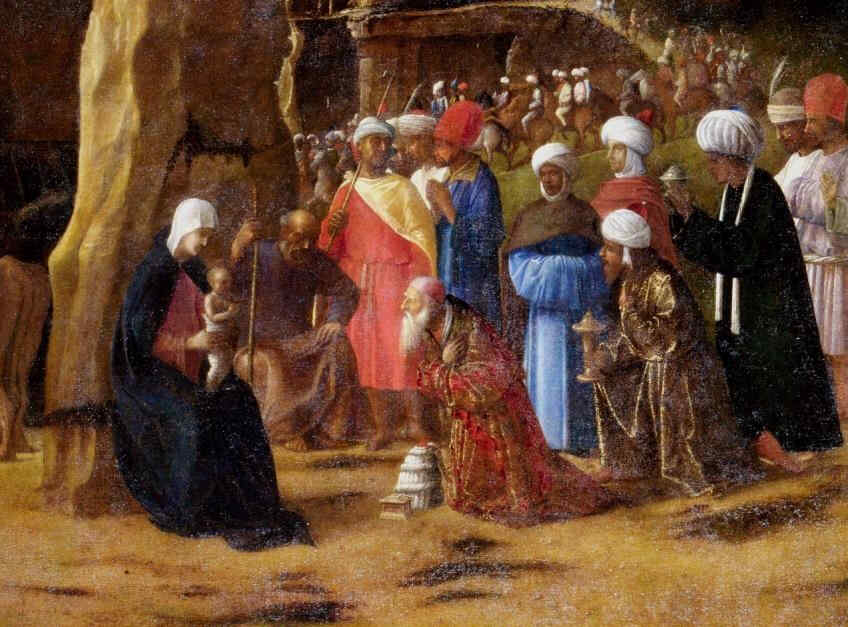
41. Giovanni Bellini. Adoration by the Kings. (Layard Gallery. London.)
And now I ask you to call to mind once more the various Dutch and Flemish Masters of whom we have spoken in a former lecture. For we now have the same subject by
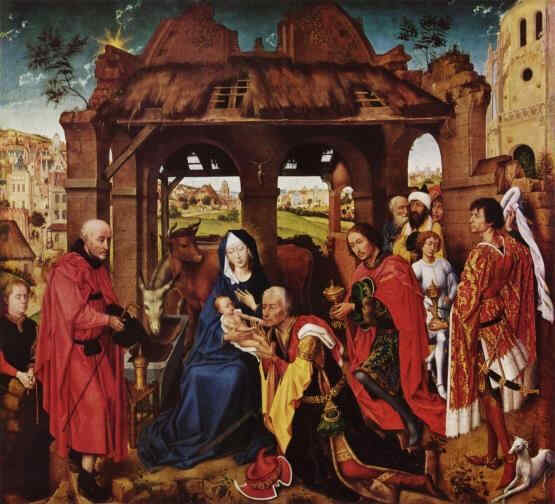
42. Rogier van der Weyden. Adoration by the Kings. (Alte Pinakothek.Munich)
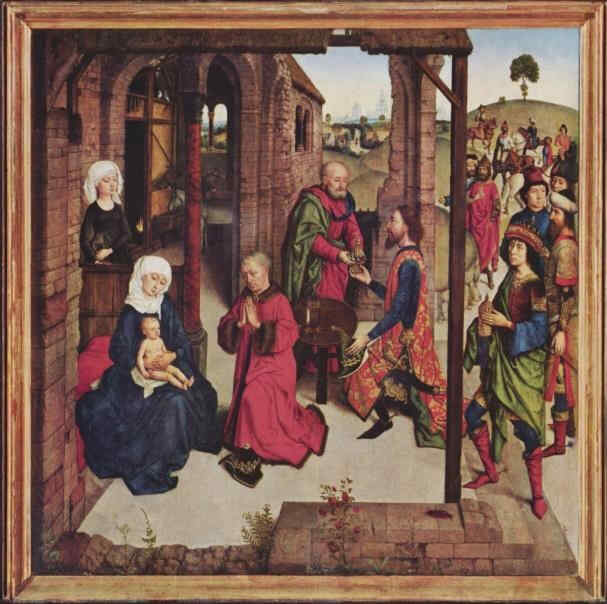
43. Dieric Bouts. Adoration by the Wise Men. (Alte Piankothek. Munich.)
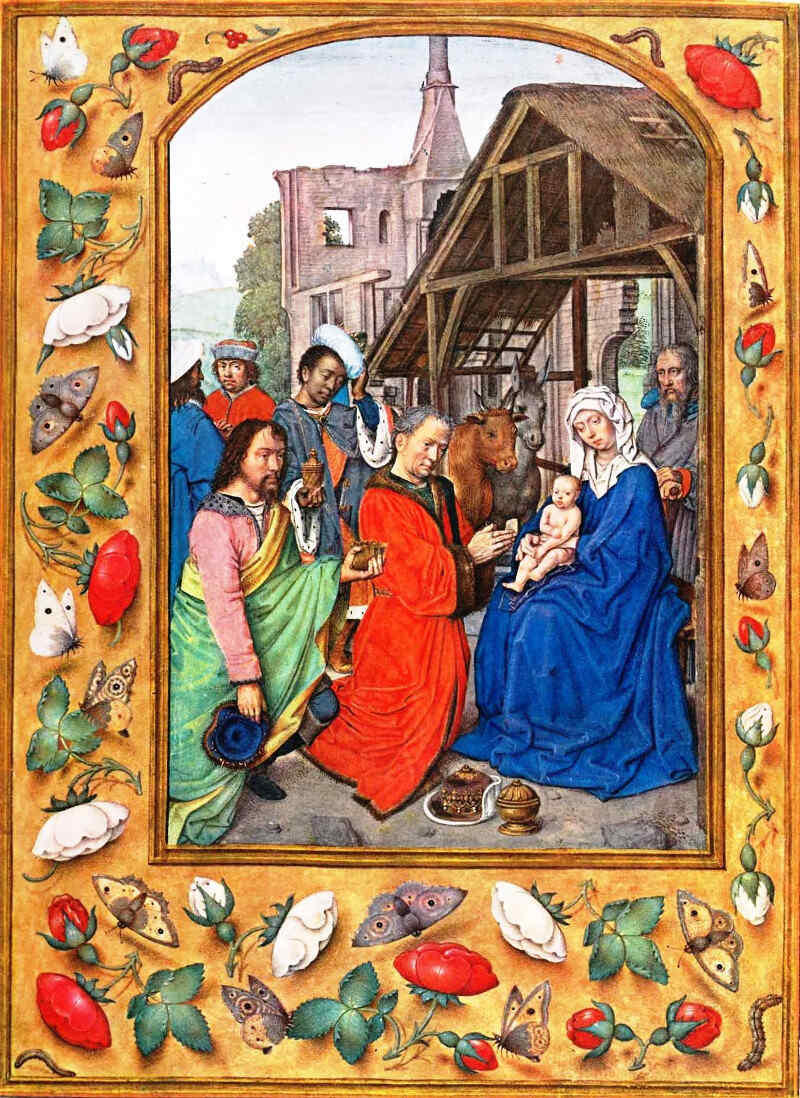
44. Adoration by the Wise Men, 15th centry, from the Brevarium Grimani.
We have spoken of the characte of these painters. The next is by the artist who worked in Bruges and died about 1523.
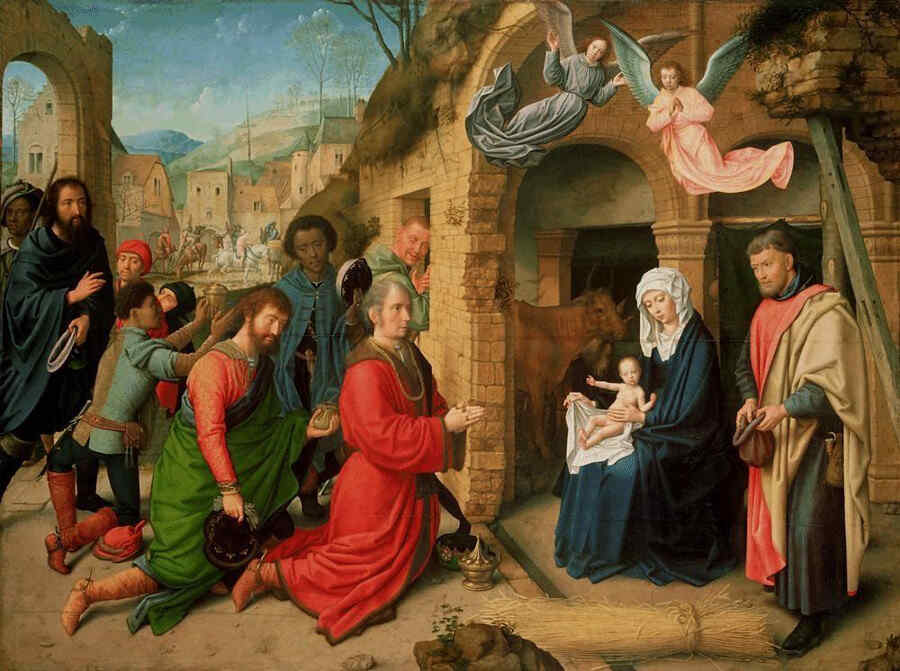
45. Gerard David. Adoration by the Wise Men. (Alte Pinakothek. Munich.)
And now the same theme treated by Leonardo.
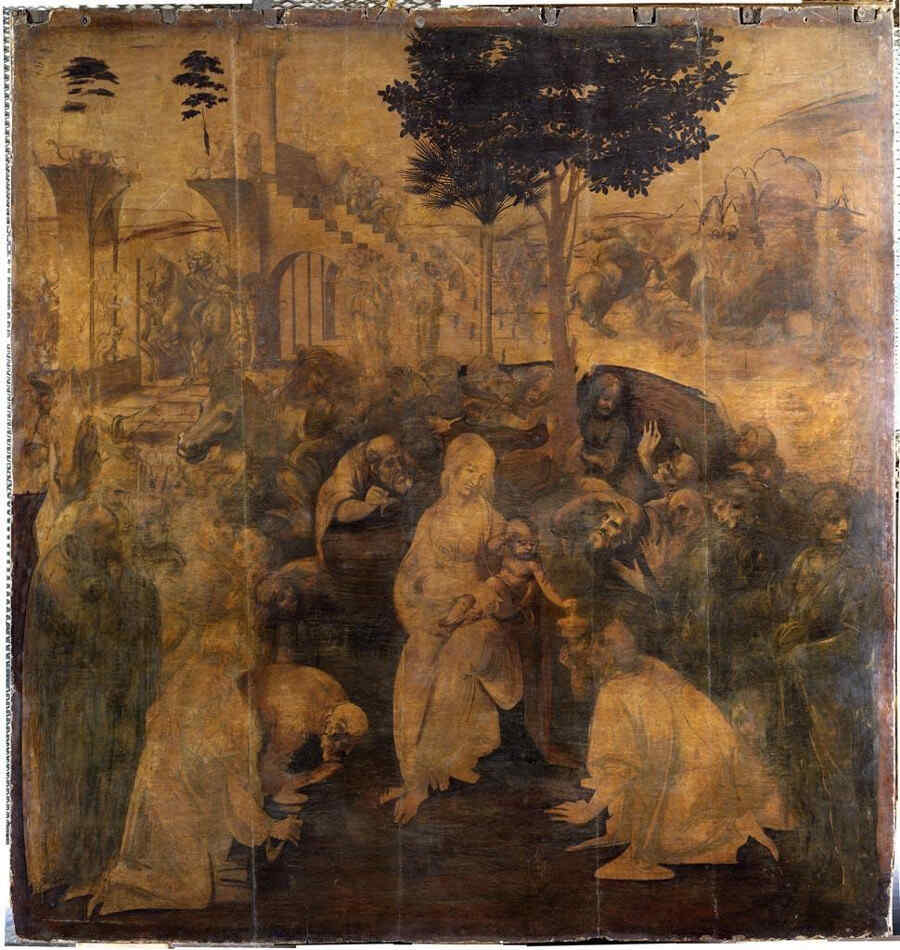
46. Leonardo da Vinci. Adoration by the Three Wise Men. (Uffizi.Florence) And by his pupil,
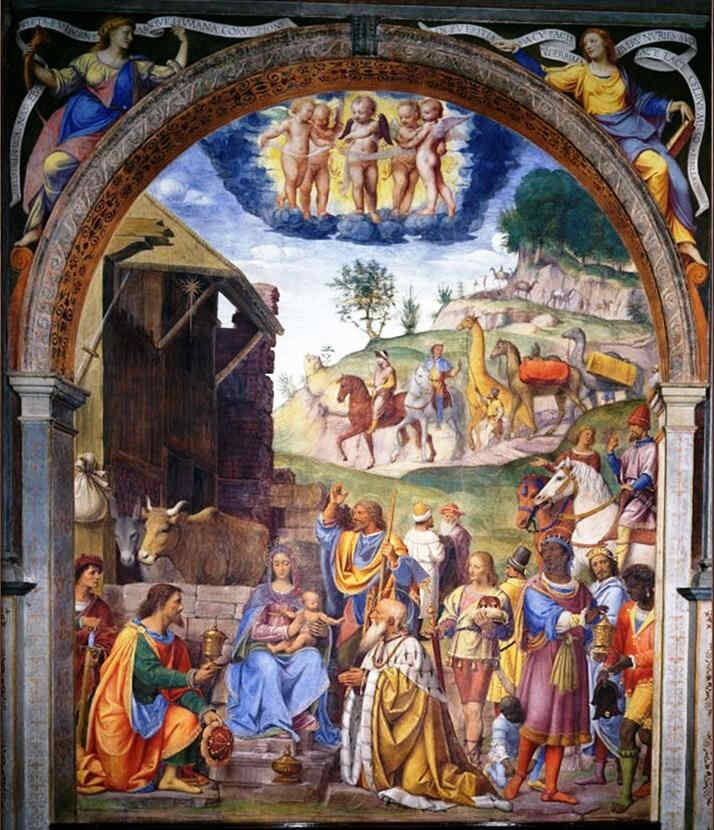
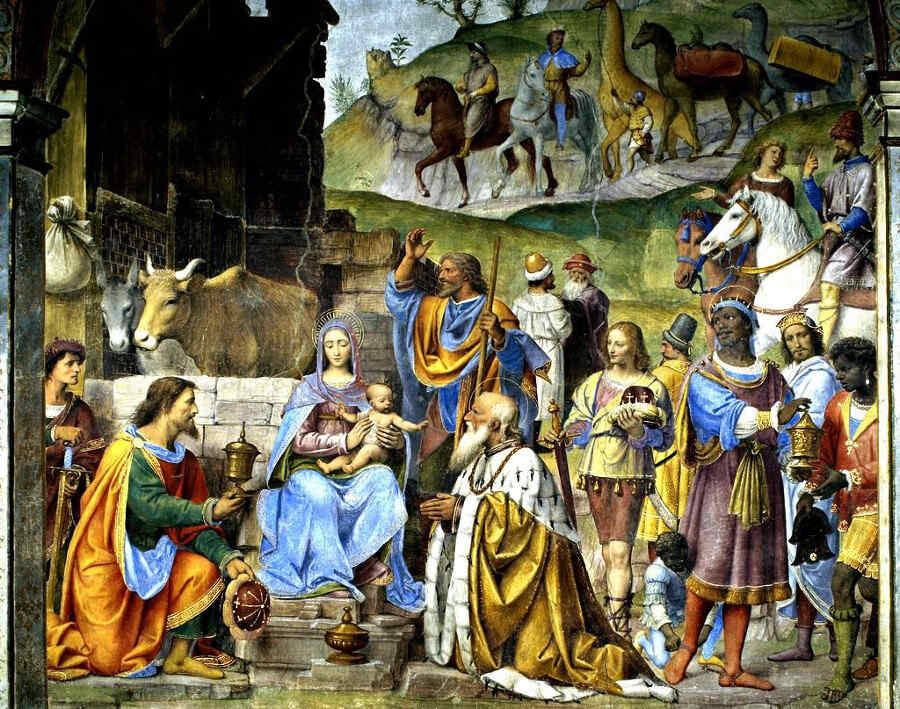
47. Luini Bernadino. Adoration by the Wise Men. (Saronno.)
Going North again:
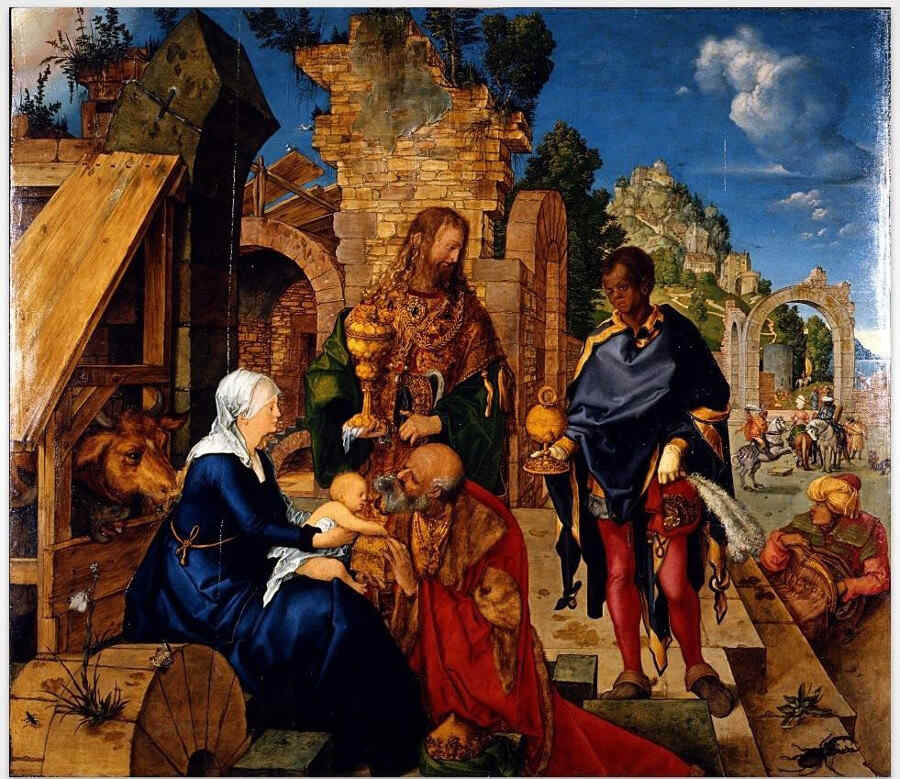
48. Dürer. Adoration by the Wise Men. (Uffizi. Florence.)
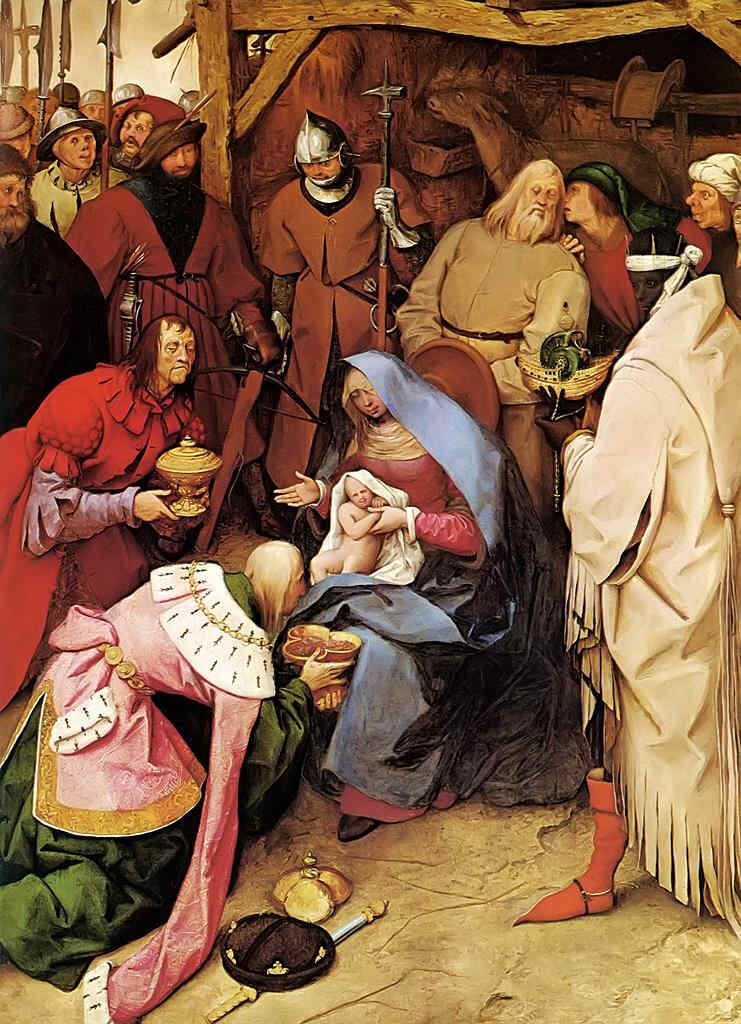
49. Brueghel. Adoration by the Wise Men. (Vienna.)
And finally, Rembrandt.
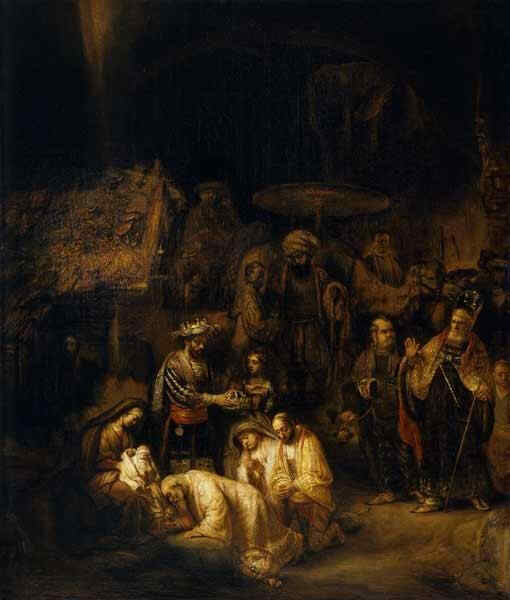
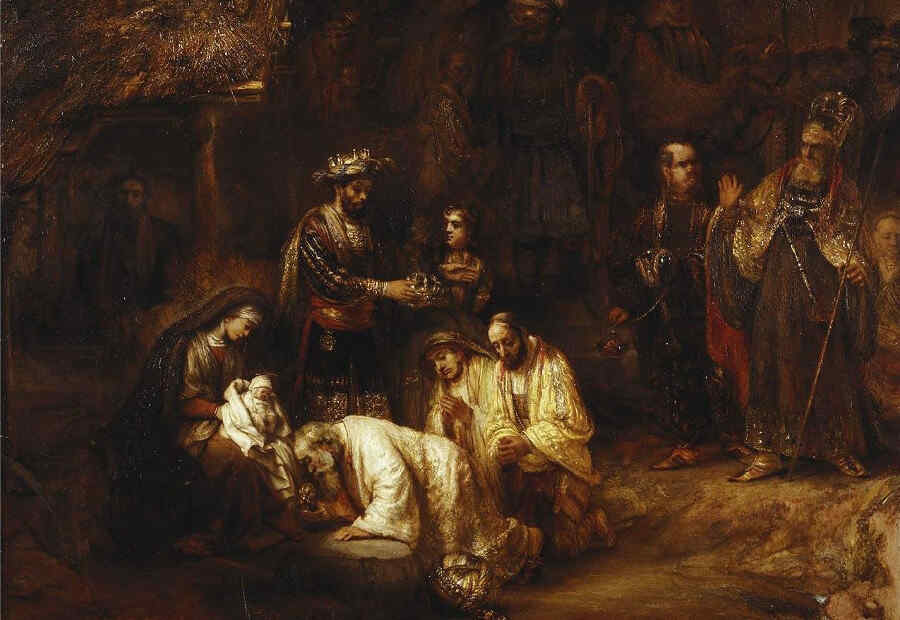
50. Rembrandt. Adoration by the Three Wise Men. (Buckingham Palace.)
And now we come to our last theme: the Flight into Egypt. First we have a painter of the late 15th and early 16th century.
51. Herrad von Lanndsberg. The Flight into Egypt.
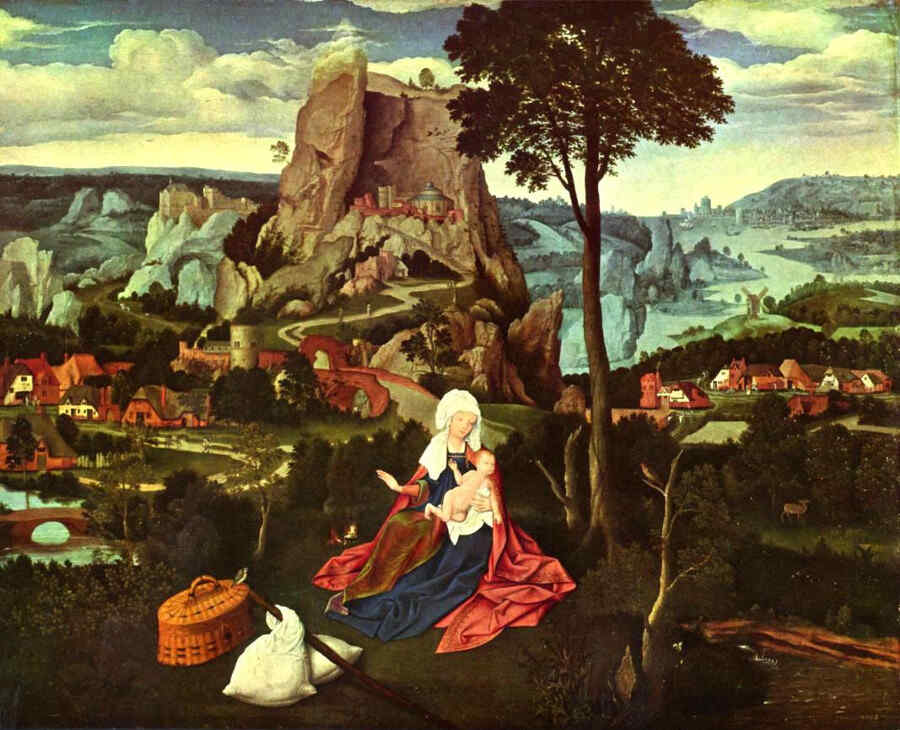
52. Joachim de Patinir. Rest in the Flight. (Prado. Madrid.)
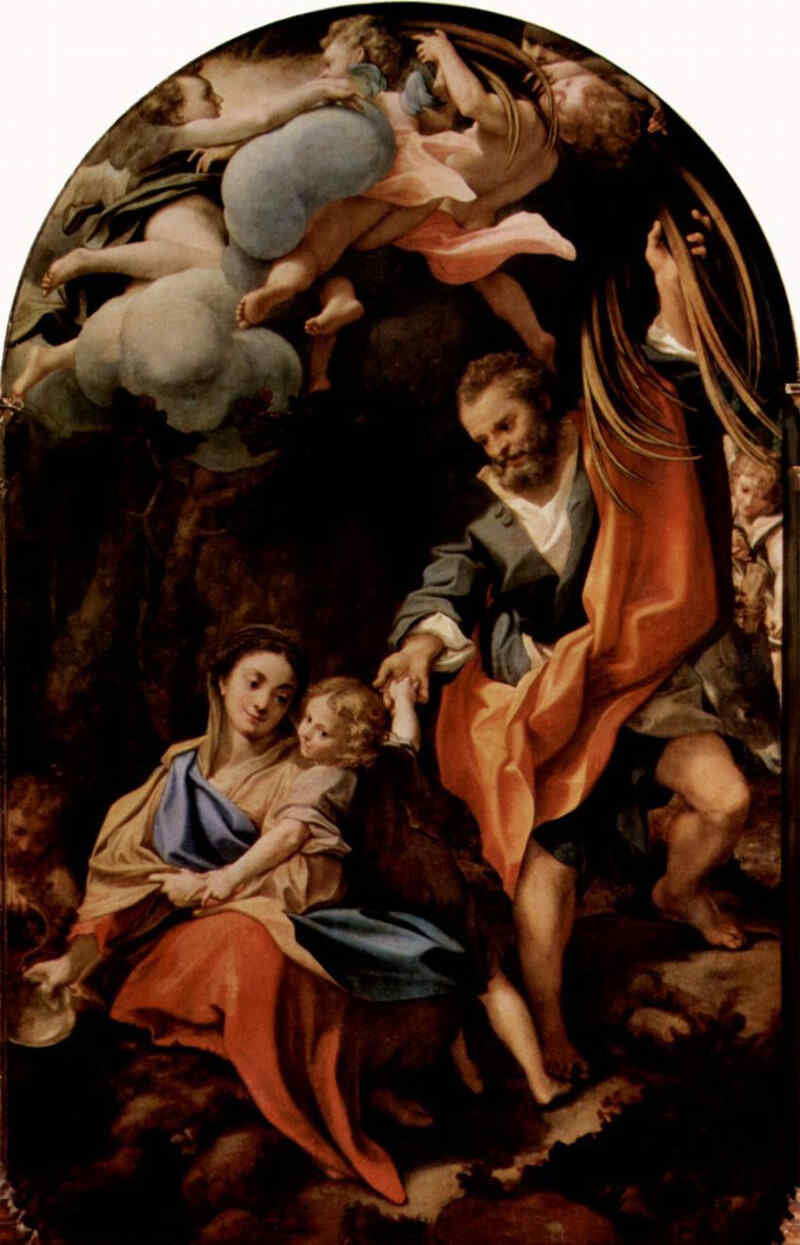
53. Correggio. Madonna della Scodella. (Parma)
The next, a little later.
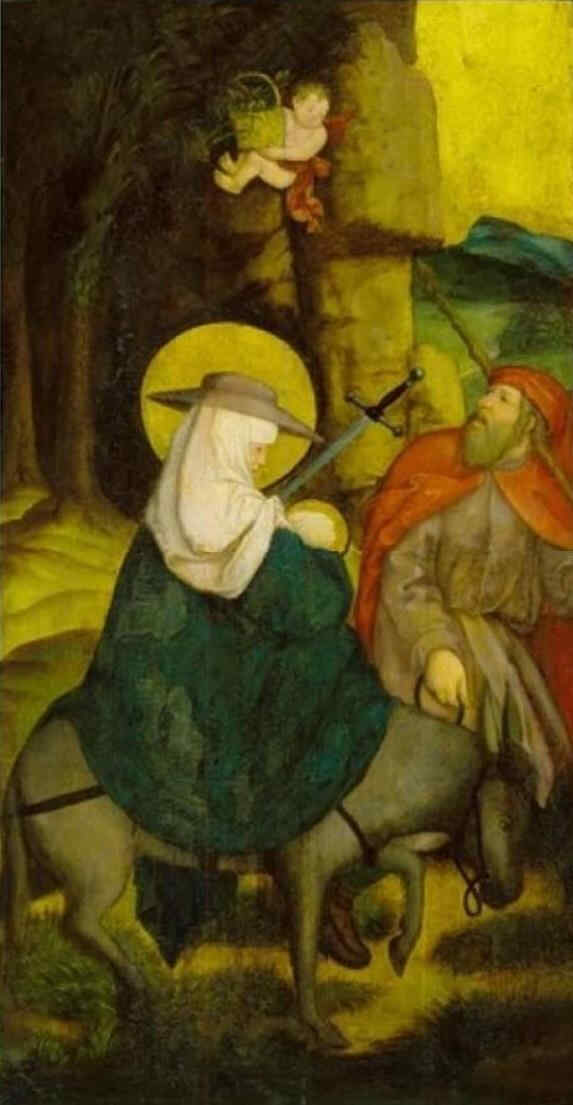
54. Bernhard Strigel. The Flight into Egypt. (Stuttgart.)
Strigel painted also in Vienna, and died in 1528.
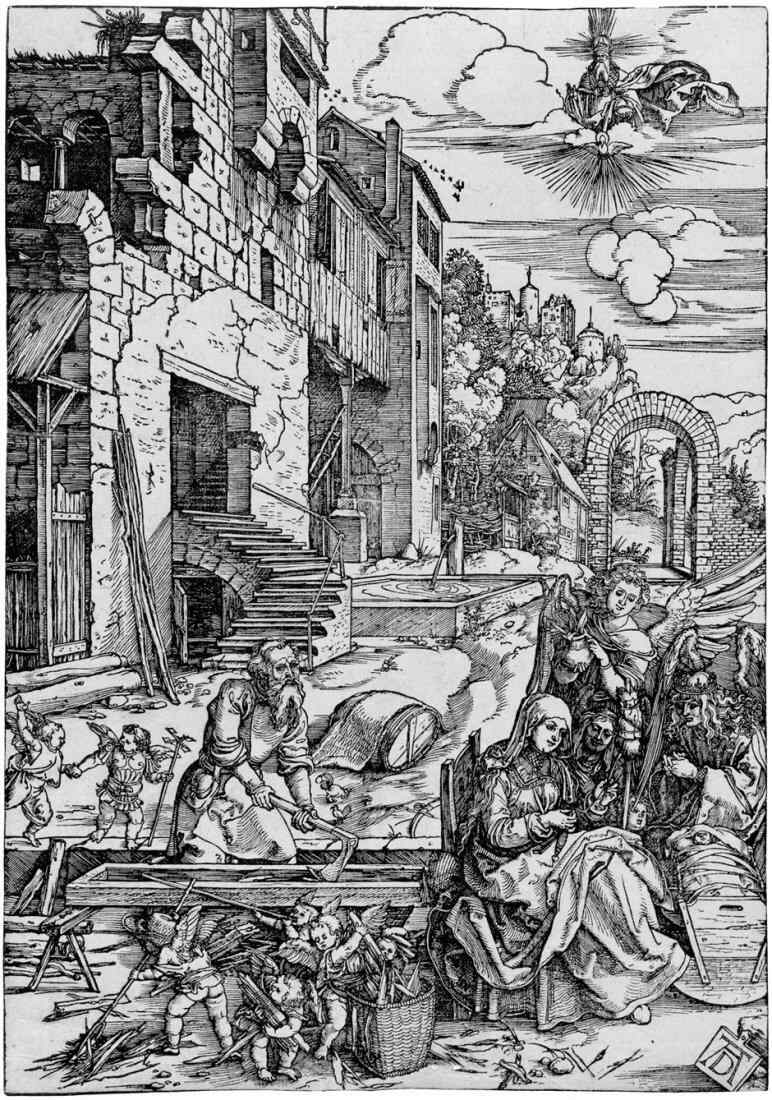
55. Albrecht Dürer. Resting on the Flight into Egypt.
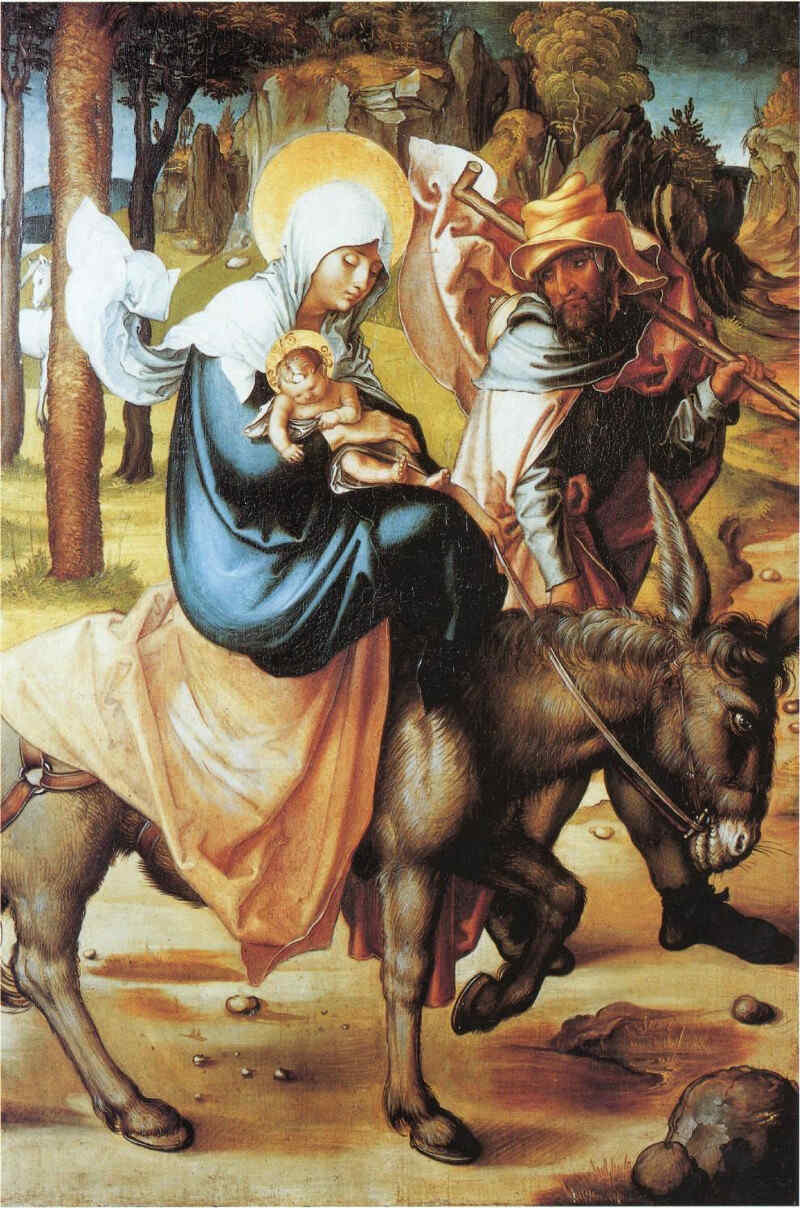
56. Workshop of Albrecht Dürer. Resting on the Flight into Egypt.
Next is Hans Baldung or Hans Grun, going on into the 16th century.
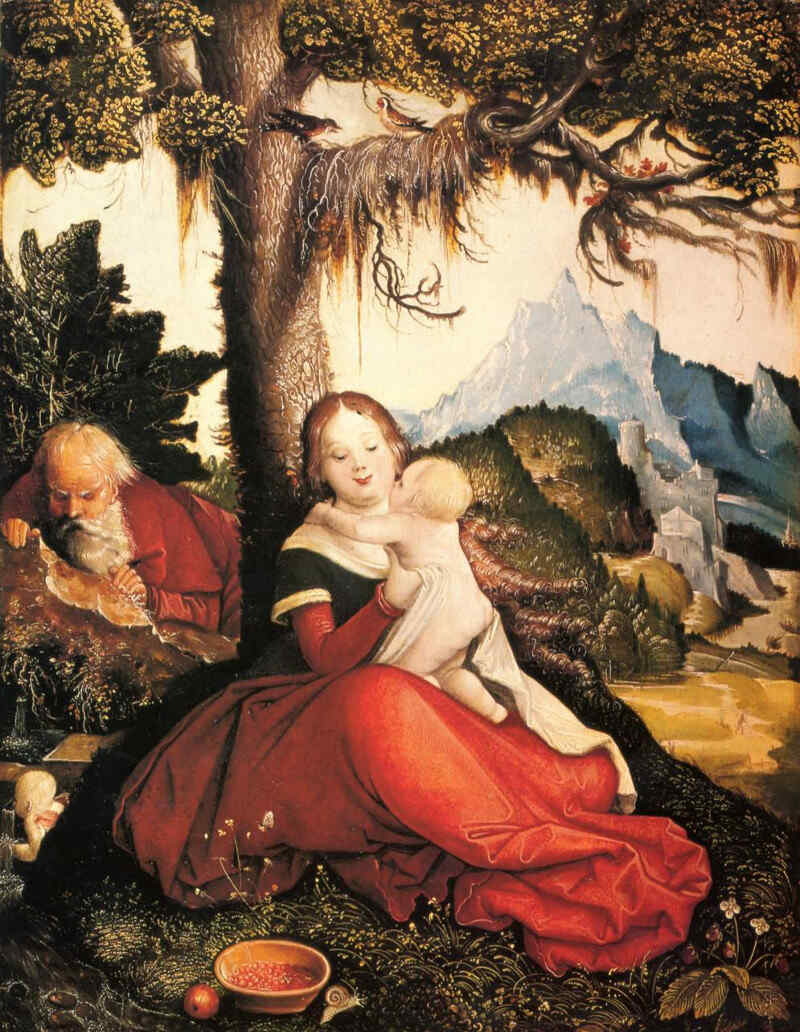
57. Hans Balding (Baldung). Rest in the Flight. (Germanisches Museum. Nuremberg.)
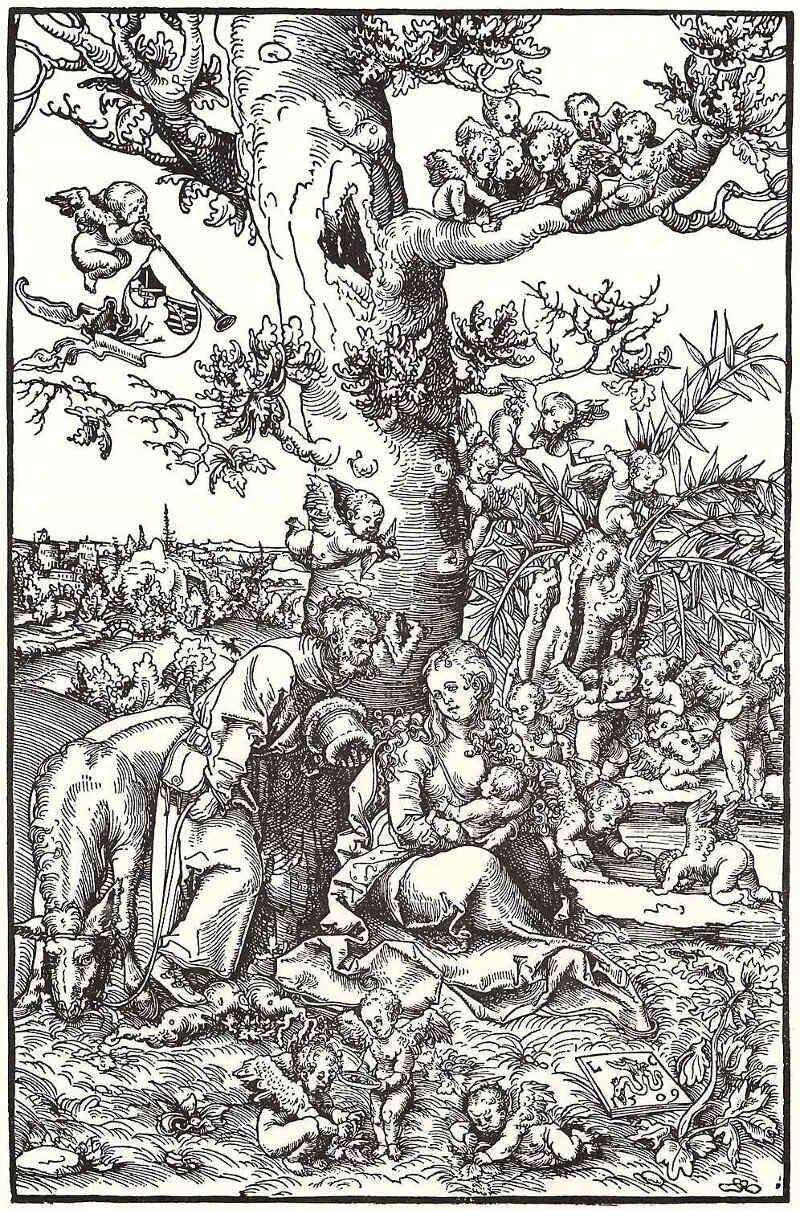
58. Lucas Cranach. Rest in the Flight. (Berlin.)
Finally, Rembrandt:
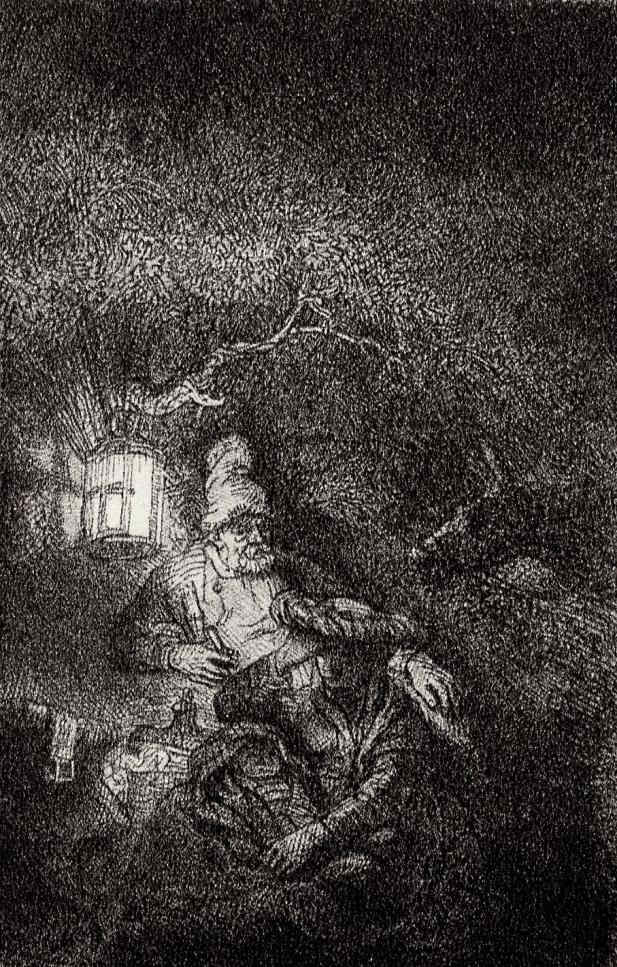
59. Rembrandt. Rest in the Flight. (Etching.)
So much for today. Perhaps you will now take the opportunity to see at close quarters this impressive picture of the Wise Men which indicates so clearly the worship of the Star with the incoming of the Christ Jesus Soul.
7. Mosaike Miniaturen Italienische, Niederländische und Deutsche Meister
Weihnachtsmotive aus mehreren Jahrhunderten: Geburt des Christus Jesus - Anbetung der Hirten -— Anbetung der Könige Flucht nach Ägypten
Wir werden Ihnen heute, da Herr Dr. Trapesnikoff die Diapositive bestellt hat, Lichtbilder zeigen, welche nicht unter demselben Gesichtspunkt vorgeführt werden, wie das bei den vorangehenden Vorführungen dieser Art der Fall war, sondern unter einem mehr stofflichen Gesichtspunkt. Wir werden Ihnen nämlich Bilder zeigen, die sich beziehen auf die «Geburt des Christus Jesus», auf die «Anbetung der Hirten», auf die «Anbetung der Könige» und auf die «Flucht nach Ägypten».
Diese Bilder, die mehrere Jahrhunderte Entwickelung umfassen, sollen uns gewissermaßen das von einer anderen Seite vor die Seele führen, was in den «Weihnachtspielen» lebt und was lebte in den Auseinandersetzungen, die ich in den letzten Vorträgen gegeben habe. Ich werde daher heute, da es sich ja nicht in erster Linie um das Künstlerische handeln wird, sondern um das Behandeln eines gewissen Stoffgebietes durch die Kunst, auch weniger von der Entwickelung in künstlerischen Prinzipien sprechen, Sie dafür aber auf einige andere Gesichtspunkte für das Vorzuführende aufmerksam machen.
Den allgemeinen Zug, den Sie für die christliche Kunstentwickelung ja entnehmen konnten aus den angestellten Betrachtungen bei den LichtbildVorführungen in den letzten Wochen, den werden Sie allerdings auch heute bemerken, indem wir vorschreiten werden von künstlerischen Darstellungen der ersten christlichen Jahrhunderte bis in die Renaissancezeit hinein. Sie werden insbesondere bemerken, wie aus der typischen Darstellung der ersten Zeiten, die gewissermaßen, wie ich es charakterisiert habe, unter dem Einflusse der Offenbarung aus der geistigen Welt stehen, die weniger auf die naturalistische Ausprägung der Formen und Farben sehen als auf die Wiedergabe der geistigen Imagination, die aus der geistigen Welt heraus sich offenbart, aus dieser Zeit werden Sie sich herausentwickeln sehen die christliche Kunst auch auf diesem Stoffgebiete zum Naturalismus hin, das heißt zu einer gewissen Wiedergabe dessen, was für den physischen Plan Wirklichkeit genannt werden kann, so daß wir immer menschlicher und menschlicher die heiligen Persönlichkeiten in der Kunst vor uns dargestellt sehen werden.
Was uns aber heute besonders interessieren muß, ist, ich möchte sagen die bildhafte Verkörperung eines Gedankens, der die letzten Vorträge durchsetzt hat. Wir werden zuerst vorgeführt sehen, was sich auf die «Geburt Christi» bezieht. Es ließ sich das nicht ganz genau trennen von dem nächsten Stoffgebiete, von der «Anbetung der Hirten». Also ich kann sagen: Zuerst sehen wir das, was sich auf die Geburt Christi bezieht im Zusammenhang mit der Anbetung der Hirten, und dann werden wir Bilder sehen, bei denen es sich hauptsächlich handeln wird um die «Anbetung der Könige», der Weisen aus dem Morgenlande, der Magier. Ich bitte Sie, das Augenmerk darauf zu lenken, wie diese beiden Strömungen sich entwickelt haben, von denen man ja die eine nennen kann die Strömung des Lukas-Evangeliums, die andere die Strömung des Matthäus-Evangeliums — wir können sie nennen die Strömungen, welche anknüpfen an die beiden Jesusknaben -, wie sich diese beiden Strömungen entwickelt haben. Auch künstlerisch müssen wir ja sehen in alledem, was mehr oder weniger zusammenhängt mit der Anbetung der Hirten, das, was besonders gut verstanden werden konnte, gefühlsmäßig, empfindungsmäßig gut verstanden werden konnte unter dem Einflusse dessen, was zurückgeblieben war von jenen nordländischen Mysterien, als deren Zentrum ich Ihnen Dänemark bezeichnet habe. Mit dieser Strömung hängt alles das zusammen, was auf die Jesus-Geburt sich bezieht, was gewissermafßen mit Jesus herauswächst aus der irdischen Evolution, aus denjenigen Geistigkeiten, die mit dem Naturdasein verbunden sind.
Die gnostische Strömung dagegen finden wir direkt ausgesprochen überall da, wo wir es zu tun haben mit der Anbetung beziehungsweise mit der Mission der Magier aus dem Morgenlande, die unter dem Einfluß des Sternes das heißt ja nichts anderes, als unter dem Einfluß desjenigen, was aus dem Kosmos geoffenbart wird - an den sich verkündenden Christus herankommen, der sich in dem Zarathustra-Jesus offenbaren wird. In all dem, was mit der Anbetung der Könige zusammenhängt, haben wir eben die gnostische Strömung, das heißt, das Bewußtsein vor uns, daß das Christus-Ereignis ein kosmisches ist, daß gewissermaßen eine Befruchtung aus dem Kosmos herein stattgefunden hat.
Unsere Freunde waren so liebenswürdig, hier Ihnen die Könige aufzuzeichnen - das Bild ist aus einem alten Evangelienbuch entnommen -, welche anbetend, das heißt Erkenntnis suchend durch Aufwendung aller Seelenkräfte, des ganzen Seeleninneren, zu dem Stern aufschauen, in dem herankommt der
Geist, der die Erde befreien soll.
678* Miniatur, 14. Jh. «Die drei Könige sehen den Stern». Federzeichnung nach dem «Speculum humanae salvationis»
Man kann sagen, daß diese Strömung, die sich ausdrückt in dem Matthäus-Evangelium, im Grunde genommen mit den weiter verfließenden Jahrhunderten immer weniger und weniger verstanden worden ist; sie lebt zwar auf, wie wir ja wissen, auch in den Weihnachtspielen; allein solches Verständnis kann gerade der Erscheinung der Magier aus dem Morgenlande heute nicht entgegengebracht werden, wie der Erscheinung des Jesus gegenüber den Hirten, der Erscheinung des Jesus gemäß dem Lukas-Evangelium, einfach aus dem Grunde, weil das letztere Verständnis ein Gefühls- und Empfindungsverständnis ist; das Verständnis aber, das entgegengebracht werden muß dem, was mit den Magiern aus dem Morgenlande zusammenhängt, muß schon ein gnostisches Verständnis sein. Und was alles gemeint ist mit dem «Folgen dem Sterne», das wird der Menschheit erst wiederum zum Bewußtsein kommen können, wenn jetzt nicht die Gnosis, sondern die anthroposophisch orientierte Geisteswissenschaft eben mehr Bekennerschaft finden wird.
Dann werden wir zuletzt einige Bilder vorführen, welche die «Flucht nach Ägypten» zeigen, die auch zusammenhängt mit dem, was man nennen könnte gnostische Offenbarung über den Christus Jesus. Darüber wollen wir heute nicht viel sprechen; es kann ein anderes Mal darüber gesprochen werden. Es handelt sich ja dabei zunächst darum, wirklich von dem Bewußtsein auszugehen, daß alles dasjenige, was in den Evangelien steht, wirklich so komponiert ist, daß schon auf die Komposition etwas zu geben ist. Die Flucht nach Ägypten, die im Zusammenhange uns erscheint mit der Mission, also getreu dem Evangelium im Zusammenhange mit den Magiern, auf Grundlage dessen gewissermaßen sich vollzieht, was die Magier zuerst unternommen haben - diese Flucht nach Ägypten bezeugt uns ja, daß das Evangelium Rücksicht darauf nimmt, daß ein Zusammenhang besteht zwischen dem, was im Alten Testament über die Ägypter, das Ägyptische überhaupt gesagt ist, und dem jüdischen Volke. Moses war bewandert in der Wissenschaft der Ägypter, das heißt in der eigentümlichen Gnosis der Ägypter. Und nun wird uns im Evangelium erzählt, daß die Magier aus dem Morgenlande durch den Stern, der im Grunde genommen der Christus-Stern ist, kommen bis zu der Geburtsstätte des Christus Jesus; daß dann aber etwas eintreten muß, was gewissermaßen nicht ganz dem Lauf des Sternes entspricht, was auch nicht im Bewußtsein der Magier lebt, das wird ja ausdrücklich angedeutet im Evangelium. Wir haben hier einen derjenigen Fälle, in denen uns gezeigt wird, daß gewissermaßen die Determination, sagen wir, die astrologisch bestimmbare Determination, für gewisse große Ereignisse durchbrochen werden muß. Wie genau die astrologische Determination demjenigen entspricht, was man wissen kann über die historischen Vorgänge, das haben Sie ja gesehen dadurch, daß Ihnen gesprochen worden ist von dem Horoskop, das unsere Freunde gestellt haben für den Punkt im Laufe der Zeit, der für den Todestag des Christus Jesus angegeben wurde. Aber wir sehen zugleich, daß der Jesusknabe, in dem die ZarathustraSeele lebte, herausgebracht werden mußte aus dem Gebiet dieses Sternes; und er wird nach Ägypten gebracht, aus Ägypten dann wieder zurückgeführt in den Bereich dieses Sternes. Das enthält das ganze Mysterium der abflutenden alten Evolution, welche in der ägyptischen Gnosis atavistisch geworden ist, mit der gewissermaßen die neue Offenbarung noch eine Verbindung eingehen muß, damit sie sich bewußt herauslöst. Das alles liegt diesen Dingen zugrunde, wenn es auch in den Evangelien weniger gesehen wird, aber in der Komposition liegt es darinnen.
Bei dieser Gelegenheit möchte ich darauf aufmerksam machen, daß es von ganz besonderer Wichtigkeit ist, daß man bei den Evangelien auf die Komposition sieht; denn der Text ist ja in vieler Beziehung korrumpiert, kann heute nur noch von denjenigen gelesen werden, die mit Hilfe, ich möchte sagen des okkulten Textes lesen können, so wie er dasteht. Insbesondere gar in den Übersetzungen ist der Evangelientext natürlich nicht zu verstehen. Aber in der Komposition - Sie können das in dem Vortragszyklus, der über das Johannes-Evangelium handelt, der in Kassel gehalten worden ist, sehen - liegt dasjenige, was unmittelbar jedem gleich auffallen kann, wenn er die Evangelien betrachtet.
Eine Bemerkung möchte ich nun noch machen, bevor wir die Bilder zeigen. Für unsere heutige materialistische Zeit ist ja eine Anschauung, ich möchte sagen für das eigentliche Zeitbewußtsein ganz verlorengegangen, welche auf solche Zusammenhänge geht, die zugrunde liegen der Offenbarung der Magier aus dem Morgenlande. Dasjenige, was heute Astrologie genannt wird, ist ja ganz und gar in dilettantische Hände übergegangen, die allen möglichen Unfug damit treiben, und nur wenige meinen es heute ernst, wenn sie von der Beziehung der Erde zum Kosmos insofern sprechen, als diese Beziehung ausgedrückt wird in physischen Verhältnissen, nämlich in der Konstellation der Sterne. Für dasjenige, was sich heute Wissenschaft nennt, als Wissenschaft ausgibt, ist ja Astrologie überhaupt ein alter Aberglaube. So gründlich zugrunde gegangen, wenn ich den Ausdruck gebrauchen darf, ist das Diesbezügliche eigentlich erst im 18. Jahrhundert; und im 18. Jahrhundert hat man noch gesprochen von etwas, was außerordentlich wichtig ist, wenn man Verständnis haben will für das Tiefe, das der Erscheinung der Magier zugrunde liegt, der drei Magier. Im 18. Jahrhundert wird von denjenigen, die sich noch etwas bewahrt haben aus den alten Initiationsverhältnissen, Einweihungsverhältnissen heraus, gesprochen von der Bedeutung der physischen Sternkonstellationen, aber auch von der Bedeutung unsichtbarer Sternkonstellationen; es wird ja im 18. Jahrhundert bei einigen Wissenden noch ausdrücklich gesagt: Es gibt auch Sterne, die erst der Eingeweihte sehen kann. — Das ist wahr; und das muß insbesondere berücksichtigt werden, wenn man verstehen will, warum den Hirten Imaginationen erscheinen, den Magiern aber Sterne erscheinen. Damit wird darauf hingewiesen, daß den Hirten die Offenbarung dadurch wird, daß sie im alten atavistischen Sinne angeborenes, traumhaftes Schauen haben; für die Magier aus dem Morgenlande wird angedeutet, daß sie durch die Wissenschaft, die noch überliefert worden ist, Kenntnis haben von den Beziehungen des Kosmos zu der Erde und dadurch wissen, was sich herannaht, gewissermaßen berechnen können, was sich herannaht. Daher sehen wir auch - und Sie werden das bemerken können, wenn wir die Evolution der Bilder betrachten werden trotz allen Übergehens zum Naturalismus, ich bitte Sie, das nachher zu beachten, die bildhafte Darstellung für die drei Magier immer weniger entsprechen. Für die drei Magier paßt das Älteste, Typische am allerbesten, denn dasjenige, was gemeint ist, ist Ja aus dem Irdischen herausgehoben. Inniger wird die Jesus-Darstellung, indem sie immer mehr ins Naturalistische übergeht, weil hier das angemessen ist, indem gerade dasjenige, was vom physischen Plane her dem Christus entgegenkommt, also mit dem natürlichen Dasein zusammenhängt, auch durch natürliche Mittel seine beste Darstellung finden kann.
Nun werden wir, nachdem ich diese Bemerkungen gemacht habe, zuerst dasjenige sehen, was mit der Geburt Christi und der Anbetung der Hirten und dann der Könige zusammenhängt.
Hier haben wir eine Mosaikdarstellung aus Palermo.
679 Palermo, Chiesa della Martorana, 12. Jh. Die Geburt Christi.
Sie sehen in diesen älteren Darstellungen eben alles typisch aufgefaßt und im Grunde genommen zurückgehend auf typische Darstellungen, die zum großen Teil vom Morgenlande her in alten Zeiten vorhanden waren für die alten Mythen. Denn auf ganz naturgemäße Weise wächst das Typische der Mythusdarstellung hinein in die Darstellung des Christlichen. Geradeso wie man den Orpheus-Typus, den Typus des Guten Hirten, der auf ältere Mythendarstellungen, Kultdarstellungen zurückgeht, genommen hat, um das neue Ereignis darzustellen, so wurden eben auch andere alte, ich möchte sagen Kompositionsmotive einfach auf das neue Christus-Ereignis übertragen.
Das nächste Bild ist eine Darstellung aus einer sogenannten Armenbibel:
680* Biblia Pauperum, um 1470 Die Geburt Christi
Diese Bibeln, die in früheren Jahrhunderten gemacht worden sind, zeigen gewöhnlich parallele Darstellungen aus dem Alten und Neuen Testament. Was man ins Auge gefaßt hat: daß das Neue Testament die Erfüllung des Alten Testamentes ist, das ist vielfach in diesen Armenbibeln enthalten. Hier auch haben wir, was uns vorzugsweise interessiert, in der Mitte: die Geburt des Christus Jesus.
Nun haben wir aus einem Evangeliar, das sich in Köln befindet:
681 Evangeliar des Klosters Limburg, 11. Jh. Die Geburt Christi
Es ist sehr interessant, wie das im Weltenall damit Verbundene hier ringsherum ist und wie noch ein Bewußtsein sich verrät von den geistigen Zusammenhängen.
Dann haben wir das Motiv aus dem «Hortus deliciarum»,
682 «Hortus deliciarium» der Herrad von Landsberg, 12. Jh. Die Geburt Christi und Die Flucht nach Ägypten
darunter: Die Flucht nach Ägypten, die wir, weil sie mit dem anderen Bild verbunden ist, damit zusammen zeigen. Wir werden diese Flucht nach Ägypten sonst erst später sehen. Oben haben Sie wunderschön naiv die Darstellung der Geburt. Sie werden den Zusammenhang fühlen mit dem, was in den Weihnachtspielen gegeben ist, die ja freilich einer späteren Zeit angehören, aber eigentlich auch auf ältere Weihnachtspiele zurückgehen, die nur nicht erhalten sind.
Und nun werden wir das Motiv nehmen, wie es auftritt bei Niccolö Pisano im 13. Jahrhundert auf einem Kanzelrelief:
683a Niccolö Pisano Die Geburt Christi
Und bei Giotto:
683b Giotto Die Geburt Christi
Sie sehen, wie alles langsam in das Naturalistische, in die naturalistische Darstellung hineinwächst. Das nächste ist nun della Robbia.
683c Giovanni della Robbia Die Geburt Christi
Damit sind wir schon im 15. Jahrhundert.
Und das ist von Meister Francke:
683d Meister Francke Die Anbetung des Kindes
Das Bild befindet sich in Hamburg; ich erinnere mich, daß ich es selber vor nicht allzulanger Zeit dort gesehen habe. Nun die «Weihnacht» von Filippo Lippi:
684 Fra Filippo Lippi Maria, das Kind verehrend
Man sieht also wirklich, wie im Laufe der Zeit der Naturalismus die Darstellung ergreift. - Das nächste Bild ist von Piero della Francesca.
685 Piero della Francesca Die Geburt Christi
Wir schreiten weiter zu Correggio:
686 Correggio Die Geburt Christi
Noch eine andere Correggio-Darstellung:
687” Correggio Maria, das Kind verehrend
Nun begeben wir uns zu den nördlicheren Meistern — die Namen kennen Sie aus den vorhergehenden Besprechungen -, zunächst jetzt zu einer Darstellung der «Weihnacht» von Schongauer:
688a Martin Schongauer Die Geburt Christi
Sehr interessant, hintereinander die italienischen und die nordischen Meister zu sehen: dort die größere Typisierung noch immer, hier die Individualisierung und dieses Schaffen aus dem Seelischen heraus. Man darf schon sagen: bis zu den zarten Füßchen ist hier alles seelisch, wenn auch die Kunstvollendung nicht so bedeutsam ist wie bei den südlichen Meistern.
Nun ein Bild von Herlin, in Nördlingen, aus dem 15. Jahrhundert:
688b Friedrich Herlin Die Geburt Christi
Damit sind wir eben am Ende des 15., hart am Ende des 15. Jahrhunderts und kommen jetzt an die Wende des 15. und 16. Jahrhunderts, zu Dürer:
688c Albrecht Dürer Die Geburt Christi
Auch an diesem Bilde bemerken Sie, wie alles dasjenige, was ich über die Lichtdarstellung gesagt habe, eben die Kunst ergreift. Es ist immer wieder sehr interessant, dies bei Dürer zu studieren.
Das nächste ist von dem, der Nachfolger Dürers war, von Altdorfer:
688d Albrecht Altdorfer Die Geburt Christi
Und jetzt werden wir eine Reihe von Bildern, die sich vorzugsweise auf die «Anbetung der Hirten» beziehen, bringen. Zunächst ältere Miniaturbilder, die sie für Bibeltexte, Evangelientexte darstellen:
69a Codex Egberti, 10. Jh. Die Geburt Christi und die Verkündigung an die Hirten
Dies stammt aus einer in Trier befindlichen Handschrift [aus der Zeit] um 980.
689 Menologium des Basilius II, 11. Jh. Verkündigung an die Hirten und Geburt Christi
Und nun gehen wir über zu der italienischen Darstellung der «Anbetung der Hirten» und haben zunächst ein Bild von Cimabue.
690b Cimabue (?) Die Anbetung der Hirten
Sie wissen, mit Cimabue stehen wir im 13. Jahrhundert. Wir gehen jetzt weiter in das 15. Jahrhundert zu Ghirlandajo:
692a Domenico Ghirlandajo Die Anbetung der Hirten
Wir haben ja gerade über diesen Meister gesprochen. Ein weiterer Meister aus dem 15. Jahrhundert ist Piero di Cosimo, Florenz.
691 Piero di Cosimo Die Anbetung des Kindes
Wir gehen jetzt herauf in das, was wir als die Niederländische Kunst kennen. Und jetzt bitte ich, sich eine ganze Weile für die Betrachtung dieses Bildes zu nehmen.
692d Hugo van der Goes Portinari-Altar, Mittelteil: Die Anbetung des Kindes
Wir haben auch von diesem Meister Goes schon gesprochen. Ein anderes Bild desselben Meisters:
466 Hugo van der Goes Die Anbetung der Hirten
692b Rembrandt Die Verkündigung an die Hirten
692c Rembrandt Die Anbetung der Hirten
Und jetzt wollen wir zu den Darstellungen übergehen, welche die «An betung der Magier» zeigen.
Da haben wir zunächst ein Relief von einem altchristlichen Sarkophag in
Ravenna: 695a Frühchristliche Plastik, 4. Jh. Die Huldigung der Magier Dann ein Mosaikbild in San Apollinare Nuovo, ebenfalls in Ravenna:
693 Ravenna, S. Apollinare Nuovo, 6. Jh. Die Huldigung der Magier
Also auch die älteren Bilder zeigen eben durchaus die Ereignisse in Zusammenhang mit der spirituellen Welt und durchaus also fern von allem Naturalismus, alles gehoben in eine höhere Sphäre.
694 Menologium des Basilius II., 11. Jh. Die Huldigung der Magier, Miniatur
Jetzt gehen wir wiederum ins 13. Jahrhundert zu Niccolò Pisano:
695b Niccolò Pisano Die Anbetung der Könige
Das ist ein Kanzelrelief.
698a Freiberger Marienkirche Bogenfeld der «Goldenen Pforte»: Die Anbetung der Könige
Das ist also die Freiberger «Goldene Pforte». Damit sind wir in der zweiten Hälfte des 13. Jahrhunderts und schreiten nun weiter zum 15. Jahrhundert:
696 Domenico Veneziano Die Anbetung der Könige
Dies Bild wurde früher dem Pisanello (Vittore Pisano) zugeschrieben.
698b Stefan Lochner Die Anbetung der Heiligen Drei Könige
Das ist also der schon früher besprochene Stefan Lochner. Nun ein Bild von Gentile da Fabriano:
697 Gentile da Fabriano Die Anbetung der Könige
Und jetzt von dem Künstler, der in der Darstellung dieses Ereignisses ebenso liebenswürdig ist wie in seinen anderen — Fra Angelico:
699a Fra Angelico Die Anbetung der Könige
699b Filippino Lippi Die Anbetung der Könige
Sehen Sie bei jedem dieser Motive, wie der Naturalismus fortschreitet. Wenn man sie durch Jahrhunderte verfolgt, gerade wenn man ein Motiv verfolgt, so ist es, von diesem Gesichtspunkt aus, besonders interessant.
699c Sandro Botticelli Die Anbetung der Könige
Nun kommen wir in die zweite Hälfte des 15. Jahrhunderts, zunächst zu Ghirlandajo,
699d Domenico Ghirlandajo Die Anbetung der Könige
und Ende des 15. Jahrhunderts zu Mantegna:
699e Andrea Mantegna Die Anbetung der Könige
700 Giorgione Die drei Philosophen (Die drei Weisen aus dem Morgenland)
Jetzt kommt Bellin::
701 Gentile Bellini (?) Die Anbetung der Könige
Nun bitte ich Sie, sich zu erinnern an die verschiedenen niederländischen, holländischen Maler, die wir angeführt haben; denn jetzt haben wir dasselbe Motiv bei van der Weyden und Bouts:
702a Rogier van der Weyden Die Anbetung der Könige
702b Dierick Bouts d. J. Die Anbetung der Könige, Mittelteil des Tragaltars «Perle von Brabant»
Über den Charakter dieser Maler haben wir ja in den vorigen Betrachtun gen gesprochen.
703 Breviarium Grimani, 15. Jh. Die Anbetung der Könige
Das nächste Bild ist von einem Maler, der auch in Brügge gemalt hat, wo er 1523 gestorben ist:
704a Gerard David Die Anbetung der Könige
Und nun das gleiche Motiv bei Lionardo,
704b Lionardo da Vinci Die Anbetung der Könige
dann bei Lionardos Schüler Luini:
705 Bernardino Luini Die Anbetung der Könige
Dann gehen wir wieder nach Norden, zu Dürer:
706a Albrecht Dürer Die Anbetung der heiligen drei Könige
Und noch dasselbe Motiv bei Brueghel,
706b Pieter Brueghel d. Ä. Die Anbetung der Könige
und dasselbe Motiv bei Rembrandt:
706c Rembrandt Die Anbetung der Könige
Und nun kommen wir zu dem letzten Motiv eben, das wir in den aufeinanderfolgenden Bildern betrachten; zu der «Flucht nach Ägypten». — Zuerst eine Darstellung aus dem 13. Jahrhundert, die wir schon gesehen haben:
707a «Hortus deliciarum» der Herrad von Landsberg, 12. Jh. Die Flucht nach Ägypten
Dann dasselbe Motiv bei Malern aus der zweiten Hälfte des 15. Jahrhunderts und vom Anfang des 16. Jahrhunderts:
707b Joachim Patinir Die Ruhe auf der Flucht
708* Correggio Madonna mit der Schüssel
707c Bernhard Strigel Die Flucht nach Ägypten
Strigel hat auch in Wien gemalt, ist 1528 gestorben.
709a Albrecht Dürer Ruhe auf der Flucht nach Ägypten
707d Albrecht Dürer, Werkstatt? Die Flucht nach Ägypten
709c Hans Baldung Grien Die Ruhe auf der Flucht
Ein Bild von Hans Baldung, Grien genannt, der auch schon in das 16. Jahrhundert herübergeht. Dann kommt Cranach,
709b Lucas Cranach d. Ä. Ruhe auf der Flucht
und zum Schluß dasselbe Motiv bei Rembrandt:
709d Rembrandt Nachtstück - Die Ruhe auf der Flucht
Damit haben wir für heute unsere Bilderserie erschöpft.
Ich bitte Sie, sich nachher vielleicht doch in der Nähe diese hier aufgestellte sehr eindrucksvolle Bilddarstellung der «Drei Könige» anzusehen, die direkt eine Anbetung des Sternes mit dem Hereinkommen der Christus-JesusSeele bedeutet.
01
7. Mosaics Miniatures Italian, Dutch, and German Masters
Christmas motifs from several centuries: Birth of Jesus Christ—Adoration of the Shepherds—Adoration of the Kings—Flight into Egypt
Today, since Dr. Trapesnikoff has ordered the slides, we will show you photographs that are not presented from the same perspective as in previous presentations of this kind, but from a more material perspective. We will show you pictures relating to the “Birth of Christ Jesus,” the “Adoration of the Shepherds,” the “Adoration of the Kings,” and the “Flight into Egypt.”
These images, which span several centuries of development, are intended to show us, in a sense, from a different perspective, what lives in the “Christmas plays” and what lived in the discussions I have given in recent lectures. Therefore, since today's lecture will not primarily deal with artistry, but rather with the treatment of a certain subject matter through art, I will speak less about the development of artistic principles and instead draw your attention to a few other aspects of what will be presented.
The general trend in the development of Christian art, which you were able to glean from the observations made during the slide presentations in recent weeks, will also be evident today as we move from the artistic representations of the early Christian centuries to the Renaissance period. You will notice in particular how, from the typical representations of the early days, which, as I have characterized them, are influenced by revelations from the spiritual world and focus less on the naturalistic expression of forms and colors than on the reproduction of the spiritual imagination that reveals itself from the spiritual world, From this period, you will see Christian art developing toward naturalism in this area of subject matter as well, that is, toward a certain reproduction of what can be called reality on the physical plane, so that we will see the sacred personalities depicted in art before us in an increasingly human form.
But what must be of particular interest to us today is, I would say, the pictorial embodiment of a thought that has permeated the last few lectures. We will first see what relates to the “Birth of Christ.” This could not be separated entirely from the next subject area, the “Adoration of the Shepherds.” So I can say: first we will see what relates to the birth of Christ in connection with the adoration of the shepherds, and then we will see images that will mainly deal with the “adoration of the kings,” the wise men from the East, the magi. I ask you to pay attention to how these two currents developed, one of which can be called the current of the Gospel of Luke, the other the current of the Gospel of Matthew — we can call them the currents that tie in with the two boys Jesus — how these two currents developed. Artistically, too, we must see in all this, which is more or less connected with the adoration of the shepherds, that which could be understood particularly well, emotionally and sensually, under the influence of what remained of those northern mysteries, whose center I have indicated to you as Denmark. Everything that relates to the birth of Jesus is connected with this current, everything that, in a sense, grows out of earthly evolution with Jesus, out of those spiritualities that are connected with natural existence.
The Gnostic current, on the other hand, can be found directly expressed wherever we are dealing with the worship or mission of the Magi from the East, who, under the influence of the star, that is, under the influence of what is revealed from the cosmos - approach the Christ who is to be proclaimed, who will reveal himself in Zarathustra-Jesus. In everything connected with the worship of the kings, we have before us the Gnostic current, that is, the consciousness that the Christ event is a cosmic one, that a kind of fertilization from the cosmos has taken place.
Our friends were kind enough to record the kings here for you — the image is taken from an old gospel book — who, in worship, that is, seeking knowledge by applying all their soul powers, their whole inner being, look up to the star in which the spirit that is to liberate the earth approaches.
678* Miniature, 14th century. “The Three Kings See the Star.” Pen and ink drawing after the Speculum humanae salvationis.
It can be said that this current, which is expressed in the Gospel of Matthew, has basically been understood less and less as the centuries have passed; it lives on, as we know, in Christmas plays; but such an understanding cannot be applied today to the appearance of the Magi from the East, just as it cannot be applied to the appearance of Jesus to the shepherds, the appearance of Jesus according to the Gospel of Luke, simply because the latter understanding is an understanding of feelings and sensations; but the understanding that must be applied to what is connected with the Magi from the East must be a Gnostic understanding. And what is meant by “following the star” will only become conscious to humanity again when, not Gnosticism, but anthroposophically oriented spiritual science finds more followers.
Finally, we will show some pictures depicting the “flight into Egypt,” which is also connected with what might be called the Gnostic revelation about Christ Jesus. We will not talk much about that today; it can be discussed another time. The first thing is to start from the awareness that everything in the Gospels is really composed in such a way that there is something to be gained from the composition itself. The flight into Egypt, which appears to us to be connected with the mission, that is, according to the Gospel, in connection with the Magi, on the basis of which, in a sense, what the Magi first undertook is carried out — this flight to Egypt testifies to us that the Gospel takes into account that there is a connection between what is said in the Old Testament about the Egyptians, about Egypt in general, and the Jewish people. Moses was well versed in the science of the Egyptians, that is, in the peculiar gnosis of the Egyptians. And now the Gospel tells us that the magi from the East, guided by the star, which is basically the Christ star, come to the birthplace of Christ Jesus; but then something must happen that does not quite correspond to the course of the star, something that is not in the consciousness of the magi, as is expressly indicated in the Gospel. Here we have one of those cases in which we are shown that, in a sense, the determination, let us say, the astrologically determinable determination, for certain great events must be broken through. How exactly the astrological determination corresponds to what we can know about historical events, you have seen that from what has been said to you about the horoscope that our friends have drawn up for the point in time that was indicated as the day of the death of Christ Jesus. But at the same time we see that the boy Jesus, in whom the soul of Zarathustra lived, had to be brought out of the sphere of this star; and he is taken to Egypt, and then brought back from Egypt to the sphere of this star. This contains the whole mystery of the ebbing old evolution, which has become atavistic in Egyptian Gnosticism, with which the new revelation must still enter into a connection, so to speak, in order to consciously detach itself. All this underlies these things, even if it is less apparent in the Gospels, but it is contained in their composition.
On this occasion, I would like to point out that it is of particular importance to look at the composition of the Gospels, for the text has been corrupted in many respects and can now only be read by those who, with the help of, I might say, the occult text, are able to read it as it stands. Especially in the translations, of course, the Gospel text cannot be understood. But in the composition — you can see this in the lecture series on the Gospel of John that was held in Kassel — lies what is immediately apparent to everyone when they look at the Gospels.
I would like to make one more comment before we show the pictures. In our materialistic age, a view that addresses the connections underlying the revelation of the Magi from the East has been completely lost, I would say, from our actual consciousness of time. What is called astrology today has fallen entirely into the hands of dilettantes who use it for all sorts of nonsense, and only a few people today are serious when they speak of the relationship between the earth and the cosmos insofar as this relationship is expressed in physical conditions, namely in the constellation of the stars. For what is called science today, what passes itself off as science, astrology is nothing more than an old superstition. This subject was only thoroughly destroyed, if I may use the expression, in the 18th century; and in the 18th century people still spoke of something that is extremely important if one wants to understand the depth that underlies the appearance of the magicians, the three magicians. In the 18th century, those who still retained something of the old initiation traditions spoke of the significance of the physical constellations, but also of the significance of invisible constellations; in the 18th century, some knowledgeable people still explicitly said: There are also stars that only the initiated can see. This is true, and it must be taken into account in particular if one wants to understand why shepherds see imaginations, but magicians see stars. This points to the fact that revelation comes to shepherds through their innate, dreamlike vision in the old atavistic sense; for the magicians from the Orient, it is suggested that through the science that has been handed down, they have knowledge of the relationship between the cosmos and the earth and thus know what is approaching, can calculate, as it were, what is approaching. Therefore, we also see – and you will notice this when we look at the evolution of the images – that despite all the transition to naturalism, I ask you to note this later, the pictorial representation of the three magicians corresponds less and less. The oldest, most typical depiction is most suitable for the three magi, is most appropriate for the three magi, because what is meant is something lifted out of the earthly realm. The depiction of Jesus becomes more intimate as it increasingly transitions into naturalism, because this is appropriate here, in that precisely what meets Christ on the physical plane, i.e., what is connected with natural existence, can also find its best representation through natural means.
Now that I have made these remarks, we will first look at what is connected with the birth of Christ and the adoration of the shepherds and then of the kings.
Here we have a mosaic depiction from Palermo.
679 Palermo, Chiesa della Martorana, 12th century. The birth of Christ.
In these older depictions, you see everything interpreted in a typical way and, basically, going back to typical depictions that were largely available in the Orient in ancient times for the old myths. For in a very natural way, the typical features of mythical depictions grow into Christian depictions. Just as the Orpheus type, the type of the Good Shepherd, which goes back to older mythological representations, cult representations, was taken to represent the new event, so other old, I would say compositional motifs, were simply transferred to the new Christ event.
The next image is a representation from a so-called Poor Man's Bible:680* Biblia Pauperum, around 1470 The Birth of Christ
These Bibles, which were made in earlier centuries, usually show parallel representations from the Old and New Testaments. What was envisaged, namely that the New Testament is the fulfillment of the Old Testament, is often contained in these poor man's Bibles. Here, too, we have what interests us most in the center: the birth of Christ Jesus.
Now we have from a gospel book located in Cologne:
681 Gospel book of Limburg Abbey, 11th century. The Birth of Christ
It is very interesting how everything in the universe is connected to this and how a consciousness of the spiritual connections is revealed.
Then we have the motif from the “Hortus deliciarum,”
682 “Hortus deliciarium” by Herrad von Landsberg, 12th century. The Birth of Christ and The Flight into Egypt
below: The Flight into Egypt, which we show together with the other picture because it is connected with it. We will see this Flight into Egypt later on. Above, you have a beautifully naive depiction of the Nativity. You will feel the connection with what is presented in the Christmas plays, which, of course, belong to a later period, but actually go back to older Christmas plays that have simply not been preserved.
And now we will take the motif as it appears in Niccolö Pisano's 13th-century pulpit relief:
683a Niccolö Pisano The Birth of Christ
And in Giotto:
683b Giotto The Birth of Christ
You can see how everything slowly grows into naturalism, into naturalistic representation. The next is della Robbia.
683c Giovanni della Robbia The Birth of Christ
This brings us to the 15th century.
And this is by Master Francke:
683d Master Francke The Adoration of the Child
The painting is in Hamburg; I remember seeing it there myself not too long ago. Now Filippo Lippi's “Christmas”:
684 Fra Filippo Lippi Mary Adoring the Child
So you can really see how naturalism takes hold of the depiction over time. - The next painting is by Piero della Francesca.
685 Piero della Francesca The Birth of Christ
We move on to Correggio:
686 Correggio The Birth of Christ
Another Correggio depiction:
687” Correggio Mary Adoring the Child
Now we turn to the northern masters—you know their names from previous discussions—starting with a depiction of “Christmas” by Schongauer:
688a Martin Schongauer The Birth of Christ
It is very interesting to see the Italian and Northern masters side by side: there, the greater typification still prevails, here, individualization and creativity stemming from the soul. It is fair to say that everything here, right down to the delicate little feet, is spiritual, even if the artistic perfection is not as significant as in the works of the Southern masters.
Now a painting by Herlin, in Nördlingen, from the 15th century:
688b Friedrich Herlin The Birth of Christ
This brings us to the end of the 15th century, right at the end of the 15th century, and now we come to the turn of the 15th and 16th centuries, to Dürer:
688c Albrecht Dürer The Birth of Christ
In this painting, too, you can see how everything I have said about the representation of light is captured in the art. It is always very interesting to study this in Dürer's work.
The next one is by Dürer's successor, Altdorfer:
688d Albrecht Altdorfer The Birth of Christ
And now we will show a series of images that refer primarily to the “Adoration of the Shepherds.” First, older miniature images depicting biblical texts, Gospel texts:
69a Codex Egberti, 10th century. The Birth of Christ and the Annunciation to the Shepherds
This comes from a manuscript located in Trier [from the period] around 980.
689 Menologion of Basil II, 11th century. Annunciation to the Shepherds and Birth of Christ
And now we move on to the Italian depiction of the “Adoration of the Shepherds” and first have a picture by Cimabue.
690b Cimabue (?) The Adoration of the Shepherds
As you know, Cimabue is from the 13th century. We now move on to the 15th century and Ghirlandajo:
692a Domenico Ghirlandajo The Adoration of the Shepherds
We have just been talking about this master. Another master from the 15th century is Piero di Cosimo, Florence.
691 Piero di Cosimo The Adoration of the Child
We now move on to what we know as Dutch art. And now I ask you to take a good long look at this painting.
692d Hugo van der Goes Portinari Altarpiece, center section: The Adoration of the Child
We have already talked about this master, Goes. Another painting by the same master:
466 Hugo van der Goes The Adoration of the Shepherds
692b Rembrandt The Annunciation to the Shepherds
692c Rembrandt The Adoration of the Shepherds
And now let us move on to the depictions showing the “Adoration of the Magi.”
First, we have a relief from an early Christian sarcophagus in
Ravenna: 695a Early Christian sculpture, 4th century. The Adoration of the Magi Then a mosaic image in San Apollinare Nuovo, also in Ravenna:
693 Ravenna, S. Apollinare Nuovo, 6th century. The Adoration of the Magi
So even the older images clearly show events connected with the spiritual world and are thus far removed from any naturalism, everything elevated to a higher sphere.
694 Menologion of Basil II, 11th century. The Adoration of the Magi, miniature
Now we move on to the 13th century and Niccolò Pisano:
695b Niccolò Pisano The Adoration of the Kings
This is a pulpit relief.
698a St. Mary's Church in Freiberg, arch field of the “Golden Gate”: The Adoration of the Magi
So this is the “Golden Gate” in Freiberg. This brings us to the second half of the 13th century, and we now move on to the 15th century:
696 Domenico Veneziano The Adoration of the Magi
This painting was previously attributed to Pisanello (Vittore Pisano).
698b Stefan Lochner The Adoration of the Magi
So this is Stefan Lochner, whom we discussed earlier. Now a painting by Gentile da Fabriano:
697 Gentile da Fabriano The Adoration of the Magi
And now from the artist who is as charming in his depiction of this event as in his others — Fra Angelico:
699a Fra Angelico The Adoration of the Kings
699b Filippino Lippi The Adoration of the Kings
See how naturalism progresses in each of these motifs. When you follow them through the centuries, especially when you follow a motif, it is particularly interesting from this point of view.
699c Sandro Botticelli The Adoration of the Magi
Now we come to the second half of the 15th century, first to Ghirlandajo,
699d Domenico Ghirlandajo The Adoration of the Magi
and at the end of the 15th century to Mantegna:
699e Andrea Mantegna The Adoration of the Magi
700 Giorgione The Three Philosophers (The Three Wise Men from the East)
Now comes Bellini:
701 Gentile Bellini (?) The Adoration of the Magi
Now I ask you to remember the various Dutch painters we have mentioned, because now we have the same motif in van der Weyden and Bouts:
702a Rogier van der Weyden The Adoration of the Magi
702b Dierick Bouts the Younger The Adoration of the Magi, center panel of the “Pearl of Brabant” altarpiece
We have already discussed the character of these painters in our previous observations.
703 Breviarium Grimani, 15th century. The Adoration of the Magi
The next picture is by a painter who also worked in Bruges, where he died in 1523:
704a Gerard David The Adoration of the Magi
And now the same motif by Leonardo,
704b Leonardo da Vinci The Adoration of the Magi
then by Leonardo's pupil Luini:
705 Bernardino Luini The Adoration of the Magi
Then we go back north to Dürer:
706a Albrecht Dürer The Adoration of the Magi
And the same motif by Brueghel,
706b Pieter Brueghel the Elder The Adoration of the Magi
and the same motif in Rembrandt:
706c Rembrandt The Adoration of the Magi
And now we come to the last motif we will look at in the series of pictures: the “Flight into Egypt.” First, a 13th-century depiction that we have already seen:
707a “Hortus deliciarum” by Herrad von Landsberg, 12th century. The Flight into Egypt
Then the same motif by painters from the second half of the 15th century and the beginning of the 16th century:
707b Joachim Patinir Rest on the Flight
708* Correggio Madonna with the Bowl
707c Bernhard Strigel The Flight into Egypt
Strigel also painted in Vienna and died in 1528.
709a Albrecht Dürer Rest on the Flight into Egypt
707d Albrecht Dürer, workshop? The Flight into Egypt
709c Hans Baldung Grien Rest on the Flight
A painting by Hans Baldung, known as Grien, who also lived into the 16th century. Then comes Cranach,
709b Lucas Cranach the Elder Rest on the Flight
and finally the same motif in Rembrandt:
709d Rembrandt Night Piece - Rest on the Flight
That concludes our series of pictures for today.
I would ask you to take a look later at the very impressive picture of the “Three Kings” displayed here, which directly symbolizes the adoration of the star with the arrival of the soul of Christ Jesus.
01