

The History of Art
GA 292
13 December 1916, Dornach
VI. Dutch and Flemish Painting
Meister Bertram, Hieronymus Bosch, Dieric Bouts, Pieter Brueghel, Petrus Christus, Gerard David, Jan Van Eyck, Master of Flémalle, Geertgen tot Sint Jans, Hugo van der Goes, Quentin Matsys, Hans Memling, and Joachim Patinir.
The pictures we shall show today are to illustrate the development of Dutch and Flemish painting towards the end of the 15th century and on into the 16th.
From the inner historical point of view, this is one of the most important moments in the evolution of Art. It is, as you know, the period immediately after the dawn of the fifth post-Atlantean epoch—that epoch which is called upon to bring forth, out of the depths of human evolution, all that is connected with the development of the Spiritual Soul. In the Dutch and Flemish pictures we shall now consider, this comes to expression in a most characteristic way. We see in every detail how the Spiritual Soul begins to work. We can see it, my dear friends, if only we bring to these works of Art an elementary power of understanding—that is to say, if we have to some extent escaped the unhappy fate of being historians of Art after the modern fashion.
The most up-to-date of the modern critics and historians will, no doubt, consider a critic like Hermann Grimm an altogether inferior intellect. But if we have not the misfortune to be quite so up-to-date, then, even if we knew nothing beforehand of the laws and impulses of human evolution as explained by Spiritual Science, we should still find in this artistic evolution a wonderful confirmation of all the differences which Spiritual Science indicates in its descriptions of the Third, Fourth, and fifth post-Atlantean epochs. It is interesting to see how gradually there emerges—century after century during these epochs—what we may regard as the fundamental frame-work of the artistic conceptions of today. It is interesting to see the several elements of it emerging in the most manifold quarters in the evolution of mankind.
If we go back to the history of drawing and painting, we find that the laws of Space, for example, have only been evolved by gigantic efforts of the human soul. The older representations in line and color do not really constitute a pictorial Art in the modern sense. They are more like a kind of narrative or story-telling on the flat surface. This applies to a by no means very distant past. (Without entering at length into these historic aspects, I will only indicate a few general points of view.)
We can see that in those olden times, the artist had in his mind's eye some story which he wished to portray—a story such as one might even narrate in words. He did not try to represent Space as it is; he simply fixed on to the flat surface what he desired to represent. The various things that he relates stand side by side on this flat surface. From our point of view, we could, at most, regard this as a kind of primitive illustration. Today we should not even allow the art of illustration to proceed in this way, merely setting down the events of the narrative on a flat surface.
At the next stage, an attempt is made to represent the ordering of things in Space, at any rate, in a most rudimentary way, by introducing the principle of overlapping. The artist makes use of the visibility, or partial visibility of this or that figure.
A figure that stands in the way of another, is in the foreground; the other stands behind it. By this method of overlapping, the surface is really used to suggest, at any rate, the dimension of depth.
At a following stage, the several figures are already made larger or smaller in proportion, taking into account that that which appears larger is to the front, while all that which appears smaller is further back. If, however, we return to the Third Post-Atlantean period, we find that this spatial treatment to which we are now accustomed, did not exist at all. They either put things down on the flat surface, as described above, or else they used the element of Space to express their thought. This, indeed, continued into the Graeco-Latin period. Contrary to the way in which things are really seen, we often find figures which are obviously to the front (nearer to the spectator) smaller in proportion to other figures which are further away. In olden times they often made use of this kind of treatment.
We see a King, for example, enthroned in the background of the picture. His subjects, in the foreground, are represented as being smaller in proportion. In Space they are not really smaller, but according to the conception prevailing, they are smaller in idea. Hence, while they are placed in the foreground, they are made smaller. This gives you the transition to a thing you will frequently find in older times—I mean what we may call "inverse perspective" compared to the perspective we know today. In this “inverse perspective” we must imagine things envisaged as they are seen by a particular figure in the picture. Figures which are in front from our point of view can, indeed, be smaller than other figures which are farther back, if a figure in the background is conceived as the observer of the scene. But to this end the man who is actually looking at the picture must entirely obliterate himself! He must either imagine himself away, or he must think himself into the picture, as it were,—into the personality of the figure conceived as the observer of the scene.
Here, then, we have an Impersonal perspective. This “impersonal perspective” was still suited to the stage of the Fourth Post-Atlantean epoch, when the Spiritual Soul was not yet so consciously born as afterwards. The man of the fifth Post-Atlantean epoch cannot forget himself; he demands a presentation arising from his own point of view. Hence it is that the art of perspective, strictly related to the visual point of the spectator, only appears with Brunellesco—that is to say, is the main, with the beginning of the Renaissance.
We may truly say that what is now called perspective was first introduced into the technique of Art at that point of time. Moreover, the South, through the impulses I characterised in one of the earlier lectures, is the inventor of perspective. For the South is much concerned with the ordering of things in the inner relationship of Space; concerned, that is to say, with qualities in extension. Thus the South is predisposed for mastery in the whole art of composition, and at a later date we see this art of composition fertilised by the Southern Renaissance—with all that I have described already as the inherent impulses which then came to the surface, and reached so high a degree of perfection.
Thus there comes forth in Art what we may call the gathering together of things in Space, where the man who looks at the picture is included in the whole conception. Truly, this corresponds to the age when the Spiritual Soul is born—when man becomes conscious of himself.
Hence it is in the south—in all that is connected with the Southern culture, which we have described before—it is here that the modern principle of perspective first arises. We see how it evolves quite naturally out of the Southern culture.
Meanwhile, however, another principle is at work, is emerging in the North; this principle we see in its nascent state, as it were, in the very moment of its origin, when we turn our gaze to the Brothers Van Eyck.
In the two Van Eycks—Hubert van Eyck to begin with, and later in his brother Jan—we see emerging, albeit in a different form as yet, what afterwards came forth as described when dealing with Rembrandt, for example. Something which emerges out of the Mid-European, Northern element. These things always find expression in external symptoms—in outwardly real symbols, if I may so call them. Brunellesco must be conceived as the inventor of modern perspective. The ancient perspective—that which underlies the Greek pictures, for example,—does not possess what is called a “vanishing point.” It has a whole “vanishing line.” The scene we see seems to converge, not in a vanishing point, but in a vanishing line. In this is, indeed, expressed the radical difference between the ancient perspective and the modern, which is the perspective of the fifth post-Atlantean epoch.
Brunellesco, then, is the discoverer of modern perspective. It is discovered in the South. Whereas in the North—this is no mere tradition, but contains a profound truth—in the North oil-painting is discovered. Although Hubert van Eyck was not the sole inventor of oil-painting, nevertheless, it is true that oil-painting was discovered in the age and out of the whole milieu out of which he created.
Now what does this signify? What is the underlying reason? For the art of oil-painting was then carried to the South. Perspective was carried from the South to the North; oil-painting from the North to the South. What does this signify?
It is deeply rooted in their fundamental character and mood of soul. In the South men have a feeling for coming together mutually in the Group. The South has far more attachment to the Group-soul as such. Hence the people of the South are fond of describing themselves as members of such and such a Group. They have little understanding of the individual principle. Such things should be taken into account, for Nations will never understand each other if they take no pains to grasp their several characteristics.
When a man has been brought up in the more Latin spirit—who has received the inner impulse of the Southern nature—speaks of his devotion to nation or people—when he calls himself a Patriot in one sense or another, he means something very different from the Mid-European who speaks of Patriotism. Mid-Europe really has no talent for this belonging together, this gathering of men together into a Group. In Mid-Europe there is a faculty for the Individual principle. The true native character of Middle Europe is expressed in the recognition of the Individual, and in the age of the development of the Spiritual Soul this implies, to begin with, the recognition of the personality, the human individual—the person.
Now, if we feel essentially the Group-element, which is, of course, extensive (spread out in space), we shall naturally live in the element of composition. One who has this tendency will have a natural understanding for the art of composition. If, on the other hand, we have a strong feeling for the individual principle, we shall seek to mould the individual from within—outward. Instead of seeing the Spirit, as it were, put forth its feelers to embrace and hold the Group together, we see the Spirit within each single form; we place the several individual figures side by side, seeing the Spirit in each single one. We seek to bring to the surface of the body what is there in the inner being of the soul.
This is not to be achieved by perspective, but by color that is irradiated, flooded by light. Thus in the profoundly Germanic brothers, Van Eyck, we have the real starting point of the modern art of color, which seeks to hold fast in the color itself, what comes from the individual character of the soul to the outer surface of the body.
The brothers Van Eyck and their successors, derive their essential inner quality from this Northern Mid-European element, while composition, which gradually finds its way into their works, is borrowed more from France and Burgundy.
It is no mere matter of chance that this special development in the 15th century took place at a time when the districts where these artists lived did not possess a hard-and-fast political structure. Such a structure was only afterwards imposed upon them from the South—from France and especially from Spain. In that period we see spread out over the Northern and Southern Netherlands the more individual City-formations—towns and cities whose connection as compact States was at most a very loose one. The people of those regions, and of that time, had no inclination to think that men ought to be held together in groups by well-defined States, where the State itself is the important thing—where the precise extent and frontiers of a particular State are considered a matter of importance. To the people out of whom the brothers Van Eyck arose, the particular nation to which they belonged was not the point. Nor did they think of what is called the “State,” or trouble themselves about its frontiers. What mattered to them was that human beings full, thorough-going human beings—should develop, regardless of the group to which they might belong.
So we see this Art of the Southern Netherlands, the regions of Flanders. The inner being of man is conjured forth to the surface of the body in a tender and thoughtful way. By a mysterious power they flood their pictures with light, introducing just that element which color can introduce, for the individual characterisation of the soul.
Then we see the burgher, the citizen virtues of the Northern Netherlands reaching down into the Southern aristocratic element. The life of the burghers gives birth to that Art which places the individual so thoroughly into the world. It is, in reality, an overcoming of the Group-soul principles in Art.
And yet, as we shall see in the very first of our pictures today, how wonderfully the mass-effects are, nevertheless, attained. But with these mass-effects, it is not that they are conceived as a group from the outset. They arc not deliberately constructed: the figures distributed in Space so as to belong together as a Group. On the contrary, these wonderful groupings arise through the very fact that each individual being has his full importance, and takes his stand beside the others.
Such are the things that we shall recognise out of this portion of artistic evolution. In the brothers Van Eyck we still have comparatively primitive, rudimentary groupings in Space, but withal a high degree of inwardness, and a strong adaptation to what is actually seen, regardless of any hard and fast conventions.
In effect, we have here the second pole of that entry into the physical reality in the artistic life, which belongs to the fifth post-Atlantean period. This pole is in the North, while the other takes its start from the Italian art of the Renaissance. There we have the element of composition, and all else is to some extent subservient to this. In the North we have a creating from within, outwards. Only gradually and by dint of constant striving do they arrive at a certain power of composition by the placing together of individuals portrayed with inwardness of soul. Thus the one aspect of the naturalistic principle in Art, which belongs to the fifth post-Atlantean epoch, found its essential fountain-head in these regions. These painters place their subject in the immediate reality which surrounds them. The Biblical story, for example, when reproduced in Art by men of earlier times, was taken right away from their immediate surroundings. But this period in Art places the Biblical narratives into the midst of the immediate naturalistic reality. Men of the Netherlands stand before us as the characters of Biblical history.
What formerly shut one off, as it were, from the outer naturalistic world—the golden background and all that was expressed in it—ceases to exist. On the very soil where we ourselves are standing, the Biblical scenes move before us.
It goes with this, quite naturally and inevitably, that they everywhere surround their human figures with that peculiar treatment of space which we find in their interiors, not in their outer landscapes. I would express it thus. Having ceased to be living in the composition, the space itself must be transposed, transplanted into the picture. Space, as such, must now appear in the picture. How, then, can this be done? By shaping a portion of the picture itself as a “space,” that is to say, by placing the figures in an “interior”—in a room, or the like. Or, again, by painting a naturalistic space such as forms itself around the human being in the landscape. Thus with all the impulses of the new age which, as above described, permeate especially this Dutch and Flemish Art, we see arising quite naturally, the art of landscape painting. The landscape appears, often with a mighty and overpowering grandeur, in the background of the figures, or in some other way.
This Art evolves and flourishes most beautifully in the age of the free cities, when every town or city in these regions has a pride in its independence, and feels no inner need for territorial union with other cities. A certain international consciousness arises. This freedom from separations, this freedom from the Group-spirit, is a product of the sound and strong Germanic burgher-spirit of those times and places.
All this grows out of the life of the Northern and Southern Netherlands. Influenced very slightly by the South—influenced only by the Southern art of composition through the adjoining southern countries—their artistic creation springs from this democratic strength and soundness of the burghers, and blossoms forth until the time when the whole thing is eclipsed, if I may put it so, by the Group-mind once more.
Thus the period in artistic evolution which we shall illustrate today is at the same time a period of free development of human beings. I might continue to say many other things; but I wanted, above all, to fix your minds on the world-historic moment when this development in Art took place.
We will now proceed at once to show a number of pictures on the screen.
We begin with the famous Altar-piece of Ghent, by the Brothers Van Eyck.
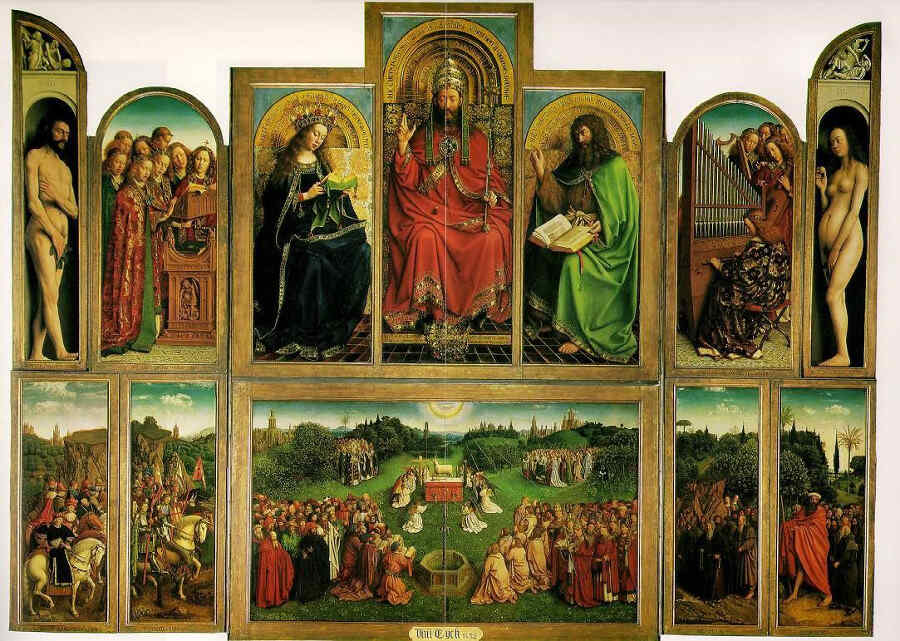
1. The Brothers Van Eyck. Altar-piece. (St. Bavo. Ghent.)
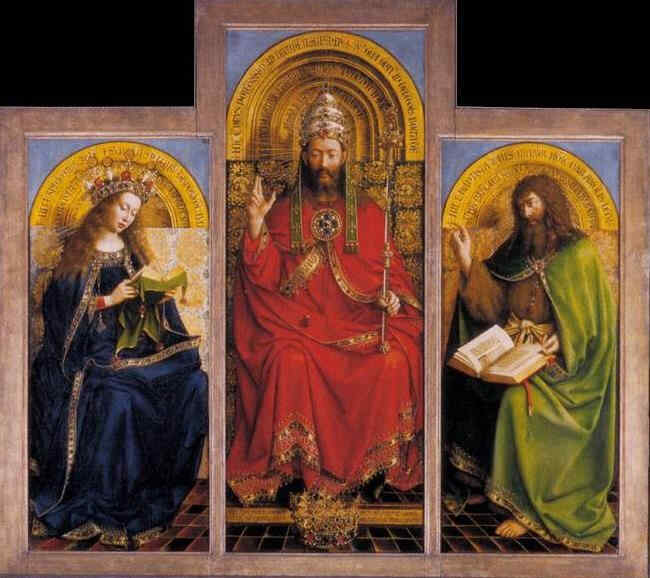
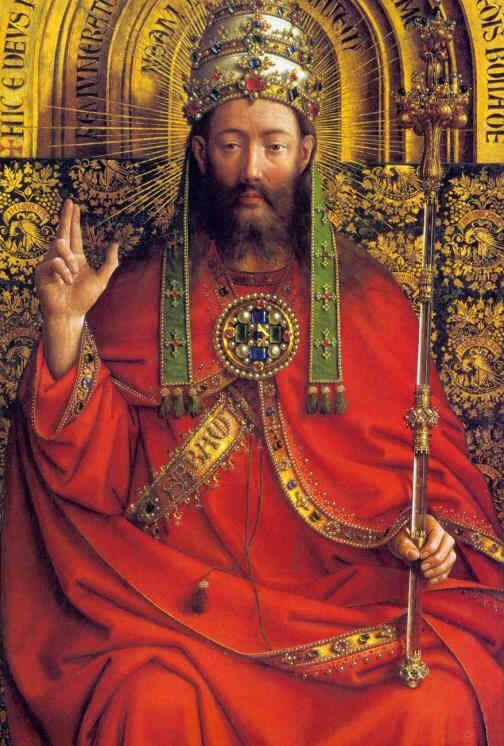
2. God, the Father
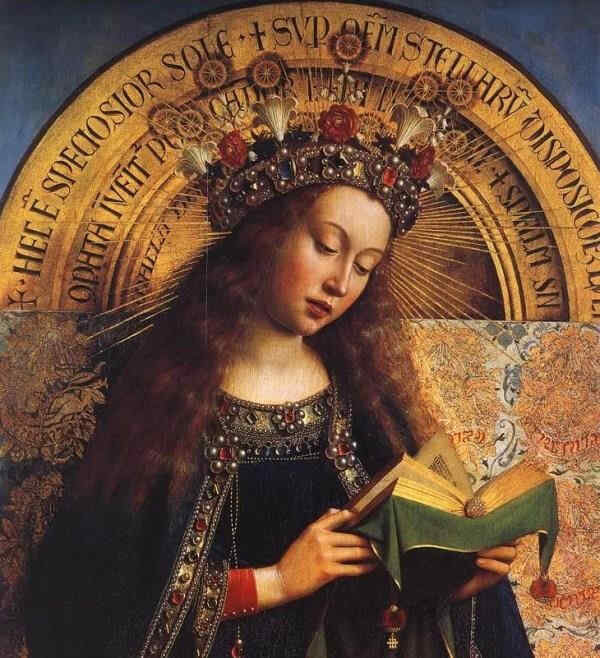
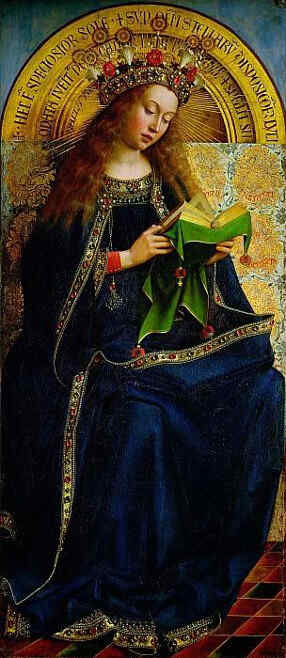
3. Mary
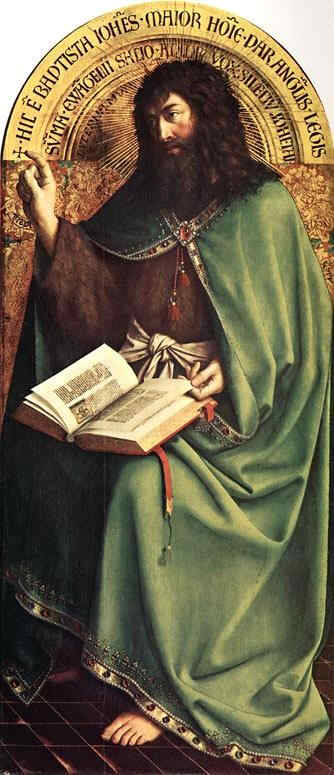
4. John
This Altar-piece consists of many parts. This is the portion seen when the front is opened—the middle portion above the Altar. The figure in the center, in Papal costume, is representing God the Father. Conceived in the spirit of the Church, God the Father is actually represented as a Pope. Nevertheless, the features I have indicated are recognisable in the whole artistic composition. If we went back still further, we should find the preceding evolution altogether steeped in Christian ideas—the Christian traditions—that is to say, which the ecclesiastics forcibly impressed upon the people. These traditions most certainly corresponded to a manner of thought inspired by the Group-consciousness. But out of the midst of this very element we now witness the individual spirit making itself felt.
The figure to your left is Mary; that on the right is St. John. Here, then, we find ourselves in the first third of the 15th century. Hubert Van Eyck died in 1426; the Altar-piece was finished by his brother Jan. It is the first third of the 15th century.
From the same Altar-piece we will show the angel-pictures, to the right and left of these central figures.
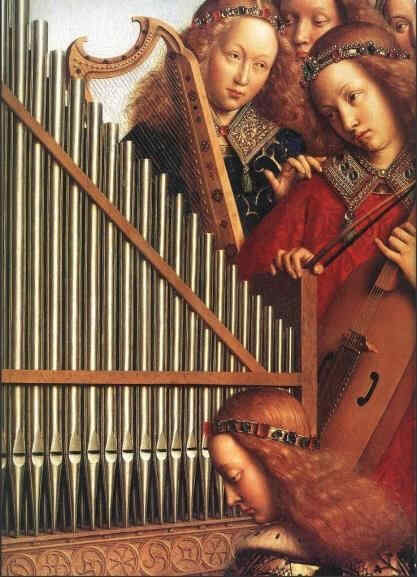
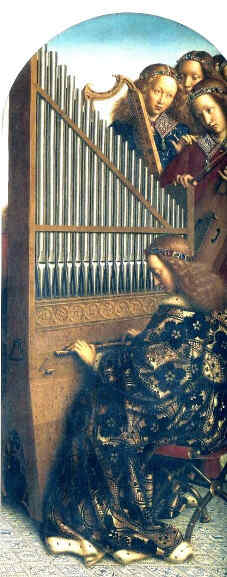
5. Angels making Music
Here you see a group of angels playing on instruments of music. Compare them with the angels by the German Christian Masters of the period immediately preceding this. Lochner, for instance, or the Master of Cologne—the pictures we saw in a former lecture. You will see how great a difference there is. The angels here are full-grown human beings, in spite of their clerical and ceremonial garments—fully developed human beings—no longer as before, half child-like forms. In such a group as this, you will see that the artist has not yet reached a thorough-going perspective. The perspective is only carried through to a slight extent. You see the whole picture on the surface—spread out like a tapestry. We will now show the angel-picture from the other side of the altar-piece.
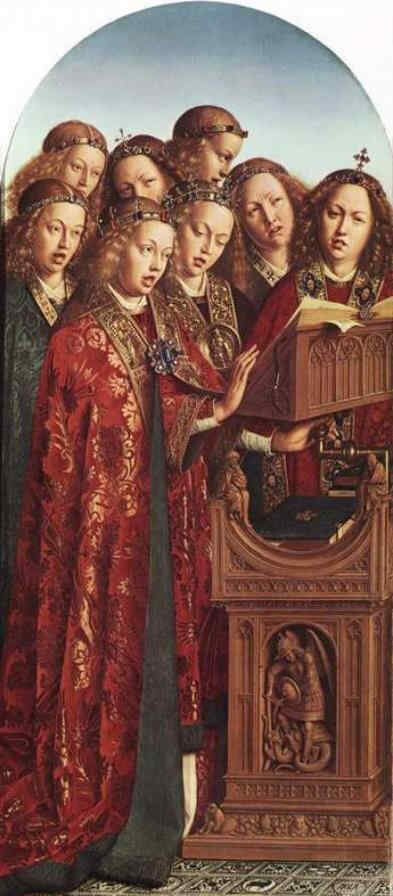
6. Angels singing
This whole Altar-piece was done by order of a wealthy Burgher for the Church of St. Bavo. The several parts are now scattered abroad—at Ghent, in Brussels, in Berlin ...
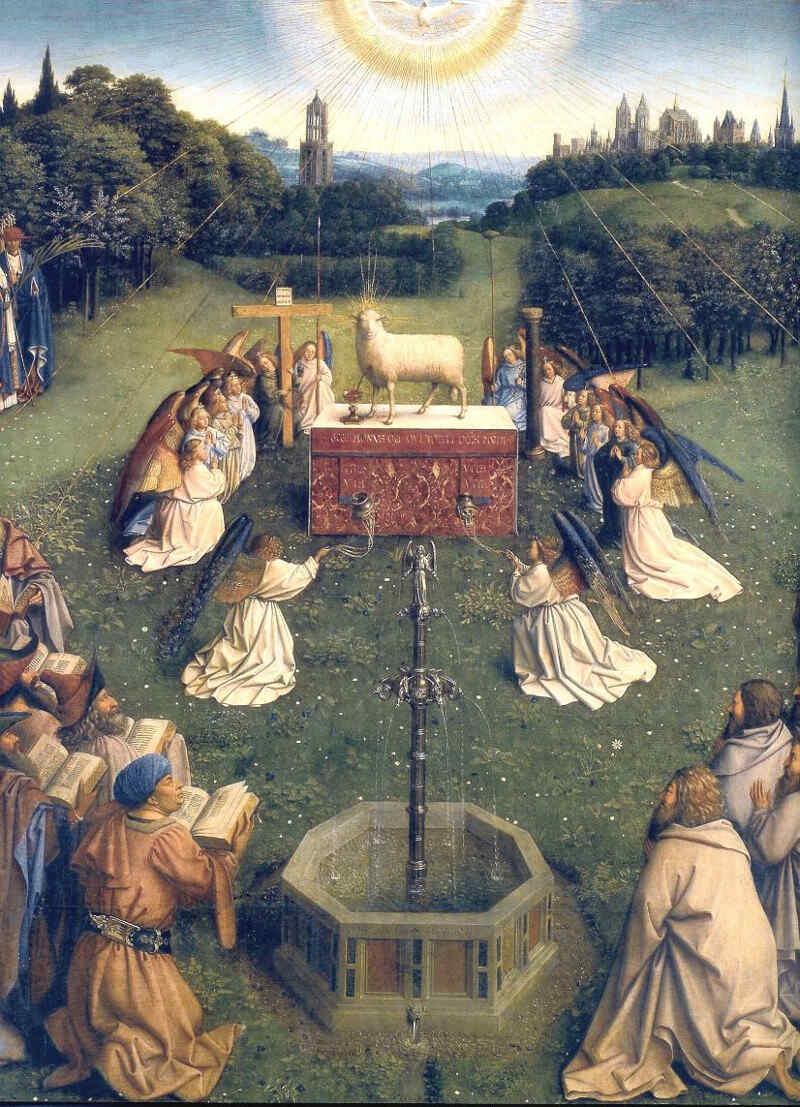
7. The Brothers van Eyck. Adoration of the Lamb.
Here we come to the main portion of the picture, beneath the other three. The “Adoration of the Lamb” is one of the fundamental motifs of this and the preceding period. Here we see it beautifully presented as the fundamental religious conception which had evolved during the course of many centuries. It could not have been embodied in this beautiful artistic form till they had so grown together with this conception as to represent it thus. Throughout the centuries of Christianity this idea had gradually taken shape—this idea of the Salvation, the Redemption of mankind through a great Sacrifice.
We must go far, far back in time to realise its full significance. Compare the subject—the story which this picture tells—with a picture, for example, of the Mithras Offering. There you have Mithras seated on the Bull; the Bull is wounded, the blood is flowing. It is the uplifting of Mithras, His salvation by the overcoming of the Beast. You are familiar with the deeper spiritual meaning of this picture; it is, if I may so describe it, the very antithesis of the one we now see before us. The rearing and rebellious Bull has to be fought down—gives up his blood by force; the Lamb gives His Blood of His own free will.
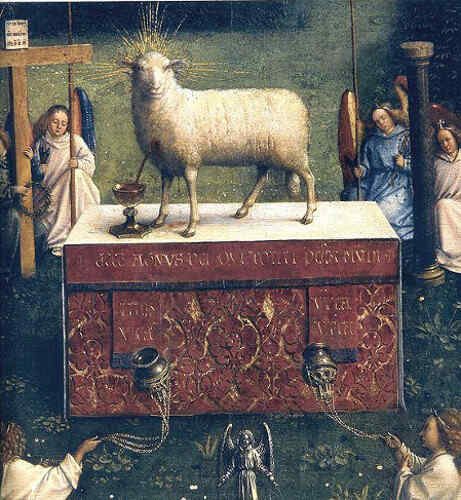
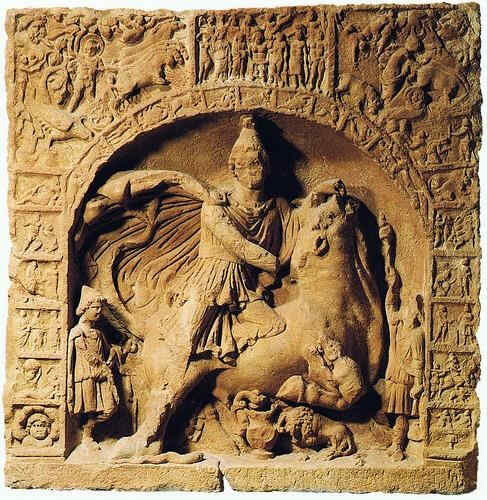
8. Adoration of the Lamb as compared to a Mithras-Relief
What does this signify? Salvation is lifted out of the element in which it was previously conceived—the element of violence, and strife and conflict. It comes into the element of free devotion and out-pouring Grace. Such is the idea which is here expressed. Not by man seeking in pride to rise beyond himself, seeking to kill his lower nature, but by experiencing in his soul that which streams through the world and patiently suffers with the world, will he attain his liberation at every point of this world's existence, his redemption.
Such is the Universal—and therefore, the individually universal—principle of redemption which we here find expressed. The Lamb is One, yet no one being is striking it. Therefore we see it offered up for every one of those who worship it, who draw near to it from all their different spheres of life—near to the Lamb of Salvation, near to the Fountain of Life.
The greatest conception of the Middle Ages, grown and matured in the course of the centuries, is thus recorded at the end of the Mediaeval Ages by the brothers Van Eyck, and there arises in this period one of the greatest of all works of Art.
Of course, we must bear in mind the points of view I emphasised just now. The individual principle, creating from out of the inner life, wrestles still with an inadequate mastery of the treatment of space. You will, for instance, scarcely be able to imagine a spectator situated with his eye in such a place as to perceive the spatial distribution of this figure here (at the bottom of the picture).
Very beautifully Van Eyck portrayed how the Impulse of the Lamb works in the various callings, in the several branches of human life. Here are some examples.
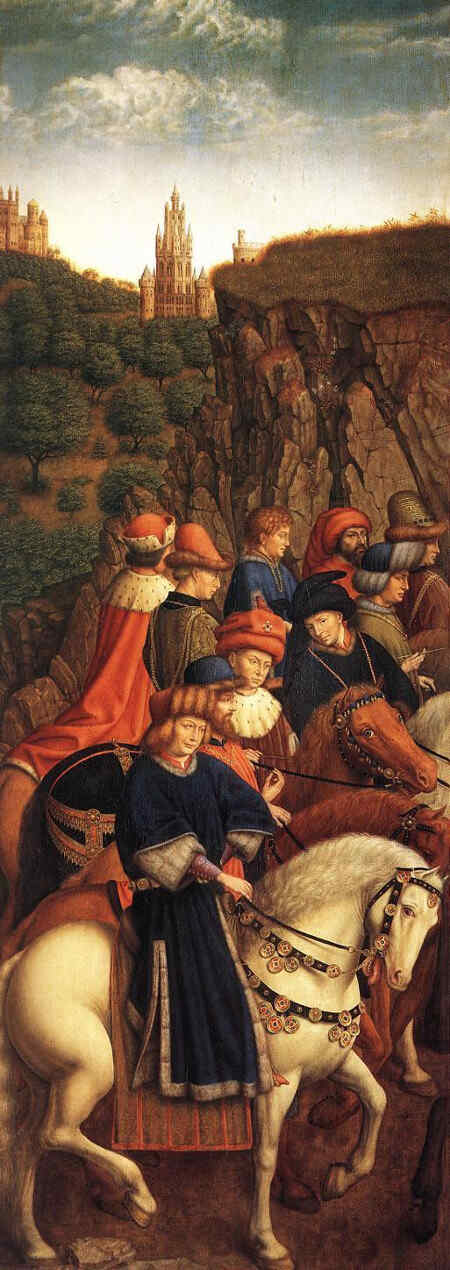
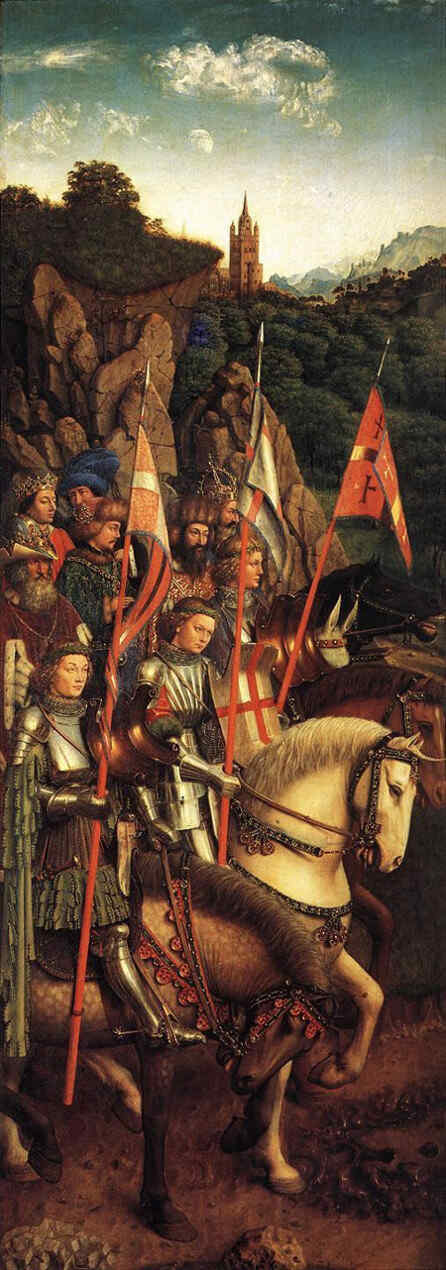
9. Brothers van Eyck. The Knights and Judges. (From the Altar-piece at Ghent. Berlin Museum.)
These are the Judges and the Knights as they draw near to the Lamb. All these are portions of the same great Altar-piece. The next is a very tender picture:
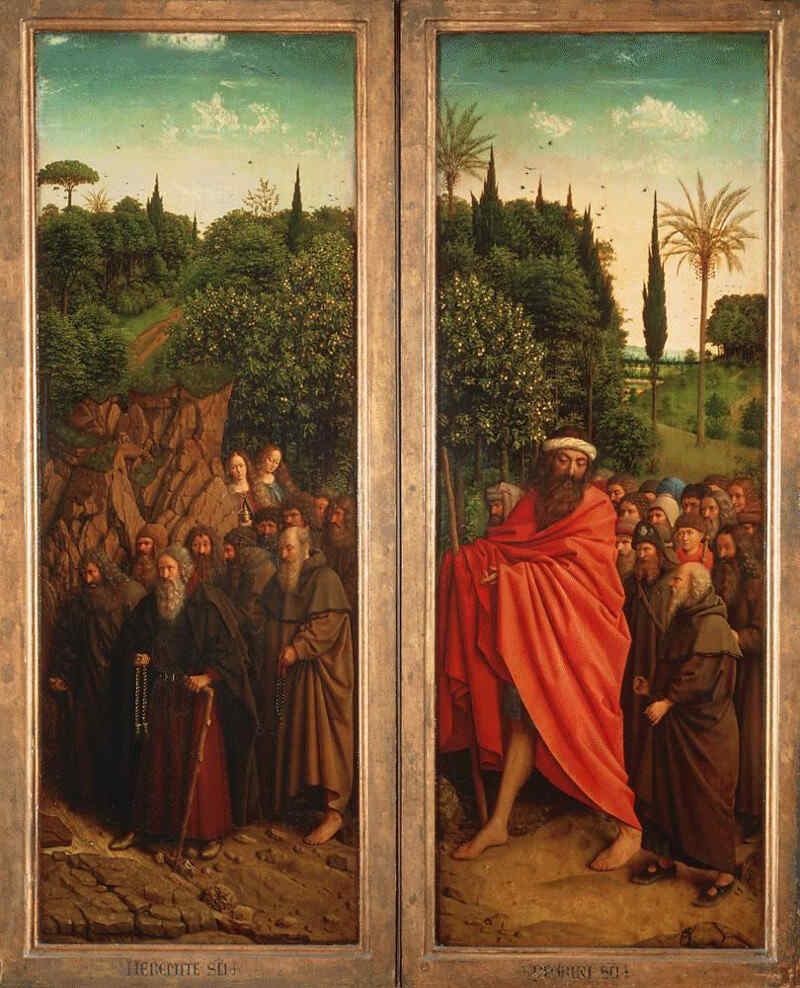
10. Brothers van Eyck. The Pilgrims and Hermits. (From the Altar-piece at Ghent.)
Here we can already admire the treatment of landscape in relation to the human beings to whom it belongs.
Hubert van Eyck died in 1426, when the Altar-piece was not nearly finished. His brother Jan continued working at it for many years, and scholars have long been engaged in the dispute, which they seem to regard as so important, as to which portions are due to Hubert and which to Jan. This dispute is, after all, more or less superfluous, if we are interested in the artistic aspect. We now come to another picture by Van Eyck.
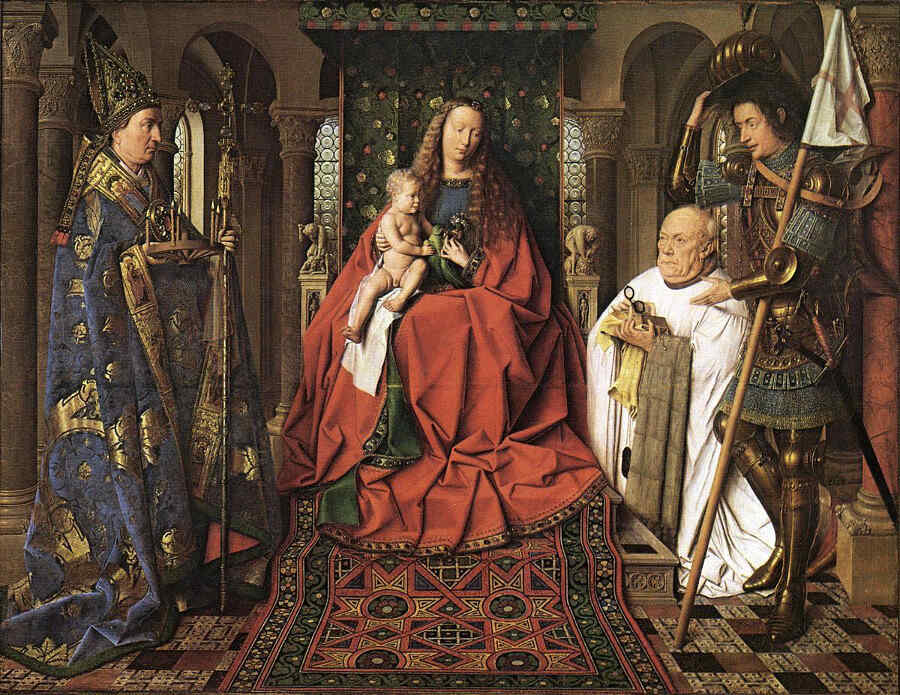
11. Jan van Eyck. Madonna. (At Bruges.)
This picture was painted in 1436. You will admire the tenderness of expression in the Madonna, no less than the characterisation of this figure (the Canon, Georg van der Pole). It reveals a wonderful observation of Nature and a strong sense of character, with all the primitiveness of the period—needless to say. The next picture was painted by Jan van Eyck in Spain, whither he had been summoned.

12. Jan van Eyck. The Waters of Life. (Prado. Madrid.)
Observe the Gothic architecture in the background. To represent the Waters of Life, the Well of Life, in connection with the Sacrifice of the Lamb, was natural to the ideas of that time. Once more, as in the former picture, you have the motif of God the Father with Mary and St. John.
Here, however, it is transferred more into the spirit of the Southern Art—not unnaturally, as the picture was painted in Spain.
In the former picture we had the same theme treated with more of the Northern character.
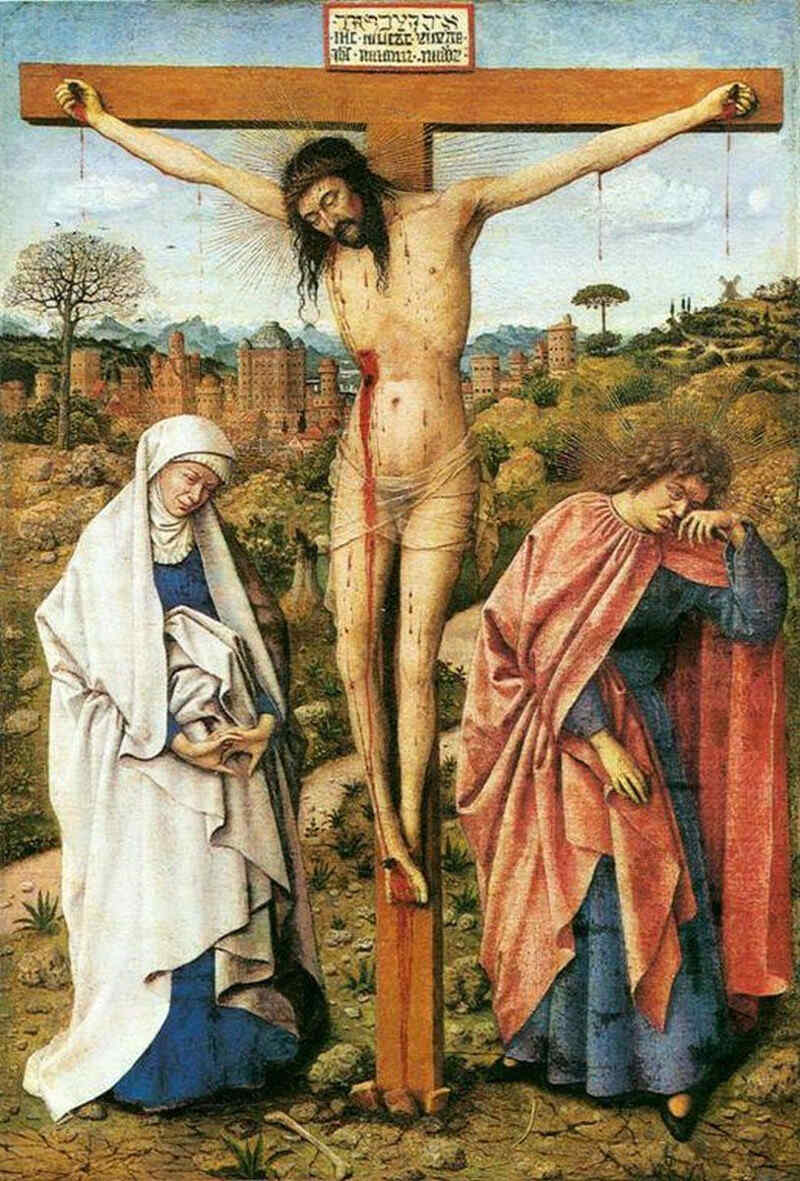
13. Jan van Eyck. The Crucifixion. (Berlin.)
Notice how the characteristic qualities come to expression in this picture. The human element far outweighs the Biblical tradition. Only the subject, the occasion, we might say, is taken from that quarter. See with what deep human sympathy the Biblical story is re-awakened, as it were. Here it is not merely the prevalent idea that it is meet to represent in pictures what the Bible tells. The whole event is felt again and re-experienced in the highest degree. It is scarcely conceivable—(pointing to the figures of Mary and St. John)—that a Southern artist would have placed this line, and this, side by side. Here, however, the painter's chief concern is not with the composition, but to give an impression of real inwardness—to realise the inner experience. And then we must say that the effect of this line, and this line, together, is most wonderful, characterising as it does the different moods of the soul.
We now give two examples of secular subjects by the same artist.
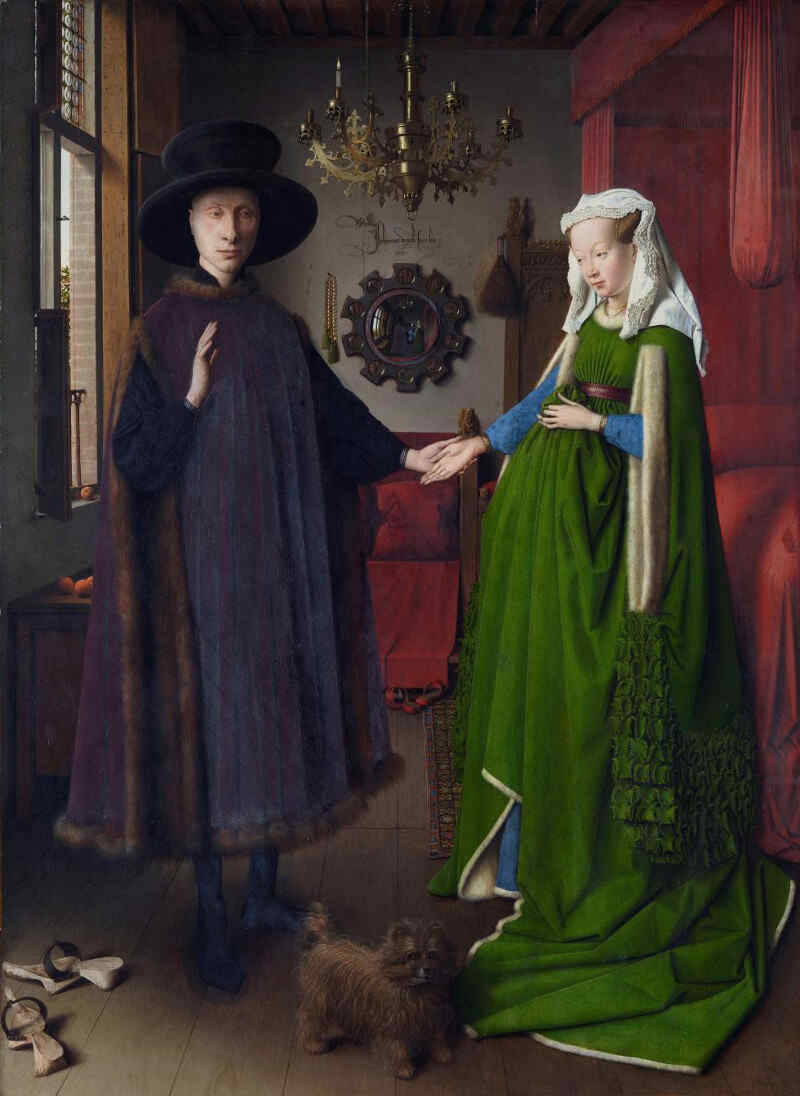
14. Jan van Eyck. The Betrothal. (National Gallery. London.)
This picture shows very clearly how great was the artist's power of characterisation and expression. Our last picture by Van Eyck shows the attempt to get still further in the way of portraiture;
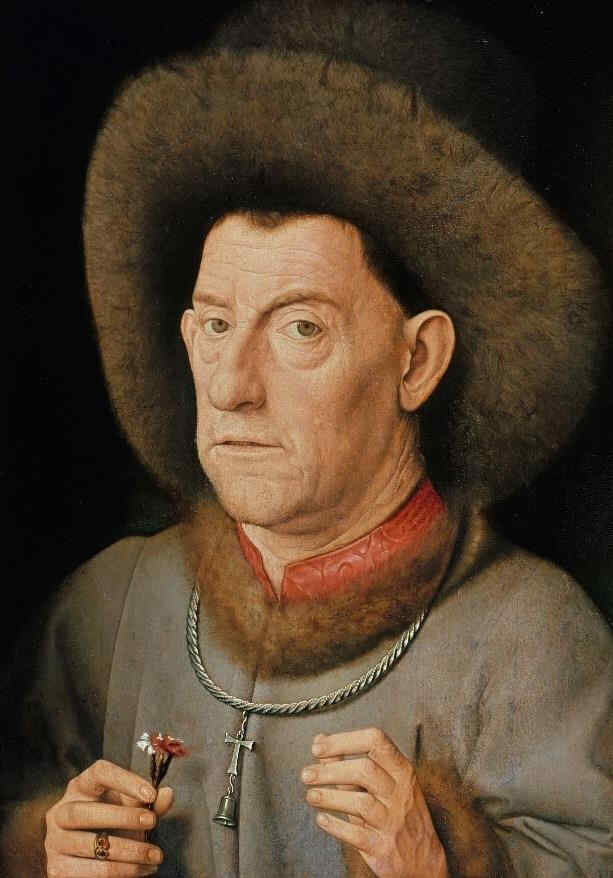
15. Jan van Eyck. The Man with the Carnation. (Berlin.)
Here you will see with great distinctness, the artist does not care at all to conceive what a man should be like; he does not work out of any such impulse, but as he sees the human being—whatever presents itself to his vision—this he reproduces.
We now come to a contemporary artist who outlived Van Eyck by a few years—the Master of Flémalle, as he is called.
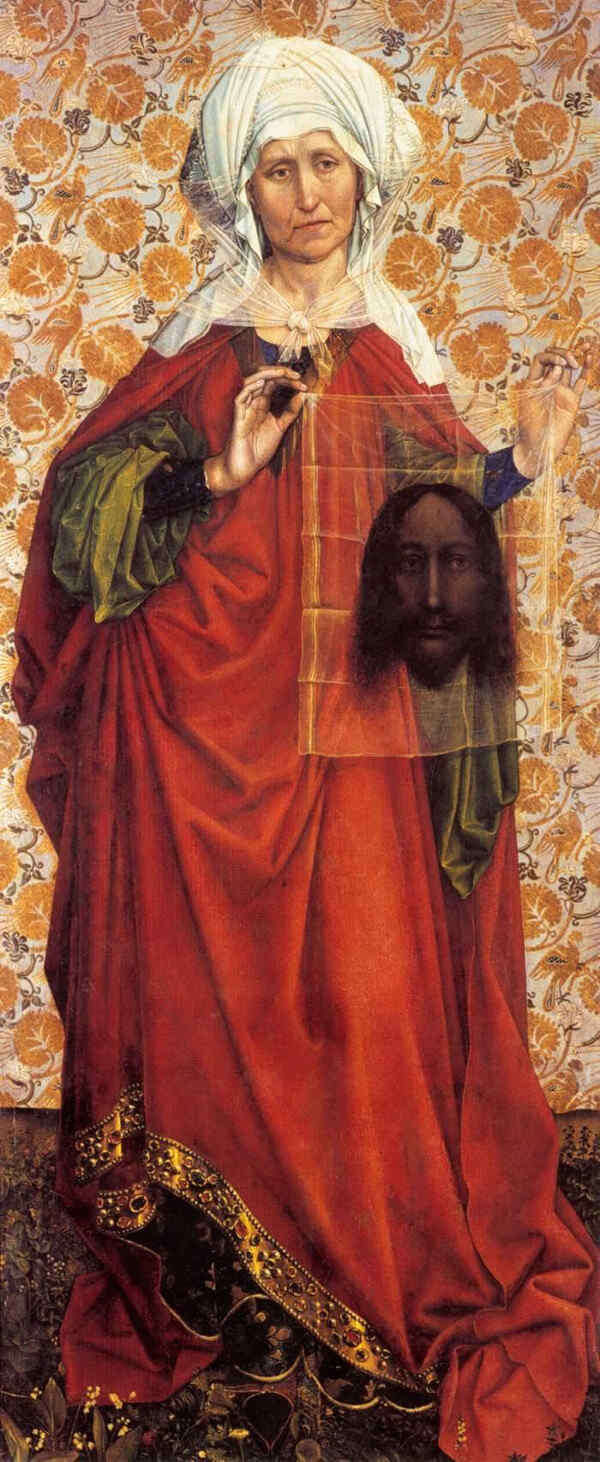
16. Master of Flémalle. St. Veronica. (Frankfort.)
In him we recognise a seeker inspired by somewhat the same impulse as the Van Eycks, yet influenced far more from France. He recognise these influences in the “line.” There is a kind of echo of artistic tradition. In Van Eyck's work we feel that everything is born out of an elemental inner need. Here, on the other hand, there is already an underlying opinion—this thing or that ought to be represented in such or such a way. Though they are not by any means predominant in his work, still we can see the Master of Flémalle accepts the principles of certain aesthetic traditions. In the former artist you will not easily find, for example, this peculiar position of the hand, nor this peculiar treatment of facial expression. These elements in the picture are undoubtedly to some extent determined by certain influences from France. An atmosphere of elegant grace is poured out over these figures, which you will not find to this extent in the figures of Van Eyck.
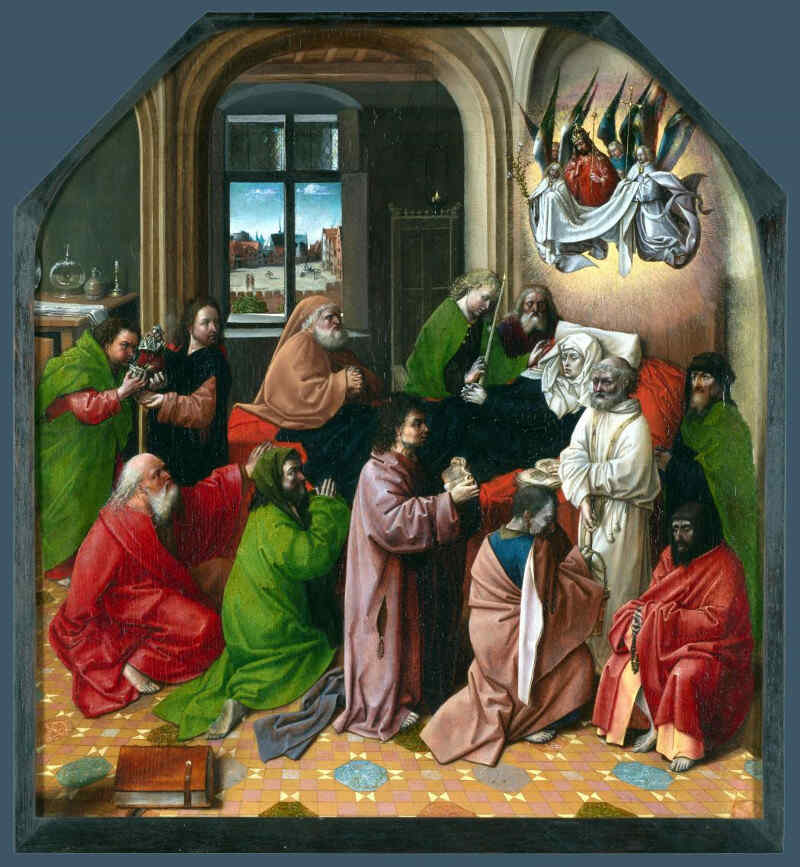
17. Master of Flémalle. Death of the Virgin. (London.)
Characteristically—this picture shows the Christian legend transplanted into the artist's present time. These pictures were painted about the thirties of the 15th century.
We now come to Van der Weyden, who—like the former artist, received certain influences from France. Still, he contains all those elements which mark him out clearly as a follower of the Van Eycks.
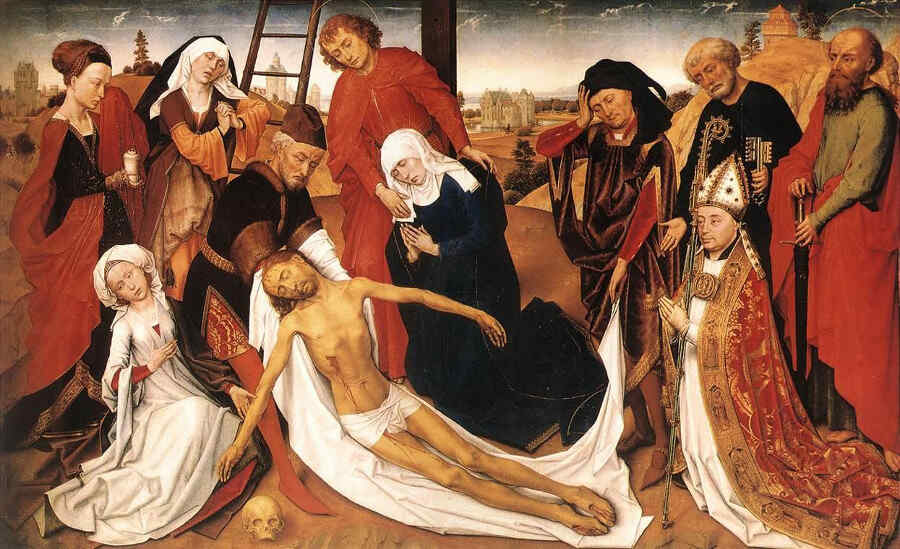
18. Rogier van der Weyden. Descent from the Cross. (Berlin.)
Already in this picture you will see a characteristic difference. There is an essentially dramatic life in this, whereas we might say Van Eyck is purely ethical. Van Eyck places his figures quietly side by side; they influence one another, but there is no one all-pervading movement. Here, however, in Van der Hayden's work, there is a certain drama in the working together of the figures. It is not merely ethical.
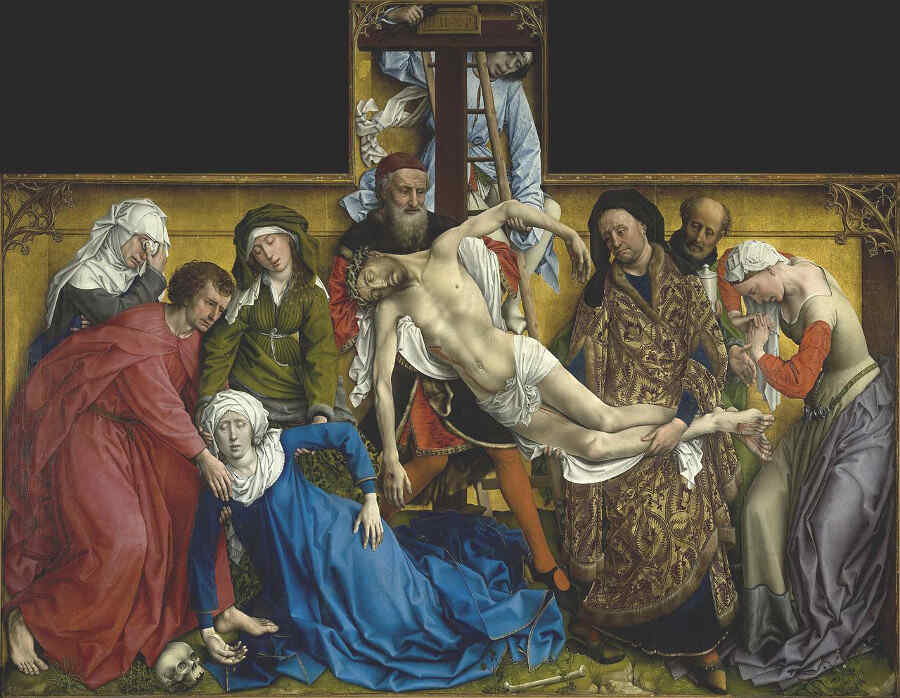
19. Rogier van der Weyden. Descent from the Cross. (Prado. Madrid.)
The same subject, treated once more by the same artist. And now a picture taken from the Christian legends.
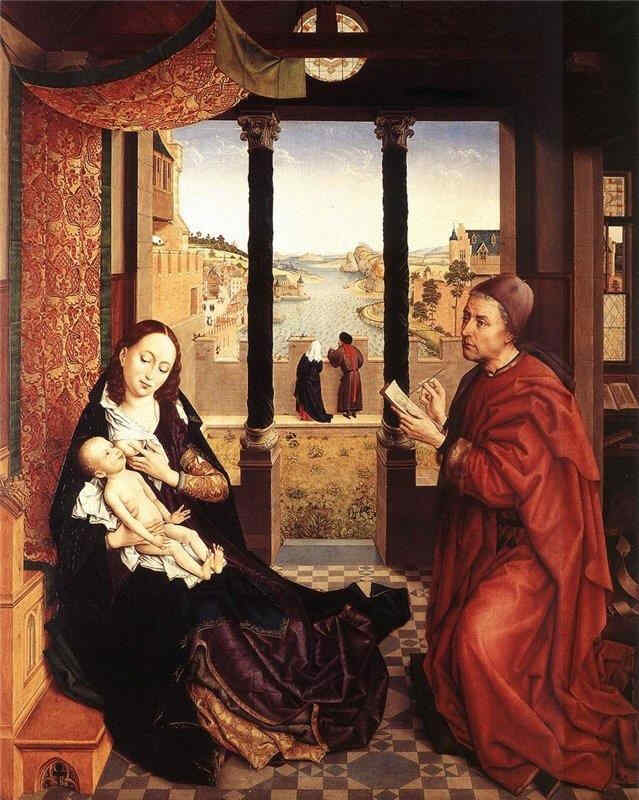
20. Rogier van der Weyden. St. Luke painting the Madonna. (Munich.)
Here you see the Evangelist St. Luke, who, as the legend has it, was a painter, painting Mary and the Child.
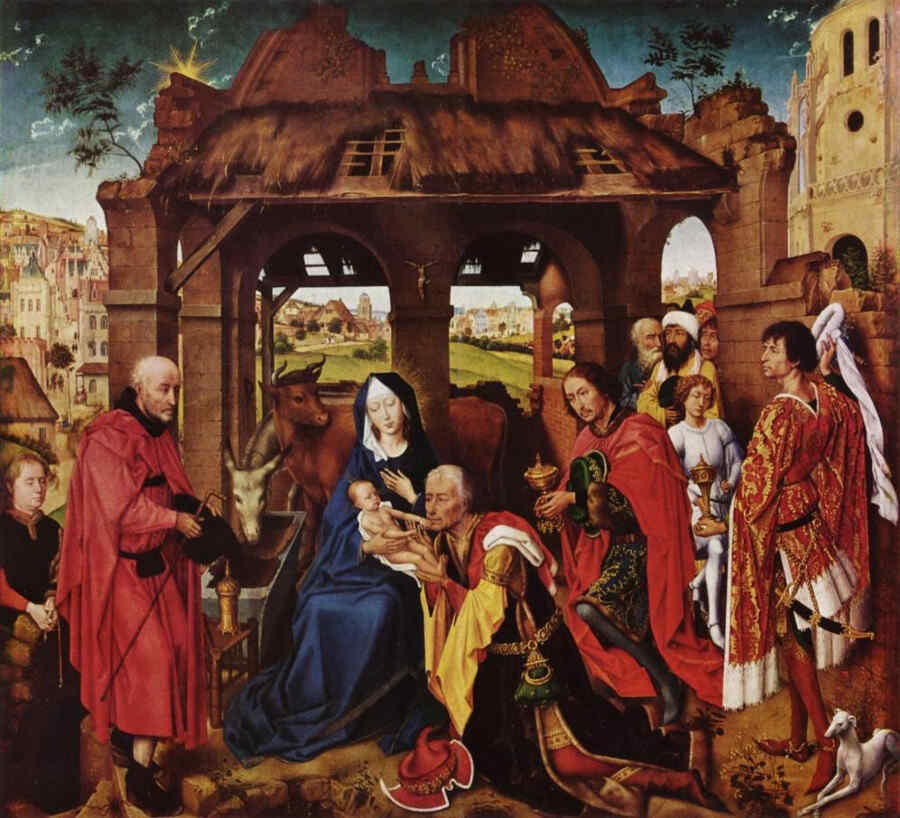
21. Rogier van der Weyden. Adoration by the Three Wise Men. (Alte Pinakothek. Munich.)
One of these is King Philip of Burgundy; this one, who is just taking off his hat, is Charles the Bold. If only by this external feature, the whole scene is very much transferred into the artist's immediate present. For the Kings who come to worship the Child, he takes the figures of princes more or less of his own time.
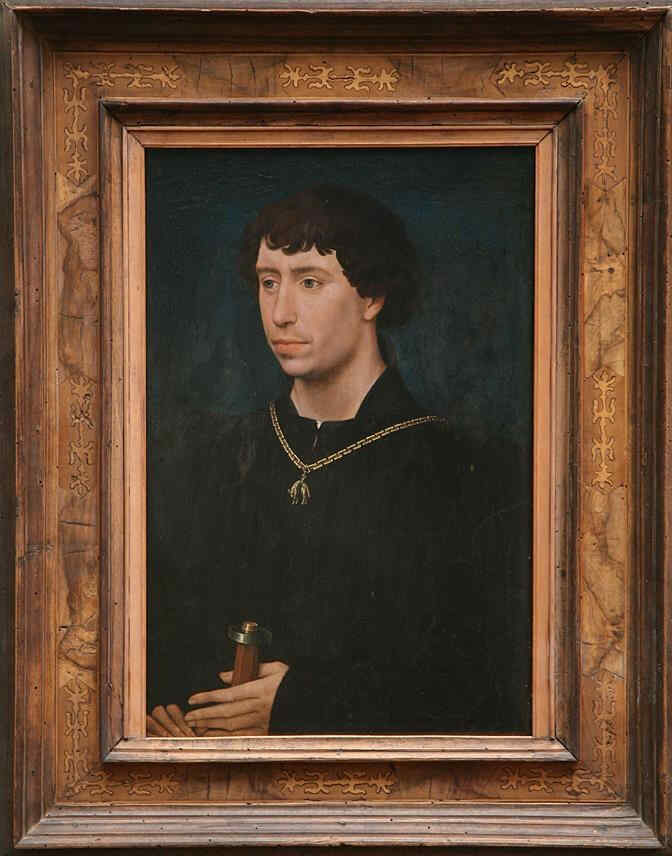
22. Rogier van der Weyden. Charles the Bold. (Berlin.)
Here, then, we have a portrait by Van der Weyden. All these artists attained—a certain perfection in the art of portraiture.
We now come to Petrus Christus:
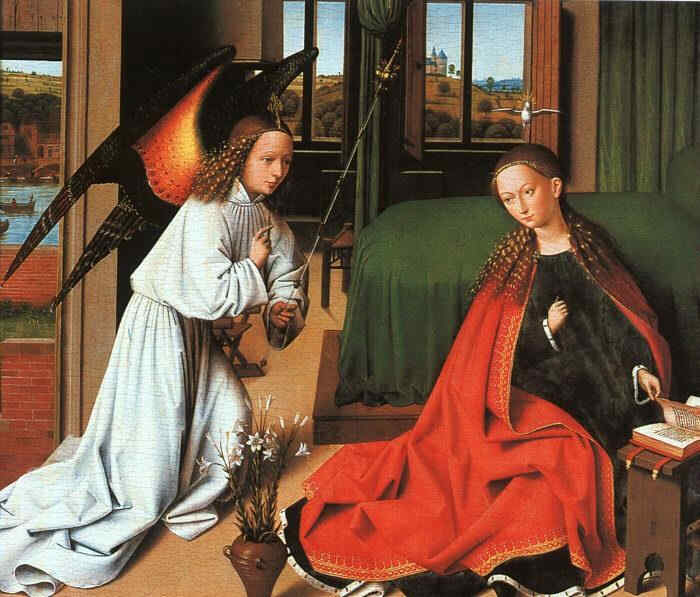
23. Petrus Christus. The Annunciation (wings of an Altar-piece) (Berlin.)
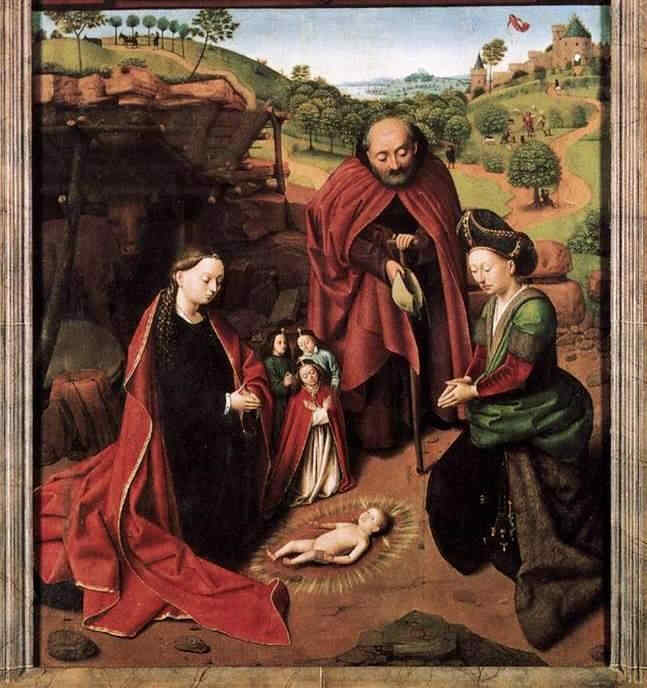
24. Petrus Christi. The Birth of Christ
The Angel and Mary (The Annunciation) and the presentation of the Christ Child. Petrus Christus works more or less equally along the lines of Van der Weyden on the one hand, and the Van Eycks on the other. These pictures were painted about 1452—the middle of the 15th century.
In the following pictures we come increasingly to the more Northerly Dutch element, where the landscape is developed to greater and greater perfection. The next picture is by Dieric Bouts the Younger. And now, a picture extraordinarily characteristic of this stream in Art:
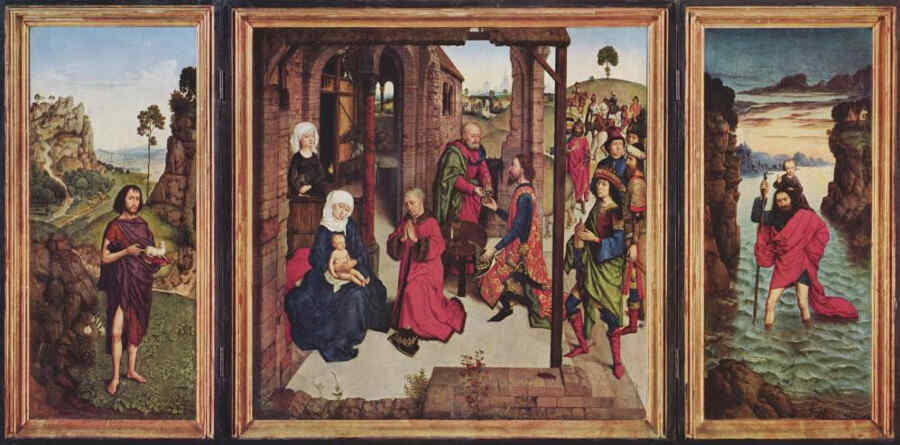
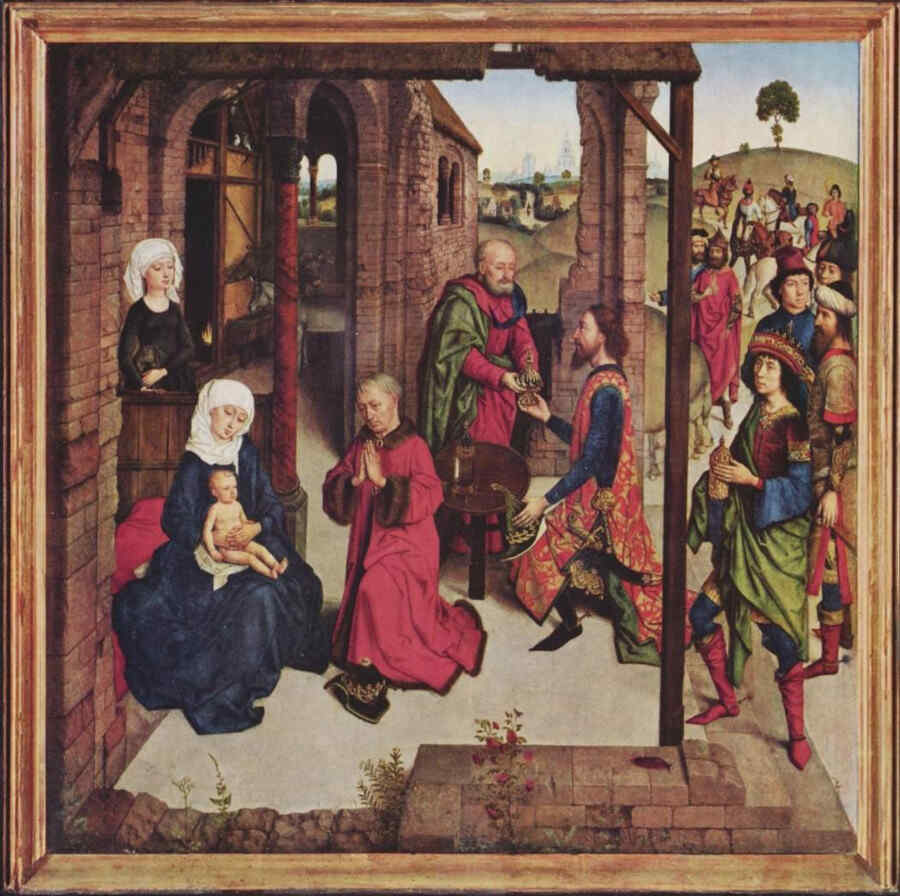
25. Dieric Bouts. Adoration by the Three Wise Men. (Alte Pinakothek. Munich.)
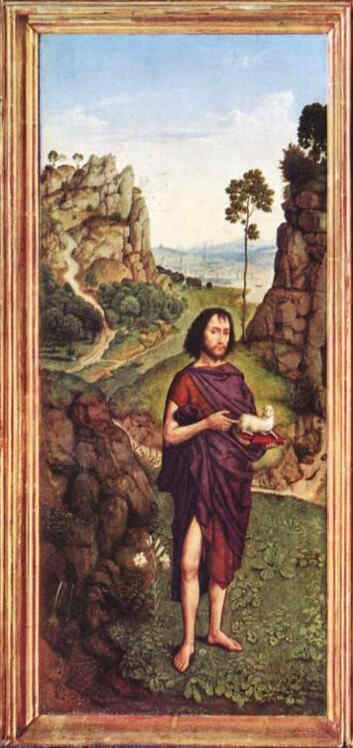
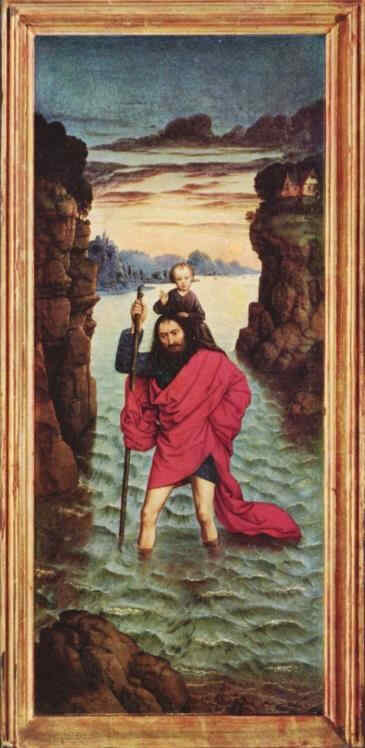
26. John the Baptist and Christopher
On one side is the Baptist; on the other side the Christophorus—the Christ-Bearer. Truly, there comes to expression here the full and immediate human inwardness, and with it the landscape that belongs to it. In Dieric Bouts you will especially notice this art—to place the human being fittingly within the landscape of open Nature.
The realistic representation of things is working its way through more and more. Man as an artist becomes more and more able to find, in the direct reproduction of Nature, what he has been striving for along this path.
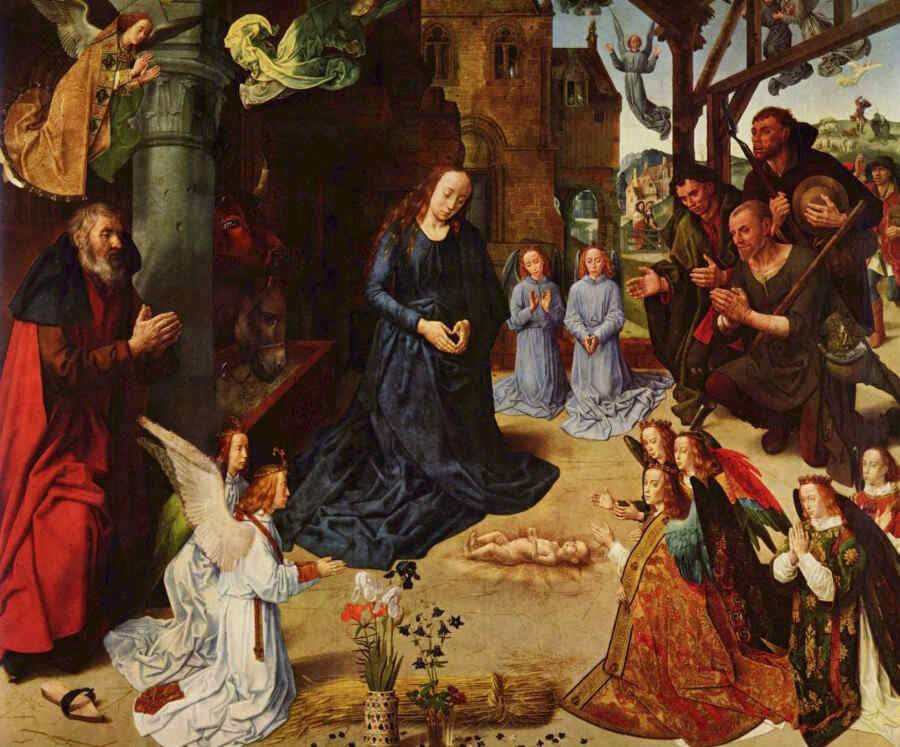
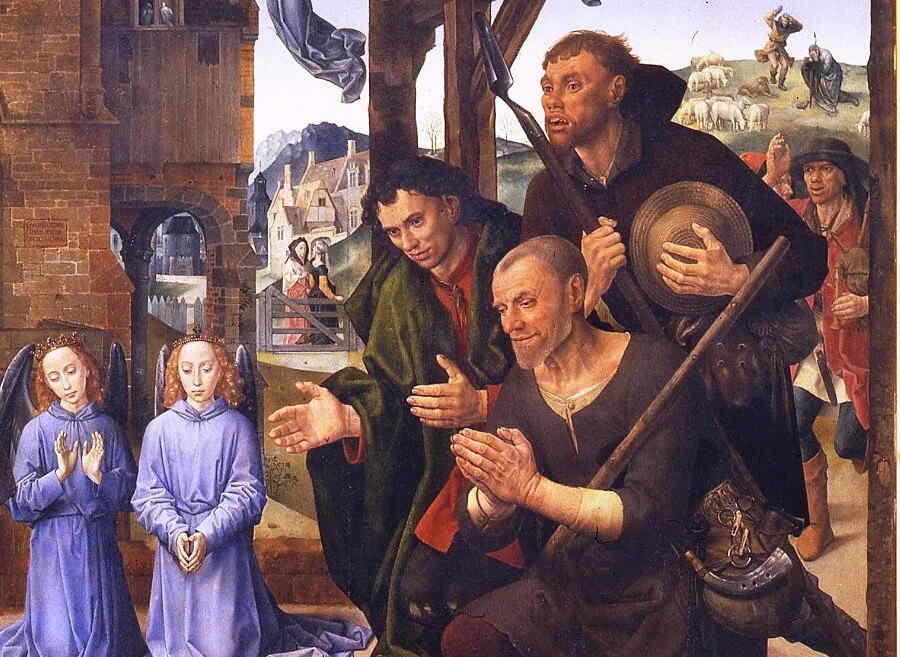
27. Hugo van der Goes. Portinari Altarpiece, c. 1475. (Uffizi. Florence.)
Truly, Realism has here reached a high degree of perfection. The same subject again:
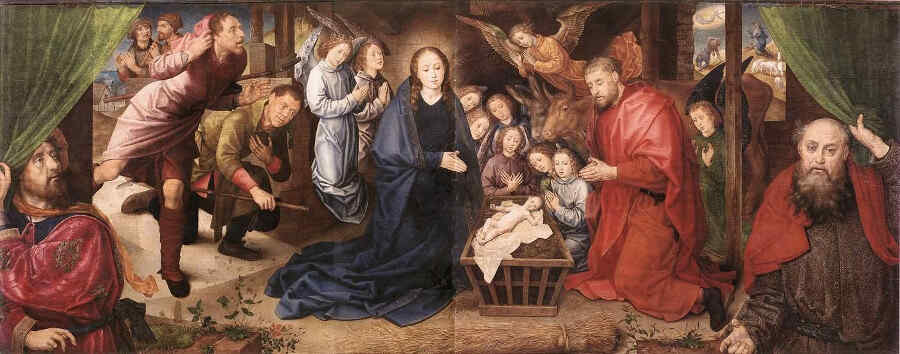
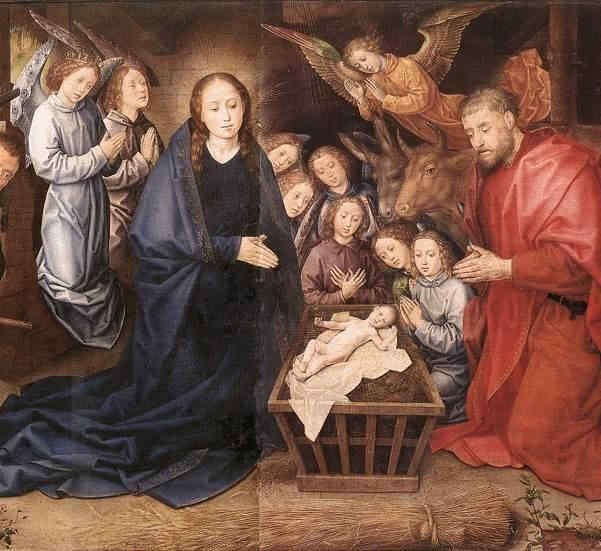
28. Hugo van der Goes. Adoration by the Shepards, 1480 (Berlin.)
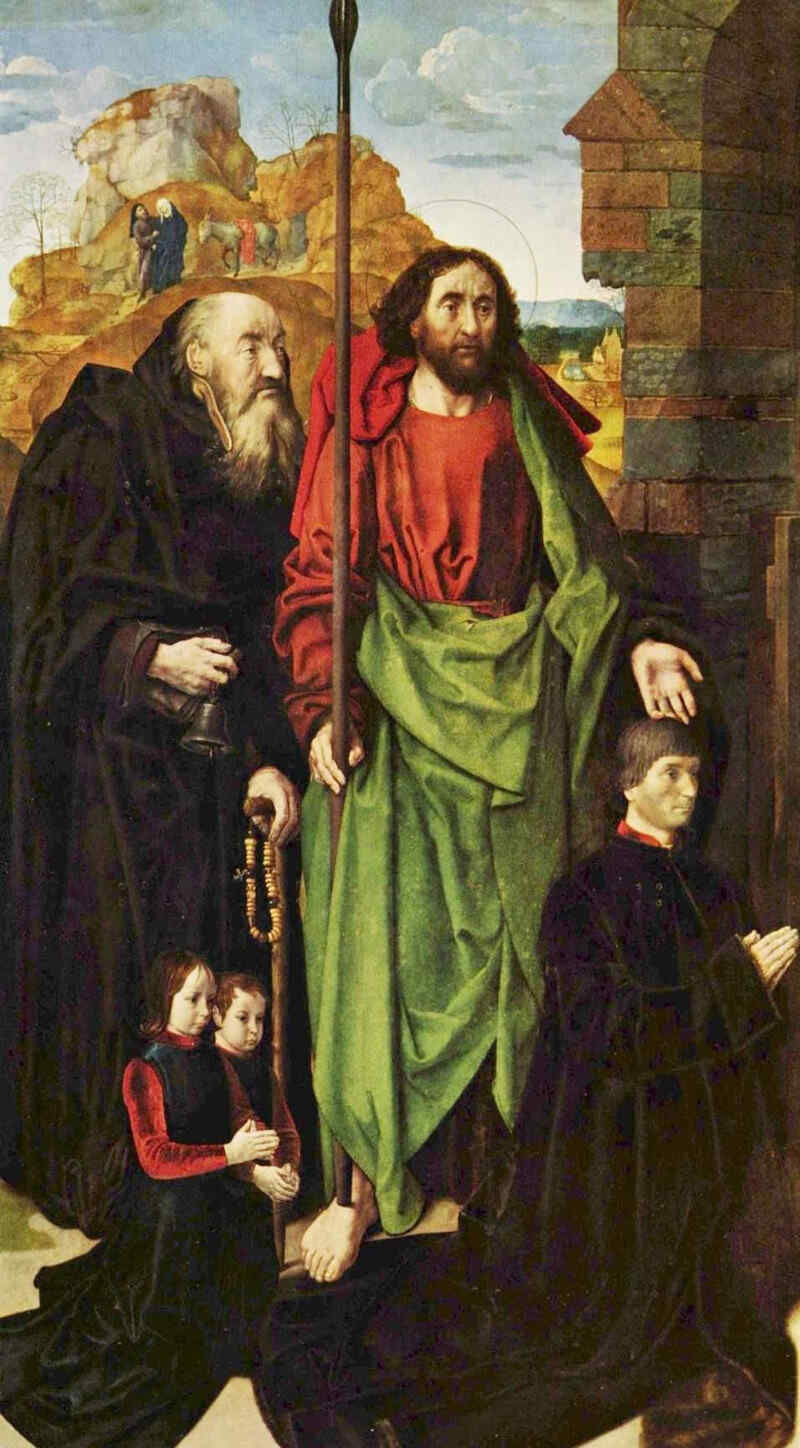
29. Hugo van der Goes. St. Anthony and St. Matthew.
Below are the Donors of the picture. By the same artist:
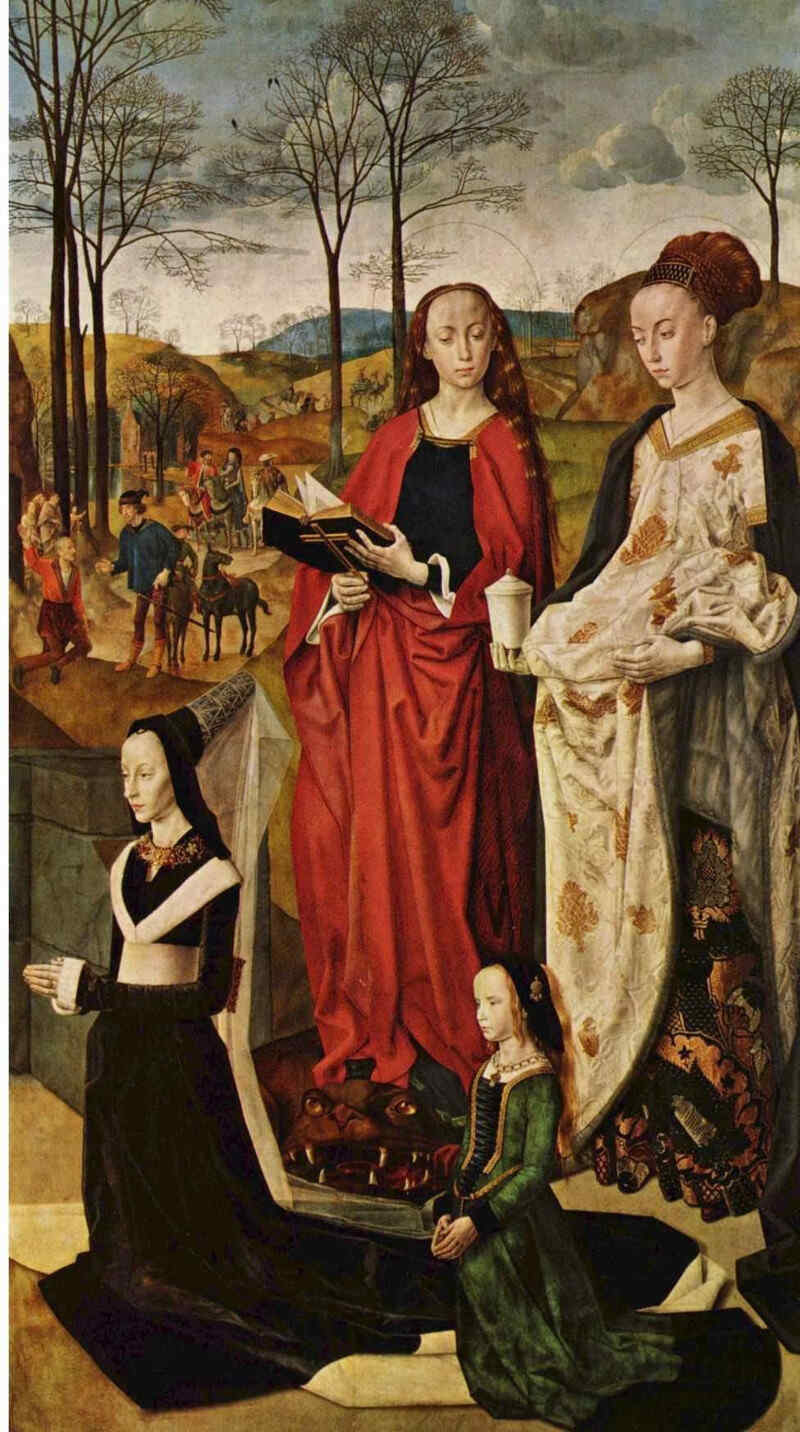
30. St. Margaret and St. Mary Magdalene. (Ste. Maria Novalis. Florence.)
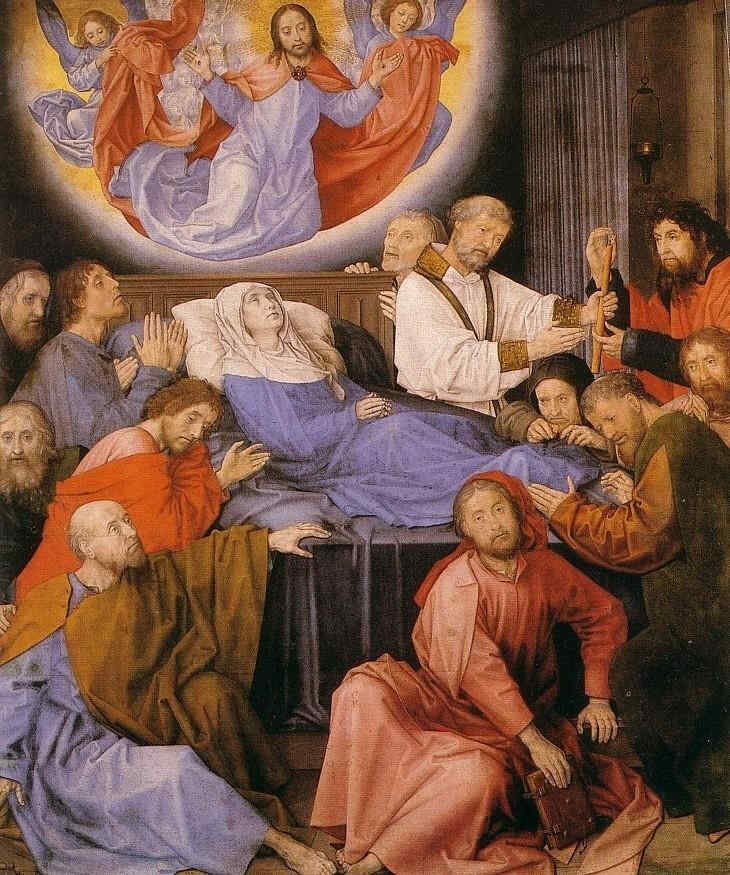
31. Hugo van der Goes. The Death of Mary. (Academy. Bruges.)
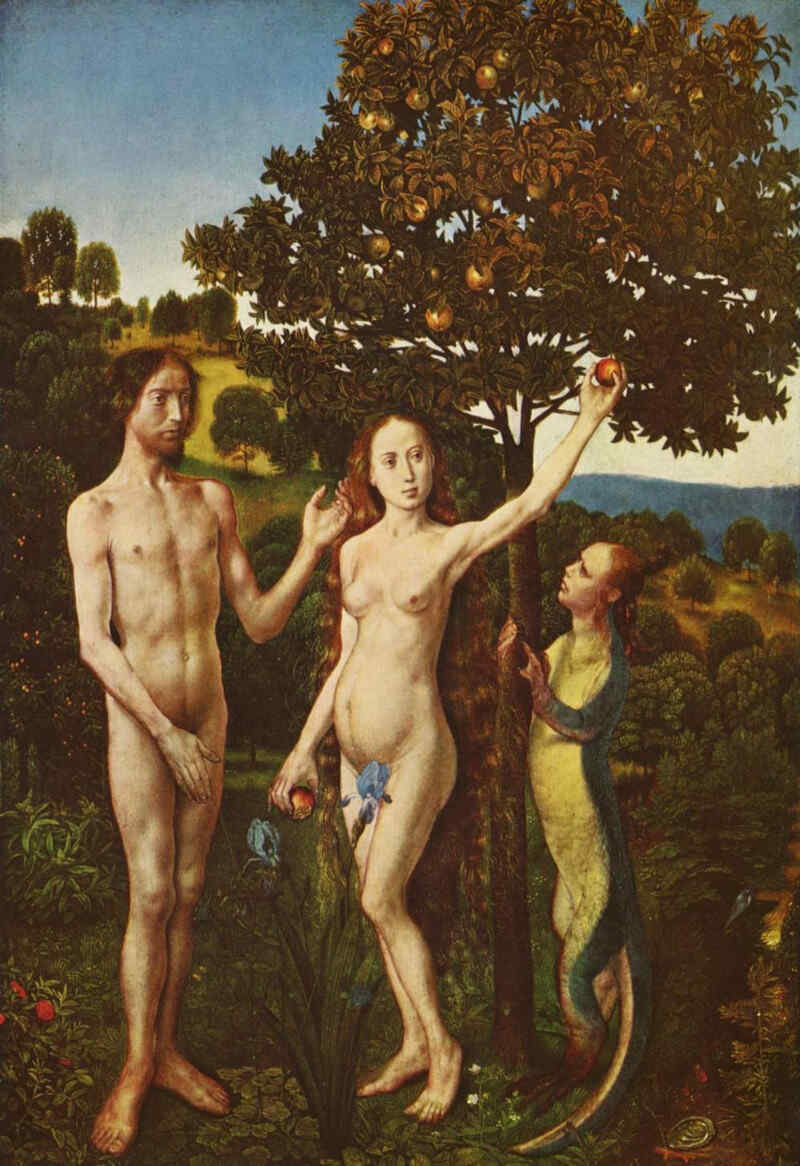
32. Hugo van der Goes. Adam and Eve. The Fall. (Vienna.)
The Art of that time—as I have said on previous occasions relating to Meister Bertram—did not picture a mere snake, but tried to portray the Luciferic element.
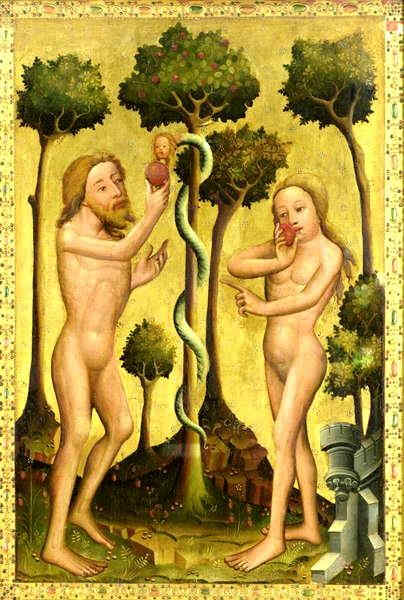
33. Meister Bertram. The Fall (Hamburg.)
That the snake itself—the existing physical snake—should have been the Tempter, is an invention of the most modern naturalistic materialism.
We now come to the artist who, educated in the School of Van der Weyden, represents, in a certain sense, its continuation. He was known in the School as Der deutsche Hans. I refer to Hans Memling.
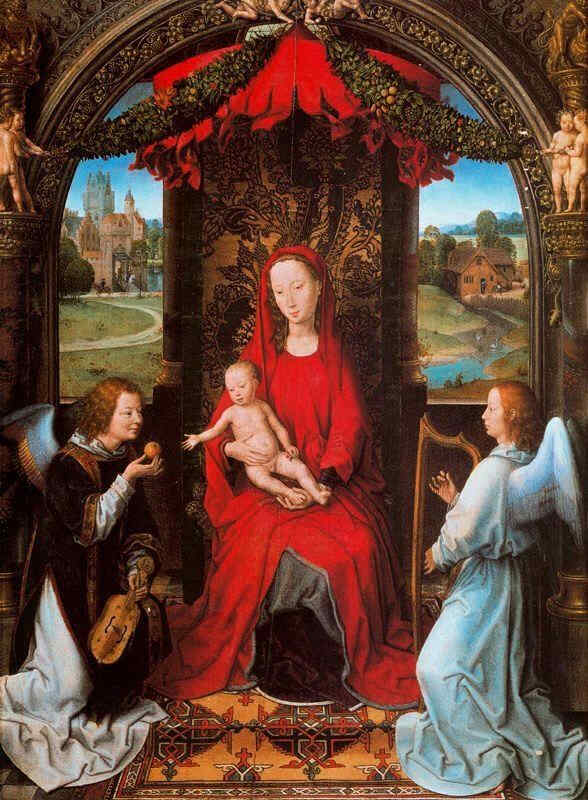
34. Hans Memling, Madonna Enthroned. (Uffizi. Florence.)
This artist was born at Mainz. We shall, if possible, in the near future, show some examples of Upper German paintings, which have their own characteristic peculiarities. Its tendencies are quite evidently present in this picture; but for the rest, Memling had absorbed all that was then living in the Art of the Netherlands, including the influence that came over from France. The next picture is also by Hans Memling.
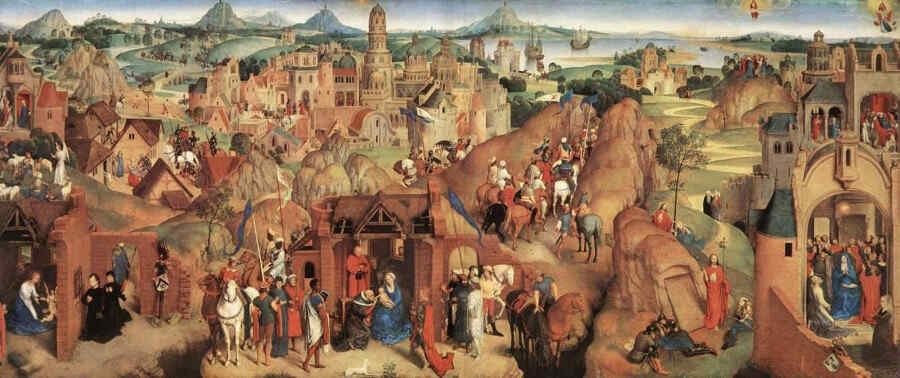
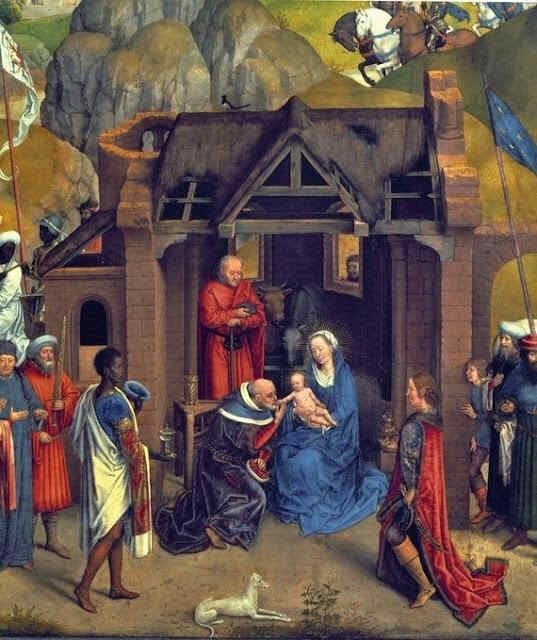
35. Hans Memling. The Seven Joys of Mary. (Munich.)
—a motif which was also familiar to those times. The various events connected with the life of Mary are here portrayed. Unfortunately it is too small in this reproduction to recognise the details very clearly.
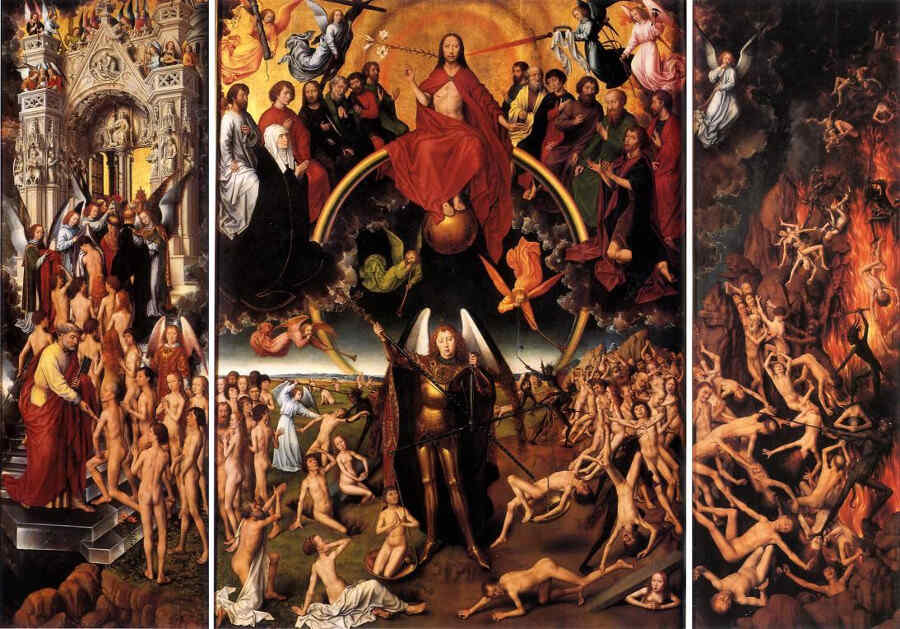
36. Memling. The Last Judgment. (Marienkirche. Danzig.)
A characteristic picture by Memling. With real genius, in his own way, he brings to expression his conception of the Last Judgment. There is a certain angular quality about it, and yet the whole event is permeated with humanity, with inward feeling. The picture is note at Danzig. A powerful trader stole the picture—but, being a pious man also, he afterwards bequeathed it to a church in Danzig.
He will also acquaint ourselves with Memling's portraits. You will see that all this School achieves a greatness of its own in representing the human individuality.
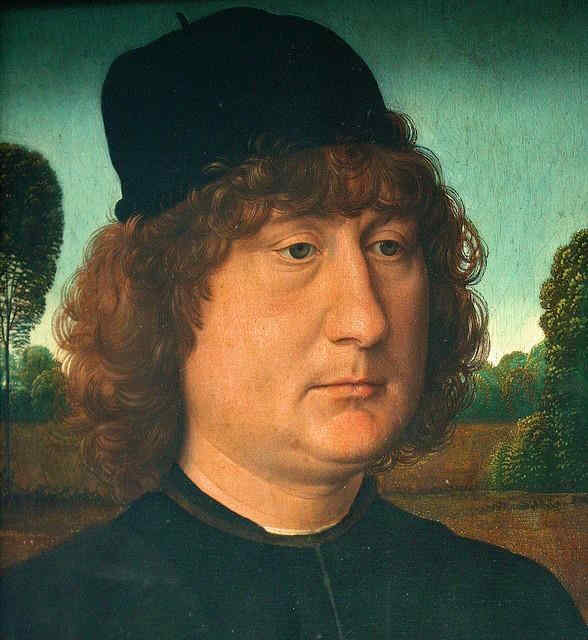
37. Memling. Portrait of a Man. (Berlin.)
The expression of the qualities of the soul in this face is, indeed, remarkable. This is a well-known picture at the Hague.
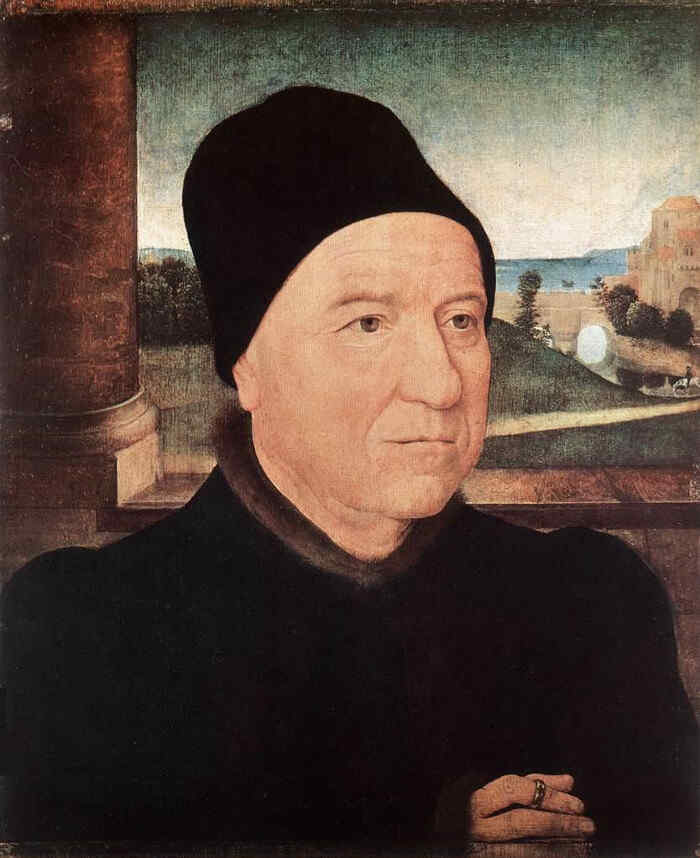
38. Memling. Portrait. (The Hague.)
We come now to the later artists who no longer show quite the same freedom and simplicity, but a certain contortion and inner complexity. David, for instance, was born in 1400; he came from Holland. Hitherto, we may say, we have had before us the pre-Reformation period in Art; the artist we shall now show brings us already very near the Reformation.
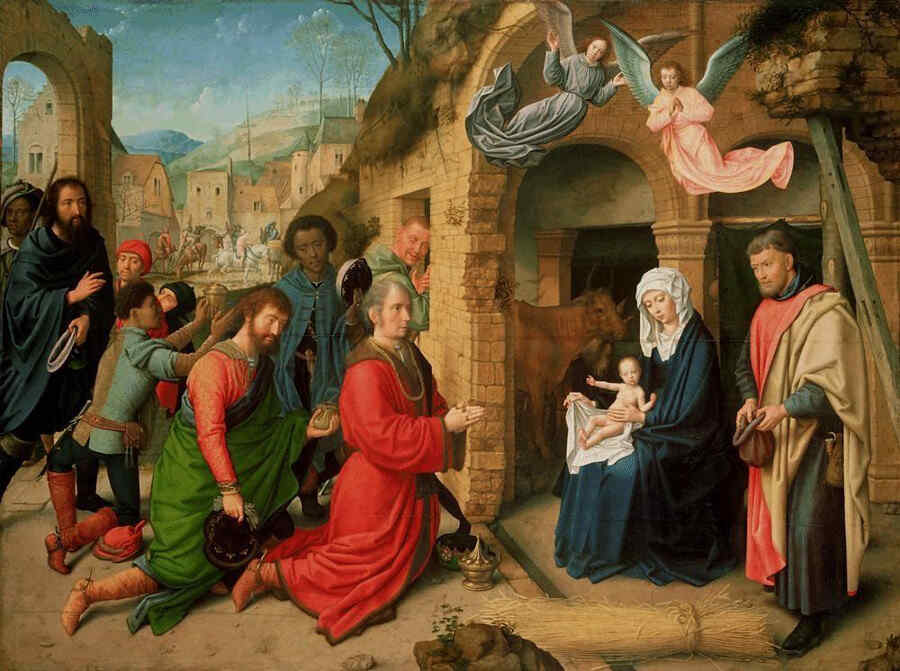
39. Gerard David. Adoration of the Magi. (Munich.)
Here you will recognise how strongly the Southern influence is already working in the element of composition.
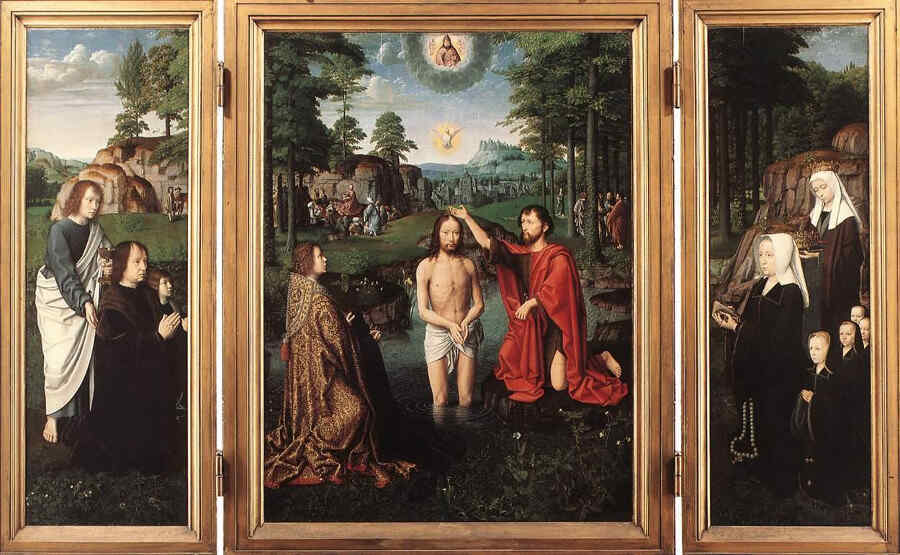
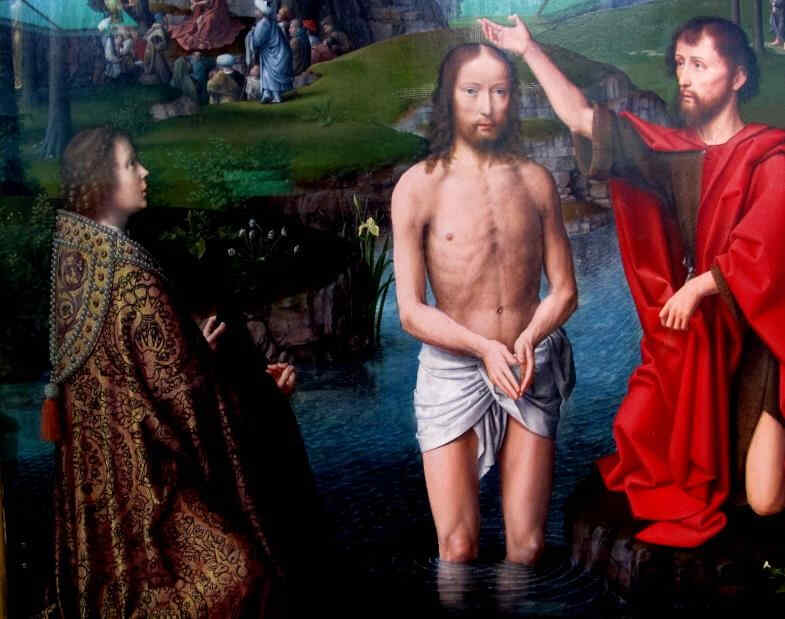
40. Gerard David. Baptism of Christ. (Bruges.)
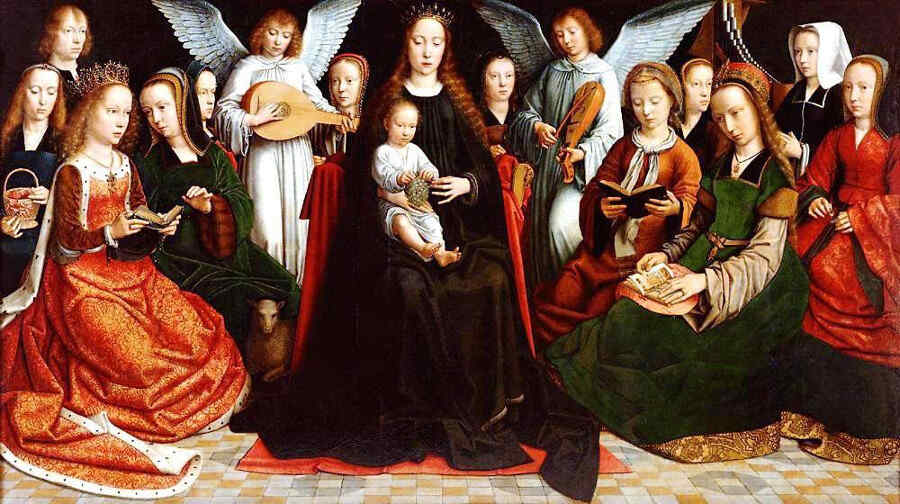
41. Gerard David. Madonna and Christ, with Angels. (Rouen.)
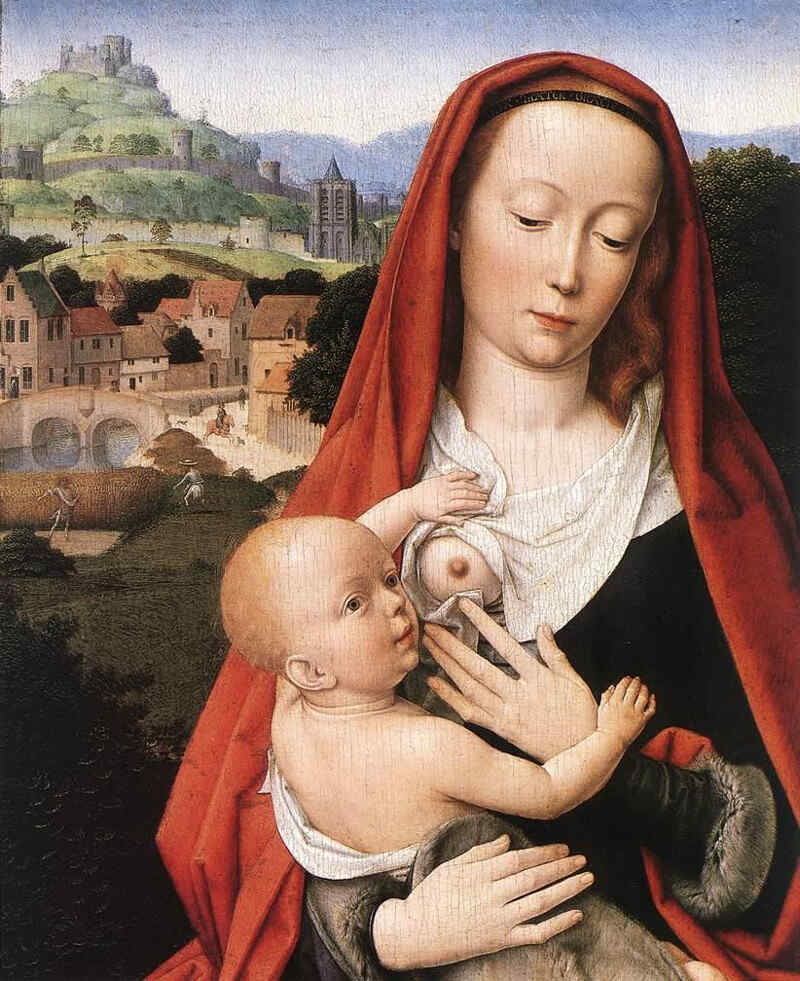
42. Gerard David. Mary and Child
The next is by an artist who was in a sense only a kind of imitation of David. We now come to Geertgen, who, though he dies at the early age of twenty-eight, does, indeed, bear within him all the peculiar characteristics of this epoch.
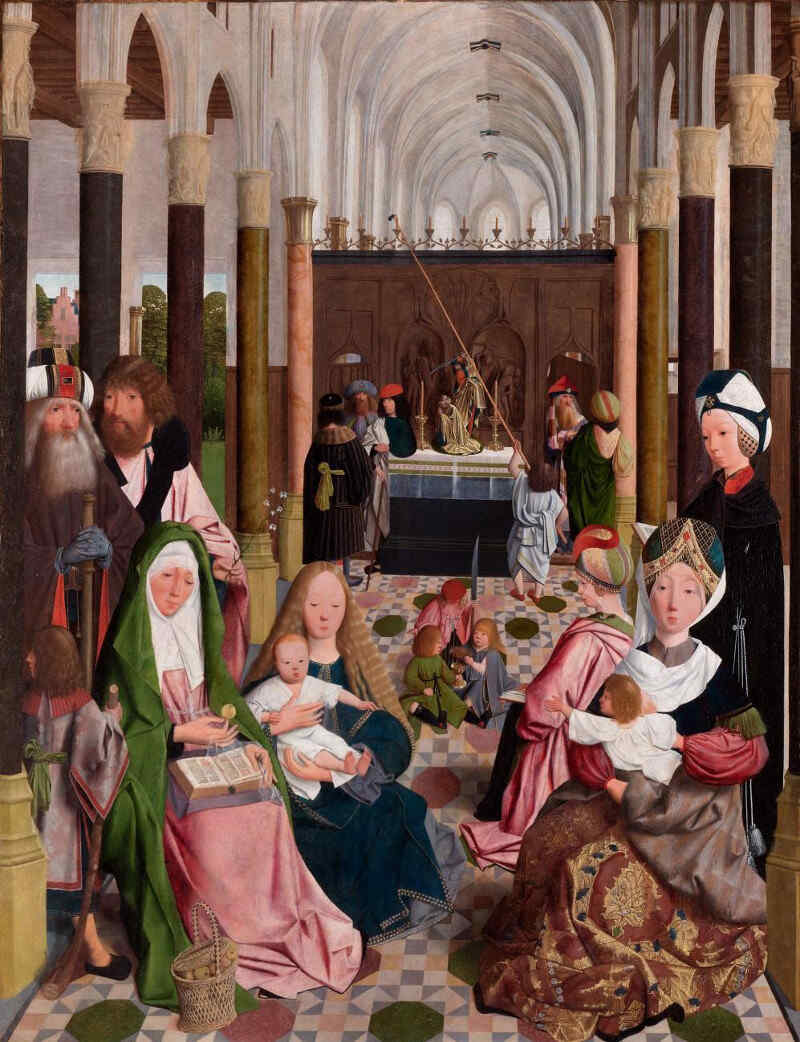
43. Geertgen. Holy Family. (Amsterdam.)
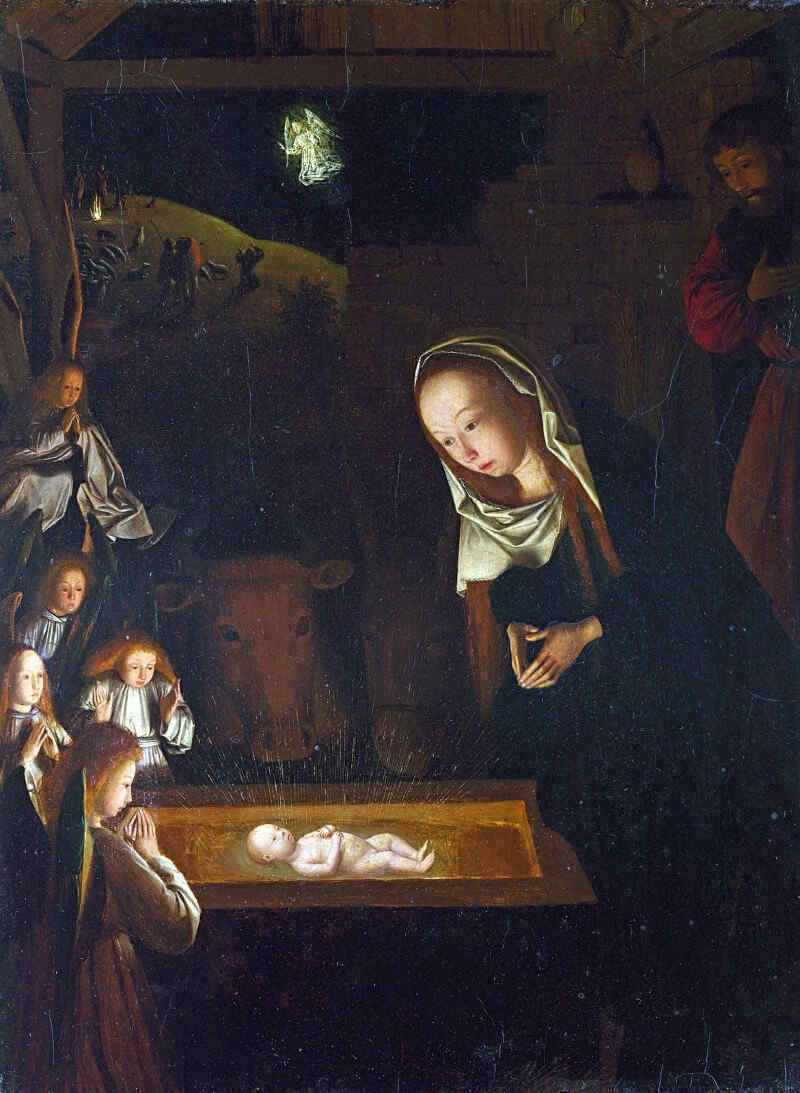
44. Geertgen. The Holy Night. (Berlin.)
As we go forward into the 16th century, other elements mingle more and more with what was characteristic of the Van Eyck period. We come now to Hieronymus Bosch.
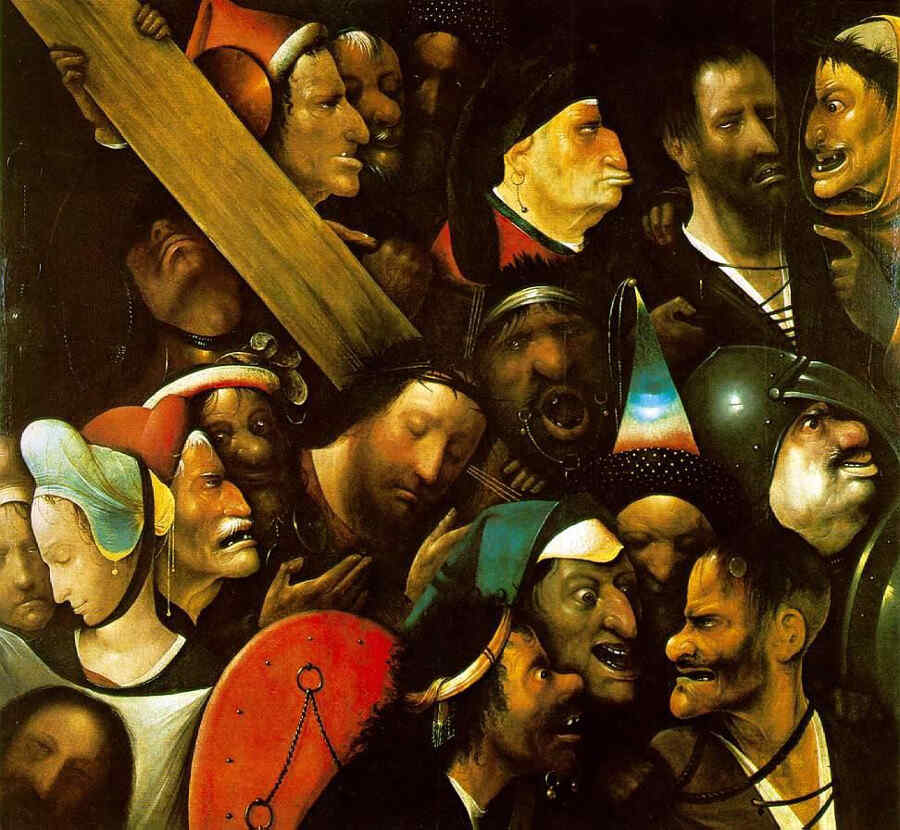
45. Hieronymus Bosch. Descent from the Cross.
In his work we find a strong element of composition. Also we have no longer the mere naturalistic observation. His work is permeated with a fanciful, fantastic feeling—so much so, that he becomes the painter of all manner of grotesque and “spooky” subjects.
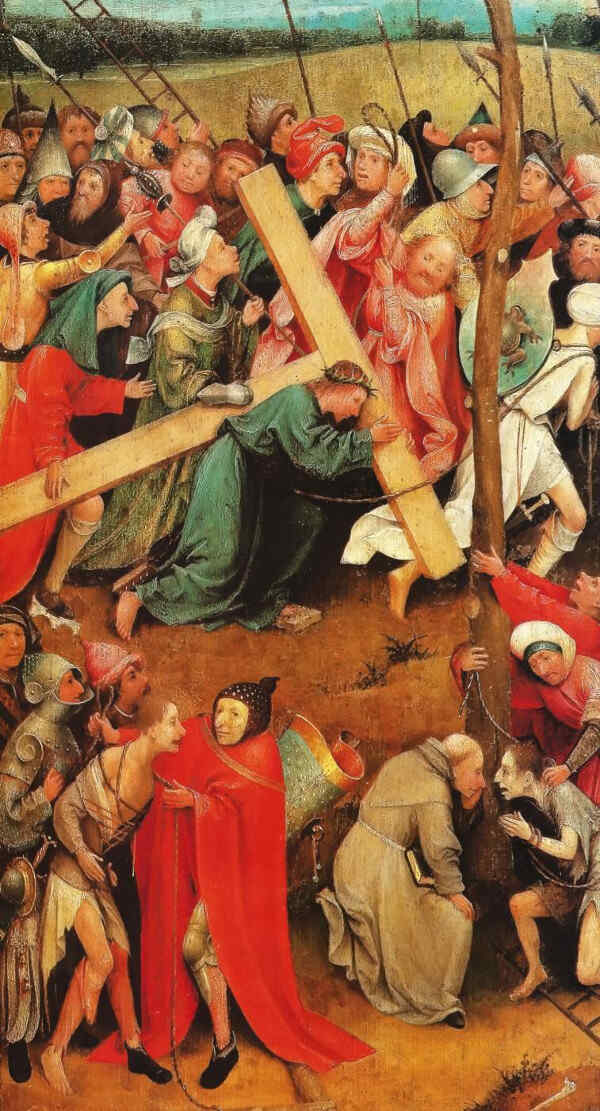
46. Hieronymus Bosch. Christ carrying the Cross.
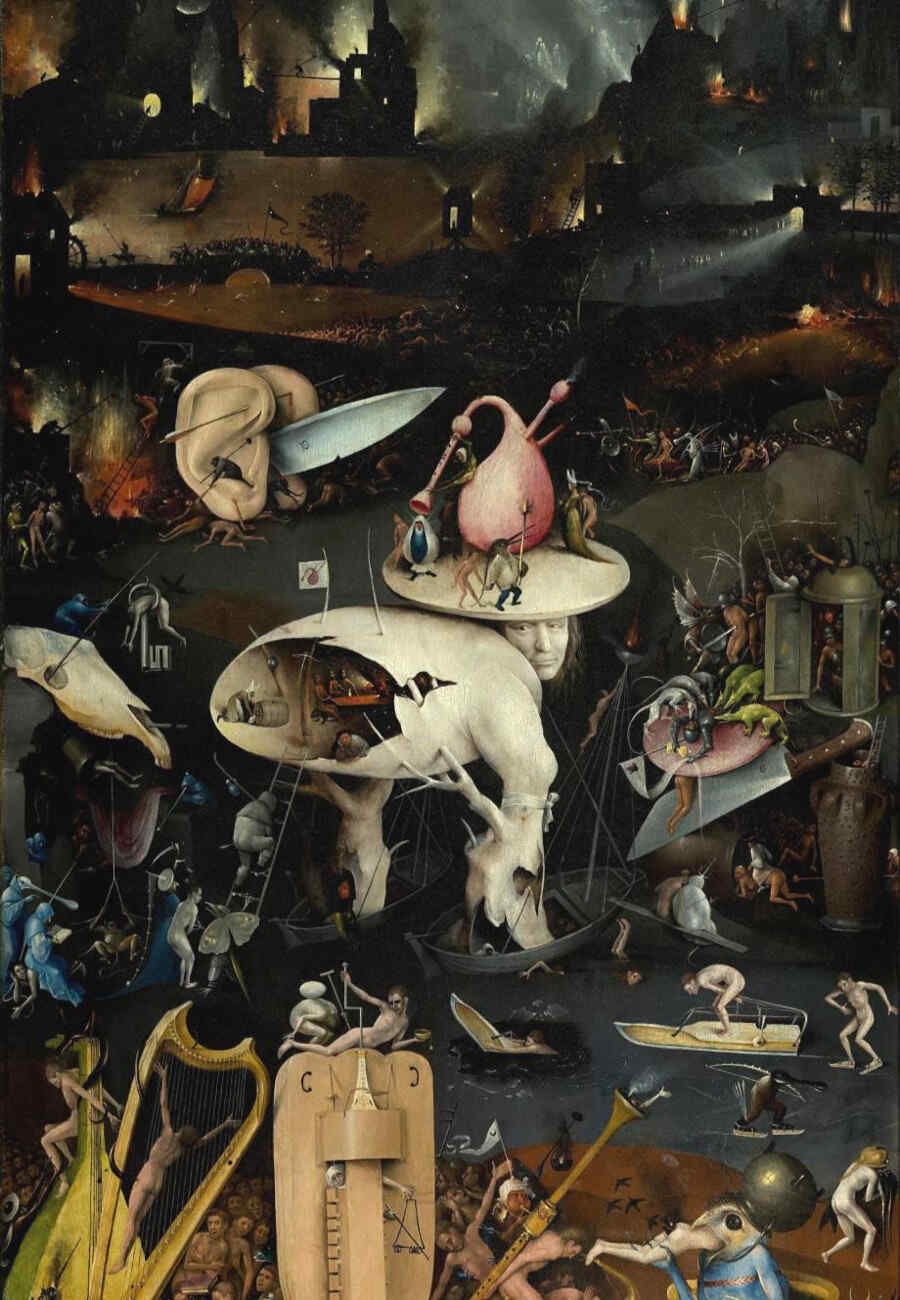
47. Hieronymus Bosch. Hell. (Prado. Madrid.)
The fantastic element is mingled with all that he had learned in this direction.
Now we come to Quentin Matsys, in whom the element of composition is already strongly paramount. Indeed, this is already in the 16th century.
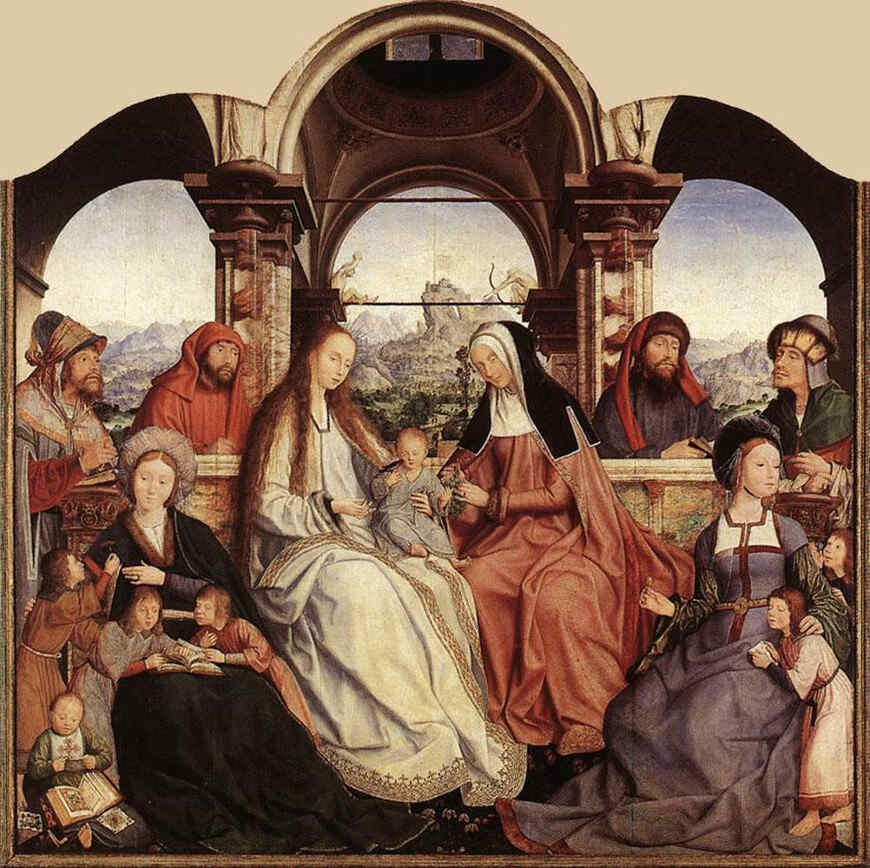
48. Quentin Matsys. Holy Family, 1509. (Brussels.)
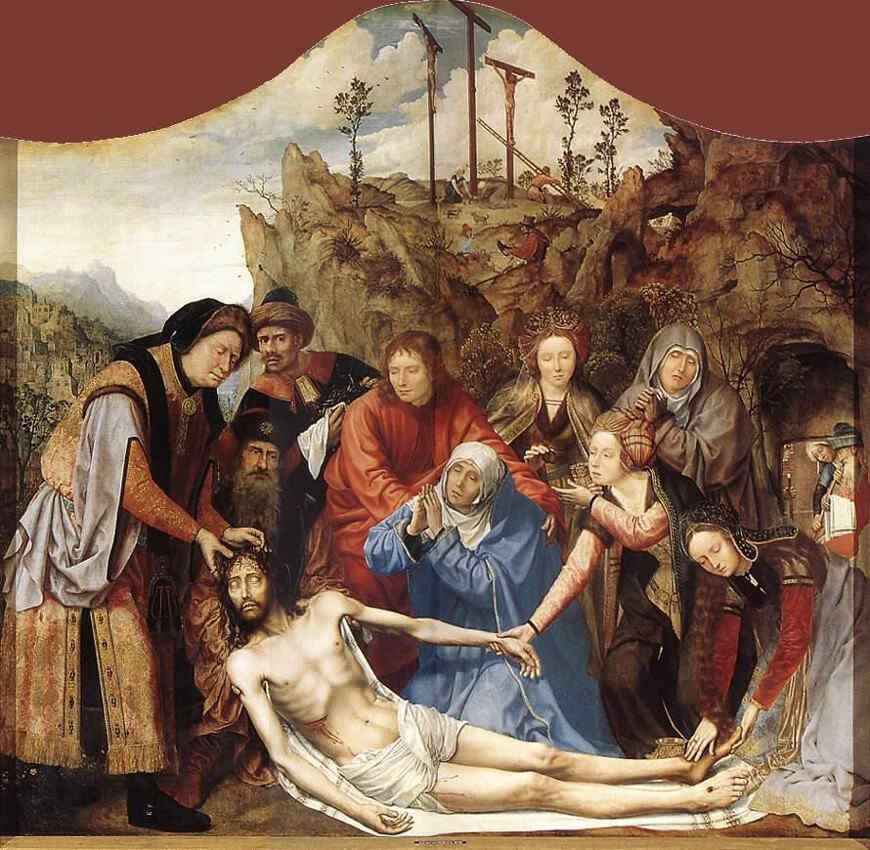
49. Quentin Matsys. Mourning for Christ. (Antwerp.)
Here you see quite deliberate composition. In the next picture we shall see how this feeling for composition combines with that for individual characterisation even where there is less intensity of form, or movement, in the group.
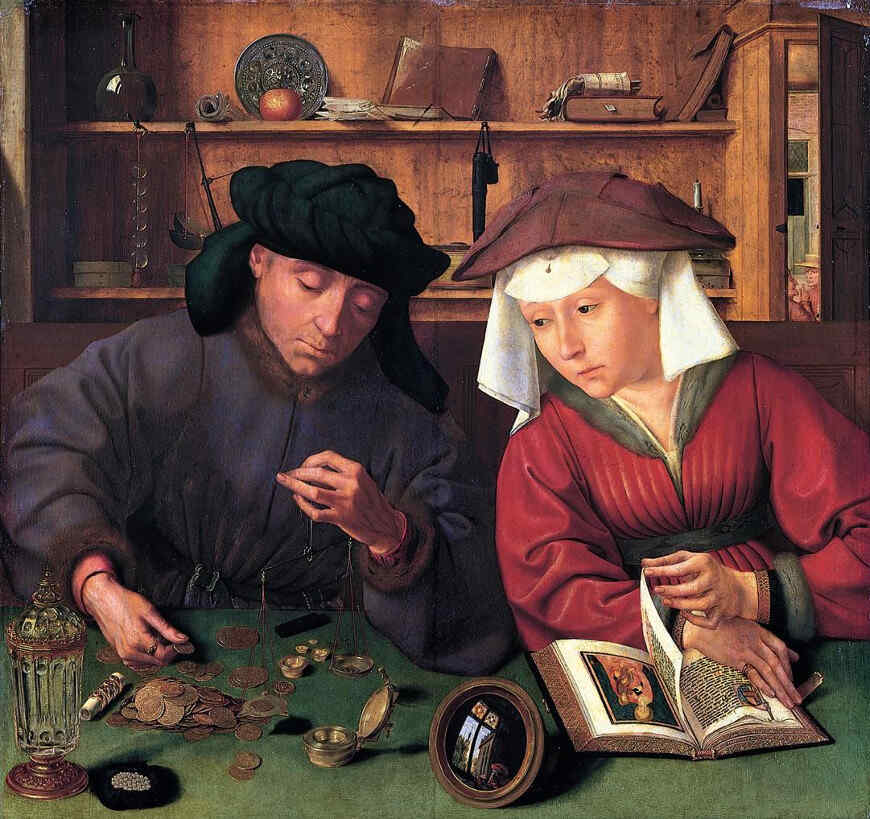
50. Quentin Matsys. The Money-Changer and His Wife. (Louvre. Paris.)
We now come to an artist who reveals the characteristics of the period especially in his landscape-painting—Joachim Patinir. It was at this time and from these regions that landscape-painting first developed and found its way into the full artistic life. Only from this time onward was it really discovered for the life of Art.
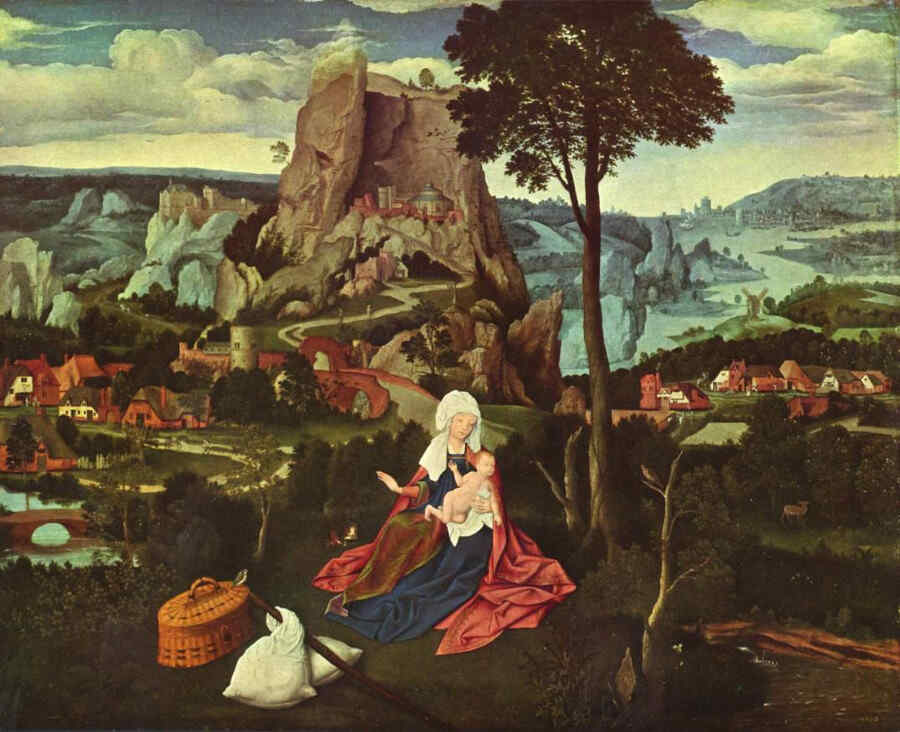
51. Patinir. The Flight into Egypt. (Madrid.)
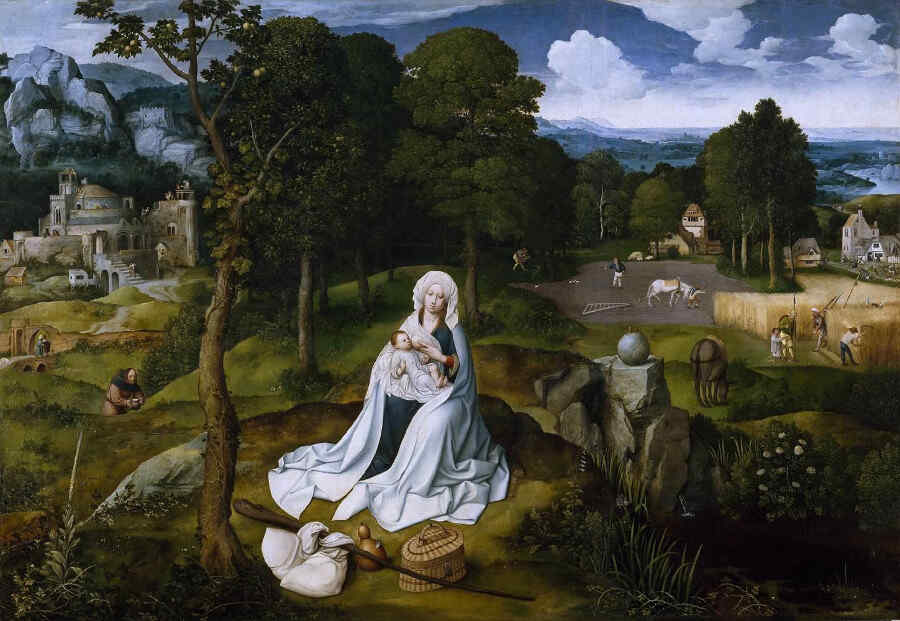
52. Patinir. The Flight into Egypt. (Berlin.)
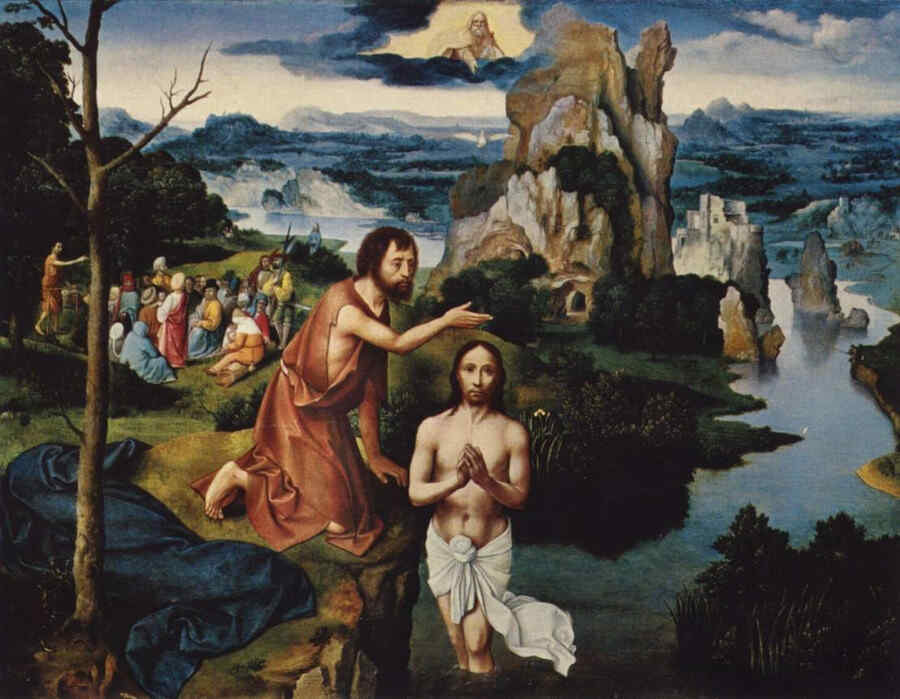
53. Patinir. The Baptism of Christ. (Vienna.)
I beg you to look at this especially, from the point of view of landscape-painting. Such landscape treatment could naturally only originate in the age of attempted naturalism; only then does landscape begin to have a real meaning for Art.
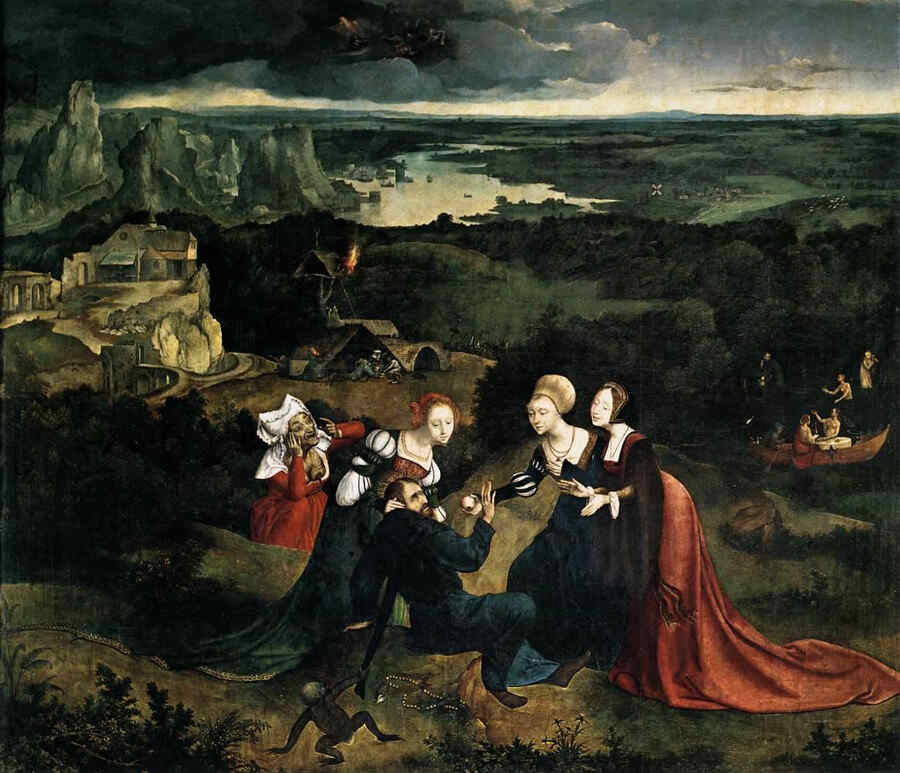
54. Patinir. Temptation of St. Anthony. (Prado. Madrid.)
The next is a painter quite definitely of the 16th century. I spoke just now of the “Burgher” element. He carries it still further, even into the sphere of the peasantry. His works are born of the elemental simplicity of the people. Nevertheless, all manner of other influences enter into them—Italian influences, for example. Thus he strangely unites his elemental Dutch simplicity with a very marked Renaissance feeling. I refer to Pieter Brueghel—born in 1525.
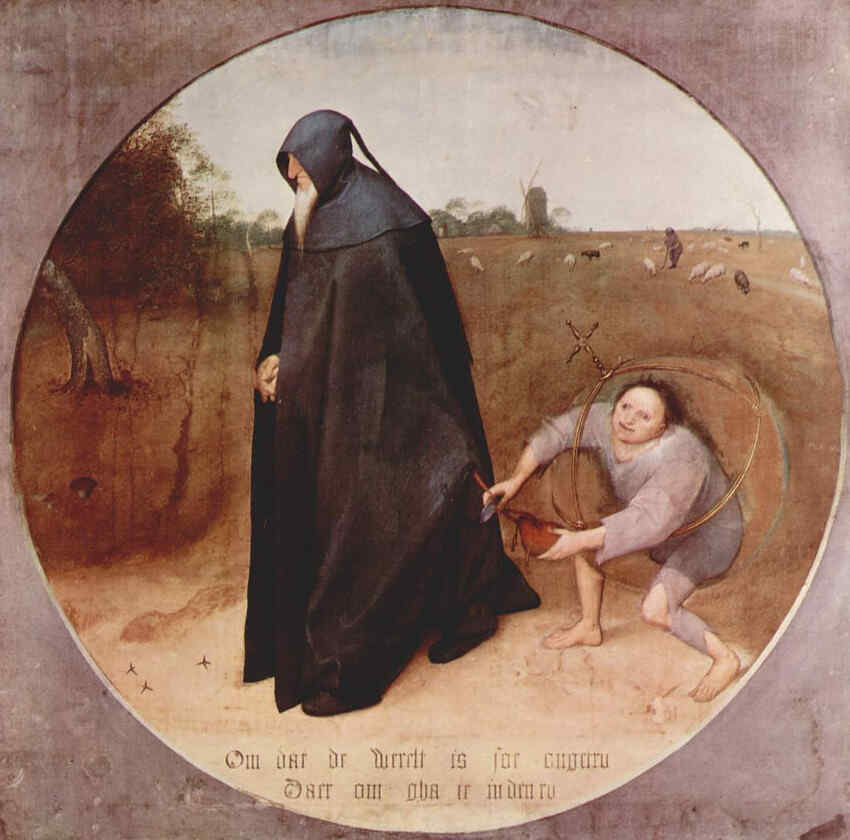
55. Brueghel. The Pious Man and the Devil. (Naples.)
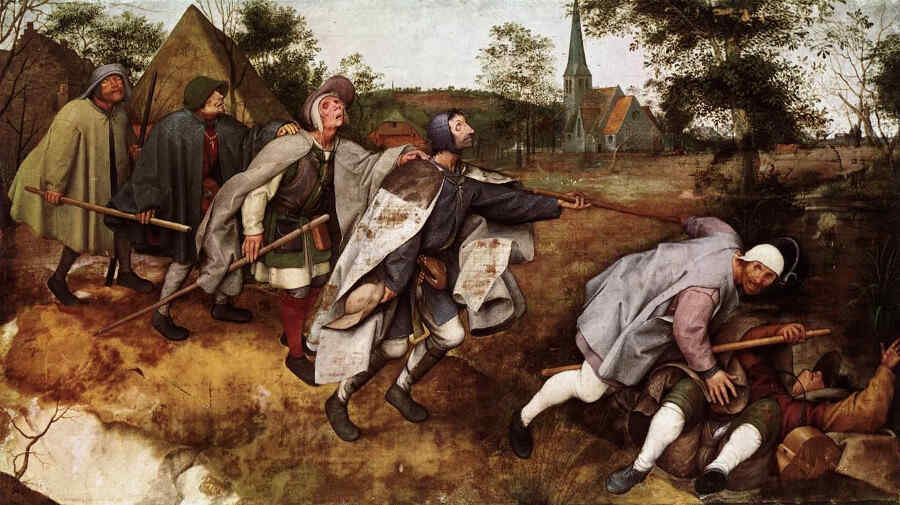
56. Brueghel. The Blind Leading the Blind. (Paris. Louvre.)
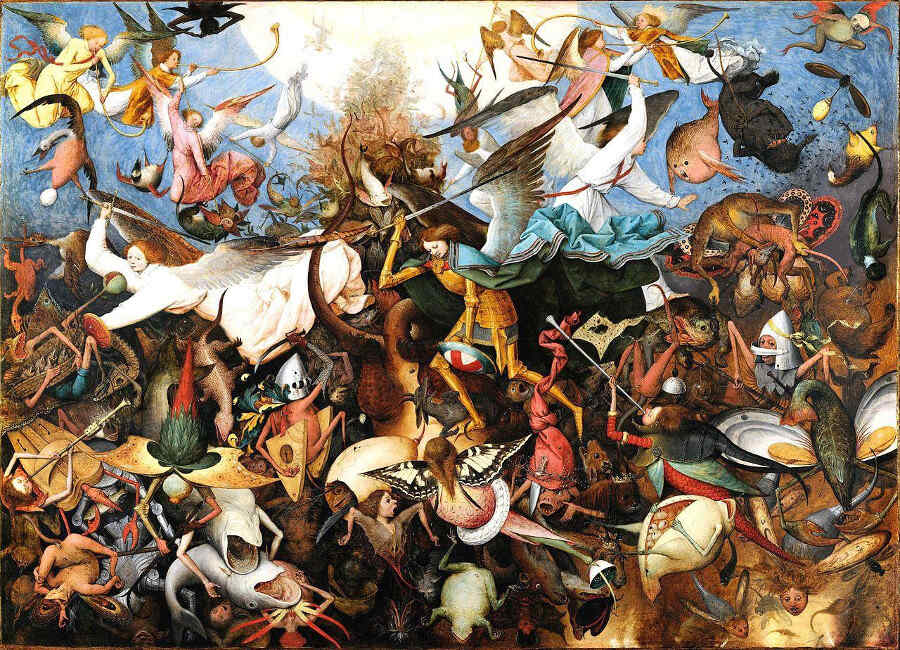
57. Brueghel. The Fall of the Angels. (Brussels.)
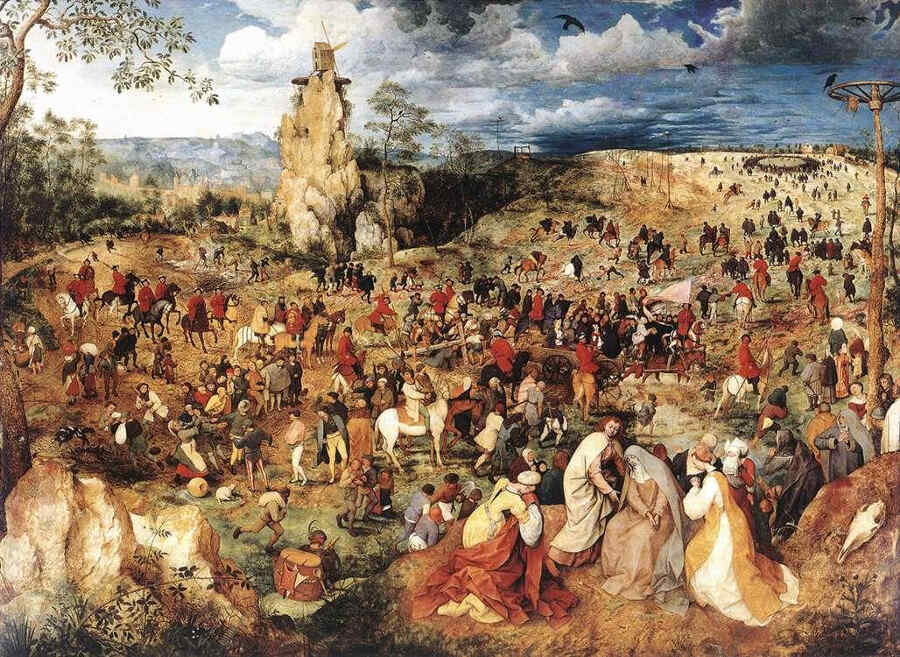
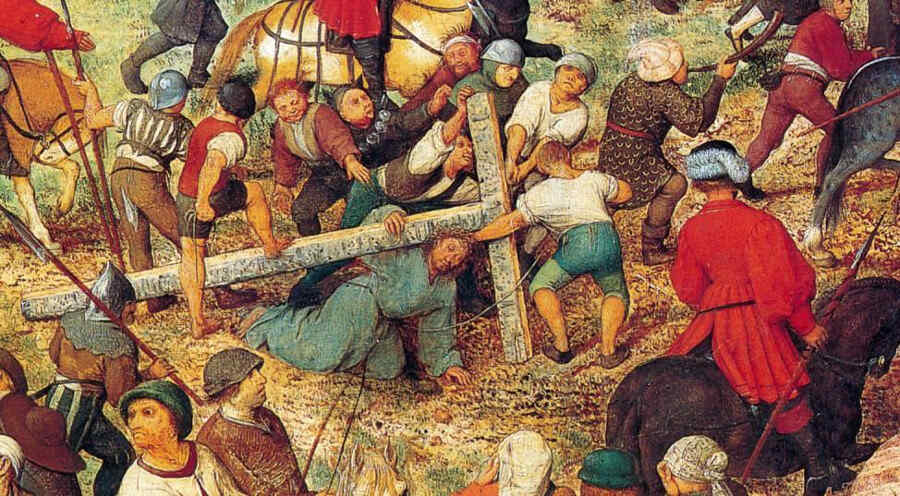
58. Brueghel. The Way to Calvary. (Vienna.)
And another Biblical subject by the same painter.
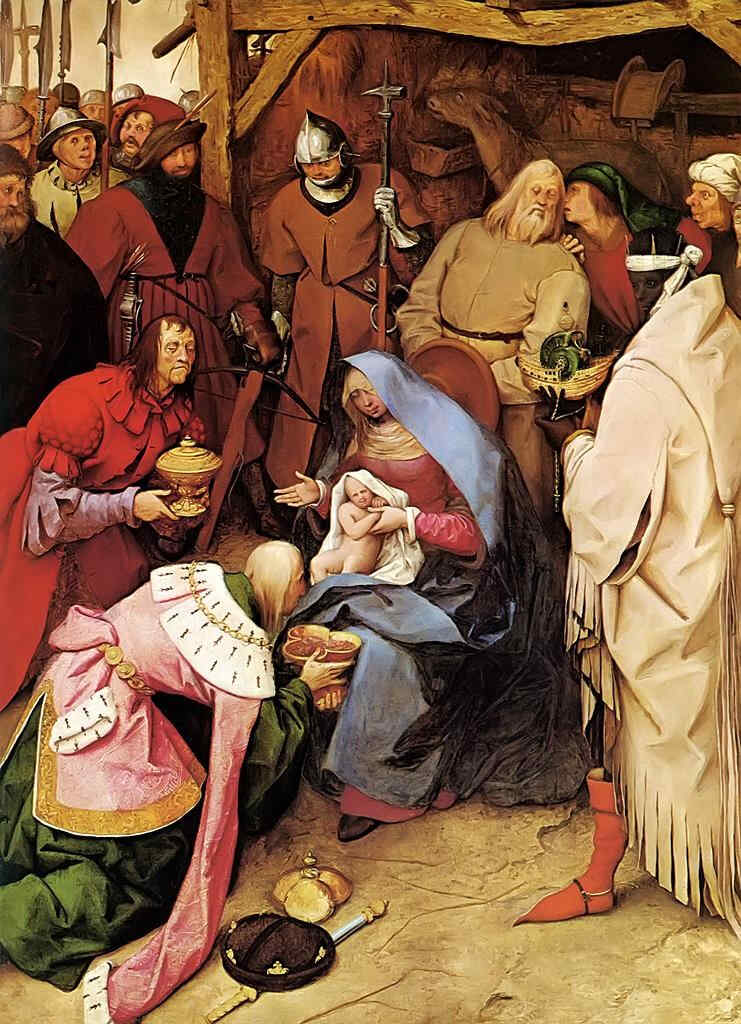
59. Pieter Brueghel. The Adoration of the Magi. (London.)
With that, we will finish for today.
6. Niederländische Malerei vornehmlich des 15. Jahrhunderts
Das auftretende Wirken der Bewußtseinsseele in der Kunst des fünften nachatlantischen Zeitraums:
Wir werden Ihnen heute eine Reihe von Bildern vorführen, welche einen Teil der Entwickelung der niederländischen Malerei, der niederländisch-flandrischen Malerei, in die Zeit des 15. Jahrhunderts herein bis zum Beginn des 16. Jahrhunderts zeigen sollen. Wir weisen damit gerade auf einen in innergeschichtlicher Entwickelung auch allerwichtigsten Zeitpunkt in der Kunstentwickelung hin. Das können Sie ja vor allen Dingen daraus ersehen, daß wir damit in bezug auf die Kunstentwickelung unmittelbar in der Zeit stehen nach dem Anbruch des fünften nachatlantischen Zeitraumes, also desjenigen Zeitraumes, der berufen ist, herauszugestalten aus der Menschheitsevolution alles dasjenige, was zusammenhängt mit der Entwickelung der Bewußtseinsseele. Und wenn man es nur einigermaßen dahin gebracht hat, kein nach modernem Zuschnitt gebildeter Kunsthistoriker zu sein, so wird man vielleicht wenigstens ein elementares Verständnis entgegenbringen können demjenigen, was sich gerade an einer charakteristischsten Stelle wie in diesem Abschnitt «Niederländische Malerei» künstlerisch so zum Ausdruck bringt, daß man in jeder Einzelheit sieht dieses Wirken, dieses auftretende Wirken der Bewußtseinsseele. Wenn man allerdings ein nach modernstem Zuschnitt gebildeter Kunsthistoriker ist, wozu ja selbstverständlich gehört, daß man einen solchen Kunsthistoriker wie Herman Grimm für einen ganz untergeordneten Geist ansieht, [beziehungsweise] wenn man ein solcher Kunsthistoriker zu sein nicht das Unglück hat, so wird man, selbst wenn man gar nichts weiß von den Gesetzen der Impulse, die wir kennengelernt haben in der Geistesentwickelung für die Menschheitsevolution, finden, daß gerade in der Kunstentwickelung die wunderbarste Bestätigung liegt für dasjenige, was Geisteswissenschaft, sagen wir namentlich für die Unterschiede des dritten, vierten, fünften nachatlantischen Zeitraumes aufweist. Und es ist interessant zu sehen, wie langsam und allmählich in den Jahrhunderten dieser Zeiträume herauskommt, was heute eigentlich als das Grundgerüst der Kunstanschauung anzusehen ist, und wie die einzelnen Elemente dieses Grundgerüstes an den verschiedensten Stellen der Menschheitsentwickelung herauskommen.
Sehen Sie, wenn wir zurückgehen in der zeichnerischen, in der malerischen Darstellung, so finden wir, daß zum Beispiel die Gesetze der Raumbehandlung wirklich durch ungeheure Anstrengungen der Menschenseele erst herausgekommen sind. Daher ist die ältere zeichnerisch-malerische Darstellung so, daß sie in unserem heutigen Sinne eigentlich nicht eine bildnerische Kunst darstellt, sondern, man möchte sagen nur die auf eine Fläche fixierte Novellistik ist, eine auf eine Fläche fixierte Erzählung. So könnte man selbst Darstellungen noch gar nicht lang hinter uns liegender Zeiten nennen. Ich werde, ohne viel auf historische Gesichtspunkte einzugehen, nur im allgemeinen heute ein paar Gesichtspunkte angeben. Man kann wahrnehmen, wie man in solchen älteren Zeiten, ohne Rücksicht zu nehmen auf Raumdarstellungen, einfach im Auge hat, irgend etwas, was man auch erzählen kann, darzustellen, und wie man, was man darstellt, eben einfach auf der Fläche fixiert, so daß nebeneinanderstehen die erzählten Dinge auf der Fläche. Wir würden von unserem Gesichtspunkte aus dieses ja nur als eine Art Illustration heute ansehen können und würden heute sogar schon von der Illustration wünschen, daß sie nicht so vorgeht, Anordnung des Erzählten, des Dargestellten auf der Fläche zu geben.
Eine nächste Stufe besteht darin, daß man versucht, in allereinfachster Weise die Raumanordnung zu fixieren, indem man das Prinzip der sogenannten Überschneidung einführt, das heißt, Veranlassung nimmt, das Sichtbarwerden zu verwenden: etwas deckt ein anderes zu, ist also Vormann; das andere ist hinten. Da wird dann schon die Fläche dazu benützt, durch die Überschneidung die Tiefendimensionen wenigstens anzudeuten.
Eine nächste Stufe ist diejenige, die man so charakterisieren kann, daß man die einzelnen Figuren gegeneinander vergrößert und verkleinert, wodurch man schon dem Rechnung trägt, daß das, was größer erscheint, mehr vorne ist, das, was kleiner erscheint, mehr rückwärts ist. Wenn wir nun zurückgehen in den dritten nachatlantischen Zeitraum, so finden wir, daß eine Raumbehandlung durchaus noch nicht vorhanden ist in dem Sinne, wie wir heute von Raumbehandlung sprechen, daß entweder die Anordnung in der Fläche eingehalten wird oder daß der Raum verwendet wird, um den Gedanken auszudrücken. Und das reicht dann noch herein in den griechisch-lateinischen Zeitraum. Wir können da in diesem Zeitraum finden, wie entgegen der Art, wie man die Dinge sieht, gewisse Figuren, die augenscheinlich vorne, also dem Zuschauer näher gestellt sein müssen, kleiner sind als Figuren, die vom Zuschauer weiter entfernt sind. In dieser älteren Zeit gibt man sich etwa einer solchen Behandlung hin: Wenn wir zum Beispiel im Hintergrund einen König postiert sehen, im Vordergrund die Untertanen, so macht man die Untertanen kleiner. Sie sind nicht räumlich kleiner, aber sie sind nach der Anschauung der Menschen dem Gedanken nach kleiner - also stellt man sie vorne hin und macht sie kleiner. Das aber bildet dann den Übergang zu etwas, was wir in der älteren Zeit sehr häufig finden können und was wir nennen können die umgekehrte Perspektive im Verhältnis zu dem, was wir Perspektive nennen. Bei der umgekehrten Perspektive müssen wir uns vorstellen, daß die Dinge so fixiert werden, wie sie irgendeine Figur im Bilde selbst sieht. Da können also die vorderen - für uns vorderen — Gestalten kleiner sein als die rückwärtigen Gestalten, wenn eine rückwärtige Gestalt als diejenige vorgestellt wird, welche eigentlich das Ganze anschaut. Dann muß sich aber der Anschauer einer solchen Darstellung vollkommen ausschalten; er muß sich wegdenken oder er muß sich gewissermaßen in das Bild hineindenken, in die Gestalt, in die Persönlichkeit hineindenken, die als diejenige gedacht wird, welche das Ganze anschaut. Wir haben es also da zu tun mit einer unpersönlichen Perspektive. Eine solche unpersönliche Perspektive war noch angemessen dem vierten nachatlantischen Zeitraum, in dem die Bewußtseinsseele in der Art, wie sie bewußt später geboren wurde, noch nicht geboren war. Der Mensch des fünften nachatlantischen Zeitraumes kann sich nicht selber vergessen, sondern er muß eine Darstellung verlangen, die auf seinen Augenpunkt hingeordnet ist. Daher tritt eigentlich die strenge Kunst der Perspektive auf den Augenpunkt des Anschauers hingeordnet erst auf mit Brunellesco, mit dem die Renaissance im wesentlichen beginnt.
Nun kann man sagen: In diesem Zeitpunkt wird eigentlich erst das, was wir heute Perspektive nennen, richtig eingeführt in die Kunstbehandlung. Und der Süden ist aus den Impulsen heraus, die ich Ihnen bei früheren solchen Betrachtungen gekennzeichnet habe, der Erfinder der Perspektive. Denn dem Süden kommt es an auf Hinordnung, Anordnung in die Raumesverhältnisse hinein; dem Süden kommt es an auf das Extensive. Daher ist er auch vor allen Dingen in der Kunst des Kompositionellen zur Meisterschaft geeignet. Und so sehen wir denn später, von der Renaissance befruchtet, im Süden das kompositionelle Element im Zusammenhang mit all dem, was ich schon dargestellt habe als das Eigentliche emporkommen und bis zur hohen Vollendung kommen. Damit also wird etwas in der Kunst zum Ausdruck gebracht, was man nennen kann Zusammenfassung von Wesenheiten im Raume so, daß dabei der Mensch als Beschauer mitgedacht wird, wie es entspricht dem Zeitalter, in dem die Bewußtseinsseele geboren wird, das heißt, der Mensch seiner selbst bewußt wird.
Nun sehen wir im Süden und in all dem, was mit der südlichen Kultur so zusammenhängt, wie ich es schon dargestellt habe, dieses Prinzip der Perspektive so auftreten, daß wir sehen: es wird naturgemäß aus dieser Südkultur heraus eigentlich richtig entwickelt. Dagegen wird ein anderes Prinzip im Norden entwickelt, und wir sehen es, ich möchte sagen im Status nascendi, im Momente des Entstehens, wenn wir den Blick hin richten auf die Brüder van Eyck.
Wenn wir den Blick richten auf die Brüder van Eyck, zunächst auf Hubert van Eyck, dann auf seinen Bruder Jan van Eyck, so sehen wir in ihnen dasjenige auftreten — allerdings noch in einer ganz anderen Form -, was später so herauskommt, wie ich es Ihnen charakterisieren konnte zum Beispiel bei Rembrandt. Aber wir sehen dieses Prinzip herauswachsen aus dem mittel-europäisch-nordischen Elemente; und solche Dinge drücken sich ja auch durch äußere, ich möchte sagen reale Symbole aus. In Brunellesco hat man den eigentlichen Erfinder der neuzeitlichen Perspektive zu denken. Denn die ältere Perspektive, wie sie den griechischen Reliefdarstellungen zugrunde liegt, die hat zum Beispiel nicht dasjenige, was man einen Fluchtpunkt nennt, sondern eine ganze Fluchtlinie; so daß also nicht die Sache so dargestellt wird, wie wenn in einem Punkte zusammenlaufen würde, was man überschaut, sondern in einer ganzen Fluchtlinie; darin ist sogar der radikale Unterschied der älteren Perspektive gegenüber der neuzeitlichen Perspektive, der Perspektive des fünften nachatlantischen Zeitraumes zum Ausdruck gekommen. Wie nun im Süden durch Brunellesco die Perspektive gefunden wird, so wird im Norden und es ist ja nicht bloß eine 'Iradition, sondern es ist etwas tief Wahres daran — die Ölmalerei gefunden. Und wenn auch nicht Hubert van Eyck allein die Ölmalerei gefunden hat, so ist es doch so, daß in dem Zeitalter und aus dem Milieu heraus, aus dem er geschaffen hat, diese Ölmalerei gefunden worden ist. Was heißt denn das aber eigentlich? Woher kommt so etwas? Denn die Ölmalerei wird dann ja nach dem Süden getragen. Die Perspektive wird von der südlichen Kunst nach dem Norden genommen, die Ölmalerei wird von dem Norden nach dem Süden getragen! Was heißt denn das? — Das wurzelt tief im ganzen Grundcharakter, in der ganzen Grundseelenstimmung des Nordens, also Mitteleuropas. Der Süden hat mehr Talent für das Sich-Fügen in die Gruppe; der Süden hat mehr noch Anhänglichkeit an die Gruppenseele als solche. Daher bezeichnet sich der Süden gern als zu irgendeiner Gruppe gehörig und hat wenig Verständnis für das Individuelle. Das müßte man natürlich durchaus berücksichtigen; denn die Völker werden sich nie verstehen, wenn sie sich nicht Mühe geben, die besonderen Charakteristiken ins Auge zu fassen. Wenn ein in romanischem Geiste Erzogener, also mit südlichem Charakter Impulsierter, von seiner Zugehörigkeit zum Volkstum spricht, sich einen Patrioten nach der einen oder anderen Richtung nennt, so meint er etwas ganz anderes, als wenn der Mitteleuropäer von Patriotismus spricht. Denn für alles dieses Zusammengehörige, dieses die Menschen in Gruppen Zusammenfassende, ist eigentlich in Mitteleuropa kein Talent vorhanden. Da ist das Talent für das Individuelle; und der ursprüngliche Charakter Mitteleuropas kommt zum Vorschein eben in der Anerkennung des Individuellen, daher zunächst in der Zeit der Entwickelung der Bewußtseinsseele in der Anerkennung des Persönlichen, des Menschlich-Individuellen. Wenn man im Gruppenhaften, also im extensiv Ausgedehnten das Wesentliche sieht, dann lebt man sozusagen auch in dem Kompositionellen; dann hat man das Verständnis für dieses Kompositionelle. Wenn man Verständnis hat für das Individuelle, dann will man das Individuelle von innen heraus gestalten; man sieht nicht den Geist wie Fangarme ausstreckend und eine Gruppe zusammenhaltend, sondern man sieht den Geist in jedem einzelnen; man stellt die einzelnen individuellen Dinge zusammen und sieht den Geist in jedem einzelnen, das heißt: man will dasjenige, was im Inneren, im Seelenhaften ist, an die Oberfläche des Körperlichen bringen.
Das geschieht nun nicht durch die Perspektive, sondern das geschieht durch die lichtdurchflossene Farbengebung. Und daher kommt es, daß die urgermanischen Brüder van Eyck gerade der Ausgangspunkt sind für die moderne Farbengebung, die Farbengebung, welche in der Farbe selber versucht, dasjenige festzuhalten, was aus dem Individuell-Seelischen an die Oberfläche des Körperhaften tritt. Und so sehen wir, daß ihre eigentliche Innerlichkeit die Brüder van Eyck und ihre Nachfolger aus diesem nordisch-mitteleuropäischen Elemente hernehmen. Und dasjenige, was in ihren Darstellungen allmählich als Kompositionelles eindringt, das nehmen sie von Frankreich, von Burgund herüber.
Nun ist es keineswegs ein Zufall, daß diese besondere Entwickelung, diese charakteristische Entwickelung im 15. Jahrhundert gerade in die Zeit hineinfällt, in der die Gegenden, in denen diese Maler leben, noch nicht festes staatliches Gefüge haben. Dieses staatliche Gefüge wird ihnen dann erst übergegossen vom Süden her, von Frankreich, und namentlich von Spanien. Dasjenige, was sich dazumal ausdehnt in den nördlichen und südlichen Niederlanden, das sind eigentlich individuelle Städtebildungen, die nur sehr wenig staatsmäßig zusammenhingen. Das ist eine Zeit, in der in dieser Gegend die Leute kein Talent haben, daran zu denken, daß Menschen gruppenmäßig zusammengehalten werden müssen durch Staatsgebilde, bei denen das Staatsgebilde die Hauptsache ist und es darauf ankommt, daf gerade so und so weit dieses Staatsgebilde im Raume sich ausdehnt. Den Leuten, aus denen emporgewachsen sind die Brüder van Eyck, kommt es gar nicht darauf an, welchem Volkstum sie angehören, wie weit sich irgend etwas, was sie Staaten nennen, an das sie überhaupt nicht denken, ausdehnt, sondern es kommt ihnen darauf an, daß Menschen, vollwertige Menschen sich entwickeln, gleichgültig, zu welcher Gruppe sie gehören. Und so sehen wir in den südlichen Niederlandsgegenden, in den flandrischen Gegenden, wie in einer sinnigen und innigen Weise des Menschen Inneres in die Körperoberfläche herausgeholt wird dadurch, daß eben gerade dasjenige, was die Farbe in die individuell-seelische Charakteristik bringen kann, was lichtdurchflossen ist, in das Bild hineingeheimnißt wird. Und wir sehen dann, wie die nordisch-niederländische Bürgerlichkeit in den südlichen Aristokratismus sich hineinerstreckt, und wie gerade aus dieser Bürgerhaftigkeit dasjenige hervorgeht, was den einzelnen Menschen so recht hineinstellt in die Welt und was damit künstlerisch wirklich eine Art Überwindung der Gruppenhaftigkeit ist.
Dabei können —- und wir werden das gleich bei den ersten Bildern heute sehen -, dabei können geradezu großartige Massenentwickelungen auf diesen Bildern auftreten. Aber diese Massenentwickelungen sind nicht so, daß sie von vornherein gruppenhaft gedacht werden, daraufhin konstruiert sind, daß sie so und so verteilt sind und raumhaft zusammengehören, sondern es entstehen die Gruppen dadurch, daß jede einzelne Wesenheit voll wichtig ist und sich neben die anderen hinstellt.
Das also ist es, was wir gerade aus diesem Stück Kunstentwickelung werden ins Auge fassen können. Wir werden sehen bei den Brüdern van Eyck gerade, ich möchte sagen eine vielfach noch zurückgebliebene Raumanordnung, aber trotz dieser zurückgebliebenen Raumanordnung eine hohe Innerlichkeit und ein Anpassen an dasjenige, was man sieht, ohne Rücksicht zu nehmen auf irgend etwas konventionell Feststehendes. Und so sehen wir denn, daß hier der andere Pol des Eingehens auf die physische Wirklichkeit ist, künstlerisch, wie das dem fünften nachatlantischen Zeitraum angemessen ist. Der andere Pol - denn der eine ist im Norden - geht von der italienischen Kunst, von der Kunst der Renaissance aus. Dort das Kompositionelle, und alles übrige gewissermaßen dienend dem Kompositionellen; im Norden dasjenige, was von innen heraus schafft und was sich erst allmählich dazu durchringt, aus der Zusammenstellung des verinnerlichten Individuellen ein Kompositionelles herauszuarbeiten. Dieses bedingt dann, daß die eine Seite des naturalistischen Kunstprinzips des fünften nachatlantischen Zeitraumes eben hier eigentlich eine ihrer Ursprungsstätten hat. Es wird in die unmittelbar den Menschen umgebende Wirklichkeit das Erzählende hineingestellt. Aus dieser den Menschen unmittelbar umgebenden Wirklichkeit war herausgenommen zum Beispiel die biblische Geschichte, wenn sie künstlerisch dargestellt wird in älteren Zeiten. Diese Zeit beginnt, die biblische Geschichte hineinzustellen in die unmittelbar naturalistische Wirklichkeit. Niederländische Menschen stehen vor uns und sind die Gestalten der biblischen Geschichte. Dasjenige, was früher sich von der äußeren, naturalistischen Welt abgeschlossen hat, ich will sagen der Goldhintergrund, dasjenige, was so zur Darstellung kam, das hört auf zu sein. Auf dem Boden, auf dem wir selbst stehen, gehen und stehen auch die biblischen Szenen.
Das aber verknüpft sich unmittelbar wie selbstverständlich damit, daß überall in der Umgebung des Menschen entweder auftritt die Behandlung des Raumes als Innenraum oder die Behandlung des äußeren Raumes. Ich möchte sagen: Der Raum hat aufgehört, selber in der Komposition des Bildes zu leben; dafür muß er auf das Bild versetzt werden, muß im Bilde selber auftreten. Wie kann er auftreten? Nun, indem man einen Teil des Bildes selber als Raum gestaltet. Das heißt, daß man einen Innenraum, ein Zimmer oder irgend etwas nimmt und die Gestalten hineinstellt; oder aber, indem man den Raum gestaltet so, wie er sich naturalistisch um den Menschen herum gestaltet als Landschaft. Daher sehen wir ganz naturgemäß mit all dem, was in der geschilderten Weise als die neuzeitlichen Impulse gerade diese niederländische Kunst durchsetzt, in großartiger, in gewaltiger Weise die Landschaft überall in dem Hintergrund oder sonst auftreten. Und am schönsten, am blühendsten entwickelt sich diese Kunst in der Zeit der Freien Städte, in der Zeit, in der in jenen Gegenden jede Stadt stolz ist auf ihre Unabhängigkeit, in der sie kein Bedürfnis hat nach territorialem Zusammenschluß mit anderen Städten. Da entwikkelt sich ein gewisses internationales Bewußtsein. Und dieses ganze Freisein von Gruppengesinnungen, das ist hervorwachsend aus dem urtüchtigen germanischen Bürgertum gerade jener Gegenden, jener Zeit, aus dem Nord- und Süd-Niederländischen, das nur ganz wenig influenziert ist von dem Kompositionellen des Südens; es ist hervorwachsend aus dem Nord- und SüdNiederländischen, das nur ganz wenig influenziert ist von dem Kompositionellen des Südens, nur insofern influenziert ist, als es angrenzt an den Süden, das aber gerade aus der demokratischen Bürgertüchtigkeit heraus auch das Künstlerische schafft, seine Blüte entfaltet, bis in jene Zeiten hinein, wo wiederum Gruppengesinnung, ich möchte sagen: die Sache überdeckt.
So ist die Zeit der Kunstentwickelung, die wir heute vorführen, auch zugleich eine Zeit der freien Entwickelung der Menschen. Und selbstverständlich, ich müßte jetzt noch sehr vieles sagen; aber ich wollte Ihnen vor allem den welthistorischen Zeitraum fixieren, in den diese Kunstentwickelung hineingestellt ist. Und jetzt können wir ja zu dem Aufzeigen einer Anzahl von Bildern unmittelbar übergehen.
Wir beginnen mit dem weltberühmten «Genter Altarbild» der Brüder van Eyck.
435* Hubert und Jan van Eyck Der Genter Altar
Dieses Altarbild besteht aus sehr vielen Teilen. Sie sehen hier das Mittelstück - wenn die vorderen Flügel aufgemacht sind. Sie sehen da zunächst den oberen Teil davon:
434 Hubert und Jan van Eyck Gottvater. Teil des Genter Altars (433)
Gottvater in der Mitte, im päpstlichen Ornat. Alles aus dem Christlichen des Südens heraus gedacht - Gottvater wirklich wie ein Papst. Aber dasjenige, was ich angedeutet habe, es ist in der künstlerischen Auffassung enthalten. Wenn wir zurückgehen würden, so würden wir finden, daß die frühere Entwickelung ganz in christliche Vorstellungen getaucht ist, in traditionell-christliche Vorstellungen, wie sie der Klerus den Leuten aufgedrängt hat, wie sie im eminentesten Sinne entsprachen einem aus dem Gruppenbewußtsein herauskommenden Denken einer solchen Gesinnung. Und wir sehen ganz aus diesem heraus das Individuelle sich geltend machen.
Nun die beiden Seitenbilder, die noch zum oberen Mittelteil gehören: links «Maria», rechts «Johannes».
437 Hubert und Jan van Eyck Maria. Teil des Genter Altars (433)
438 Hubert und Jan van Eyck Johannes. Teil des Genter Altars (433)
Damit sind wir also im ersten Drittel des 15. Jahrhunderts: 1426 stirbt Hubert van Eyck; sein Bruder macht dieses Altarbild fertig, Jan van Eyck.
Wir werden jetzt die links und rechts vom Mittelteil befindlichen Engelbilder des Genter Altars vorführen:
439 Hubert und Jan van Eyck Musizierende Engel. Teil des Genter Altars (433)
Sie sehen eine Engelgruppe musizierend, ganz verschieden von dem, was wir heute gesehen haben, selbst, wenn Sie sie mit den Engeln vergleichen in der unmittelbar vorangehenden christlichen deutschen Malerei, wie wir sie bei Stefan Lochner und dem «Kölner Meister» gefunden haben. — Sie sehen den großen Unterschied: Hier haben wir vollentwickelte Menschen als Engel, wenn auch, ich möchte sagen in kirchlichen Zeremonialgewändern, vollentwickelte Menschen, nicht mehr wie früher halbkindliche Gestalten. Aber zugleich sehen Sie, wie ein vollständig durchgebildetes Arbeiten in der Perspektive an einem solchen Gruppenbilde noch nicht eingehalten wird. Es ist durchaus noch in sehr geringem Maße eine Perspektive durchgeführt. Sie sehen das Ganze, ich möchte sagen auf der Fläche, teppichartig.
Nun das andere Engelbild von der anderen Seite:
440 Hubert und Jan van Eyck Singende Engel. Teil des Genter Altars (433)
Das ganze Bild ist auf Bestellung eines reichen Bürgers für die Kirche St. Bavo, damals die Johannes-Kirche in Gent, gemacht worden, ist jetzt in der Welt zerstreut in den einzelnen Teilen: in Gent, Brüssel und Berlin.
Und nun kommen wir gewissermaßen zu dem Hauptteil des Bildes, das sich am Altar unterhalb dieser drei befindet:
435 Hubert und Jan van Eyck Anbetung des Lammes. Mittelteil des Genter Altars (433)
Hier sehen Sie eines der Grundmotive dieser und der früheren Zeit.
Es ist diese ganze grandiose Darstellung wiedergebend eine religiöse Grundidee, möchte ich sagen, die sich so allmählich im Laufe der Jahrhunderte heraufgebildet hat und die es zu einer künstlerischen Verkörperung erst bringen konnte, als man eben so weit war, künstlerisch das auszudrücken, was man sich dachte als «Anbetung des Lammes». Es hatte sich ja in den Jahrhunderten der Christenheit allmählich herausgebildet diese Idee von der Erlösung durch das Opfer, von der Befreiung des Menschen durch das Opfer.
Man muß weit zurückgehen, wenn man die ganze Bedeutung dieser Idee ins Auge fassen will. Sie können unmittelbar ein solches Bild hier, das heißt seine novellistische Seite, sein Motiv vergleichen, ich will sagen: mit einer Darstellung des Mithras-Opfers.
436° Römische Plastik Stiertötender Mithras
Wenn Sie dieses Mithras-Opfer nehmen, wie Mithras auf dem Stier sitzt, ihn verwundet, wie das Blut fließt, so sehen wir die Erhöhung des Mithras und damit auch seine Erlösung durch die Überwindung des Tieres herbeigeführt. Sie kennen die tiefere spirituelle Bedeutung dieses Motivs. Ich möchte sagen: es ist das polarisch entgegengesetzte Motiv von diesem.
435 Hubert und Jan van Eyck Anbetung des Lammes. Mittelteil des Genter Altars (433)
Der sich dort (436) aufbäumende, bekämpft werden müssende Stier muß sein Blut lassen; das Lamm gibt freiwillig sein Blut. Damit aber wird herausgehoben die Erlösung aus dem Elemente, in dem sie früher stand, herausgehoben aus dem Gewalttätigen, Kämpferischen, und wird verlegt in das Hingebende, Gnadeerwirkende. Und so drückt sich darinnen die Idee aus: Nicht dadurch, daß der Mensch sich in Hochmut über sich selbst hinausheben und das Niedere töten will, sondern dadurch, daß er das durch die Welt Flutende, in Geduld für die Welt Leidende in seiner Seele durchlebt, erlangt er in jedem Punkt des Weltendaseins seine Befreiung. Dieses universalistische und damit gerade individuell-universelle Befreiungsprinzip ist damit ausgedrückt. Das Lamm ist ein einzelnes, aber kein einzelner durchsticht es; daher ist es für jeden hier geopfert, die es anbeten, die aus den verschiedenen Lebenssphären heraus sich ihm nähern, nähern dem Erlöser-Lamm und nähern dem Quell, dem Brunnen des Lebens.
Es ist also der größte Gedanke, die größte Idee, die sich allmählich im Laufe der Jahrhunderte herausgebildet hat, im ausgehenden Mittelalter durch die Brüder van Eyck festgehalten worden. Damit haben wir gerade innerhalb dieser Entwickelungsperiode eine der größten, bedeutsamsten Kunstschöpfungen, die wir natürlich beurteilen müssen von dem Gesichtspunkte aus, den ich Ihnen gerade geltend gemacht habe. Ich möchte sagen: Es kämpft noch das Individuelle, aus dem Inneren heraus Schaffende mit einer mangelnden Beherrschung der Raumbehandlung. Sie werden namentlich sich bei einem solchen Bilde schwer unmittelbar einen Zuschauer denken können, der in seinem Augenpunkte angebracht ist so, wie er sich darbietet mit der Raumverteilung der Figur, die da unten ist auf dem Bilde, dem Brunnenengel.
Van Eyck hat dann in großartiger Weise die einzelnen Berufszweige, wie in sie alle der Impuls des Lammes hineinwirkt, dargestellt. Eine nächste Gruppe daraus - einzelne heben wir heraus: die Richter und die Ritter,
441 Hubert und Jan van Eyck Die Richter. Teil des Genter Altars (433)
442 Hubert und Jan van Eyck Die Ritter. Teil des Genter Altars (433)
wie sie sich nähern dem Lamm. Das sind alles Teile dieses großen Genter Altares.
Das Nächste ist dann das Innige, die Einsiedler und die Pilger,
443 Hubert und Jan van Eyck Die Einsiedler. Teil des Genter Altars (433)
444 Hubert und Jan van Eyck Die Pilger. Teil des Genter Altars (433)
wobei wir eben schon bewundern können die Behandlung des Zusammenklanges des Menschen mit seinen Landschaften.
Hubert van Eyck ist gestorben 1426, wie ich schon sagte; da war dieses Altarbild noch lange nicht fertig; viele Jahre noch hat daran sein Bruder, Jan van Eyck, gearbeitet, und die Gelehrten beschäftigen sich schon seit langer Zeit mit dem ihnen so wichtig erscheinenden Streite, welche einzelnen Teile dem Hubert und welche dem Jan gehören, ein Streit, der für den, der auf das Künstlerische geht, ja ein ziemlich überflüssiger ist.
Nun kommen wir zu einem anderen Bilde des Jan van Eyck:
445 Jan van Eyck Die Madonna des Kanonikus van der Paele
Das Bild ist 1436 gemalt, und Sie werden daran ebenso bewundern können die Innigkeit der Madonna in ihrem Ausdruck wie auf der anderen Seite die nun wirklich aus einer grandiosen Naturbeobachtung heraus, aber zugleich mit einem gewissen Sinn für das Charakteristische, bei aller Primitivität der damaligen Weise natürlich, aufgefaßte Gestalt des Kanonikus.
Nun kommen wir zu einem Bild, das Jan van Eyck in Spanien gemalt hat, wohin er geschickt worden ist: der Brunnen des Lebens,
446 Jan van Eyck Der Brunnen des Lebens
mit der gotischen Architektur im Hintergrunde. Die Wasser des Lebens, die Brunnen des Lebens im Zusammenhange mit dem Opfer des Lammes darzustellen, war ja damals etwas, worauf die Ideen gingen. Wiederum finden Sie hier das Motiv des Gottvaters in ähnlicher Weise wie auf dem ersten Bild; Madonna und Johannes - eigentlich nurmehr, ich möchte sagen in das südlich Kunstgemäße - das eben herangetreten ist, da er dieses Bild in Spanien gemalt hat - dasjenige verwandelt, was in nordischer Art in dem ersten Bilde vor Ihre Seele getreten ist.
Und nun wollen wir sehen, wie in einer «Kreuzigungsdarstellung»
447 Jan van Eyck Die Kreuzigung
die besonders charakteristische Art dieser Kunst zum Ausdruck kommt. Das Menschliche überwiegt weit das Traditionelle, das aus der Bibel Entlehnte. Von dort her ist, ich möchte sagen nur der Anlaß genommen; aber man sieht, wie allgemein-menschlich mitgefühlt ist, wiedererweckt ist dasjenige, was biblisches Motiv ist. Nicht bloß ist hier die Meinung, man solle das darstellen, was in der Bibel mitgeteilt ist, sondern nacherlebt, nachgefühlt im eminentesten Sinne ist es. Man würde sich nicht leicht denken können, daß unmittelbar ein südlicher Künstler diese Linie hier und diese Linie — bei Maria und Johannes - zusammengemalt hätte; aber wenn es nicht auf das Kompositionelle, sondern darauf ankommt, den Eindruck der Innerlichkeit zu geben, dieses Innerliche wiederzugeben, dann wirkt eben diese Linie hier zusammen mit dieser hier, weil es gerade die verschiedenen Seelenverfassungen so charakteristisch zum Ausdrukke bringt. - Und nun noch zwei Bilder der Profanmalerei desselben Künstlers.
448 Jan van Eyck Die Verlobung des Giovanni Arnolfini
Dieses Bild zeigt besonders deutlich, wie weit eben der Künstler gekommen ist in der Fähigkeit, charakteristisch auszudrücken, was er ausdrücken wollte.
Und das letzte Bild von van Eyck, das wir haben, das zeigt Ihnen den Versuch, weiterzukommen gewissermaßen in der Porträtdarstellung,
449 Jan van Eyck Der Mann mit der Nelke
wobei bei diesem Bilde besonders deutlich zu sehen ist, wie man gar nichts darauf gibt, sich Vorstellungen zu machen, wie der Mensch sein soll, und aus diesem Impuls heraus arbeitet, sondern wie man den Menschen anschaut, und was der Anschauung sich darstellt, das gibt man wieder.
Und nun kommen wir zu einem Zeitgenossen, der den van Eyck etwas überlebt, zu dem Meister von Fl&malle, wie man ihn nennt, in dem wir einen Sucher mit ähnlichen Impulsen sehen, der aber viel mehr beeinflußt ist von dem, was von Frankreich herüberkommt, was man in der Linienführung, in dem Nachwirken der künstlerischen Tradition sieht. Bei van Eyck sieht man: es ist aus einem elementarischen Bedürfnis heraus erwachsen. Hier sieht man, daß schon zugrunde lag die Meinung, dies oder jenes müsse so oder so gestaltet werden; aber sie überwiegt nicht sehr, diese Meinung. Aber dennoch, man sieht darinnen, daß eben gewisse ästhetisch-künstlerische Traditionen Prinzipien sind. Man wird nicht leicht zum Beispiel gerade diese besonders eigentümliche Handlage oder auch die ganze Führung in der Gesichtsdarstellung bei van Eyck finden, sondern Sie werden sie hier finden als mitbewirkt durch einen gewissen Einfluß von Frankreich her.
450 Meister von Flemalle Die hl. Veronika
Dafür ist natürlich der Hauch mehr, ich möchte sagen eleganten Lebens über die Gestalten gegossen als über diejenigen van Eycks.
Dann haben wir von demselben Meister den «Tod der Maria»,
451 Meister von Flemalle Der Tod der Maria
nun wirklich dafür charakteristisch, wie in die unmittelbare Gegenwart herein die christliche Legende versetzt wird. Das sind Bilder, die etwa in den dreißiger Jahren des 15. Jahrhunderts geschaffen sind.
Und nun kommen wir zu Rogier van der Weyden, der nun ebenso von Frankreich herüber beeinflußt ist wie der vorige, aber alle die Elemente hat, die aus der deutlich vorhandenen Nachfolge des van Eyck, beziehungsweise der van Eycks herstammen.
452 Rogier van der Weyden (Schule) Die Beweinung Christi
In dieser sehen Sie, wie aber charakteristisch unterscheidend bei diesem Meister das auftritt, daß in das Bild dramatisches Leben hineinkommt, während van Eyck durchaus episch ist. Van Eyck stellt die Gestalten ruhig nebeneinander; sie wirken gewissermaßen aufeinander, ohne daß man einen das Ganze durchsetzenden Zug hat. Hier (bei van der Weyden) finden Sie in dem Zusammenwirken der Gestalten Dramatik, nicht bloß Epik.
Nun dasselbe Motiv von demselben Maler noch einmal:
453 Rogier van der Weyden Die Kreuzabnahme
Und jetzt ein Bild aus der christlichen Legende. Sie sehen den Evangelisten Lukas, der janach der Legende ein Maler war, die Maria auf dem Bilde malend.
454 Rogier van der Weyden Der Evangelist Lukas malt die Madonna
Nun haben wir noch ein Bild von diesem Meister,
455 Rogier van der Weyden Die Anbetung der Könige (Columba-Altar)
wobei der eine der Könige Philipp von Burgund ist und der andere Karl der Kühne, der den Hut abzieht; es ist auch die ganze Szene sehr in die damalige Gegenwart hereingerückt schon durch diese Äußerlichkeit; denn er hat eben seine mehr oder weniger unmittelbar gegenwärtigen Fürstengestalten als Könige genommen, die kommen, das Kind anzubeten.
456 Rogier van der Weyden Bildnis Karls des Kühnen von Burgund
Alle diese Maler erlangen eine gewisse Vollkommenheit in der Porträtkunst.
Und nun kommen wir zu einem Meister Petrus Christus. Sie sehen da zwei Altarflügel von ihm:
457 Petrus Christus Die Verkündigung
458 Die Geburt Christi
Von Petrus Christus muß man sagen, daß er eigentlich ohne besonderes Ausgesprochenes nach der einen oder nach der anderen Richtung in der Linie arbeitet, wie van der Weyden nach der einen und van Eyck nach der anderen Seite. 1452, also in der Mitte des 15. Jahrhunderts, sind diese Bilder gemalt.
Nun kommen wir immer mehr und mehr zu denjenigen Bildern, welche dem Charakter nach das mehr nordholländische Element noch hineintragen. Und dabei finden wir dann ganz besonders mit Vollkommenheit die Landschaft ausgebildet.
Die nächstfolgenden Bilder sind von Dierick Bouts dem Jüngeren. Gerade für diese Künstlerschaft außerordentlich Charakteristisches
Dierick Bouts d. J., Flügel des Altars «Perle von Brabant»
460 Johannes d. T.
461 Der hl. Christophorus
auf der einen Seite der Täufer, auf der anderen Seite der Christophorus, der Christusträger — Bilder, in denen wirklich die ganze unmittelbar menschliche Innigkeit zum Ausdruck kommt und auf der anderen Seite das wirklich dann dazugehörige landschaftliche Element. Gerade auch bei Bouts sehen Sie dieses eintreten, sehen in der Kunst dieses Hineingestelltsein des Menschen in die freie Natur.
459 Dierick Bouts d. J. Die Anbetung der Könige, Mittelteil des Altars «Perle von Brabant»
Und nun kommen wir aber immer mehr und mehr zu dem sich Hindurcharbeitenden einer ganz realistischen Darstellung. Das heißt: Es ist der Mensch, der Künstler immer mehr imstande, dasjenige, was angestrebt war auf diesem Wege, wirklich in der unmittelbaren Wiedergabe des Natürlichen zu suchen. Wir sehen das zunächst bei Hugo van der Goes:
466 Hugo van der Goes Die Anbetung der Hirten
Hier ist der Realismus eben wirklich bis zu einem gewissen hohen Grade der Vollkommenheit innerhalb dieser Kunstevolution gekommen.
Hugo van der Goes
462 Portinari-Altar, Mittelteil: Die Anbetung des Kindes
463* Die Hirten, Teil von 462
464 Portinari-Altar, Flügel: Hl. Antonius und hl. Matthäus mit Stiftern
465 Portinari-Altar, Flügel: Hl. Margarethe und hl. Magdalena mit Stiftern
Unten sind diejenigen, die das Bild gestiftet haben, darauf.
467 Hugo van der Goes Der Tod der Maria
468 Hugo van der Goes Der Sündenfall
Sehen Sie, diese Kunst hat nicht - ich habe einmal schon darüber gesprochen im Hinblick auf den Meister Bertram — eine Schlange unmittelbar dargestellt, sondern das Luziferische:
469* Meister Bertram Der Sündenfall, Teil des Grabower Altars
Daß die Schlange selber, so wie sie als physische Schlange existiert, den Menschen verführt hat, das ist erst eine Erfindung des Naturalismus der neuesten Zeit, des Materialismus.
Und nun kommen wir zu dem Künstler, der in der Schule von van der Weyden gebildet worden ist und gewissermaßen diese Schule fortsetzt, der dort in dieser Schule genannt wurde der «deutsche Hans» — nämlich zu Hans Memling. Sie sehen hier eine Maria mit dem Kinde.
472 Hans Memling Maria mit dem Kinde
Der Künstler ist in der Mainzer Gegend geboren und hat in diesem Bilde - wenn wir nächstens können, werden wir Ihnen die eigentliche Oberdeutsche Malerei vorführen, die besonders charakteristische Eigentümlichkeiten hat - einiges von dem offenbar in seinen Anlagen Liegenden hinübergetragen, aber im übrigen alles, was in der niederländischen Malerei in dieser Zeit lebte, einschließlich ihrer Einflüsse von Frankreich her, angenommen.
Und nun von demselben Hans Memling ein Motiv, das der damaligen Zeit auch nahelag: die verschiedenen Ereignisse, die sich an Maria anfügten, darzustellen.
470 Hans Memling Die sieben Freuden der Maria
Es sind meistens Szenen aus dem Leben der Maria. Es ist natürlich zu klein, als daß man auf die Einzelheiten auch nur im Anschauen eingehen könnte.
Aber nun nehmen wir ein charakteristisches Bild von Memling,
471 Hans Memling Das Jüngste Gericht
in dem er in einer in seiner Art wirklich genialen Weise seine Vorstellung vom Jüngsten Gericht zum Ausdruck gebracht hat. Sie sehen selbstverständlich etwas von Eckigkeit, Kantigkeit, aber doch von einer menschlich innigen Durchdringung des Vorganges. Das Bild ist gegenwärtig in Danzig, weil ein Handelsherr, der ein Räuber war, das Bild geraubt hat und es, weil er sehr fromm war, der Kirche von Danzig nachher gestiftet hat.
Nun wollen wir noch die Porträtkunst dieses selben Hans Memling kennenlernen, und Sie werden sehen, wie alle diese Maler wirklich in der Wiedergabe der menschlichen Individualität in ihrer Art Großes leisten.
473 Hans Memling Männliches Bildnis (Berlin)
Die Wiedergabe des Seelischen in diesem Antlitz ist schon etwas ganz Außerordentliches. - Und nun noch ein anderes:
474 Hans Memling Männliches Bildnis (Den Haag)
Dieses Bild ist ja sehr bekannt.
Nun kommen wir dann schon zu immer späteren Künstlern, die gewissermaßen schon nicht mehr den ganz freien Zug, sondern ein gebundeneres Wesen zeigen. Zunächst Gerard David. Er ist geboren schon gegen 1460; er ist aus Holland nach Brügge zugewandert. Und während wir bis jetzt die künstlerische Vor-Reformation gehabt haben, haben wir in diesem Künstler schon dasjenige, was sich immer mehr der Reformation nähert:
475 Gerard David Die Anbetung der Könige
Wir sehen, wie da natürlich schon das südliche Element hereinwirkt in das Kompositionelle.
477 Gerard David Die Taufe Christi
Eine «Taufe Christi» von demselben Künstler und eine «Madonna mit dem Kiinde».
478 Gerard David Madonna mit Heiligen und Engeln
476 Gerard David Maria mit dem Kinde
Und nun kommen wir zu einem Künstler, der gewissermaßen nur eine Art Nachahmer des Gerard David ist, der schon mit achtundzwanzig Jahren gestorben ist — Geertgen tot Sint Jans, der aber doch in gewissem Sinne alle die Eigenheiten dieser Kunstperiode in sich trägt:
479 Geertgen tot Sint Jans Die Heilige Sippe
Und noch ein Bild von demselben:
480 Geertgen tot Sint Jans Die Geburt Christi
Je weiter es nun vorangeht in die Zeit gegen das 16. Jahrhundert zu, desto mehr kommen andere Elemente hinein in das eigentlich Charakteristische für die Eyck-Periode, die ich angeführt habe. So kommen wir jetzt zu Hieronymus Bosch:
481 Hieronymus Bosch Die Kreuztragung (Gent)
Da sehen Sie schon, wie ein stark kompositionelles Element hineinkommt und gewissermaßen nicht mehr die bloßen naturalistischen Beobachtungen vorhanden sind, wie ein phantasievolles Element durchwirkt. Daher wird er auch der Maler von allerlei bloß Phantastischem, Spukhaftem.
Zunächst noch eine weitere «Kreuztragung»:
482 Hieronymus Bosch Die Kreuztragung (Madrid)
Wir haben dann ein Bild von ihm, das die «Hölle» darstellt:
483 Hieronymus Bosch Die Hölle. Rechter Innenflügel des Altars «Garten der Lüste»
Da sehen Sie also das Phantastische mit dem, was gelernt worden ist nach dieser Richtung, vermischt. Sie sehen diesen merkwürdigen Aufenthalt.
Und nun kommen wir zu Quentin Massys, der schon durchaus stark das Kompositionelle vorwiegend hat. Das ist schon 16. Jahrhundert:
485 Quentin Massys d. Ä. Die Heilige Sippe. Mittelteil des’ Annen-Altars
Das Bild ist 1509 gemalt.
486 Quentin Massys d. Ä. Die Beweinung Christi, Johannes-Altar
Da sehen Sie schon das ganz bewußßtte Kompositionelle.
Im nächsten Bilde werden Sie sehen, wie die kompositionelle Phantasie auch in einem, was verhältnismäßig weniger Gestaltung hat, sich verbindet mit dem Charakteristischen:
484 Quentin Massys d. Ä. Der Wechsler und seine Frau
Nun wollen wir wieder zu einem Künstler gehen, der insbesondere im Landschaftsbilde Ihnen die Eigentümlichkeiten dieser Periode zeigt - Joachim de Patinir malt insbesondere gerade bedeutende Landschaftsbilder, wie überhaupt in dieser Zeit und von dieser Seite her die Landschaft hineinwächst in die Kunst. Man kann ja sagen, daß eigentlich wirklich die Landschaft erst von dieser Zeit ab entdeckt ist für die Kunst:
487 Joachim Patinir Die Ruhe auf der Flucht (Berlin)
488” Joachim Patinir Die Ruhe auf der Flucht (Madrid)
489 Joachim Patinir Die Taufe Christi
Ich bitte Sie, diese Bilder hauptsächlich vom Gesichtspunkte der Landschaftsmalerei anzusehen. Es ist ja natürlich, daß diese Landschaft erst im Zeitalter der versuchten naturalistischen Nachbildung eintreten kann; und da beginnt ja erst die Landschaft einen Sinn zu haben in der Malerei.
490 Joachim Patinir Die Versuchung des hl. Antonius
Nun kommen wir zu einem Künstler, der schon eben stark in das 16. Jahrhundert herüberfällt, der das, was ich das Bürgerliche genannt habe, sogar, ich möchte sagen bis zum Bauernhaften hat, ganz aus dem elementaren Volkstum heraus malt, aber auf der anderen Seite alle möglichen Einflüsse in sein Schaffen einströmen hat und sogar Italienisches aufgenommen hat - merkwürdigerweise also das Holländisch-Elementare mit dem schon auf die Renaissance hin Arbeitenden vereinigt und einen gewissen Humor hat. Das ist Pieter Brueghel der Ältere, geboren 1525.
Da haben wir den frommen Mann und hinter ihm den Teufel:
491 Pieter Brueghel d. Ä. Der Teufel und der Fromme
Dann haben wir einen Fall der Engel von ihm - wie die Engel verworfen werden:
493 Pieter Brueghel d. Ä. Der Fall der Engel
Dann haben wir noch biblische Bilder von ihm:
494 Pieter Brueghel d. Ä. Die Kreuztragung
495% Pieter Brueghel d. Ä. Die Anbetung der Könige
492 Pieter Brueghel d. Ä. Die Parabel von den Blinden
Damit wollen wir für heute schließen.
6. Dutch Painting, primarily of the 15th century
The manifesting activity of the consciousness soul in the art of the fifth post-Atlantean epoch:
Today we will show you a series of paintings that illustrate part of the development of Dutch painting, Dutch-Flemish painting, from the 15th century to the beginning of the 16th century. In doing so, we are pointing to a moment in art history that is also of utmost importance in terms of internal historical development. You can see this above all from the fact that, in terms of the development of art, we are directly in the period after the dawn of the fifth post-Atlantean epoch, that is, the period that is called upon to shape out of human evolution everything that is connected with the development of the consciousness soul. And if one has managed to some extent not to be an art historian educated in the modern style, one will perhaps be able to show at least an elementary understanding of what is expressed artistically in such a characteristic place as this section on “Dutch painting,” so that one can see in every detail this activity, this emerging activity of the consciousness soul. However, if you are an art historian educated in the most modern way, which of course includes considering an art historian such as Herman Grimm to be a completely inferior spirit, [or] if you are not unfortunate enough to be such an art historian, then even if you know nothing about the laws of impulses that we have learned about in the spiritual development of human evolution, you will find that it is precisely in the development of art that the most wonderful confirmation lies for what spiritual science shows, namely for the differences between the third, fourth, and fifth post-Atlantean periods. And it is interesting to see how slowly and gradually, over the centuries of these periods, what is actually regarded today as the basic framework of the view of art emerges, and how the individual elements of this basic framework emerge at various points in human development.
You see, when we go back to the graphic and pictorial representation, we find that, for example, the laws of spatial treatment only emerged through tremendous efforts of the human soul. Therefore, older drawings and paintings are such that, in our present-day sense, they do not actually represent a pictorial art, but rather, one might say, are simply novellas fixed on a surface, narratives fixed on a surface. This is how one could describe representations from times not so long ago. Without going into historical aspects in great detail, I will I will only mention a few points in general today. One can see how, in such older times, without taking spatial representations into account, the aim was simply to depict something that could be told, and how what was depicted was simply fixed on the surface, so that the things told stood side by side on the surface. From our point of view today, we would only be able to regard this as a kind of illustration, and today we would even wish that illustrations did not proceed in this way, arranging what is narrated and depicted on the surface.
The next stage consists of attempting to fix the spatial arrangement in the simplest possible way by introducing the principle of so-called overlap, that is, taking the opportunity to use visibility: one thing covers another, and is therefore in front; the other is behind. The surface is then used to at least suggest the dimensions of depth through overlapping.
The next stage can be characterized by enlarging and reducing the individual figures in relation to each other, thereby taking into account that what appears larger is more in front, and what appears smaller is more in the background. If we now go back to the third post-Atlantean period, we find that a treatment of space in the sense in which we speak of it today, either in terms of maintaining the arrangement in the surface or using space to express ideas, is not yet present. And this continues into the Greco-Latin period. In this period, we can see how, contrary to the way we see things, certain figures that are obviously in the foreground, i.e., closer to the viewer, are smaller than figures that are further away from the viewer. In this older period, people indulged in such a treatment: for example, if we see a king positioned in the background and his subjects in the foreground, the subjects are made smaller. They are not spatially smaller, but they are smaller in people's minds – so they are placed in the foreground and made smaller. But this then forms the transition to something that we find very often in the older period and which we can call the reverse perspective in relation to what we call perspective. In reverse perspective, we have to imagine that things are fixed as they are seen by some figure in the picture itself. So the figures in the foreground — the foreground for us — can be smaller than the figures in the background if a figure in the background is imagined as the one who is actually looking at the whole picture. But then the viewer of such a representation must completely switch off; he must think himself away or, in a sense, think himself into the picture, into the figure, into the personality that is thought of as the one looking at the whole. So we are dealing here with an impersonal perspective. Such an impersonal perspective was still appropriate to the fourth post-Atlantean period, in which the consciousness soul, in the way it was later consciously born, had not yet been born. The human being of the fifth post-Atlantic period cannot forget himself, but must demand a representation that is oriented toward his point of view. Therefore, the strict art of perspective oriented toward the viewer's point of view only really appears with Brunelleschi, with whom the Renaissance essentially begins.
Now one can say: it is at this point in time that what we today call perspective is actually introduced into the treatment of art. And the South, based on the impulses I have pointed out to you in earlier such considerations, is the inventor of perspective. For the South is concerned with orientation, with arrangement in spatial relationships; the South is concerned with the extensive. Therefore, it is also particularly suited to mastery in the art of composition. And so we see later, inspired by the Renaissance, the compositional element in the South, in connection with everything I have already described, emerge as the essence and reach a high level of perfection. This expresses something in art that can be called the summarization of essences in space in such a way that the human being as observer is taken into account, as befits the age in which the consciousness soul is born, that is, when human beings become conscious of themselves.
Now we see this principle of perspective appearing in the south and in everything connected with southern culture, as I have already described, in such a way that we see it developing naturally and correctly out of this southern culture. In contrast, another principle is developed in the north, and we see it, I would say, in its nascent state, at the moment of its emergence, when we turn our gaze to the van Eyck brothers.
When we look at the van Eyck brothers, first at Hubert van Eyck, then at his brother Jan van Eyck, we see in them the emergence — albeit in a completely different form — of what later came to fruition, as I was able to characterize for you in Rembrandt, for example. But we see this principle emerging from Central European-Nordic elements; and such things are also expressed through external, I would say real, symbols. Brunelleschi is considered the actual inventor of modern perspective. For the older perspective, as it underlies Greek relief representations, does not have what is called a vanishing point, but rather an entire vanishing line; so that the object is not represented as if it converged at a single point, but rather in an entire vanishing line; This even expresses the radical difference between the older perspective and the modern perspective, the perspective of the fifth post-Atlantic period. Just as perspective was discovered in the south by Brunelleschi, so oil painting was discovered in the north, and this is not merely a tradition, but something deeply true. And even if Hubert van Eyck did not discover oil painting alone, it is nevertheless true that in the age and milieu in which he created, oil painting was discovered. But what does that actually mean? Where does something like this come from? Because oil painting is then carried south. Perspective is taken from southern art to the north, oil painting is carried from the north to the south! What does that mean? — It is deeply rooted in the whole basic character, in the whole basic soul mood of the north, i.e., Central Europe. The south has more talent for fitting into the group; the south is even more attached to the group soul as such. Therefore, the south likes to identify itself as belonging to a particular group and has little understanding for the individual. Of course, this must be taken into account, because peoples will never understand each other if they do not make an effort to consider their particular characteristics. When someone educated in the Romanic spirit, that is, someone with a southern character, speaks of his belonging to a people, calls himself a patriot in one direction or another, he means something quite different from what a Central European means when he speaks of patriotism. For all this togetherness, this bringing people together in groups, there is actually no talent in Central Europe. There is a talent for the individual, and the original character of Central Europe comes to the fore precisely in the recognition of the individual, and therefore, initially, in the period of the development of the consciousness soul, in the recognition of the personal, the human-individual. If one sees the essential in the group, that is, in the extensively expanded, then one also lives, so to speak, in the compositional; then one has an understanding of this compositional aspect. If one has an understanding of the individual, then one wants to shape the individual from within; one does not see the spirit as extending tentacles and holding a group together, but one sees the spirit in each individual; one puts the individual things together and sees the spirit in each individual, that is, one wants to bring what is inside, in the soul, to the surface of the physical.
This is not achieved through perspective, but through light-filled coloring. And that is why the ancient Germanic brothers van Eyck are the starting point for modern coloring, the coloring that attempts to capture in the color itself that which emerges from the individual soul onto the surface of the physical. And so we see that the van Eyck brothers and their successors draw their actual inner life from this Nordic-Central European element. And what gradually enters their representations as compositional elements, they take from France, from Burgundy.
Now, it is by no means a coincidence that this particular development, this characteristic development in the 15th century, coincides precisely with the period in which the regions in which these painters live do not yet have a solid state structure. This state structure is then imposed on them from the south, from France, and especially from Spain. What was expanding in the northern and southern Netherlands at that time were actually individual cities that had very little connection to the state. This was a time when people in this region had no talent for thinking that people had to be held together in groups by state structures, in which the state structure was the main thing and it mattered how far this state structure extended in space. The people from whom the van Eyck brothers emerged did not care at all which ethnic group they belonged to, or how far something they called states, which they did not think about at all, extended, but what mattered to them was that people, fully-fledged human beings, developed, regardless of which group they belonged to. And so we see in the southern regions of the Netherlands, in the Flemish regions, how the inner life of human beings is brought out in a meaningful and heartfelt way on the surface of the body, precisely because that which color can bring into the individual soul's characteristics, that which is flooded with light, is mysteriously incorporated into the image. And we then see how the Nordic Dutch bourgeoisie extends into the southern aristocracy, and how it is precisely from this bourgeoisie that what truly places the individual human being in the world emerges, and what is thus artistically a kind of overcoming of group identity.
In the process — and we will see this right away in the first pictures today — truly magnificent mass developments can appear in these pictures. But these mass developments are not such that they are conceived as groups from the outset, constructed in such a way that they are distributed in a certain way and belong together spatially; rather, the groups arise because each individual entity is fully important and stands alongside the others.
This, then, is what we can see in this particular piece of artistic development. In the work of the van Eyck brothers, we see what I would call a somewhat backward spatial arrangement, but despite this backward spatial arrangement, there is a high degree of inwardness and an adaptation to what one sees, without regard for anything conventionally established. And so we see that here is the other pole of responding to physical reality, artistically, as is appropriate to the fifth post-Atlantean period. The other pole—for the one is in the north—stems from Italian art, from Renaissance art. There, the compositional, and everything else serving the compositional, so to speak; in the north, that which creates from within and which only gradually works its way through to developing a compositional element from the combination of the internalized individual. This then means that one side of the naturalistic art principle of the fifth post-Atlantic period actually has one of its places of origin here. The narrative is placed into the reality that immediately surrounds people. From this reality immediately surrounding people, biblical history, for example, was taken out when it was artistically represented in earlier times. This period begins to place biblical history into immediate naturalistic reality. Dutch people stand before us and are the figures of biblical history. That which was previously separated from the external, naturalistic world, i.e., the gold background, that which was thus depicted, ceases to be. The biblical scenes also walk and stand on the ground on which we ourselves stand.
But this is directly and naturally linked to the fact that everywhere in the human environment, space is either treated as interior space or as exterior space. I would like to say: space has ceased to live in the composition of the picture itself; instead, it must be transferred to the picture, it must appear in the picture itself. How can it appear? Well, by designing part of the picture itself as space. This means taking an interior space, a room or something else, and placing the figures inside it; or designing the space in the same way that it naturally forms around people as a landscape. Therefore, with everything that permeates Dutch art in the manner described as modern impulses, we naturally see the landscape appearing everywhere in the background or elsewhere in a magnificent, powerful way. And this art developed most beautifully and flourished most during the era of the Free Cities, a time when every city in those regions was proud of its independence and had no need for territorial union with other cities. A certain international consciousness developed. And this complete freedom from group mentality emerged from the industrious Germanic bourgeoisie of precisely those regions, that time, from the northern and southern Netherlands, which was only very slightly influenced by the compositional style of the south; it emerged from the northern and southern Netherlands, which was only very slightly influenced by the compositional style of the south, only insofar as it bordered on the south, but which, precisely because of its democratic bourgeois efficiency, also created art, allowing it to flourish until those times when group mentality, I would say, overshadowed the matter.
Thus, the period of artistic development that we are presenting today is also a period of free human development. And of course, I still have a lot to say, but I wanted above all to establish the period of world history in which this artistic development took place. And now we can move on directly to showing a number of pictures.
We begin with the world-famous “Ghent Altarpiece” by the van Eyck brothers.
435* Hubert and Jan van Eyck The Ghent Altarpiece
This altarpiece consists of many parts. Here you can see the centerpiece—when the front wings are open. First, you see the upper part of it:
434 Hubert and Jan van Eyck God the Father. Part of the Ghent Altarpiece (433)
God the Father in the center, in papal regalia. Everything is conceived from the Christian perspective of the South – God the Father really looks like a pope. But what I have indicated is contained in the artistic conception. If we were to go back, we would find that earlier developments were completely steeped in Christian ideas, in traditional Christian ideas, as imposed on the people by the clergy, as they corresponded in the most eminent sense to a way of thinking that emerged from the group consciousness of such a mindset. And we see the individual asserting itself entirely out of this.
Now the two side panels, which still belong to the upper central section: on the left “Mary,” on the right “John.”
437 Hubert and Jan van Eyck Mary. Part of the Ghent Altarpiece (433)
438 Hubert and Jan van Eyck John. Part of the Ghent Altarpiece (433)
This brings us to the first third of the 15th century: Hubert van Eyck dies in 1426; his brother, Jan van Eyck, completes this altarpiece.
We will now show you the angel paintings on the left and right of the central section of the Ghent Altarpiece:
439 Hubert and Jan van Eyck Angels playing music. Part of the Ghent Altarpiece (433)
You see a group of angels playing music, very different from what we have seen today, even if you compare them with the angels in the immediately preceding Christian German painting, as we found in Stefan Lochner and the “Cologne Master.” — You can see the big difference: here we have fully developed humans as angels, albeit, I would say, in ecclesiastical ceremonial robes, fully developed humans, no longer semi-childlike figures as before. But at the same time, you can see how a fully developed perspective is not yet adhered to in such a group picture. Perspective is still only used to a very limited extent. You see the whole thing, I would say, on the surface, like a carpet.
Now the other angel painting from the other side:
440 Hubert and Jan van Eyck Singing Angels. Part of the Ghent Altarpiece (433)
The entire painting was commissioned by a wealthy citizen for St. Bavo's Church, then St. John's Church in Ghent, and is now scattered around the world in individual parts: in Ghent, Brussels, and Berlin.
And now we come, so to speak, to the main part of the painting, which is located on the altar below these three:
435 Hubert and Jan van Eyck Adoration of the Lamb. Central section of the Ghent Altarpiece (433)
Here you can see one of the basic motifs of this and earlier times.
This entire grandiose depiction reflects a fundamental religious idea, I would say, which gradually developed over the centuries and could only be artistically embodied when people were ready to artistically express what they thought of as the “Adoration of the Lamb.” Over the centuries of Christianity, this idea of redemption through sacrifice, of the liberation of mankind through sacrifice, had gradually developed.
One must go back a long way to grasp the full meaning of this idea. You can immediately compare such an image here, that is, its novelistic side, its motif, with a depiction of the sacrifice of Mithras.
436° Roman sculpture Mithras slaying the bull
If you take this Mithras sacrifice, how Mithras sits on the bull, wounds it, how the blood flows, we see the exaltation of Mithras and thus also his redemption brought about by overcoming the animal. You know the deeper spiritual meaning of this motif. I would say: it is the polar opposite of this motif.
435 Hubert and Jan van Eyck Adoration of the Lamb. Central section of the Ghent Altarpiece (433)
The bull rearing up there (436), which must be fought, must shed its blood; the lamb gives its blood voluntarily. But this highlights the redemption from the element in which it previously stood, lifted out of the violent, combative, and transferred to the devoted, grace-inducing. And so the idea is expressed therein: Not by man raising himself above himself in pride and wanting to kill the lowly, but by living through in his soul that which flows through the world, suffering patiently for the world, does he attain his liberation in every point of worldly existence. This universalistic and thus precisely individual-universal principle of liberation is thus expressed. The lamb is one, but no one pierces it; therefore, it is sacrificed here for everyone who worships it, who approaches it from different spheres of life, approaches the redeeming lamb and approaches the source, the fountain of life.
It is thus the greatest thought, the greatest idea, which gradually developed over the centuries and was captured by the van Eyck brothers at the end of the Middle Ages. This gives us one of the greatest and most significant artistic creations of this period of development, which we must of course judge from the point of view I have just outlined to you. I would like to say that the individual, who creates from within, is still struggling with a lack of mastery of spatial treatment. In particular, it is difficult to imagine a viewer standing at the point of view of such a painting, as it presents itself with the spatial distribution of the figure at the bottom of the painting, the fountain angel.
Van Eyck then magnificently depicted the individual professions, showing how the impulse of the lamb affects them all. The next group from this—we highlight individuals: the judges and the knights,
441 Hubert and Jan van Eyck The Judges. Part of the Ghent Altarpiece (433)
442 Hubert and Jan van Eyck The Knights. Part of the Ghent Altarpiece (433)
as they approach the Lamb. These are all parts of this great Ghent Altarpiece.
The next is the intimate, the hermits and the pilgrims,
443 Hubert and Jan van Eyck The Hermits. Part of the Ghent Altarpiece (433)
444 Hubert and Jan van Eyck The Pilgrims. Part of the Ghent Altarpiece (433)
where we can already admire the treatment of the harmony between man and his landscapes.
Hubert van Eyck died in 1426, as I already mentioned; at that time, this altarpiece was still far from finished; his brother, Jan van Eyck, continued to work on it for many years, and scholars have long been engaged in what they consider to be an important debate about which individual parts belong to Hubert and which to Jan, a debate that is rather superfluous for those interested in the artistic aspect.
Now we come to another painting by Jan van Eyck:
445 Jan van Eyck The Madonna of Canon van der Paele
The painting was created in 1436, and you will be able to admire both the intimacy of the Madonna's expression and, on the other hand, the figure of the canon, which is based on a magnificent observation of nature, but at the same time with a certain sense of the characteristic, natural in all its primitiveness of the style of the time.
Now we come to a painting that Jan van Eyck painted in Spain, where he had been sent: The Fountain of Life,
446 Jan van Eyck The Fountain of Life
with Gothic architecture in the background. Depicting the waters of life, the fountains of life in connection with the sacrifice of the lamb, was something that ideas were focused on at that time. Once again, you will find the motif of God the Father here in a similar way to the first painting; Madonna and John – actually, I would say, in the southern artistic style – which has just emerged, since he painted this picture in Spain – transforming what appeared before your soul in the northern style in the first painting.
And now let us see how in a “depiction of the crucifixion”
447 Jan van Eyck The Crucifixion
the particularly characteristic nature of this art is expressed. The human aspect far outweighs the traditional, borrowed from the Bible. I would say that only the occasion is taken from there; but one sees how universally human sympathy is felt, how the biblical motif is revived. Here, it is not merely the opinion that what is communicated in the Bible should be depicted, but rather that it should be relived and felt in the most eminent sense. It would be difficult to imagine that a southern artist would have painted this line here and this line—with Mary and John—together; but if the aim is not compositional, but rather to convey the impression of inner life, to reproduce this inner life, then this line here works together with this one, because it expresses the different states of mind so characteristically. - And now two more secular paintings by the same artist.
448 Jan van Eyck The Betrothal of Giovanni Arnolfini
This painting shows particularly clearly how far the artist had come in his ability to express characteristically what he wanted to express.
And the last painting by van Eyck that we have shows you the attempt to advance, so to speak, in portraiture,
449 Jan van Eyck The Man with the Carnation
whereby this painting shows particularly clearly how one does not bother to imagine how the person should be, and works from this impulse, but rather how one looks at the person and reproduces what is presented to the eye.
And now we come to a contemporary who outlived van Eyck somewhat, the Master of Fl&malle, as he is called, in whom we see a seeker with similar impulses, but who is much more influenced by what comes over from France, which can be seen in the lines and in the after-effects of the artistic tradition. With van Eyck, you can see that it grew out of an elementary need. Here you can see that the opinion that this or that must be designed in a certain way was already underlying, but this opinion does not predominate. Nevertheless, you can see that certain aesthetic and artistic traditions are principles. For example, you will not easily find this particularly peculiar hand position or even the entire style of facial representation in van Eyck, but you will find it here as the result of a certain influence from France.
450 Master of Flemalle St. Veronica
Of course, there is a touch more, I would say, elegant life poured over the figures than over those of van Eyck.
Then we have the “Death of Mary” by the same master,
451 Master of Flemalle The Death of Mary
which is really characteristic of how Christian legend is transported into the immediate present. These are paintings that were created around the 1430s.
And now we come to Rogier van der Weyden, who is just as influenced by France as the previous artist, but who has all the elements that come from the clearly evident influence of van Eyck, or rather the van Eycks.
452 Rogier van der Weyden (school) The Lamentation of Christ
In this painting, you can see how characteristic of this master is the dramatic life that enters the picture, while van Eyck is thoroughly epic. Van Eyck places the figures calmly next to each other; they interact with each other in a certain way, without there being a unifying theme throughout the whole. Here (in van der Weyden's work), you find drama in the interaction of the figures, not just epic.
Now the same motif by the same painter once again:
453 Rogier van der Weyden The Descent from the Cross
And now a painting from Christian legend. You see the evangelist Luke, who according to legend was a painter, painting Mary in the picture.
454 Rogier van der Weyden The Evangelist Luke Painting the Madonna
Now we have another painting by this master,
455 Rogier van der Weyden The Adoration of the Kings (Columba Altar)
one of the kings is Philip of Burgundy and the other is Charles the Bold, who is taking off his hat; the whole scene is also very much brought into the present day by this external appearance; for he has taken his more or less immediately present princely figures as kings who come to worship the child.
456 Rogier van der Weyden Portrait of Charles the Bold of Burgundy
All these painters achieve a certain perfection in the art of portraiture.
And now we come to a master, Petrus Christus. You can see two altar wings by him here:
457 Petrus Christus The Annunciation
458 The Birth of Christ
It must be said of Petrus Christus that he actually works without any particular emphasis in one direction or the other, unlike van der Weyden on the one hand and van Eyck on the other. These paintings were created in 1452, in the middle of the 15th century.
Now we are coming more and more to those paintings which, in terms of character, still carry the more northern Dutch element. And here we find the landscape rendered with particular perfection.
The following paintings are by Dierick Bouts the Younger. They are particularly characteristic of this artist.
Dierick Bouts the Younger, wing of the altarpiece “Pearl of Brabant”
460 John the Baptist
461 St. Christopher
On one side is John the Baptist, on the other St. Christopher, the bearer of Christ—images that truly express the whole of immediate human intimacy and, on the other side, the truly appropriate landscape element. You see this happening especially in Bouts, you see in art this placing of man in the great outdoors.
459 Dierick Bouts the Younger. The Adoration of the Kings, center section of the altarpiece “Pearl of Brabant.”
And now we are coming more and more to the emergence of a completely realistic representation. That is to say, it is the artist who is increasingly able to seek what was strived for in this way in the immediate reproduction of the natural. We see this first in Hugo van der Goes:
466 Hugo van der Goes The Adoration of the Shepherds
Here, realism has truly reached a certain high degree of perfection within this artistic evolution.
Hugo van der Goes
462 Portinari Altar, center section: The Adoration of the Child
463* The Shepherds, part of 462
464 Portinari Altar, wing: St. Anthony and St. Matthew with donors
465 Portinari Altar, wing: St. Margaret and St. Magdalene with donors
Below are those who donated the painting.
467 Hugo van der Goes The Death of Mary
468 Hugo van der Goes The Fall of Man
You see, this art does not—I have already spoken about this in relation to Master Bertram—depict a snake directly, but rather the Luciferian:
469* Master Bertram The Fall of Man, part of the Grabower Altarpiece
The idea that the serpent itself, as it exists as a physical serpent, seduced humans is an invention of modern naturalism, of materialism.
And now we come to the artist who was trained in the school of van der Weyden and, in a sense, continues this school, who was called the “German Hans” in this school — namely Hans Memling. Here you see a Mary with the Child.
472 Hans Memling Mary with the Child
The artist was born in the Mainz area and, in this painting—if we can, we will show you the actual Upper German painting, which has particularly characteristic features—he has transferred some of what was obviously in his nature, but otherwise accepted everything that was alive in Dutch painting at that time, including its influences from France.
And now, from the same Hans Memling, a motif that was also close to the heart of the time: depicting the various events that befell Mary.
470 Hans Memling The Seven Joys of Mary
These are mostly scenes from the life of Mary. Of course, it is too small to be able to go into the details even when looking at it.
But now let us take a characteristic painting by Memling,
471 Hans Memling The Last Judgment
in which he has expressed his idea of the Last Judgment in a truly ingenious way. Of course, you can see something angular and edgy, but also a deeply human insight into the process. The painting is currently in Danzig because a merchant, who was a robber, stole it and, because he was very pious, subsequently donated it to the church in Danzig.
Now let us take a look at the portrait art of this same Hans Memling, and you will see how all these painters really achieve greatness in their own way in the reproduction of human individuality.
473 Hans Memling Male Portrait (Berlin)
The rendering of the soul in this face is truly extraordinary. - And now another one:
474 Hans Memling Male Portrait (The Hague)
This painting is very well known.
Now we come to later artists who, in a sense, no longer show the completely free stroke, but a more restrained nature. First, Gerard David. He was born around 1460 and emigrated from Holland to Bruges. And while we have had the artistic pre-Reformation up to now, in this artist we already have something that is moving closer and closer to the Reformation:
475 Gerard David The Adoration of the Kings
We can see how the southern element naturally influences the composition.
477 Gerard David The Baptism of Christ
A “Baptism of Christ” by the same artist and a “Madonna with Child.”
478 Gerard David Madonna with Saints and Angels
476 Gerard David Mary with Child
And now we come to an artist who is, in a sense, merely an imitator of Gerard David, who died at the age of twenty-eight—Geertgen tot Sint Jans, who nevertheless embodies all the characteristics of this artistic period in a certain sense:
479 Geertgen tot Sint Jans The Holy Family
And another painting by the same artist:
480 Geertgen tot Sint Jans The Birth of Christ
The closer we get to the 16th century, the more other elements are introduced into what I have described as characteristic of the Eyck period. This brings us to Hieronymus Bosch:
481 Hieronymus Bosch The Carrying of the Cross (Ghent)
Here you can already see how a strong compositional element comes into play and, in a sense, the mere naturalistic observations are no longer present, but are interwoven with an imaginative element. This is why he is also known as the painter of all kinds of fantastical and spooky things.
First, another “Carrying of the Cross”:
482 Hieronymus Bosch The Carrying of the Cross (Madrid)
We then have a painting by him that depicts “Hell”:
483 Hieronymus Bosch Hell. Right inner wing of the altarpiece “The Garden of Earthly Delights”
So here you see the fantastical mixed with what has been learned in this direction. You see this strange abode.
And now we come to Quentin Massys, who already has a strong compositional focus. This is already the 16th century:
485 Quentin Massys the Elder. The Holy Family. Center section of the Altar of St. Anne
The painting was painted in 1509.
486 Quentin Massys the Elder. The Lamentation of Christ, St. John Altarpiece
Here you can already see the very deliberate composition.
In the next picture, you will see how compositional imagination, even in a work that is relatively less elaborate, is combined with characteristic features:
484 Quentin Massys the Elder. The Money Changer and His Wife
Now let us return to an artist who shows you the peculiarities of this period, especially in landscape painting—Joachim de Patinir paints particularly significant landscapes, as landscape painting generally grew into art during this period and from this perspective. One could say that it was really only from this period onwards that landscape was discovered for art:
487 Joachim Patinir The Rest on the Flight (Berlin)
488” Joachim Patinir The Rest on the Flight (Madrid)
489 Joachim Patinir The Baptism of Christ
I ask you to view these paintings primarily from the perspective of landscape painting. It is natural that this landscape could only emerge in the age of attempted naturalistic reproduction; and that is when landscape began to have meaning in painting.
490 Joachim Patinir The Temptation of St. Anthony
Now we come to an artist who is already strongly influenced by the 16th century, who paints what I have called the bourgeois, I would say even to the point of rusticity, but on the other hand has all kinds of influences flowing into his work and has even absorbed Italian influences—strangely enough, he combines the Dutch elemental with the already Renaissance-oriented and has a certain sense of humor. That is Pieter Brueghel the Elder, born in 1525.
Here we have the pious man and behind him the devil:
491 Pieter Brueghel the Elder. The Devil and the Pious Man
Then we have a fall of the angels by him – how the angels are cast down:
493 Pieter Brueghel the Elder. The Fall of the Angels
Then we have some biblical images by him:
494 Pieter Brueghel the Elder. The Carrying of the Cross
495% Pieter Brueghel the Elder. The Adoration of the Kings
492 Pieter Brueghel the Elder. The Parable of the Blind Men
We will conclude with that for today.